
On 11 August 1918, Vladimir Lenin wrote a telegram from the Kremlin to a few party men in Penza, a provincial town south east of Moscow. Four numbered instructions and a postscript. It takes thirty seconds to read. Here it is.
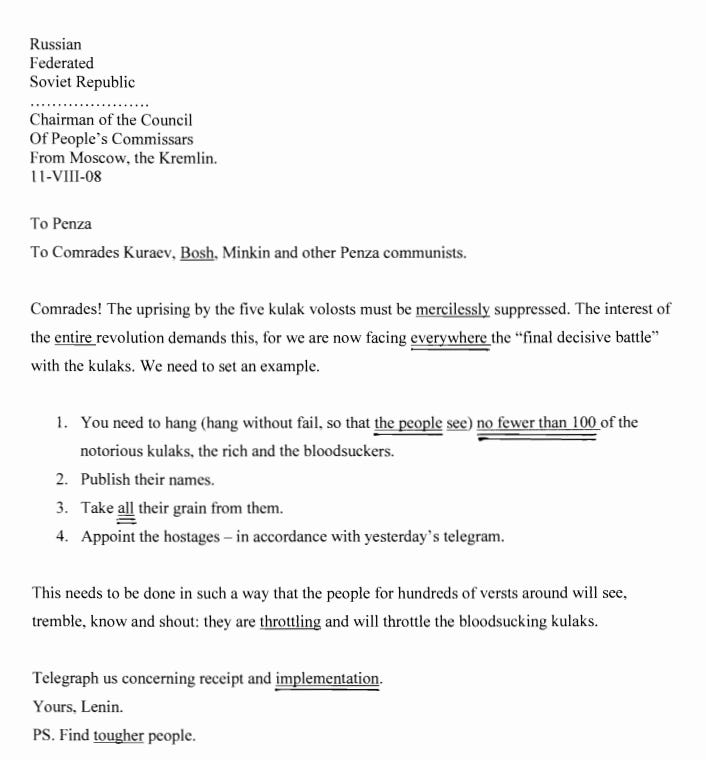
The Marxists Internet Archive, not a hostile witness, hosts the document and the translation in full, sourced from the Library of Congress exhibit of the Russian archives. Nobody disputes it is real. The Soviet state filed it and the Soviet state kept it.
So what is a kulak? On paper, a prosperous peasant.
The word is Russian for “fist”, village slang for the tight fisted man who loaned money (ie invested), hired labour, owned a few more acres and maybe a second horse.
Bolshevik theory promoted this piece of rural gossip into a class: the rural bourgeoisie, exploiters in miniature, and therefore enemies. Contemporise it and you are describing the middle class.
A house, a bit put away, a small business, an investment property. Nothing that would impress anybody at Davos.
Here is the part that matters.
The category had no floor. No acreage test, no income threshold, no register you could check yourself against. Whether you were a kulak depended entirely on who was pointing.
First it meant any peasant with something worth taking. Then any peasant who objected to it being taken. Then any peasant a local official found inconvenient. A decade later, under Stalin, the same undefined word carried dekulakisation, which deported and killed people by the million.
Sound familiar?
The big end of town. Vested interests. A fair share of tax.
Anyone objecting to the Albanese government’s latest tax grab.
People with the temerity to want to save something and leave it to their children, which used to be called providing for your family and is now called intergenerational inequality.
None of these have a floor either. That is not sloppiness. A category that cannot be defined cannot be argued with, and a person who cannot argue can only comply.
Which brings the postscript, the coldest line in Lenin’s document.
Someone in Penza had argued for persuasion instead of force. Lenin’s answer was not to address the objection. It was to replace the man. Find tougher people. Reluctance is a staffing problem.
Now think about who is supposed to be speaking for Australians.
The Business Council, the ACCI, the Australian Banking Association, the AMA, whichever alphabet claims to represent your industry.
Watch what they actually do when a minister announces something ruinous.
A carefully worded submission supporting the government’s objectives while noting some implementation challenges. A discreet lunch. A press release that could have been drafted in the minister’s office and possibly was.
Never a fight, because the people running these outfits are not there to fight. They are there to maintain access, and access is granted by the very people they would have to fight.
Lenin needed a hundred bodies and a published list to make a province stop arguing.
The Australian government never has to do that. Compliance is voluntarily.
Comments
Nothing yet. Say the first thing.
Sign in to join the conversation.