
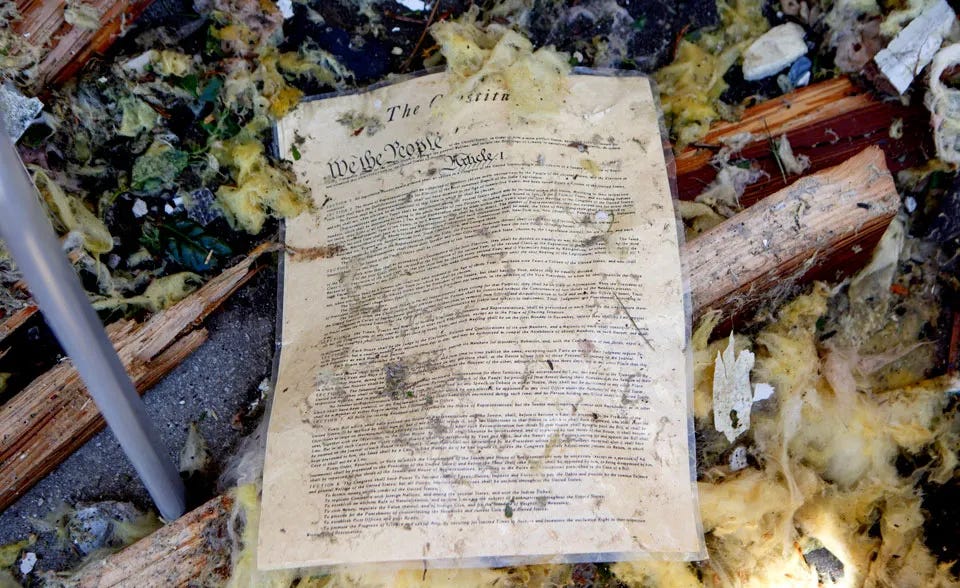
For years, Donald Trump’s opponents warned that he would corrupt government institutions, politicize law enforcement, bend legal rules to political ends, treat opponents as enemies, and weaken the constitutional restraints designed to limit political power. Their fear of him was so consuming that they gradually repeated one of the oldest political patterns in American history: They began doing many of those things themselves.
That is the part of the Trump story that has received far less attention than it deserves. The central constitutional danger was not merely that one politician might abuse power. It was that individuals and institutions claiming to restrain power increasingly persuaded themselves that ordinary restraint no longer applied because the target was Donald Trump. Once that conviction took hold, almost any departure from ordinary constitutional practice could be redescribed as necessary.
There is nothing uniquely Trumpian about that temptation. American history is filled with moments when perceived emergencies became arguments for expanding governmental power or relaxing constitutional restraint.
The Alien and Sedition Acts, the suspension of habeas corpus during the Civil War, the Palmer Raids, the internment of Japanese Americans, McCarthyism, COINTELPRO, and the expansion of surveillance after September 11 all reflected the same recurring impulse. Different generations identified different enemies. Different institutions employed different tools. The underlying reasoning remained remarkably consistent: Extraordinary dangers supposedly required extraordinary departures from ordinary constitutional practice.
The Trump era belongs within that larger tradition. What distinguishes it is not that the exception existed, but the particular form it assumed.
A counterintelligence investigation involving associates of a presidential campaign became acceptable because the candidate was viewed as presenting a national security risk. Secret surveillance proceeded through applications later found to contain serious inaccuracies and omissions because investigators believed the suspicions justified the urgency. A real Russian interference operation became intertwined with a much broader public narrative that Trump had conspired with Moscow to secure the presidency, even though Robert Mueller ultimately did not establish such a conspiracy.
The important point is not that nothing happened. Russia interfered in the 2016 election. Trump associates had contacts worthy of investigation. The constitutional question is what institutions allowed themselves to do once suspicion hardened into a dogged determination to stop Trump by any means they could.
The Carter Page surveillance applications should have prompted a national reckoning over civil liberties and the responsibilities that accompany secret surveillance. Instead, they became largely absorbed into the political argument over Donald Trump himself. Criticizing defective surveillance increasingly came to be interpreted as defending its target. The constitutional question quietly gave way to the partisan one. Instead of asking whether the government had exercised extraordinary powers with extraordinary care, many Americans asked only whether the target deserved those powers.
That inversion did not end with Russiagate.
The January 6 Select Committee investigated one of the gravest assaults on the constitutional transfer of presidential power in modern American history. Yet the congressional committee also illustrated how easily investigation can become a sham trial when those conducting it largely agree beforehand about the meaning of the evidence. It operated without a genuine internal opposition, presented carefully produced hearings organized around a prosecutorial narrative, and later became embroiled in disputes over records that were not fully preserved or transferred.
The constitutional problem was never that Congress investigated January 6. Congress plainly possessed both the authority and responsibility to investigate it. The deeper problem was that a body presenting itself as an authoritative historical investigator increasingly resembled an institution vested in conducting a mere witch-hunt. When political institutions become more concerned with presenting conclusions than testing competing explanations, inquiry gradually gives way to one-sided advocacy.
The criminal cases against Trump reflected a similar development. Whatever one thinks of the underlying allegations, Americans became accustomed to seeing a former president and leading opposition candidate simultaneously confronted by federal, state, and local criminal prosecutions after declaring that he would seek office again. The cases differed significantly in their legal theories and factual foundations, but their cumulative effect was unmistakable. Criminal law increasingly became part of presidential politics rather than remaining visibly distinct from it.
Ironically, the relentless effort to demonstrate that no president stands above the law helped produce a Supreme Court decision recognizing what seems to many to be broader constitutional immunity for official presidential acts. Whether one applauds or condemns that ruling, it permanently altered the constitutional landscape in ways no one originally anticipated.
Perhaps the most revealing episode came later. Jack Smith’s investigation obtained communications involving dozens of members of Congress from both political parties. Justice Department records indicate that investigators received some of those communications before the filter-team review established to screen potentially privileged material had completed its work.
The significance of that disclosure does not depend upon whether every communication was privileged or whether every legislator whose messages appeared became an investigative target. It lies elsewhere. DOJ investigators pursuing the government’s principal political opponent came into possession of communications involving the legislative branch under procedures that themselves became subjects of constitutional concern. The issue ceased to be Donald Trump alone and became the relationship among the branches of government themselves.
Viewed separately, each of these episodes can be debated on its own terms. Viewed together, they reveal a recurring institutional pattern. Political expediency gradually displaces constitutional restraint. Investigative neutrality yields to political urgency. Constitutionally dubious procedures become easier to rationalize because the target is deemed uniquely dangerous.
That pattern is neither Republican nor Democratic. It is deeply American.
Again and again, Americans have persuaded themselves that this emergency or that adversary differs from all previous threats, and that constitutional restraint must therefore yield to political necessity. The names change. The institutions change. The legal theories change. The underlying logic remains remarkably familiar.
Trump’s opponents incessantly argued that he threatened constitutional government because he treated institutions as instruments of political combat. Yet, in opposing him, many increasingly did that very thing. They warned that he would politicize law enforcement, then defended investigations of great political consequence. They warned that he would weaponize state power, then endorsed departures from the wise exercise of prosecutorial discretion. They warned that he would disregard institutional norms, then relaxed longstanding expectations of neutrality and adversarial restraint because ordinary procedures no longer seemed adequate. Yet they did not invent this constitutionally erosive pattern; they repeated it.
That realization makes the Trump era larger than Donald Trump himself. The greatest constitutional danger has never been a single person or president. It has always been the recurring willingness of government institutions to persuade themselves that this time is sufficiently different to justify once again departing from the restraints designed precisely for moments of fear and political passion.
Rules protecting unpopular people are not constitutional technicalities. They are the reason constitutional government exists. Secret surveillance demands unusual rigor because the target cannot challenge the government’s representations. Investigations require discipline because politics easily amplify suspicion. Congressional inquiries require transparency because history cannot cross-examine a mere television drama. Prosecutors must exercise caution during elections because any criminal process carries immense political implications. The separation of powers matters most when each branch believes its objective is paramount.
Those principles matter most when the target is widely feared or deeply disliked because that is precisely when abandoning them becomes easiest.
The deeper scandal of the Trump era, then, is not that it exposed a new temptation, but that powerful institutions, fully aware of this country’s long history of emergency-driven constitutional excess, nevertheless convinced themselves that Donald Trump constituted yet another good reason to further undermine America’s constitutional order. In doing so, they once again demonstrated how readily constitutional restraint yields to political necessity whenever enough people become convinced that this crisis is unlike all the others.
That is how exceptions become precedents. Every generation invents its own justification. But, of course, the precedents remain long after the justification has faded.
The lasting constitutional lesson of the Trump era therefore extends well beyond the man himself. The most enduring threat to a constitutional republic has never been one ambitious political leader. It has been the recurring belief that some preferred ends are important enough to excuse abandoning the restraints that exist to govern everyone, especially the so-called defenders of democracy.
Comments
Nothing yet. Say the first thing.
Sign in to join the conversation.