
Booker T. Washington understood a problem that Americans still have difficulty discussing honestly. In his 1911 book My Larger Education, he described a class of people who made “a business of keeping the troubles, the wrongs, and the hardships of the Negro race before the public.” Some advertised those wrongs because they wanted sympathy, he wrote, and some because “it pays.” His conclusion was characteristically unsentimental: “Some of these people do not want the Negro to lose his grievances, because they do not want to lose their jobs.”
Washington was not denying the grievances. He had been born enslaved and spent his adult life building institutions under the shadow of Jim Crow. He knew perfectly well that black Americans had troubles worth exposing. His warning concerned the subtle change that occurs when another person’s suffering becomes the source of one’s income, prominence, and authority. A burden to the sufferer can become an asset to the person paid to represent it.
The insight reaches well beyond race. Every profession develops incentives. Teachers need students. Doctors need patients. Lawyers need clients. Most devote themselves honorably to helping the people who come through their doors.
Yet every profession also faces the temptation to become more dependent upon the existence of a problem than upon its resolution. Washington recognized that black leadership could suffer from the same human weakness. The influence, reputation, and livelihood of some could become quietly tied to the continuation of the very racial grievances they claimed to oppose.
We now call one version of that arrangement race hustling. The term is often used too casually, sometimes as a way of dismissing any black person who speaks plainly about racial injustice. That careless usage has made it easier for genuine race hustlers to hide behind genuine civil rights history. They treat every criticism of their methods as an attack on the cause itself, as though questioning the advocate were equivalent to abandoning the victim.
The distinction becomes clearer when we examine conduct rather than professed sincerity. A civil rights advocate begins with the person who has suffered and follows the evidence wherever it leads. A race hustler begins with a narrative that has already proved publicly persuasive and looks for suffering that can be organized within it. The first wants justice even when the truth disappoints his allies. The second becomes most influential when suffering can be arranged around a racial offender—preferably a white one—because those are the cases that command the greatest public attention, media interest and institutional response.
Black Americans die every day from violence, neglect, addiction, educational failure, medical indifference, family breakdown and ordinary human cruelty. Most of those deaths never summon the nationally recognized guardians of black life. There is no crowded stage, no procession of celebrities, no historical roll call and no reward announced before television cameras. The machinery awakens most dramatically when the facts can be organized around a white assailant, a police officer or a white-controlled institution.
This does not mean police misconduct or racial violence should receive less attention. State violence deserves special scrutiny because government acts with public authority and public money. Nor does it mean every advocate who specializes in civil rights litigation is dishonest. The point is narrower and more serious: Public urgency often appears to depend less upon the magnitude of the loss than upon the racial usefulness of the suspected offender.
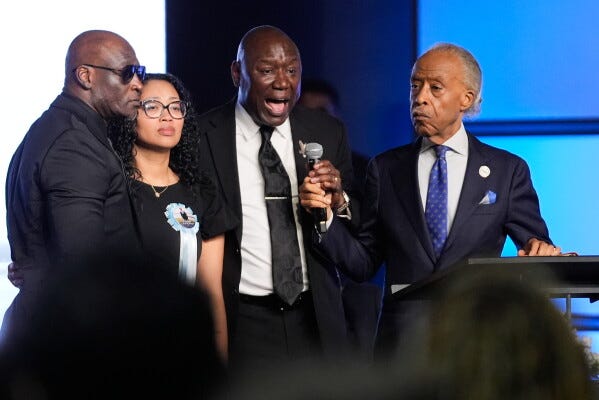
The unresolved death of 18-year-old Nolan Wells offers a painful illustration. Before lawyers, activists, commentators or politicians entered the picture, there was simply a mother and father whose black son left for a Fourth of July outing and never came home. The mysterious circumstances surrounding Nolan’s death, as well as local authorities’ initial response, understandably troubled Wells’s parents, who retained civil rights attorney Ben Crump to seek answers to the question any loving mother and father would ask: What happened to our son?
Crump’s involvement was not without value. His team obtained an independent autopsy, pursued cellphone evidence, sought photographs and digital records, retained audio and ocean-engineering experts, met with prosecutors and pressed for grand jury review. The independent pathologist classified both the cause and manner of death as “undetermined—pending investigation.” Decomposition and the earlier autopsy limited what could be learned from the second examination, and several important questions remained open.
Those facts deserved serious attention. Wells’s parents were entitled to an investigation that did not begin by deciding what it would eventually conclude. An early statement that foul play was not suspected may have been no more than a preliminary assessment, but grieving parents could reasonably hear it as institutional indifference or, worst, as the language of cover-up in a state whose history is rife with systemic racism. Crump was right therefore to insist that “undetermined” means undetermined, not accidental merely because an accident appears administratively convenient.
The question is not whether Crump had grounds to investigate. He plainly did. The more difficult question is whether his public presentation remained proportionate to what the investigation had actually established. That distinction matters because advocacy and race hustling are not the same thing. One seeks the truth. The other necessarily arranges existing facts into a politically and economically convenient story.
A clear example of the latter is Crump’s use of the phrase “not ruled out.” At an NAACP press conference, he acknowledged that the second autopsy found no fractures or deep-tissue injuries. He said the reddish discoloration found in the tissue at the back of Wells’s head had an unknown cause, no associated laceration and no underlying skull fracture. Yet the same finding was repeatedly presented as a matter of unusual concern, accompanied by the reminder that foul play had not been ruled out.
Of course, when the cause of a death is undetermined, murder has not been ruled out, but neither has accident. Both remain possible; neither has been established. That distinction sounds technical, yet it carries enormous rhetorical force. Once an audience has been emotionally prepared to expect wrongdoing, “not ruled out” can easily be heard as “probably happened.” The words remain cautious, but the impression becomes increasingly certain.
The same dynamic appeared elsewhere. Crump repeatedly described the second autopsy as having received Wells’s body “without his neck” or “without his throat,” although the underlying forensic issue was that certain internal neck structures retained after the original autopsy were unavailable for independent examination. He also publicly emphasized a report that Wells had been found “fully clothed,” a claim later disputed by the United Cajun Navy. Each issue deserved investigation. The difficulty was that uncertain forensic findings and disputed factual details were increasingly presented together before authentication or expert resolution. Individually they raised questions. Collectively they began to suggest answers.
Crump repeatedly insisted that he sought truth no matter whom it implicated or exonerated. He said he was not casting aspersions and had done nothing more than ask questions. Those disclaimers belong in any fair account. But rhetoric consists of more than the sentence in which a speaker denies responsibility for the meaning created by all the others.
His press conferences about Wells’s death were not quiet evidentiary briefings. Crump placed Wells in a spoken lineage that included Emmett Till, Medgar Evers, Trayvon Martin, Ahmaud Arbery, Breonna Taylor and George Floyd. Needless to say, such historical analogies perform powerful moral work long before anyone consciously evaluates the evidence.
Those names are not merely famous. They are settled symbols of racial violence, official misconduct, or grave public injustice. Once an unresolved death is placed inside that company, listeners naturally begin interpreting uncertainty through an established moral lens. The comparison does not prove homicide. It simply makes homicide feel increasingly natural before the evidence has earned that conclusion.
To place Wells among those victims before anyone had established that he was murdered was therefore to do more than request transparency. It supplied the moral category in which the audience was expected to understand the case. Crump did not have to say that Wells’s white friends killed him. The historical comparisons, racial contrasts, references to accountability and repeated questions about those friends performed the suggestive work for him.
The method became clearer when Wells’s case was publicly joined with two other recent deaths of 18-year-old black men. Crump emphasized that each young man had been the only black person, or one of very few black people, among white companions. The cases occurred in different places, involved different mechanisms and remained at different stages of investigation. Their common racial geometry nevertheless became the basis for suggesting that the similarities could not be dismissed as coincidence.
That is how narrative overtakes evidence. Human beings naturally think in patterns. Patterns help us understand history, recognize danger, and make sense of scattered events. But patterns are trustworthy only when they emerge from the evidence. When the pattern comes first, facts gradually stop functioning as evidence and begin functioning as illustrations. Every new ambiguity is interpreted in the direction already chosen. Facts no longer acquire meaning primarily from what they independently establish. They acquire meaning from the pattern into which they have been placed.
Crump also argued that if three young black men had returned without a white companion who was later found dead, they would have been detained, interrogated, and compelled to surrender their phones. The observation touches a genuine historical nerve. American law enforcement has not always distributed suspicion evenly. But the constitutional answer to unjust treatment of black suspects is not unjust treatment of white witnesses, and police may not hold people until they provide satisfactory answers merely because the public finds their story unconvincing.
Of course, race hustling often pays very well. Therefore, a familiar defense is that every serious cause requires professional, and especially legal, advocates who must be compensated for their time and efforts. That is true. Thurgood Marshall was paid, the NAACP raised funds, and civil rights litigation does not finance itself. That said, the problem is not compensation. It is an incentive structure in which some forms of black suffering enlarge a leader’s power while others scarcely register.
Race hustling is therefore not proved by a salary, a television appearance, or a prominent lawsuit. It reveals itself through epistemic conduct. Does the advocate distinguish possibility from probability? Does he correct a useful error as prominently as he announced it? Does he acknowledge evidence that weakens the racial interpretation? Does he protect innocent people from the mob his rhetoric may have helped assemble? Does his concern endure when the offender is black, the institution is ideologically friendly, or the cameras have left?
The temptation is hardly confined to one side. America has also produced a thriving counter-industry that discovers racial fraud in every accusation and treats every dishonest activist as evidence that racism itself is largely imaginary. The two enterprises often sustain one another. One discovers white supremacy in every ambiguity. The other discovers racial manipulation in every complaint. Both need the conflict to remain visible, and ordinary black Americans supply the funerals while professionals argue over their meaning.
The proper answer is not silence about race. America has had too much real racial cruelty to make denial intellectually respectable. The answer is to insist that those who invoke that history do so with greater care, not less, because its moral power is so great. Emmett Till’s name should illuminate established evil, not lend borrowed certainty to an unresolved death.
Nolan Wells’s parents deserve the truth about their son. His friends deserve not to be transformed into racial killers by implication before evidence establishes a crime. Mississippi authorities deserve scrutiny, but not presumptive conviction. Crump deserves credit for forcing unanswered questions into public view as well as criticism for arranging those questions inside a racial narrative that ran ahead of what was known.
That combination, in fact, is what makes race hustling difficult to confront. The hustler does not always fabricate the suffering. He may locate a real wound, give voice to a genuinely neglected family and uncover evidence that would otherwise remain hidden. The exploitation begins when the wound is valued chiefly for the narrative it can sustain, the villain it can furnish, and the authority it can confer.
Booker T. Washington understood very well how some transform black people’s suffering and victimization into an ignoble vocation. A black family’s grief becomes a platform, uncertainty becomes a preconceived narrative, and the black victim becomes an indispensable supporting character in a story whose real focus is the race hustler himself.
Comments
Nothing yet. Say the first thing.
Sign in to join the conversation.