
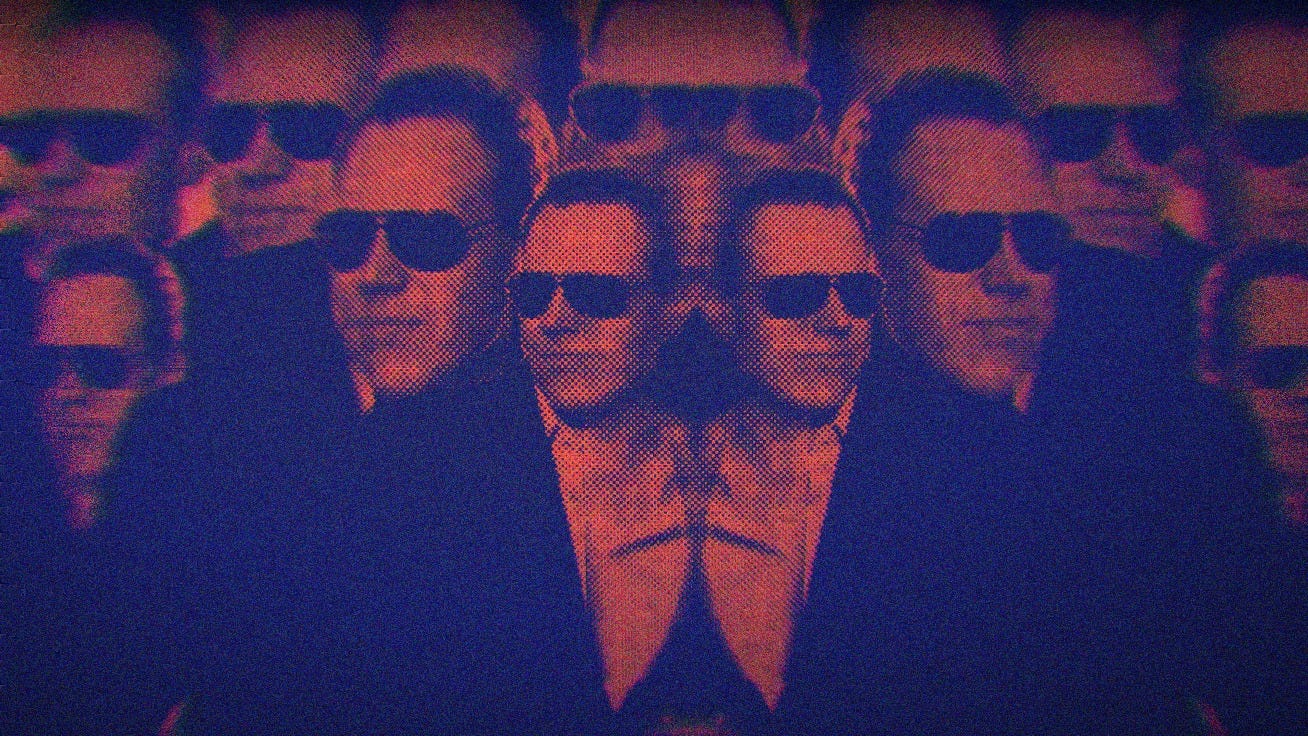
The early episodes are awful. Debuting in 2013, the Bret Easton Ellis Show begins with back-to-back interviews with Kanye West and Marilyn Manson, and here, Bret is clearly out of his depth, more accustomed to answering the questions than asking them. Any reasonable listener would have ventured no further.
But he settles into the gig. Subsequent conversations smooth out. Bret builds a format. He keeps his digressive riffing to the long episode introductions, recording monologues lasting thirty minutes or more. Waiting guests are told they can ‘look at their phone’ during the reading. This detail has always struck me as delicious. Every time Bret is on one — decreeing the state of Hollywood, or the indignities of parking, travel, socialising, or publishing — I can picture his guests (Tarantino, say, or Kim Gordon) sitting across the table, aloof, scanning Facebook Marketplace on their screens.
Strangely enough, these long monologues proved productive. His 2019 collection White is largely culled from the intro scripts, breaking a long drought in his writing career. The book sells well. He then rolls the intro concept the other way, narrating the first draft of The Shards (2021) at the start of the pandemic episodes in 2020/21. For a year, he maintains that The Shards is a memoir rather than a novel, committing to the bit with regular updates from aggrieved family members and friends, all of whom are either disappointed with their inclusion in the book or reaching out to offer corrections.
After this, the podcast earns a grudging respect, if not a giant audience. A recent guest, Anika Jade Levy1 remarked that the show is now one of the more high-profile bookings a literary author can make.
This probably says more about the state of literature than Bret’s show.
Bret doesn’t care. He likes doing his podcast.
The show continues.
I have been paying for all this since 2018.
Speaking of Levy, during her recent appearance she told the following story about her mother:
Levy: “I was at the Motion Picture Home visiting my mom’s old boss, Joanna Ray, legendary casting director — Lynch’s casting director. And she said, I think she was quoting Napoleon: “David Lynch loved women, but he didn’t respect them.”
And my mom said, “David Lynch was a genius. He didn’t respect anyone.”
I believe Levy’s mom also worked with Lynch, so this story is about two older women talking shop. Even from a distance, there’s something unassailably true about it. Lynch respected the muse, and everything and everyone else came second. His lack of respect is fundamental.
Yet, this is far from the first time the topic of David Lynch has come up on the podcast. He was never a guest Bret was chasing:
Ellis: “I said something bad about Wild At Heart in an interview in the 80s. In the 2000s, someone tried to introduce us, and he glared at me and didn’t shake hands. 20 years later, he was still fuming. All that whimsical, folksy, positive stuff was horseshit.”
That quote above is copped from an excellent collection of quotes put together by author Daniel Falatko. Falatko often posts about the show on Substack, and when I see these notes, I feel a degree of solace.
Most people I know view the Bret Easton Ellis show as an abomination —another edge-lord experience, by American literatures’s enfant terrible— but Falatko seems to see it for what it is:
A miracle.
When has any literary figure as significant as Bret, laid themselves bare in such an ordinary way:
The show is entirely about Bret Easton Ellis. He is not the host of an interview podcast. He is the subject.
The guests are there to talk to Bret, and we are listening to each episode of the show to hear what the guest will ask Bret, or how the guest’s answers will elicit a new story from Bret.
It’s rarely confrontational. In recent years, his guests know the deal. I think for many people, appearing on the show is about going to his house and meeting him.
For example, when author Jarett Kobek visited Bret’s condo on ‘North Doheny Drive, just below Sunset Boulevard’ (stated every episode), he told Ellis that American Psycho is the American novel with which every writer since has had to contend. He meant it, too. This is not an unusual interaction at all. Bret often asks guests when they first started reading him.
So I can understand why people dislike this podcast. If you dislike Bret Easton Ellis or his work, this might be the single worst podcast ever made.
This tweet below is not directly related to the show or to this article, but it has been discussed by Bret on the show at least once, so I’m allowing it.
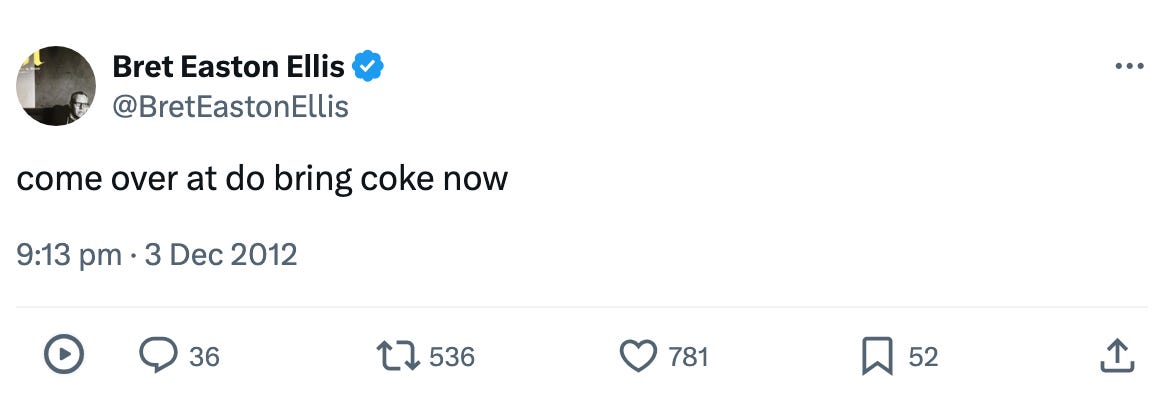
The explanation for this tweet is this: he was so drunk, he mistook Twitter for his phone’s messaging app.
See.
It’s hard not to be romantic about Bret Easton Ellis.
This is the guy all those famous guests want to meet. And he meets them in his condo, ready and willing, the sort of guy who posts this on the open internet and never takes it down.
One cannot quibble with his honesty.
Alexander Sorondo’s article, The Very Good Soldier, is an excellent primer on Ellis’ career if you are new to all this. The article —discussed on the show, of course— is 20,000-words long and can be summarised as such: Bret Easton Ellis is very successful and very famous (for an author), but his life has not been without its difficulties. He’s a guy who has lived, lost, partied, hounded around, and made many friends and enemies. So if he sounds a little aggrieved and crotchety, it may be because he has taken his fair share of punches.
The article ends with a quote from the podcast, as it should.
I actually remember the episode. During a bit of back and forth with his producer, Bret reflected on his life. He admitted to the good and the bad. He said he was happy to still be alive, but:
“I’m too old to be grateful.”
Comments
Nothing yet. Say the first thing.
Sign in to join the conversation.