
By Arpad Szakolczai
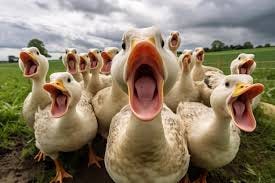
‘…duckspeak, meaning 'to quack like a duck'...Provided that the opinions which were quacked out were orthodox ones, it implied nothing but praise.’ George Orwell, ‘The Principles of Newspeak’
In George Orwell’s 1984, the then-future totalitarian state used, or rather imposed, a new language, called Newspeak. The language was new in the sense that it proliferated the official use of certain clichés and terms which prevented people from thinking, or expressing their own opinions and experiences, as instead they were required to talk using new or simplified words which were only able to express and transmit the dogmas of the ruling ideology.
The book was based on very real experiences, both of Orwell himself, including his participation in the Spanish Civil War, and of his friends Franz Borkenau and Arthur Koestler, both of whom had extensive experiences with Communism, who would become the two most important leaders of the anti-communist league of the 1950s, and both incidentally had Hungarian roots. The imposed transformation of language was indeed a central feature of Communist power, both before and after the publication of Orwell’s book. It involved both the prohibition of certain terms that were previously widely used, for example in addressing people, and the imposition of new formulas (the path-breaking first sociological essay of Elemér Hankiss, published in Summer 1978 in Valóság [‘Reality’] discussed this). One of the most important of these was ‘comrade’ (elvtárs), which in its Hungarian version meant ‘companion (társ) in matters of principle (elv)’. In hard Stalinist times everybody was supposed to address everyone else as ‘comrade’, which implied that ‘we’ all shared the same principles, which of course was completely untrue. By the time I was growing up, this was not that necessary, though still quite prevalent, and I still remember that I was unable to utter this word, under any condition, just as I just could not utter the words ‘Soviet Union’. A similar development was the use of shortened or ‘mosaic’ words, a practice in which the Soviet Union played a pioneering role (just as in planning), and which I always considered highly problematic, except for special cases, as it implies both a fake sense of familiarity and an in-depth destruction of language.
Well, all this is about the past, again, one could say. However, this would be grievously wrong, as both practices are spiralling out of control in our own days, being among the most important examples for neo-communism. In this blog, I’ll single out for attention certain new words, or certain words which are increasingly used in an altered sense. It is also an invitation for others to do the same – which eventually might result in a dictionary of contemporary Newspeak or Duckspeak.
Biodiversity
A central feature of Newspeak-like terminology is that it uses or introduces words which seemingly nobody could oppose or resist; which express either a triviality, or a central element of contemporary ideology that pretends to be universal and unassailable. Biodiversity is a prime such word. What it expresses is that in ‘nature’ – which means everywhere in our world before it was altered by technology – plants, animals, all kinds of beings existed together in a relationship which had a degree of equilibrium, balance, and thus harmony – these words originally and essentially meaning more or less the same thing. This order of things – a genuine order of things – was altered with agriculture, especially modern industrialised agriculture and its monoculturalism, and of course with similar parallel developments of modernity.
This is self-evident. It is also something to lament and do something about and against. Which the term ‘biodiversity’, and related efforts, are supposedly doing.
Yes, but with a difference, or rather a subtle trick. This trick is that, instead of identifying the culprit as modern technologies and methods, and laying the emphasis on restoration, return, a reassertion of the previous balance that developed over thousands and millions of years, and which therefore had a genuine harmonious stability, the substitution of a new term, ‘biodiversity’, for the now seemingly old-fashioned ‘nature’, flatters us moderns with the sense of doing something really forward-looking and progressive, instead of helping to recognise ourselves, and our modern ways, as the source of the problem. So we moderns again come out the better, as the ones who invented ‘biodiversity’, and so instead of interfering with nature, we are rather producing a better world even in this sense!
The word ‘nature’ is particularly important in the official ideology through its absence. Because the real concern ought to be not ‘biodiversity’, an invented-constructed word, but preserving and restoring Nature. The central issue is to understand what exactly ‘nature’ is, here or elsewhere. And this is not an easy task. Nature of course first of all is a word, and this word has manifold meanings. But the central meaning of nature is evident: by ‘nature’ we essentially mean things are as they are – or rather were – at any part of Earth before human intervention. So nature is different in every different area of Earth that has a degree of independent consistency – and of course all these areas are not completely independent, but their interdependence, in various ways and gradations, constitutes the nature of the Earth.
Which, again, is an evident triviality.
But it leads to two points which are less trivial.
The first is that it would make no sense to say that we should have left everything as it was. We as humans can have an impact on the world around us, even should have, using our intelligence (nous). But intelligence does not imply instrumental rationality, or Artificial Intelligence, the most lethal contemporary version of instrumental rationality. It means a non-destructive, non-violent work in and on ‘nature’. The word ‘domestication’ already indicates something similar, as it implies that certain plants and animals in this way became closer to our ‘home’, or became more ‘home-like’. This certainly cannot be said of monoculture agriculture, or industrial meat-production. But Hungarian language even here offers a better example. The Hungarian word for ‘domesticate’ is nemesít or ‘ennoble’, and it is particularly instructive: first, because the term is not rooted in and limited to social hierarchy, as in Indo-European languages, but is used for example for the grafting of fruit trees; and second, because its etymological root, nem, means ‘gender’, and so the archaic wisdom behind being ‘noble’, in archaic Hungarian, implies behaving properly, according to one’s true gender: a manly man and a womanly woman are noble. There might be other modes of behaving and being; the zoo of God is vast, as they say; but those are not noble.
The second is that, beyond the question of nobility – which is by no means negligible – there is the additional issue that the term ‘biodiversity’ surreptitiously omits and thus ignores ‘nature’. This is a point that has a much broader relevance. ‘Nature’, and especially ‘natural’, somehow, have become prohibited words in our brave new politically correct world.
This will become even more visible through the ensuing entries.
‘Biological’ products
Sometime over the past couple of decades, I would guess around 15 years ago – but this certainly requires research – the labelling of certain products, like washing powders or other cleaning devices changed, and instead of some of them being called “natural”, they became ‘biological’. I was astonished at the change, as first of all the new designation was plain wrong: ‘natural’ meant the use of ingredients that could be found in nature, while ’biological’ referred to a scientific discipline, and so had a definitely ‘manipulative’ connotation, different from the adjective ‘natural’. I really did not understand what was going on, as the term did not have the appeal which the adjective ‘“natural’ had – so why the change?
This became clear through the way the other component of the expression ‘biodiversity’ came to be used.
Diversity
The term ‘diversity’ in itself is quite innocuous, even benevolent. I used it myself, decades ago, as a counterforce to ‘equality’. As an aspect of my growing up under Communism in Hungary, I was always weary of ‘equality’ as a catchword and value, finding it artificial, as nothing is really equal with anything else – even every snowflake is different from other snowflakes, as I came to know, much to my delight. Defenders of equality of course claimed that they mean something in law, as a right, or as a principle, but I felt that this is problematic even there: the equality of rights was always promoted in the name of people who suffered in one way or another, but exactly for this reason, under certain conditions, some people should have more rights than the others, while under different conditions different people should have less rights. Diversity worked here as a counterweight to the abstract and universalistic claim of equality.
This is, and was, fine, until diversity gained a quite different meaning, prominent in contemporary academic – and broader – politics. This no longer implies that people are different, or diverse, in all kinds of ways, and that this diversity should be recognised and acknowledged, but that certain minority groups, or groups that are considered as having been not recognised properly in the past, should now be not only recognised but specifically promoted.
One has to be very careful here, as one is treading on a very treacherous terrain, going against contemporary ideologies that are loudly supported, no longer just by hardcore ideologues but by the force of the law. Of course, at stake is the assessment of the contemporary politics of gender and sexuality, with all its excesses. So let me give a very concrete and very recent illustration.
In Hungarian news, in recent days a great deal of attention was given to the number of European laws of which Hungary was found in breach – going back to the times before the recent elections. One of these was the rule that in certain corporate positions at least 40% or 33% of the holders should be women (https://24.hu/kulfold/2026/04/29/kotlezettsegszegesi-eljaras-magyarorszag-europai-bizottsag/). Now this is indeed a serious issue, but not in the intended sense – namely, that we should all be upset about such an unlawfulness in Hungary.
Rather, we should be really upset due to the opposite reason. Breaking the law, a real break of the law, of course, is a serious matter. But this kind of statistical fiddling should never have gained the force of law. Instead of lamenting about breaking such laws, the really interesting thing would be to research how and why such absurd ideas came to have the force of the law, devaluing the law itself.
We seem to have come very far from words, yet words, language and the law are very closely related. The law is where words matter a lot, often even excessively so, thus the close connection between the corruption of language and of the law is not surprising. The more the law is reduced to verbal and quantitative gymnastics, the more ordinary words lose their meaning, becoming altered and replaced with artificial and often misleading linguistic constructions.
The real meaning of the shift from ‘natural’ to ‘biological’ will become clearer with the last entry of this blog: ‘environment’. But the next entry also has its relevance.
Inclusivity
The next in our series of absurd Newspeak words is ‘inclusivity’. The novelty of the word is confirmed by Wiktionary, according to which it was ‘modelled after exclusivity, 1920s, but in more common usage only since the late 1980s’. I first encountered, not the word but the related practice, in my first year as Head of the Sociology Department at UCC, Ireland. There, in accordance with a practice I encountered in academic life before, I wanted to have restricted departmental meetings, meaning accessible only to permanent senior members. I thought this was something standard, and did not anticipate the enormous uproar it generated, making it impossible for me to pursue the idea. Most people failed to appreciate, even understand, the underlying idea that everything is governed by degrees, in line with Shakespeare’s famous passage in Troilus and Cressida (I.iii.528ff): there are professors, senior lecturers, permanent junior lecturers, temporary junior lecturers, postdocs, PhD and MA students, not forgetting administrators: each belong to a different register inside the life of any university, and to claim that a university should be democratic and all-inclusive, making all of them equal, for example through equal voting power, is simply non-sensical.
Then came the word inclusivity, which Wiktionary might date to the late 1980s, but I only encountered in the 21st century. It is clearly a mirror word of exclusivity, and that word has its meaning, and character – even a multiple one. ‘Exclusion’ certainly implies the exercise of power, even a quite violent one, which prevents entry, or belongingness, to those who fail to meet certain criteria. The early works of Michel Foucault, for example, were much concerned with certain ‘techniques of exclusion’, and their problematic justification. The word also gained a somewhat different meaning in the sense of venues reserved for the super-rich and powerful.
However, instead of outright rejecting any practice of exclusion, and calling for universal inclusivity – which Foucault never did – one should rather be concerned with the exact ways and modalities of different practices of exclusion. As, to give only some examples, nobody in his right mind would consider the exclusion of underaged children from attending certain film screenings an act of autocracy; or allow the presence of the public in a PhD seminar of an otherwise ‘public’ university. Similarly, while opposing discrimination is another central trope in our contemporary world, discrimination actually is one of the most important aspects of our mental faculties: we need to discriminate, and judge, the situation surrounding us continuously, otherwise we would be exposed to anything taking place and anybody happening to be around us.
Advocates of inclusivity and the fight against discrimination might even grant that we are right in these cases, claiming that their point is different. But unfortunately, they are wrong, as they indeed wage a generalised and universalistic fight against exclusion and discrimination, failing to discriminate between different modalities of exclusion, and time and again support absurd cases in the name of human rights.
The next key term of contemporary Newspeak is reform.
Reform
It requires no lengthy argument to present the case that ‘reform’ is a ubiquitous word in our contemporary world. Everything but literally everything is continuously undergoing reforms, from the political system through education and health to the law. We have become so much used to the pervasive terminology of reform that we cannot even conceive that something might be wrong with it.
Yet, it is evidently wrong, as whatever is well formed doesn’t need to be continuously re-formed. And if something is badly formed, it needs to be fixed, and that’s it!
Of course, the eternal proponents of reforms argue that this is necessary because of continuous change.
But far from offering an answer, this idea is a central part of the problem itself, ‘change’ being the following in our list of Newspeak non-words.
Change
The permanentisation of reforms is necessary as everything is continuously changing, and we all want change, right! No, wrong. Permanent change is the worst of the worst, as it is a modality of permanent liminality, and permanent liminality, or transitionality becoming lasting, being stuck in a limbo state where nothing is settled, nothing is finalised, everything is continuously altered, is the very heart of the modern condition, and a main reason for its ills.
‘Change We Can Believe In’ was the slogan of Obama in 2008, one that much helped him to win the elections – but rather then showing his statesman-like qualities, it rather demonstrated what was so desperately wrong with Obama, and his mode of demagogy – admitting that much of contemporary politics is nothing but demagogy.
The point does not require complicated arguments to substantiate – we just must detach ourselves from the contemporary all-pervasive ideological machineries. ‘Change’ as a word has no positive value; in fact, no value whatsoever in itself. Death is a change, and a quite major one, just as any alteration in the weather – whether for rain or sunshine. Change is indeed a permanent feature of nature, but it doesn’t mean that everything is always changing. Animals are born, grow up, and then remain quite stable for a long time – until they become old and die. Plants follow the seasons, which involve a quite regular ‘change’ – though not simply ‘change’, rather the rhythm of nature. Change, in nature, takes place in an ordered manner, and by degrees, not by campaigns of reforms.
Human life, social and political life, economic life does not have to slavishly follow the rhythms of nature, but cannot be detached from it either – whether from its actual changes, or as a model. Periods of change in nature co-exist with quite long periods of stability, and it is right that this should be also so in human life, and even more so there, as only such stability provides the possibility of meaning. Meaning is something specific to human life – plants don’t have a meaning, even animals don’t have a perception of meaning. But continuous change renders human life unpredictable and meaningless. Which is not good for anyone – except for those tricksters who make their power and fortune on the back of the misfortune of us all – and who have now come to rule all of us, in the name of economic growth (meaning: they make as much money as imaginable) and inclusive democracy (meaning: distinguished people of culture who could see through their tricks are eliminated in the name of politically correct ideologies, where public intellectuals, instead of standing up for culture, rather gain mediatic attention as promoters and slaves of such ideologies).
Welcome to Trickster Land, the realm of permanent liminality, where everything always changes, so that nobody can be concerned with the inevitable loss of meaning.
The next – and for the moment last – word in our list is the environment. It also returns to the first word in our list, making evident the incredible trick by which the destroyers of nature – including human nature – suddenly redeem themselves as the preservers of the environment!
Environment
Today, instead of trying to preserve nature, the dominant discourse argues about the preservation of the environment. This talk rhymes well with the emphasis on change, as the environment, just as change, is without any inherent value. It is just what surrounds us; anything that surrounds us; and much of what surrounds us is without any value whatsoever. The ‘environment’ of our life includes the ruins of former factories, unliveable and collapsing multilevel buildings and neighbourhoods, or infinite road systems, entrapping the walkers, among many other similar things, none of which should be concerns for preservation.
So, then, why this change of discourse? The answer, again, is quite simple. Nature, for our hyper-modern politically correct world, has become a dirty word. This is because many items on the central agenda of current fashionable ideologies go against nature, promote things which for time immemorial, and in all cultures, were considered as unnatural. And thus a ‘return to nature’, or a ‘preservation of nature’ could no longer be proposed, lest it be turned against these ideologues. Which is the reverse side of the problems with words this blog has discussed.
Concluding remarks
Thus, and again, words are important. The clarity of their meaning must be preserved. New words should only be introduced with good reason, where necessary. Not as acts of political indoctrination, but as tools for human and social understanding. Like ‘permanent liminality’!
Comments
Nothing yet. Say the first thing.
Sign in to join the conversation.