
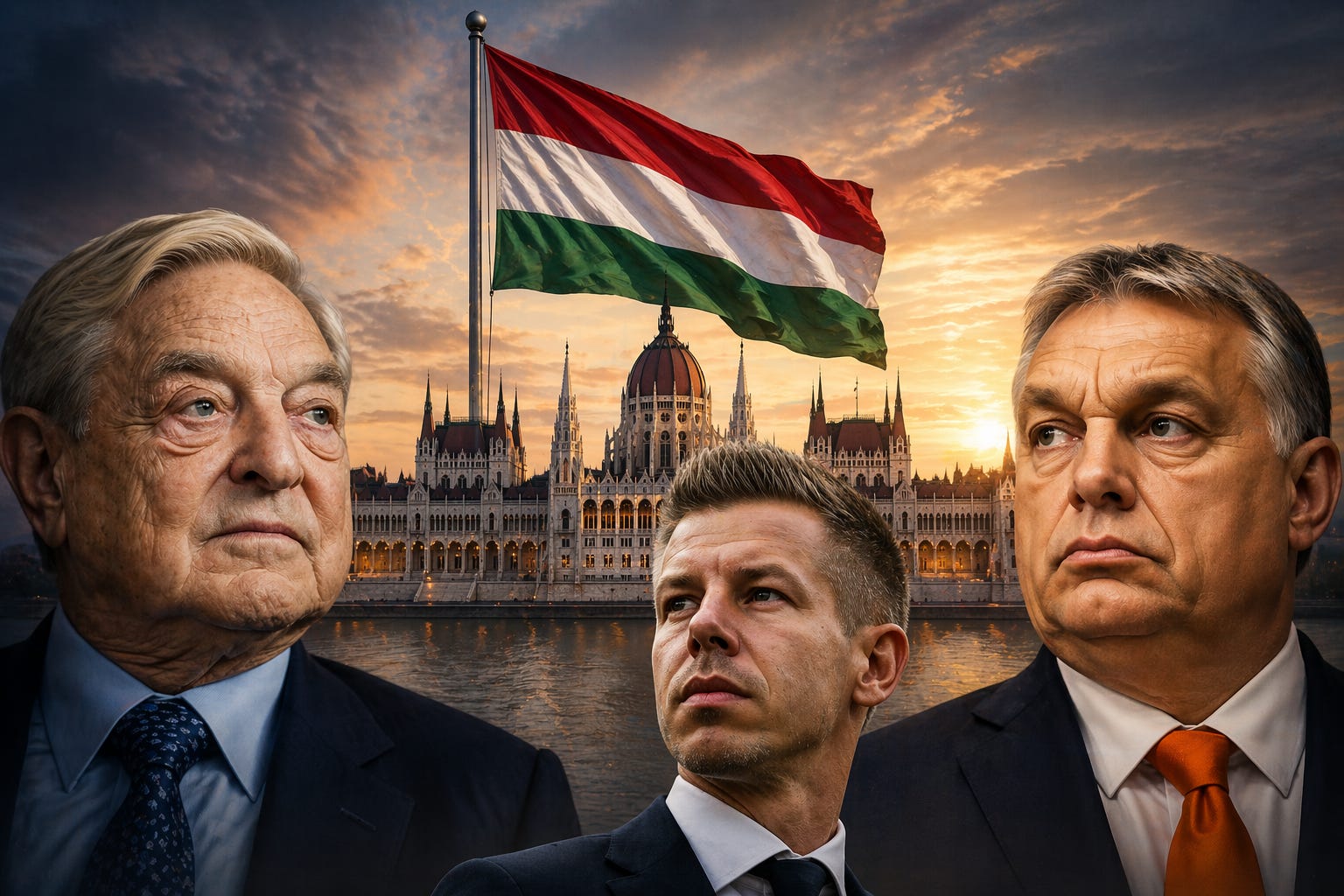
It is very rare that Hungary gains the centre of international attention – and this usually is for “wrong”, or at least catastrophic emergency reasons. The last time this happened was in October-November 1956, when Hungarians, first and last among all the Soviet satellite countries, became engaged in an open uprising and armed freedom fight against their Communist rulers and even the Red Army. A similar noble defeat took place in 1848-9, when Hungarians succeeded against the Habsburg Empire, but could not do so against the Russian armies. And one could continue.
The international attention devoted to the Hungarian elections was enormous, and certainly excessive. It was for days the main item on the BBC or the main American news outlets; vice-president Vance came to Budapest before his negotiations with Iran in Turkey. Was this justified? And should we all now be happy?
Well, the question first concerns this “we”. I, for one, am Hungarian by birth and citizenship, though I have not lived there now for over 35 years. I was also closely involved, in different ways, in experiencing and even studying on the spot the collapse of Communism and its immediate aftermath, so have an insider position concerning not simply the “past”, but the liminal moment of 1987-1991 where many of the current developments are formatively rooted. But the broader “we” implies almost everyone, though especially – and this is most important – as perceived and filtered through the eyes of the contemporary mainstream left-liberal media and the related intellectual gurus of our time, who define, or rather impose upon and overwhelm public opinion. And according to this “we”, we are supposed to be happy as a bird, celebrating the victory over Orbán.
But in this happiness, evidently, just as in the excessive interest in the Hungarian elections, there is something forced, unreal, and having the character of a scapegoating process. I, for one, did not like Orbán and Fidesz in general, already in 1988-89. I knew about Orbán, as he was a protégé of a close colleague of mine at the Institute of Sociology, Hungarian Academy of Sciences, who was the main Soros contact person at that time, but I came to dislike, already then, sort of instinctively, all of them – Orbán and Fidesz, and Soros and his cronies. I considered Orbán demagogic and arrogant, and the idea behind Fidesz seriously misdirected. Famously, only persons under the age of 30 were eligible to become members, but I thought this was the origin of a new, dangerous Puritanism: we are the clean ones, those under thirty, not dirty, not tainted by Communism. But this was dangerously wrong: many older people became quite toughened in the silent resistance under communism – something already practiced in 1850-60, under the “Bach age”, the period of absolutist Habsburg rule which followed the defeat, with Russian help, of the Hungarian freedom struggle – while the very young neither shared their culture, as they were completely educated under the Communist regime, nor their broader experience. Proclaiming the young as the pure was nonsensical, and recalled the first period of Communist power, whether in Hungary or Russia. So I do have reasons to be satisfied now, and in a way hopeful.
But my hopes are not the hopes of the left-liberal media-dominated so-called “public opinion”. The problem with Orbán was not his general orientation and policies, but the manner in which he conducted them – or failed to realise them. From the start, this was based on mistrust – a deep-seated suspicion of anyone who was not his close ally. This meant he surrounded himself with cronies, which inevitably led to the increasing corruptness of the entire regime, as a politics based on that kind of personal trust meant a willingness to tolerate and support anything the “trusted” people did.
Orbán was originally a young left-liberal, who eventually turned traditionalist-conservative as he realised that in Hungary this is the only possibility to secure stable political power. Many people doubted the genuine seriousness of this turn – one could see on national television politicians born or educated in Budapest suddenly imitating local rural accents. Such a turnaround inside Fidesz also meant that personal trust and an almost paranoid distrust of “others” became even more prevalent. A compact clique came to rule the country in the name of traditional-conservative family-national-religious values. At the same time a conflict developed between these values – or the way Orbán represented them – and the political and mediatic rulers of Europe.
The defeat of Orbán is celebrated around the world as the victory of democracy – as Brussels, or the BBC, or the critical-theory-animated public intellectuals understand it.
But, as will soon be evident, this is not the way Hungarians understand it – or, for that matter, many people around Europe, and even elsewhere, and who are often denigrated as populists. “Populism” is an inadequate term for understanding the present, invented and promoted by those who try to impose – and largely succeeded in imposing – their own globalist-cosmopolitan agenda on the world.
Interestingly, here Western Europeans will have, and probably already have, something to learn from their Eastern fellow Europeans, and this concerns belief in the media.
For historical reasons, and so certainly with reason, in Western Europe there was, and mostly still is, a general trust in newspapers, and in the media in general; while in the East whatever the “official” media stated was always mistrusted – again with a reason. But over the last decades, though with deep roots in the past – the distrust by Goethe of the press was famous – the game radically changed, and the mainstream Western media, instead of relying on the main values of European culture, became increasingly engaged in a trickster revaluation of values, step by step transforming the way people thought. This could not happen in the East, as there most people never trusted the media, rather kept to the own views and values, in spite of Communist and post-communist indoctrination – though, of course, for a time could be taken – and were taken – for a ride, in various manners. Simple people, in the sense of Dickens, know that they can only trust those whom they are personally acquainted with.
When “people” in the “West” talk about happiness concerning the Hungarian elections, it is tacitly assumed that this will mean that Hungary will stand in the line of the general policy recommendations of Brussels and the global liberal media-supported elite.
But this will not happen.
The reason is very simple. Hungary was not suffering under a traditionalist-conservative ideology imposed by an autocratic leader. It was the other way around. An arrogant, even paranoid leader, with autocratic character traits, became traditionalist-conservative, as that was the only way somebody could become elected after the initial turbulences of the post-communist transition period, in a fundamentally traditionalist-conservative country like Hungary.
Thus, Hungary will remain, in its basic outlook, traditionalist-conservative, in the German sense of “value-conservativism”, even in the period after Orbán. It will not follow the currently fashionable ideology – that was not at the heart of classical liberal democracy either – that has become so dear for the media-driven left-liberal consensus, supporting the global elites.
Some of the central differences can be anticipated along the following lines:
- The new government will not be supporting a politics favourable to global migration. This politics is a version of the classical-leftist politics of suffering, blackmailing people through a sense of guilt about colonialism – which is completely meaningless in East-Central Europe – and hiding the cheap labour-force motivation beyond human rights ideology. However, most migrants, as ethnographic studies demonstrated, are conned and entrapped by illusory promises, and the outcome is not helpful for anybody – except, again, the global elites who thus can continue their world destruction, masqueraded as economic growth and progress, through a cheap labour force.
- It will focus on a politics of family, the support for families as basic units of human and social life, which individualistic legislation, again everywhere favoured by – as favouring – the global elites and hiding behind the ideology of human rights, systematically deny – the recent Swiss elections, as a result of which the basis for calculating tax liability has changed from the family to the individual, being the latest example (so even Switzerland!).
- It will continue to oppose the current, global-liberal politics of sexuality. The individualisation of sexuality was never anywhere official policy before the last few decades, as it undermines families – but, this being the exact aim of the media-driven current mainstream ideology, it has now become supported, again in the name of human rights. Let there be no misunderstanding. Exceptions and small minorities should not be oppressed by the majority, to be sure. But minuscule and somewhat extreme minority interests should not be publicised and become the heart of political life – at least, in my reading, Hungarians will always think so. And not only them.
These are only some of the major issues where the new government will continue the policy of the previous – or should continue it, otherwise it will be voted out massively.
I should immediately add a note about “human rights”. For many decades, leftist-critical circles derided the idea of human rights, supporting instead the “masses”, especially the working classes, who are impoverished by capitalism, “human rights” being viewed as an ideology designed to defend capitalism. The defence of human rights was centrally used against Communism, and especially by Pope John Paul II, who was the single most important factor behind the defeat of Communism. Leftist critics, who entered a void situation with the collapse of communism, quickly recovered and – a main trickster ruse – made the idea defeating them the heart of their new ideology, though of course emptying it out of any meaning.
So, while no doubt in Hungary there will be major changes, there will also be a lot of continuity, disappointing again those leftist observers of the “East” who repeatedly try to project their own questionable pet dreams there. One could evoke here Alexis de Tocqueville, and his idea that the French Revolution implied more continuity than was usually perceived – a particularly relevant parallel, as the conservative-liberal spirit of Tocqueville captures quite well traditional Hungarian conservative liberalism (szabadelvűség, of which a main representative was Kálmán Tisza, 1830-1902) – though as if in reverse, as in Hungary continuity will lie not in centralised state power, but in value conservativism.
Comments
Nothing yet. Say the first thing.
Sign in to join the conversation.