
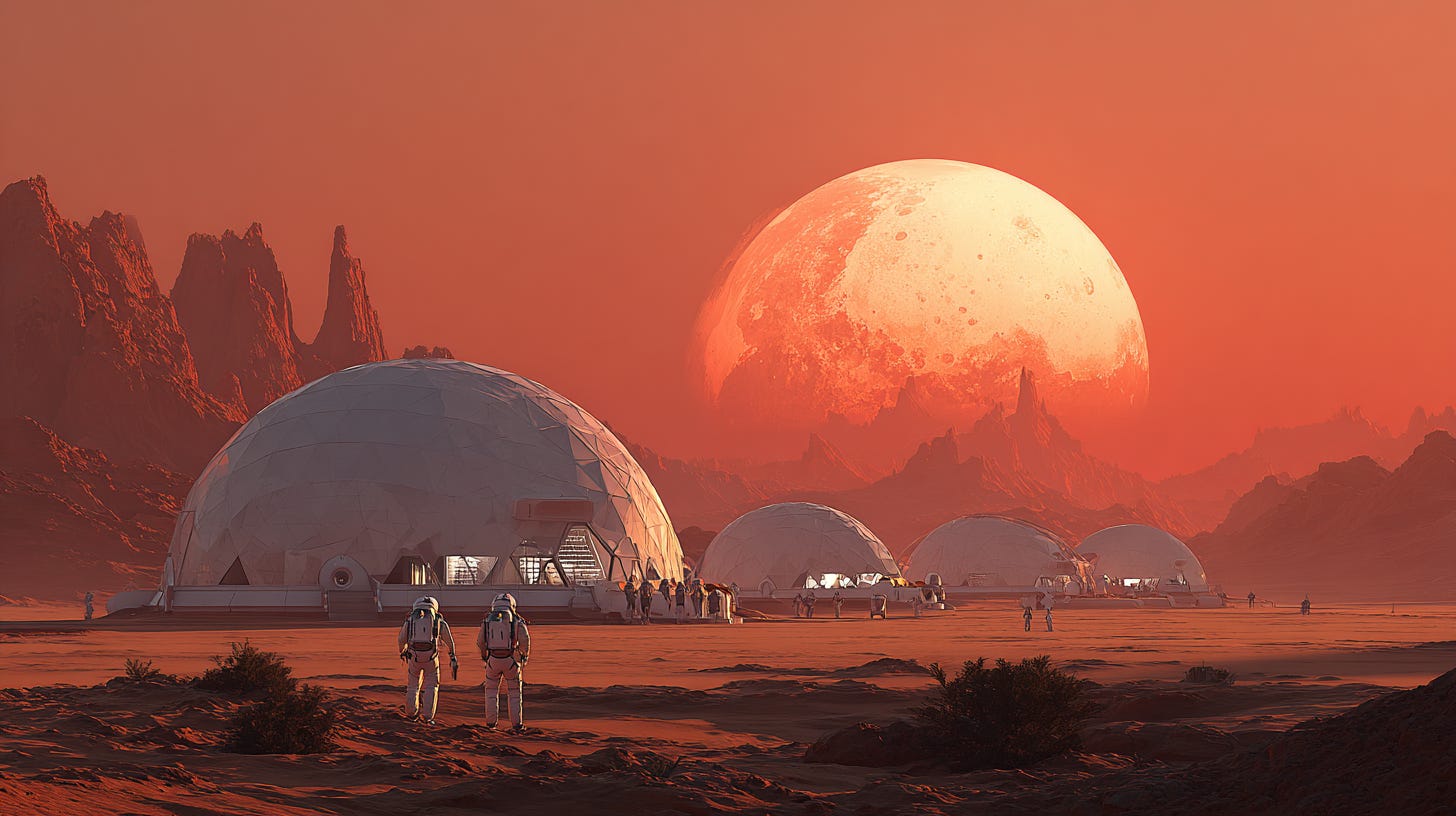
Imagine the first sunrise on Mars.
A faint golden light stretches across the horizon, revealing a patchwork of habitats and rovers set against a red plain. Inside those domes, humanity’s new settlers realize they are more than visitors. There are no inherited traditions or systems waiting for them. Only profound possibility.
Life on Mars starts simple: oxygen, water, heat, food, shelter. Where Earth’s cities formed beside rivers and forests, Martian communities gather around oxygen converters and hydroponic bays. Every breath is a group project. Every meal, a collective win against the alien cold.
Arguments here stem from survival, not from ideology. A malfunctioning filter or an overused airlock might be the next big crisis. On Earth, most problems come with a safety net. On Mars, every issue is a test of community and trust.
As the adrenaline of the first weeks fades, settlers begin to ask deeper questions. How will resources be allocated? How will conflicts be resolved? Without centuries-old precedent, Martians invent social rules from real necessity, not out of convention. Laws might first emerge as routines, ready to change as quickly as the weather.
Instead of legal codes gathering dust, rules on Mars live and are visible, evolving with every discovery or setback. If disagreement breaks out over who gets fresh lettuce or how to apportion power, it could be settled with a quick open vote and logged in a public ledger available to everyone.
Borders on Earth are marked with ink and walls. On Mars, connection matters more than distance. Each habitat becomes a node collaborating with others, sharing knowledge, data, and resources in real time. This is a true network society: not built from geography, but from coordination.
Participation defines citizenship. The engineer who maintains oxygen, the farmer tending hydroponics, and the teacher sharing knowledge all hold the same civic weight. Contribution is the currency of trust, and reputation its reward.
In a way, Mars will be the biggest living test of Balaji’s network state theory. Instead of being bound by birth or borders, citizens align around purpose and shared values. Governance emerges organically through action, not inheritance. Rules are agreed upon in open systems, and legitimacy flows not from central authority, but from collective consent.
Power emerges from trusted contribution and collaboration, not from titles.
Eventually, Martians will ask what counts as money. Packing up cash for interplanetary transport is out of the question. Local currency will almost certainly be digital. Elon Musk, for example, and others have proposed that cryptocurrencies could be the backbone of the Martian economy (at least according to my AI tools). Bitcoin, Marscoin, or some yet-unnamed token might track value and trade, running transparently and automatically as life demands something reliable in a world so unfamiliar.
There will be practical challenges. Communication between Earth and Mars can take up to forty minutes for a round trip. This makes it necessary for the settlement to have its own local ledger, updating in real time. Transactions for oxygen, food, or power will happen through wristbands and digital wallets, confirmed instantly across local networks and later synced with Earth’s blockchains (this might be your chance to have Ethereum on Mars vitalik.eth). Over time, contribution and trust may become more valuable than any balance of tokens. An engineer with a perfect maintenance record may have more standing in the community than a silent coin hoarder.
When the time comes to write the rules for Martian society, the process will recall the bold experiment of the United States’ constitutional convention. Like those first American founders, Martian settlers will not have ready-made answers. They will need to debate, improvise, and adapt, searching for the values that can bind a new frontier community. Openness, self-determination, fairness, and resilience will need to be agreed upon.
Where the US Constitution began with pen and parchment, Mars may encode its founding principles in open-source software: transparent, auditable, and accessible to all. The aim is not to mimic old blueprints but to continue the human tradition of collaborative invention, adapting it daily to new realities.
In many ways, this Martian moment echoes the spirit of Isaac Asimov’s Foundation. In his novels, civilization stands on the edge of decline, and a small group of thinkers creates a “Foundation” to preserve knowledge and rebuild the future. They are builders standing at the edge of entropy, armed only with foresight, science, and belief in progress.
Martian settlers will find themselves in a similar position. They will not be escaping collapse but restarting the cycle of civilization in a new context. Like Hari Seldon’s scientists, they will rely on prediction, cooperation, and shared intellect rather than power or conquest. Each dome, each digital network, will serve as its own foundation, a node in a living Seldon Plan built not to survive disaster, but to prevent it.
If Earth is the Galactic Empire on the wane, Mars may become humanity’s first conscious reboot. A place where knowledge is the constitution and progress the religion.
Perhaps Mars is not the continuation of civilization but its reset. A reminder that every society, no matter how advanced, must begin again with shared trust and mutual dependence. On Earth, we built upward. On Mars, we build inward. Toward meaning, connection, and the fragile art of cooperation.
Martian life will ask us to rediscover the essence of being human, stripped of noise and legacy. Each act of care, each shared decision, each repaired system will carry the quiet weight of our collective identity. In learning to survive together, we may finally remember what makes us worth surviving at all.
Because the question that will define this new world is not how far we can go, but how deeply we can remain human as we go farther than ever before.
No posts
Comments
Nothing yet. Say the first thing.
Sign in to join the conversation.