
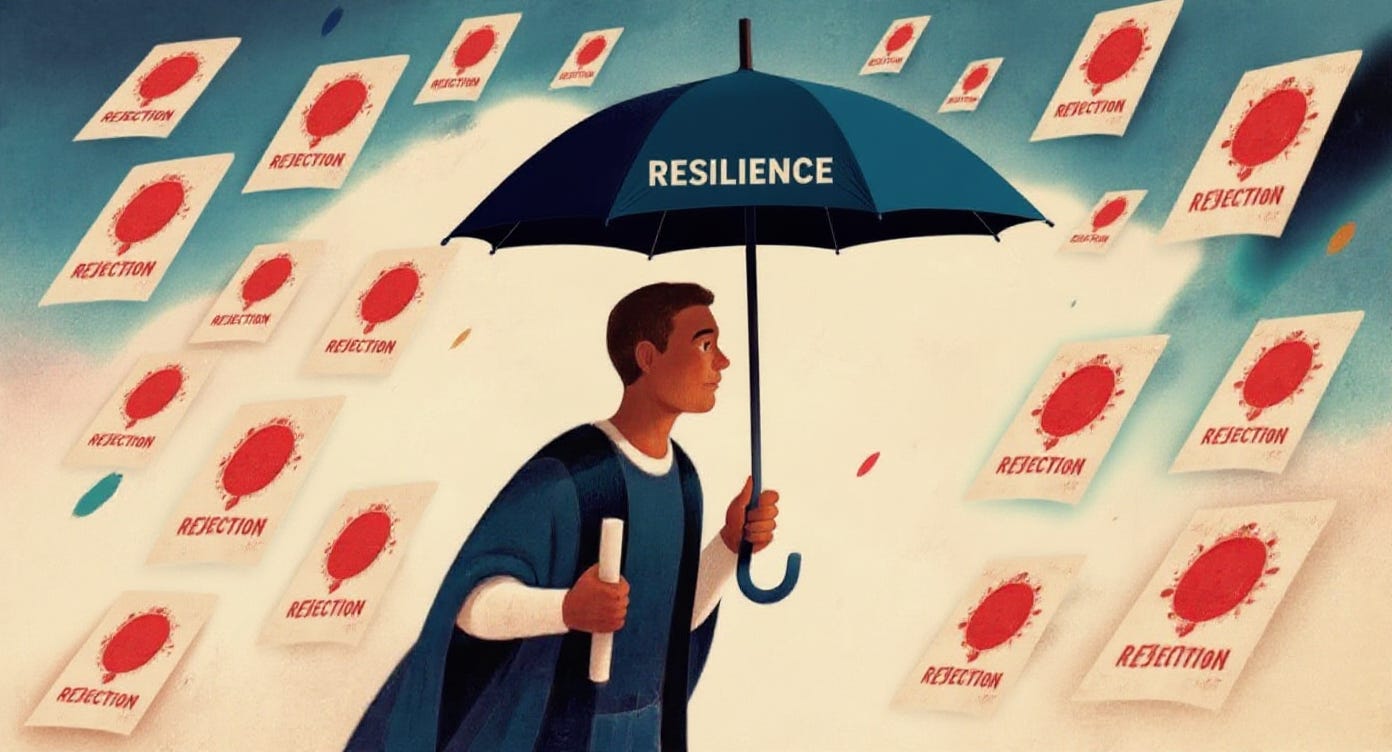
If you missed out on a dream internship or received a rejection email, this guide shows you simple tools to lift your confidence, manage stress, and bounce back stronger. You’ll learn easy routines for getting support, building healthy habits, and taking small early wins that add up to bigger opportunities.
New to the workforce and hit your first job rejection, layoff, or tough review? Use these research-backed tips to regain your footing, focus on fresh skills, and turn setbacks into stepping stones. The advice here helps you build practical resilience that makes a real difference in work, networking, and future applications.
For students: Mindfulness for Students (Mindfulness Initiative, UK) – Free tools focused on stress management for young people in education.
For young professionals: MindTools: Building Resilience – Global platform with extensive free resilience guides for early-career professionals.
Premium Newsletter users can Click Below for a more detailed interactive Resilience Worksheet that you can fill in and print online.
Resilience App for Premium Users
You spent weeks on your internship application. You imagined the perfect summer and maybe even practiced what you’d say on your first day. But the reply is just a polite no. Or maybe you finally landed a junior role, only to miss the mark on your first big project. Suddenly it feels like being an athlete who just fumbled a game-winning play—stunned at first, but then forced to go back to basics and start rebuilding with each new drill.
For students, rejection hits like a hard exam score or missing out on a club spot. Most people want to hide or give up. For new professionals, that first career setback feels like sitting on the bench after missing a string of shots. In both cases, resilience grows not from ignoring pain, but from doing the little things that slowly rebuild your confidence.
“Resilience is the ability to recover quickly from setbacks or difficulties. It means you can learn from mistakes and keep moving forward.”
— Youth Employment UK
A 2024 study from the Journal of Career Assessment found students who actively reflected on rejections and used peer support bounced back much faster than those who dwelled in isolation. Brief daily “self-affirmations” (quick notes on any small personal win) proved especially powerful in restoring motivation after setbacks (Sharma & Liew, 2024).
A new World Health Organization (WHO) report shows young professionals benefit most from simple, structured resilience routines. Early-career employees who used basic weekly trackers (logging a small achievement or learning each day) reported higher confidence and lower risk of burnout. The same report highlights that people rarely get taught these process-based approaches in school or at work, leaving them unprepared for real-life failure (WHO, 2025).
Harvard’s Center for Wellness finds gratitude journals and “stress walks” help both students and young employees bounce back by focusing on movement and personal progress—not just big goals (Harvard University, 2025).
The real struggle is that few resources walk you through a clear, step-by-step confidence routine after a setback. Most advice stays vague or jumps to advanced theories, while new adults need basic, repeated actions that actually fit their lifestyle.
The “Bounce Back Board” (for Students and Young Professionals):
Draw a simple chart: columns for “Setback,” “How I Felt,” “What I Did Next.” After your next rejection, fill it in. Review it each week to spot your own growth.
Mini Wins Tracker (for Students):
Each day, write down one thing you did well or learned (even if small). Use notes on your phone, or a sticky note in your planner. By the end of the week, scan the list and celebrate any pattern of progress.
Stress Reset Walk (for Young Professionals):
Move your body after a bad workday. Take a 15-minute walk and leave your phone behind. Afterward, jot a quick note: “One thing I noticed today that was good” to re-center your mood.
Positive Peer Text (for Both):
Try this: message a peer or coworker after a setback. Share what went wrong and ask if they have experienced the same. The research shows sharing the story reduces shame and builds early-career networks (Sharma & Liew, 2024).
Healthy Boundaries Habit (for Young Professionals):
Schedule a time daily to step away from work tasks. It can be as little as 10 minutes. Use the “pause” to breathe, move, or focus on something fun—this basic boundary boosts resilience and energy (WHO, 2025).
Click below to download your FREE Resilience Bounce-Back Guide.
Download the Bounce-Back Guide
When did you last face a tough academic or extracurricular rejection? What did you do right afterward?
Who in your life can listen without judging? Have you reached out to them about setbacks?
What everyday routine helps you most when you’re feeling low? Is there one you can add this week?
Can you recall a job or work goal that did not work out? What was your first action afterward?
Who at your current job or in your field seems approachable for advice? How can you start a conversation about career disappointments?
How do you react when you see peers succeed after your own setback? What’s one mindset shift to try?
Join career and resilience discussions at Reddit’s r/GetEmployed (global, free).
Everyone stumbles. Those wins you see on social media often hide a dozen no’s and behind-the-scenes recoveries. Your early career is for building skills and routines you can actually fall back on. Each time you get up, connect with someone who understands, and rack up a small win, you set a foundation for bigger things ahead. If you act on just one of these routines, you’ll already be further along than most.
Harvard University, Center for Wellness. (2025). Well-being tips for students and early professionals. Retrieved from https://wellness.huhs.harvard.edu/
Sharma, R., & Liew, M. (2024). Bouncing back from rejection: Confidence interventions for emerging adults. Journal of Career Assessment, 32(2), 194-210.
World Health Organization. (2025). Strengthening resilience in the workplace. Retrieved from https://www.who.int/publications-detail-redirect/9789241550451
Mindfulness Initiative. (n.d.). Mindfulness for students. https://www.themindfulnessinitiative.org/mindfulness-for-students
MindTools. (n.d.). Building resilience. https://www.mindtools.com/pages/article/resilience.htm
No posts
Comments
Nothing yet. Say the first thing.
Sign in to join the conversation.