

Everyone loves to say, “Don’t sweat the small stuff.”
It sounds wise, modern, and efficient. It lets us feel like we’re operating on some high, strategic plane, “focusing on what really matters” while we wave away typos, missed deadlines, half-read chapters, and sloppily written assignments as beneath us.
But here’s the uncomfortable truth: the “small stuff” is exactly where your life is being built.
And if you’re a university student, the “small stuff” is either constructing your future Inner Citadel brick by brick, or quietly hollowing it out.

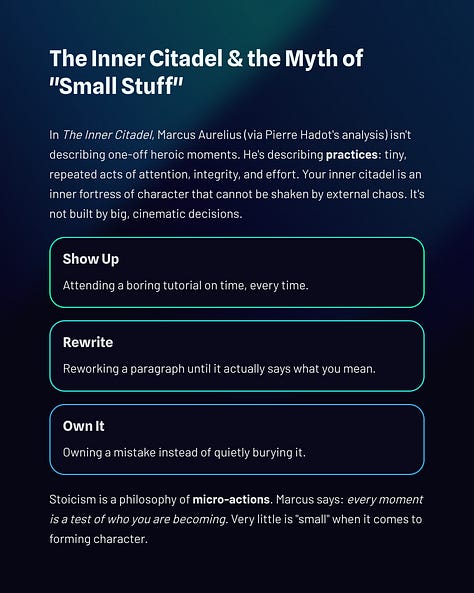
In The Inner Citadel, Marcus Aurelius (via Pierre Hadot’s analysis) is not talking about one-off heroic moments. He’s talking about practices; tiny, repeated acts of attention, integrity, and effort.
Your “inner citadel” is that inner fortress of character and judgment that cannot be shaken by external chaos. It’s not built by big, flashy, cinematic decisions.
It’s built by:
Showing up on time to a boring tutorial
Rewriting a paragraph until it actually says what you mean
Checking a calculation again even though you’re tired
Owning a mistake instead of quietly burying it
Stoicism is a philosophy of micro-actions.
Marcus doesn’t say, “Ignore the small stuff; focus on the big, meaningful things.” He says, in effect: every moment is a test of who you are becoming. Very little is “small” when it comes to forming character.
Students often say something like:
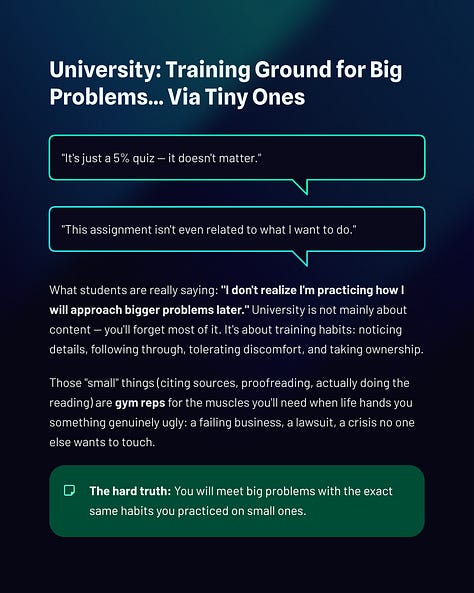
“It’s just a 5% quiz; it doesn’t matter.”
“It’s just a group project; no one cares.”
“This assignment isn’t even related to what I want to do.”
What they’re really saying is:
It is about learning how to:
Notice details
Follow through
Tolerate discomfort
Think clearly under constraints
Take ownership over work with your name on it**
Those “small” things (citing sources properly, labeling graphs correctly, proofreading your work, actually doing the reading instead of skimming SparkNotes-equivalents) are the gym reps for the muscles you’ll need when life hands you something big and ugly:
A failing business
A sick parent
A lawsuit
A massive product failure
A crisis at work that nobody else wants to touch
If you’ve spent years training yourself to shrug off details and cut corners whenever something feels “too small to matter,” what exactly do you think you’ll call on when the stakes are finally high?
You will meet big problems with the same habits you practiced on small ones.
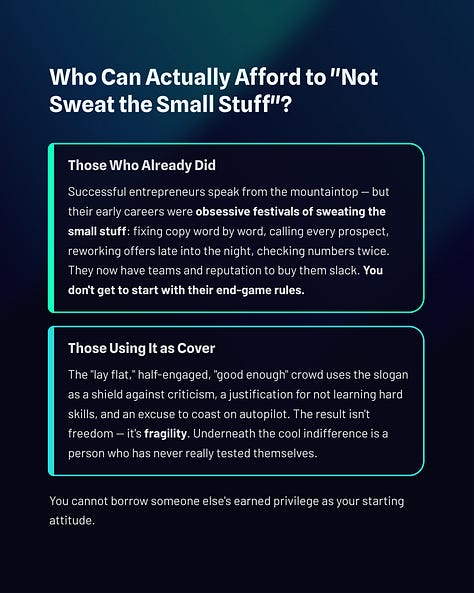
There are two main categories of people who loudly preach “Don’t sweat the small stuff”:
People like Dean Graziosi, successful entrepreneurs, authors, and operators often speak from the mountaintop saying, “Don’t worry about the little things; focus on impact.”
What they rarely emphasize is that their early careers were obsessive festivals of sweating the small stuff:
Fixing copy word by word
Calling every prospect
Reworking offers late into the night
Checking numbers, then checking again
Now they’re at a point where:
They have teams to handle details
Their reputation buys them slack
They genuinely should prioritize leverage over micromanaging every pixel
But you don’t get to start with their end-game rules.
You cannot borrow someone else’s earned privilege as your starting attitude.
This is the “lay flat,” half-engaged, “good enough” crowd.
The slogan “don’t sweat the small stuff” becomes a:
Shield against criticism
Justification for not learning hard skills
Excuse to coast through university or work on autopilot
The result isn’t freedom; it’s fragility.
Underneath the cool indifference is a person who knows they have never really tested themselves.
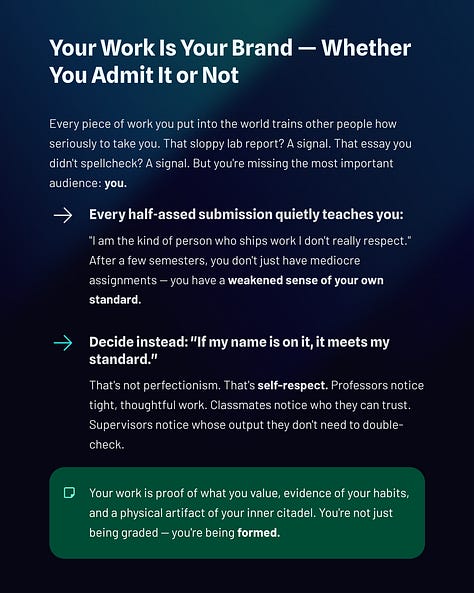
Here’s a hard pill: every piece of work you put into the world is training other people how seriously to take you.
That sloppy lab report? That’s a signal.
That messy slide deck? That’s a signal.
That essay you didn’t bother to spellcheck? That’s a signal.
You may tell yourself:
“It’s just for uni.”
“The professor won’t even read it properly.”
“No one cares about this course.”
But you’re missing the most important audience: you.
Every time you attach your name to something half-assed, you are quietly teaching yourself:
“I am the kind of person who ships work I don’t really respect.”
After a few semesters of that, you don’t just have a pile of mediocre assignments… you have a weakened sense of what your standard even is.
Contrast that with someone who decides:
“If my name is on it, it will meet my standard, even if no one else is watching.”
That’s not perfectionism. That’s self-respect.
And over time, it becomes a personal brand:
Professors notice who consistently turns in tight, thoughtful work
Classmates notice who they can trust on group projects
Supervisors and mentors notice whose output they don’t have to double-check
Work and projects are not just tasks to get through. They’re:
Proof of what you value
Evidence of your habits
Physical artifacts of your inner citadel
You’re not just being graded. You’re being formed.
In The Inner Citadel, Hadot frames Marcus’s Meditations as a series of spiritual exercises; small, daily practices that reinforce a way of being:
Bringing your attention fully into the present moment
Treating each action as if it were your last
Aligning each decision with virtue: justice, courage, temperance, wisdom
Translate that into student life:
Answering an email clearly and on time becomes an exercise in respect and reliability.
Checking your references becomes an exercise in honesty and intellectual integrity.
Reworking an argument in your essay becomes an exercise in clarity of thought.
Doing the assignment properly instead of half-reading the rubric becomes an exercise in discipline and care.
Each one seems small. Each one is, in Marcus’s language, a chance to “do the work of a human being” well.
The point is not to obsess and melt down over every comma.
The point is to use the small tasks as training for your soul.
A common pushback:
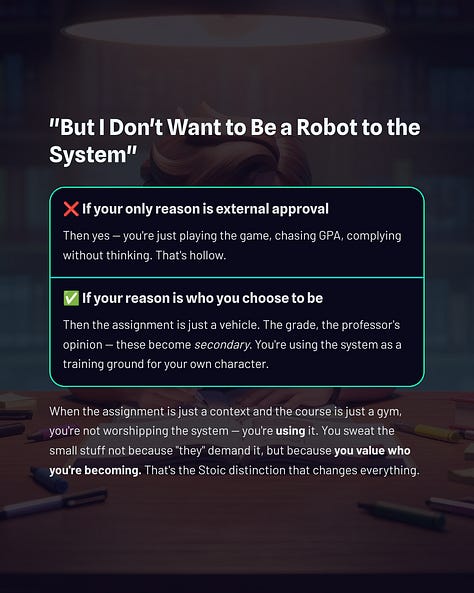
“If I care too much about all these small details, I’m just playing the game, feeding the system, becoming a GPA-chasing robot.”
That’s only true if:
Your only reason for doing good work is external approval, and
You stop thinking and simply comply.
But what if your reason is:
“I do my work well because that’s who I choose to be.”
Then:
The assignment is just a vehicle.
The job is just a context.
The course, the grade, the professor’s opinion—these become secondary.
You’re not worshiping the system; you’re using it as a training ground for your own character.
In other words: you sweat the small stuff not because “they” demand it, but because you value who you’re becoming.
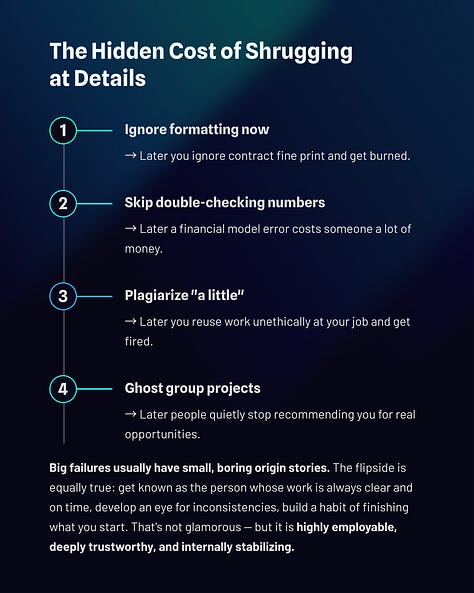
Let’s be brutally concrete about what “not sweating the small stuff” looks like in the wild:
You ignore formatting guidelines now → later you ignore contract fine print and get burned.
You don’t double-check numbers in a lab → later you don’t double-check a financial model, and someone loses a lot of money.
You plagiarize “a little” because it’s “just uni” → later you reuse work unethically at your job and get fired.
You ghost a group or miss deadlines repeatedly → later people quietly stop recommending you for real opportunities.
Big failures usually have small, boring origin stories.
The flipside is also true:
You get known as the student whose work is always clear and on time.
You develop an eye for inconsistencies.
You become that person who catches the error before it explodes.
You build a habit of finishing what you start.
That’s not glamorous, but it is highly employable, deeply trustworthy, and internally stabilizing.

A few practical, Stoic, “Inner Citadel” aligned moves:
Choose a personal standard.
Decide: “Nothing with my name on it will be lazy.”
Not perfect. Not flawless. Just not lazy.
Treat each assignment as a rep, not a judgment.
View every small task as practice for:
Clarity
Precision
Follow-through
Integrity
Start caring about the process, not just the grade.
Ask yourself:
Did I understand what I was doing?
Did I put in focused, honest effort?
Did I improve even slightly from last time?
Notice where you habitually say “this doesn’t matter.”
That sentence is often a red flag.
Pause and ask: “What kind of person am I rehearsing being right now?”
Let the small stuff reveal your character—and then refine it.
When you catch yourself mailing it in, don’t spiral into shame.
Just note: “Okay, that’s a weak brick in my citadel. Next one goes in stronger.”
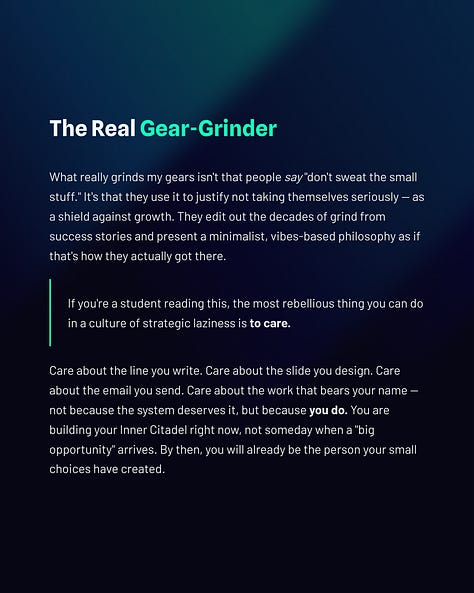
What specifically grinds my gears is not that people say “don’t sweat the small stuff.”
It’s that:
They use it to justify not taking themselves seriously.
They use it as a shield against growth.
They edit out the decades of grind from the success stories and present a minimalist, vibes-based philosophy as if it’s how they actually got there.
If you’re a student reading this, the most rebellious thing you can do in a culture of strategic laziness is to care.
Care about the line you write.
Care about the slide you design.
Care about the email you send.
Care about the work that bears your name—not because the system deserves it, but because you do.
You are building your Inner Citadel right now, not someday when a “big opportunity” arrives. By then, you will already be the person your small choices have created.
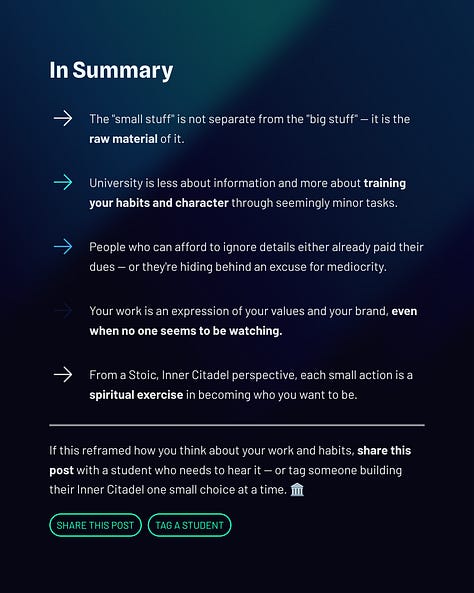
The “small stuff” is not separate from the “big stuff”; it is the raw material of it.
University is less about information and more about training your habits and character through seemingly minor tasks.
The people who can afford to ignore details usually already paid their dues, or they’re hiding behind an excuse for mediocrity.
Your work is an expression of your values and your brand, even when no one seems to be watching.
From a Stoic, Inner Citadel perspective, each small action is a spiritual exercise in becoming who you want to be.
No posts
Comments
Nothing yet. Say the first thing.
Sign in to join the conversation.