
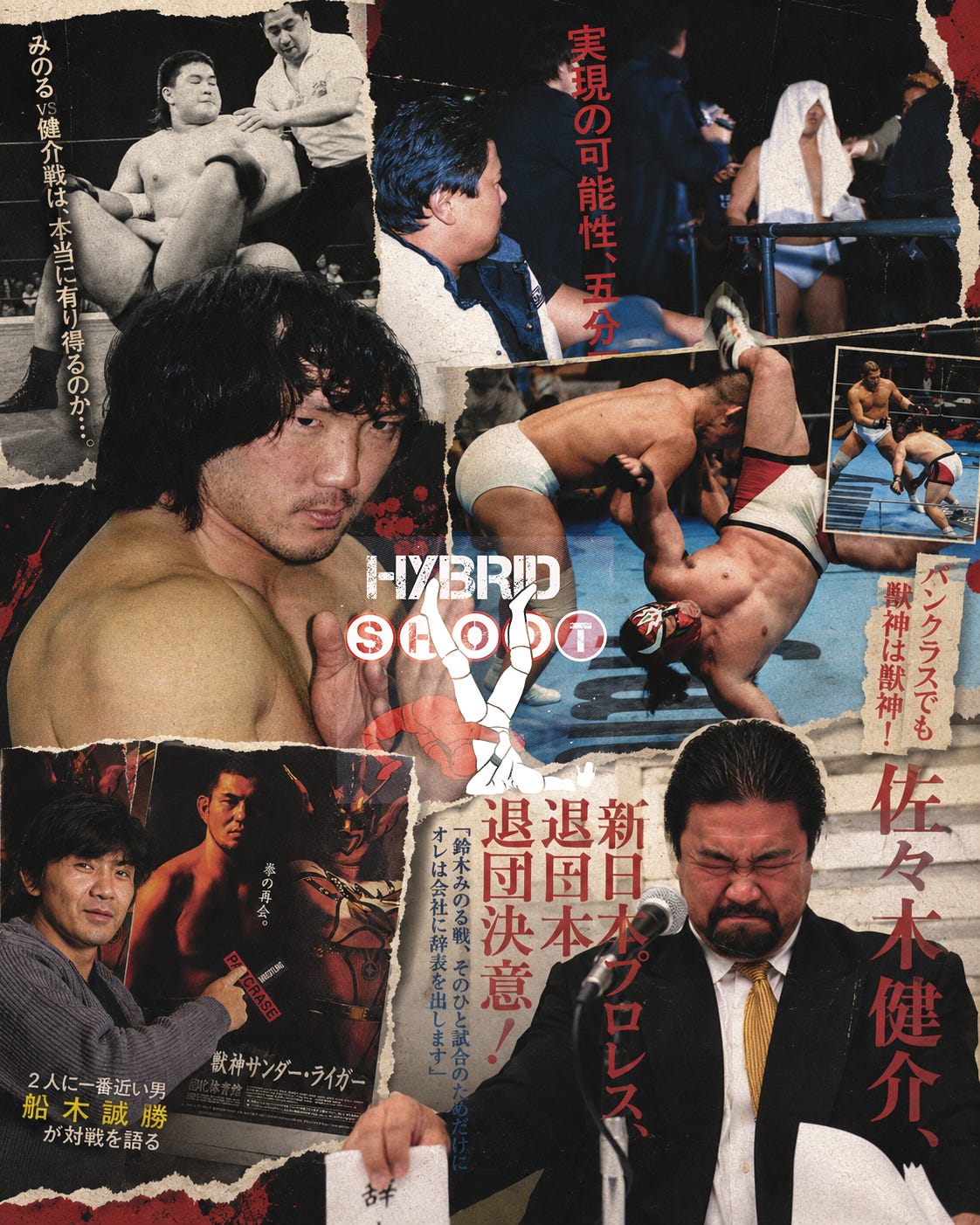
Jushin “Thunder” Liger had made the walk hundreds of times. Thousands, maybe, the iconic “Ikari no Jushin” blaring as he made his way to the ring, the song still echoing as he climbed the corner to greet the crowd. But make no mistake—Jushin Liger had never walked the aisle quite like this.
Bare-chested.
Wearing a stripped-down combat mask.
On foreign ground.
Ready, or trying to be, for a real fight.
It was November 30, 2002. The place was Yokohama Cultural Gymnasium. A sellout of 5,900 had come to see the most elaborate showman in all of wrestling stripped nearly bare.
Across the ring was a man he had once known well, a dojo kid1 when Liger began his transformation into something larger than himself. But Minoru Suzuki was a young boy no more. Years in the UWF style, then Pancrase, had hardened him into something colder than iron. He was a living weapon, a submission machine. If Liger was a bright star, the joyous savant of the junior heavyweight division, Suzuki was a black hole where joy went to die.
Suzuki explained it this way:
“There’s something Liger said in a magazine. That pro wrestling is about making your opponent shine. That’s Liger’s pro wrestling. But I’ve said before that my pro wrestling is about erasing the opponent’s light. If they want to shine, they can shine on their own. So I say to Liger: if you can shine, let’s see you shine.”2
It was 9:15 p.m. when the bell rang, Liger jumping the gun only to be sent back to the corner, the energy electric as everyone waited to see how his flashy style of combat would translate to a type of wrestling reduced to its barest, most essential elements.
“His body, that distinctive pro-wrestler kind of body that is broad from side to side,” Weekly Pro-Wrestling wrote, “stood out at once.”
So too his actions.
The first thing Jushin Thunder Liger did in Pancrase was the most Jushin Thunder Liger thing imaginable. He crouched low, came forward behind a jab like a man about to shoot—and then hurled himself into the air, turning his body into a rolling kick.3
It was defiant, beautiful, absurd, and doomed.
Suzuki slipped to one side. The kick caught him high but did no real damage. He kept his feet, maintained his base, and quickly came down on top. Right in front of the assembled press, he looked up and did the scariest thing possible.
Minoru Suzuki laughed.
It was over before it had truly begun.
But this is not really a story about a wrestler trying MMA once and failing. It is a story about a promise that changed hands.
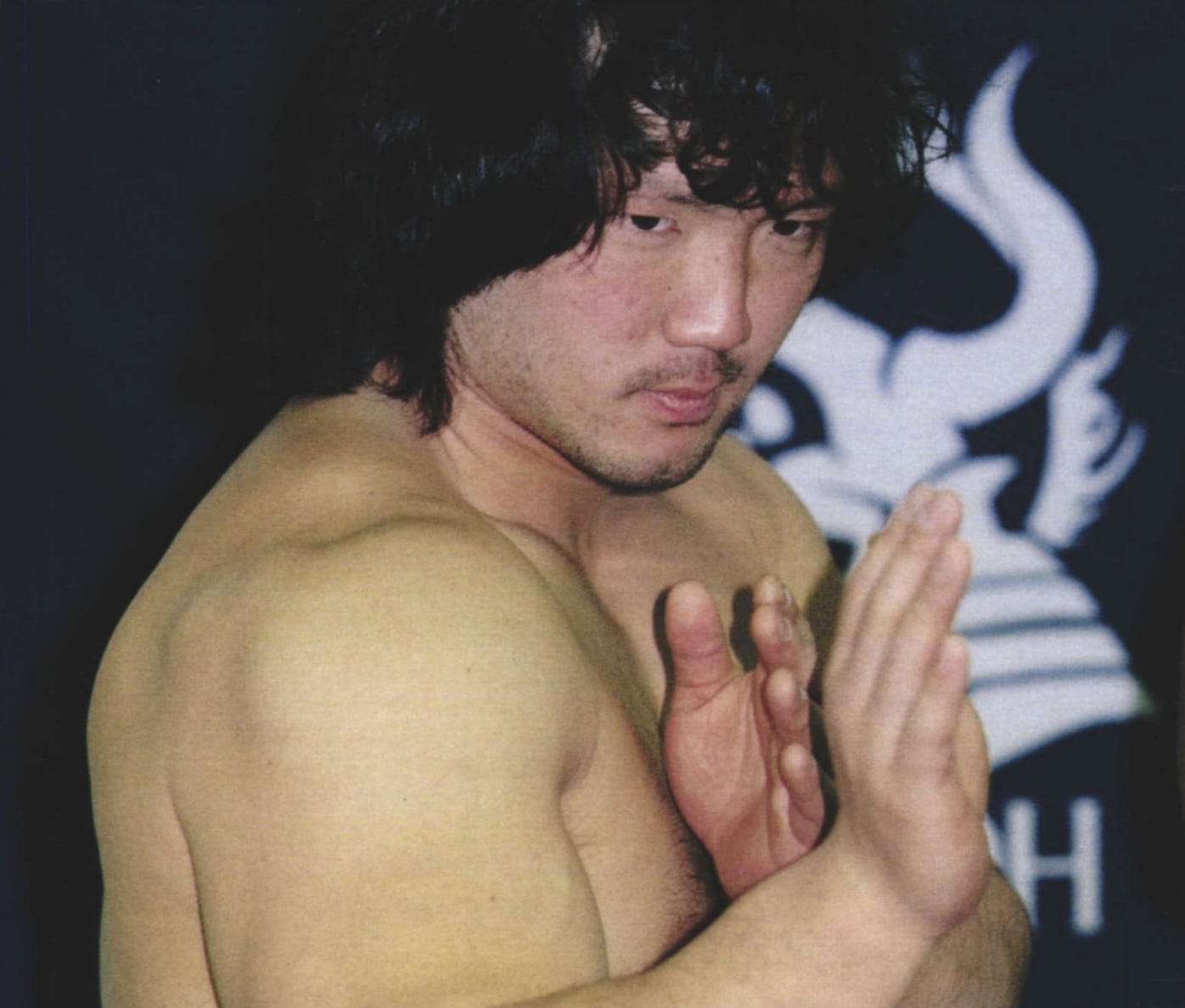
The mask made it easy to misunderstand him—but Liger was not a mere mascot, some cartoon wrestler who accidentally wandered into a shoot. Before the shooting star press and the colorful costume, he was Keiichi Yamada, just like Suzuki a New Japan dojo product, one of those strange creatures formed in a system where performance, punishment, and pride shared the same room.
In the New Japan apparatus, no matter how elaborate the public exhibitions became, the back room training remained the same. Kotetsu Yamamoto built the bodies, endless, cruel training a daily ritual. Then Yoshiaki Fujiwara took over, stretching the worn joints and muscles to breaking, teaching a collection of testosterone junkies something approaching science, classes in kinesthetic torture turning showmen into warriors.
Masakatsu Funaki, who founded Pancrase alongside Suzuki, remembered Liger as a man who loved “cement,”4 who took Fujiwara’s real sparring sessions5 as seriously as anyone. Hot-blooded, he was the first to step forward when violence seemed the most acceptable answer.
“If someone came storming into the dojo looking for a fight,” Funaki recalled, “Liger was the first one to go.
“At the time, he was one of the most martial-arts-minded people in New Japan. I remember Fujiwara School very clearly. Back then, we were all starving for technique. Everyone was an ambitious wrestler. Everyone wanted to work with Fujiwara-san. The one monopolizing his time was Liger. After Liger went overseas6, I monopolized Fujiwara-san. After I went overseas, Suzuki monopolized him.
“...His specialty back then was the armlock. The moment he grabbed your arm, you thought, ‘Ah, he’s got me.’ Anyway, he’s very strong. Fujiwara-san used to tell him all the time, ‘With you, it’s all strength. Use more leverage.’”
These early training sessions did not make Liger the equivalent of a Pancrase fighter. Those dojo days were in the distant past after all, miles and mileage of a life spent in wrestling sapping his body’s ability to respond to his commands. But it made the reckoning that unfolded sharper. Liger knew enough about violence to respect it—and perhaps just enough to truly believe he could still answer its siren song.
Liger’s sudden, unexpected appearance in Pancrase clearly left Funaki, himself recently retired, feeling nostalgic. In a different timeline, it might have been him and Liger who founded the promotion, not him and Suzuki.
But it was Minoru who had the vision for it, the will to change an entire industry to suit his desires, molding the wrestling universe to be an answer to his dreams. That, Funaki believed, would be the difference.
“For Suzuki, this is a match he absolutely cannot be allowed to lose,” he said. “He left New Japan, created his own style, and built up the Suzuki we have now. For him to lose easily to a pure New Japan guy like Liger — he cannot allow that. It’s a Pancrase ring. He absolutely cannot lose.”
The stage was set. The stakes high. And here’s the twist—Liger had not chosen this moment. He was not supposed to be opposite Suzuki in that ring. He was there because another man wasn’t.
Fifteen years earlier, two young men met in the dojo of New Japan Pro Wrestling, bonded in the way that young men can only be in the formative years of their lives. Twelve times they met in the ring as young wrestlers in 1988, both promising prospects, both with futures bright.
Twelve times Kensuke Sasaki got the better of Minoru Suzuki.
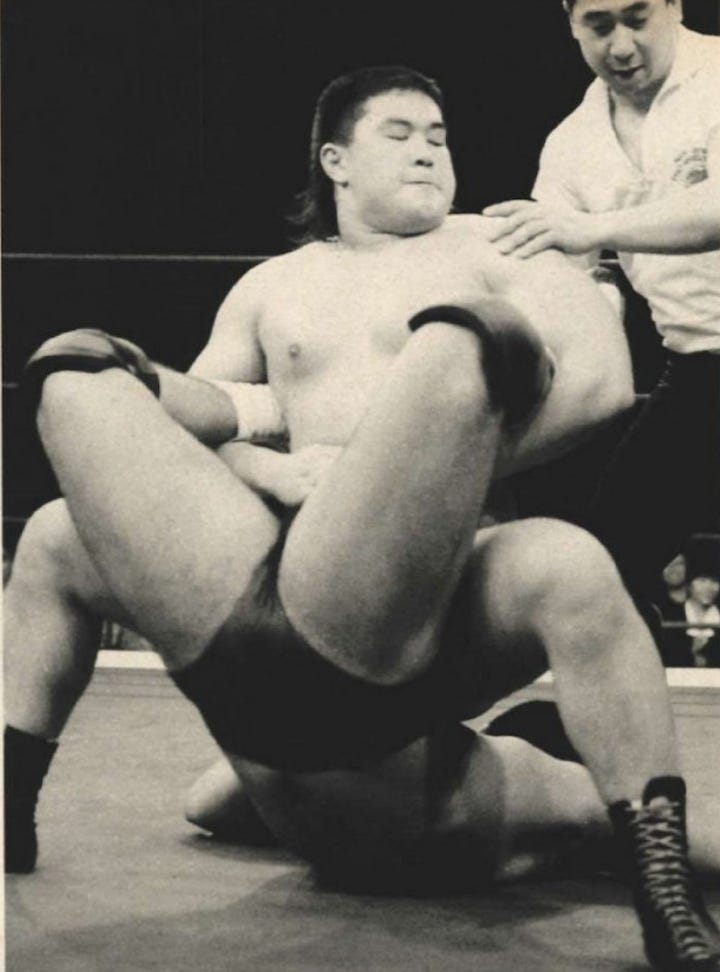
It wasn’t quite that simple of course. Even in 1988, the dynamic was already strange. Sasaki won the matches, but Suzuki won the magazine writeups. Every line bent toward Suzuki, praising his preternatural ability and poise: his joint locks, his UWF scent, his connection to Fujiwara, his unnerving confidence. All this in a 20-year-old’s body. Sasaki had beaten him, sure. But the article made it feel like Suzuki had revealed the future:
Against Sasaki, Suzuki did not show any gap in experience at all. If anything, he showed offense and defense equal to Sasaki’s — maybe even beyond it.
When they tied up, Suzuki would throw. When it went to the ground, he would go for joint locks. Armbar, wakigatame, facelock — he showed one submission technique after another, changing freely from one to the next.
Recently, New Japan’s preliminary matches have been criticized for lacking energy. But this unexpected offense pulled the crowd in. Even though it was the first match, people were shouting, “Finish him!” and “Squeeze!”
Suzuki’s joint-lock style was not foreign to New Japan. It was New Japan before New Japan forgot itself. He’d learned it, first from his contemporary Funaki and then from the wily old master himself, Fujiwara, the product of hours on the mat.
“Even if I got caught 100 times the first time, if the next day it’s 98, I’m really happy,” Suzuki said in a 1988 interview. “And if the day after that it’s 97, then that means there was one more hold I didn’t get caught in. That’s what it feels like.”
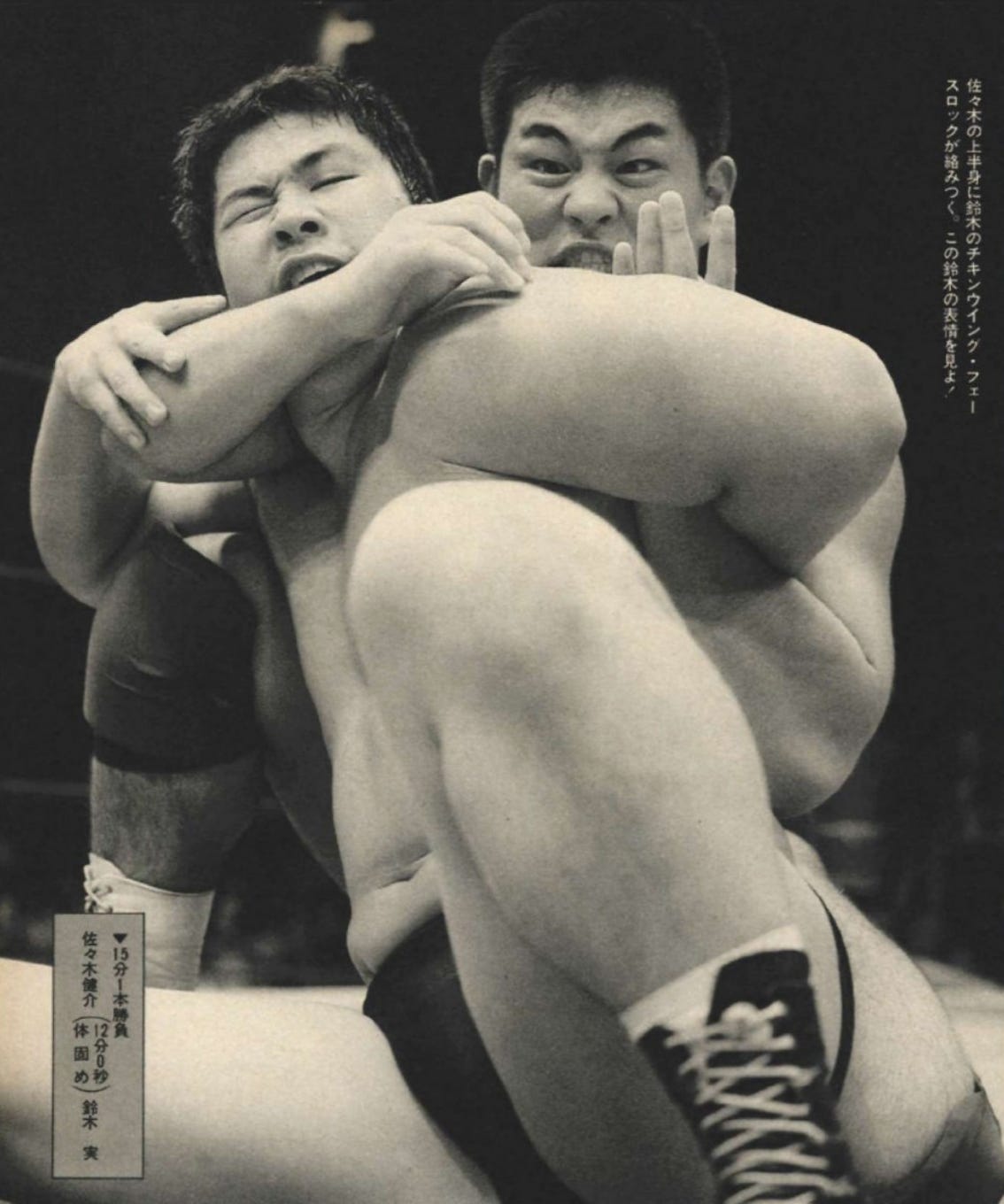
Many young wrestlers dreamed no larger than simply moving one rung up the ladder at a time. But not Suzuki. This was a young man who dreamed so large, his ambitions couldn’t exist in the sport as it was. He’d need to rebuild it in his own image first. And he would. That, however, was the future.
“I used to talk about this with Funaki all the time. If we were going to surpass Inoki, we said, we had to do something bigger,” Suzuki said. “Funaki said he wanted to fight Mike Tyson. Me? I wanted to move people. If Funaki could move 100,000, I wanted to move a million. Bigger is better. I wanted to become that kind of man and throw everything I had into pro wrestling.”
But in 1988, grand designs weren't enough. Brand new to the ring, Suzuki’s enviable skills were routinely neutralized by the sheer mass of the mountain.
In the old clippings from Weekly Pro Wrestling, their rivalry already had its shape. Suzuki was the revelation, the young joint-lock prodigy who made reporters talk about Fujiwara, UWF, and New Japan’s forgotten origin point. Sasaki was the “mountain.” Again and again, Suzuki could make him suffer, could attack the legs, could force him into the old game of holds and counters. But Sasaki remained above him, winning not with subtlety but with strength. If the 1988 articles made Suzuki look like the future, they also made clear that Sasaki was the first summit he could not reach.
“The mountain named Sasaki” was “high and steep.” Suzuki couldn’t scale it. Would that be different in 2002? That’s something the two men hoped to find out.
After their final match in 1988, the two made a promise to each other, a young man’s vow, powerful and pure.
“We started at the bottom together,” Sasaki recalled. “We trained together under Fujiwara. We wanted only to become strong. Someday, when we had risen, we would do this again...We made a promise.”
Instead, the two took very different paths.
Suzuki and Funaki migrated to the Newborn UWF, attempting to prove pro wrestling was the ultimate martial art. But even that wasn’t bold enough for the two young visionaries. Breaking free from the system entirely, they founded Pancrase—a revolutionary experiment that asked a dangerous question: What if pro wrestling was all cement, all the time?7
For a time, Tokyo fell in love with the answer. Pancrase became a cult phenomenon, a sanctuary for fans looking to mainline violence in its purest form. But the subsequent explosion of global mixed martial arts quickly crowded the market, taking combat to extremes that made even the Pancrase pioneers uncomfortable. Worn down by years of unscripted punishment, the founders broke. Funaki retired. Suzuki, plagued by knockouts and head injuries, was forced into modified catch bouts that banned striking entirely.
Worse, to Suzuki and Funaki, the promotion’s new crop of fighters lacked the theatrical soul of the founders. They were gifted martial artists, but they didn’t understand the pro wrestling ethos—that a dramatic, heartbreaking loss could hold more value than a boring win.
Pancrase was struggling.
Sasaki, by contrast, stayed the traditional course. He ascended to the top of New Japan, captured heavyweight gold, and even donned face paint to partner with Road Warrior Hawk. Yet, no matter how much steel he lifted or how many titles he held, he could never fully escape the towering shadows of the men who preceded him—the iconic Three Musketeers.8
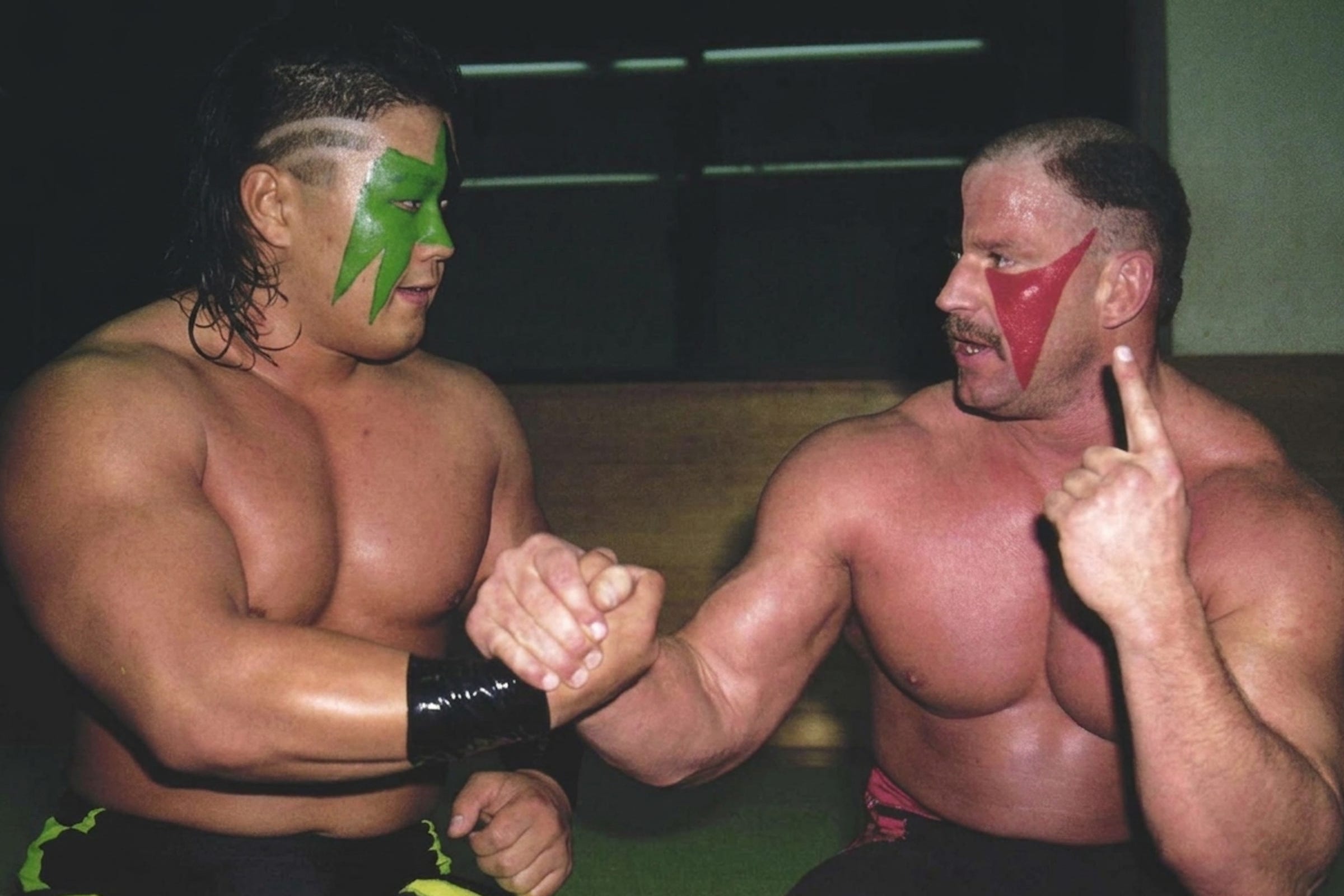
When the MMA boom hit Japan, Sasaki’s position grew perilous. Antonio Inoki had become obsessed with reality combat, aggressively inserting his wrestlers into legitimate shoots while bringing foreign fighters into wrestling rings. In this hostile new landscape, traditional showmanship was losing its value.
To survive, Sasaki needed a different kind of currency. He quietly traveled to America, training with Don Frye and taking a last-minute fight on a low-profile Gladiator Challenge card. But a brief excursion into regional MMA wasn’t enough to alter his trajectory. Cutting his signature mullet wouldn’t change what he was in the eyes of the public either.
To truly reinvent himself, he didn’t just need a win. He needed a reckoning. He needed Minoru Suzuki.
On May 2, 2002, immediately after a celebration of New Japan’s first 30 years, the two men agreed the time had come. A bout between the two was originally scheduled for the event, scuttled when “negotiations fell apart because Pancrase didn’t think it was a good idea for one of their wrestlers to do a worked match.”9
But the two men weren’t willing to let things go that easily.
They felt strongly they should do battle once again, both looking to start new chapters in the waning days of their primes. There was something authentic and genuine about their confrontations in those early days, something both felt was missing in their current incarnations. They were ready, once again, to see who was stronger.
“We shook hands in total darkness, where the spotlight didn’t even reach us,” Suzuki said. “That’s very us, though.”
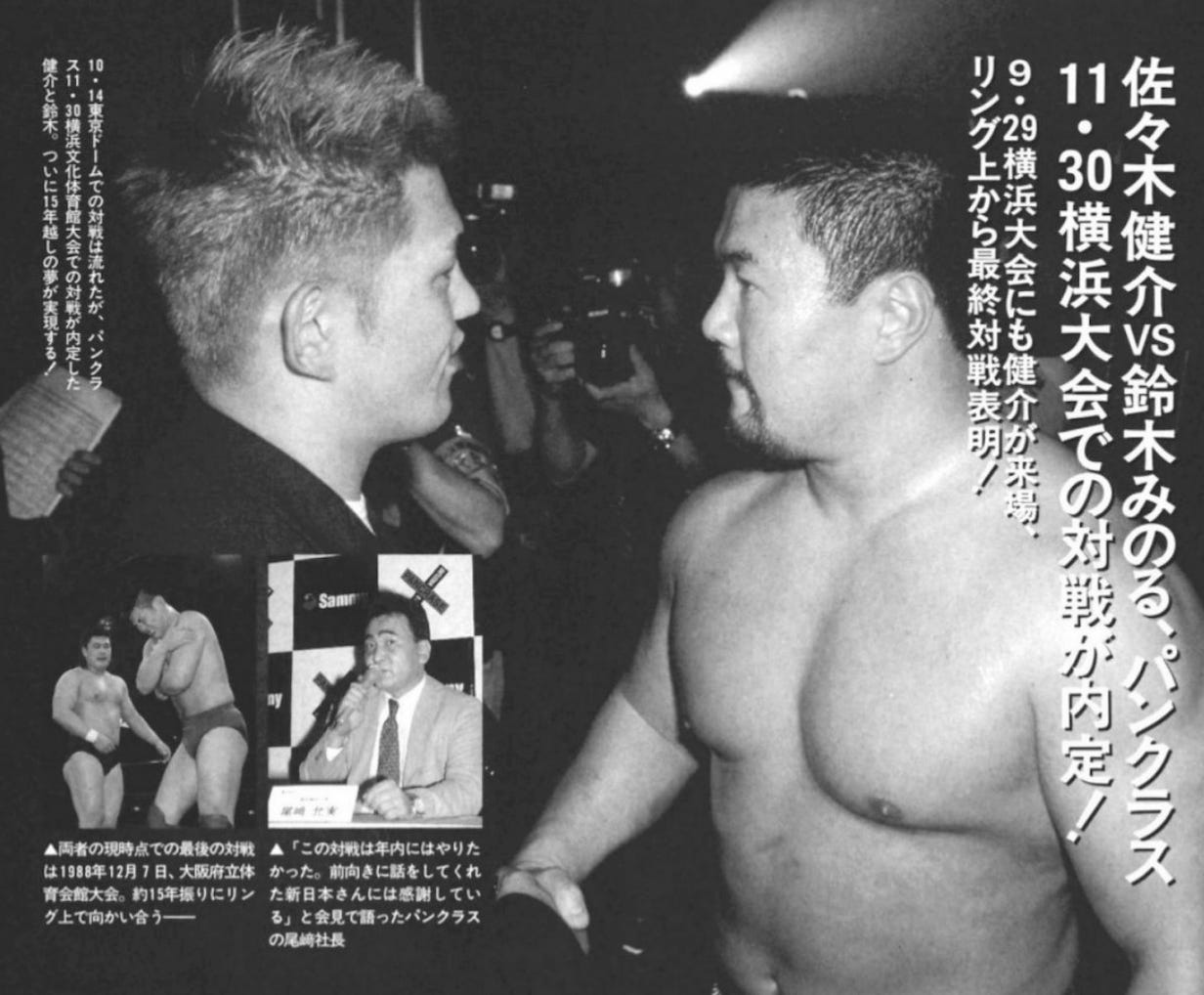
It was almost anti-television. The cameras missed it. Suzuki didn’t care. “So what?” he said. “‘Shall we do it?’ ‘Let’s do it.’ Isn’t that enough?” That was the whole point. The promise did not need broadcast proof or an audience. It only needed the two men who had originally made it.
“Whether that moment lives or dies depends on our own spirit,” Suzuki told the press. “Whatever the rules are, this is still a story made from raw emotion. The feelings that exist inside Kensuke Sasaki and Minoru Suzuki — those are raw.
“So why not have a raw fight? A living fight.10 There are a lot of people who don’t like the phrase shinken shōbu11 — “serious fight” or “real fight” — so call it something else if you want. But that’s what it is.”
—So Minoru Suzuki vs. Kensuke Sasaki is something that goes beyond pro wrestling rules or vale tudo rules?
Suzuki: I hope it becomes that.
If he is still the same human being he was back then — if he still has that same pure feeling of wanting to climb upward — then I think something incredible will be left behind. But if he has changed, then it becomes something different. That I don’t know.
We won’t know unless we go in with the feeling of, “Ready, go,” and trade blows for real.
—Still, the reason this match is attracting so much attention is that…for Kensuke, this is an outside-style fight — maybe the first of his career in a real sense.
Suzuki: A pure promise from when we were kids — that’s important. I really think so.
When you become an adult, poison gets into your body. All kinds of escape routes get in too. And now, of course, my life and his life are completely different. The influences we’ve been under are different. The way we’ve turned out is different.
But no matter where you are, no matter what job you’re doing, there’s a part of you that shouldn’t change.
I think this match makes people wonder: what happens when the feelings from that time, still inside Suzuki, collide with New Japan Pro-Wrestling’s Kensuke Sasaki?
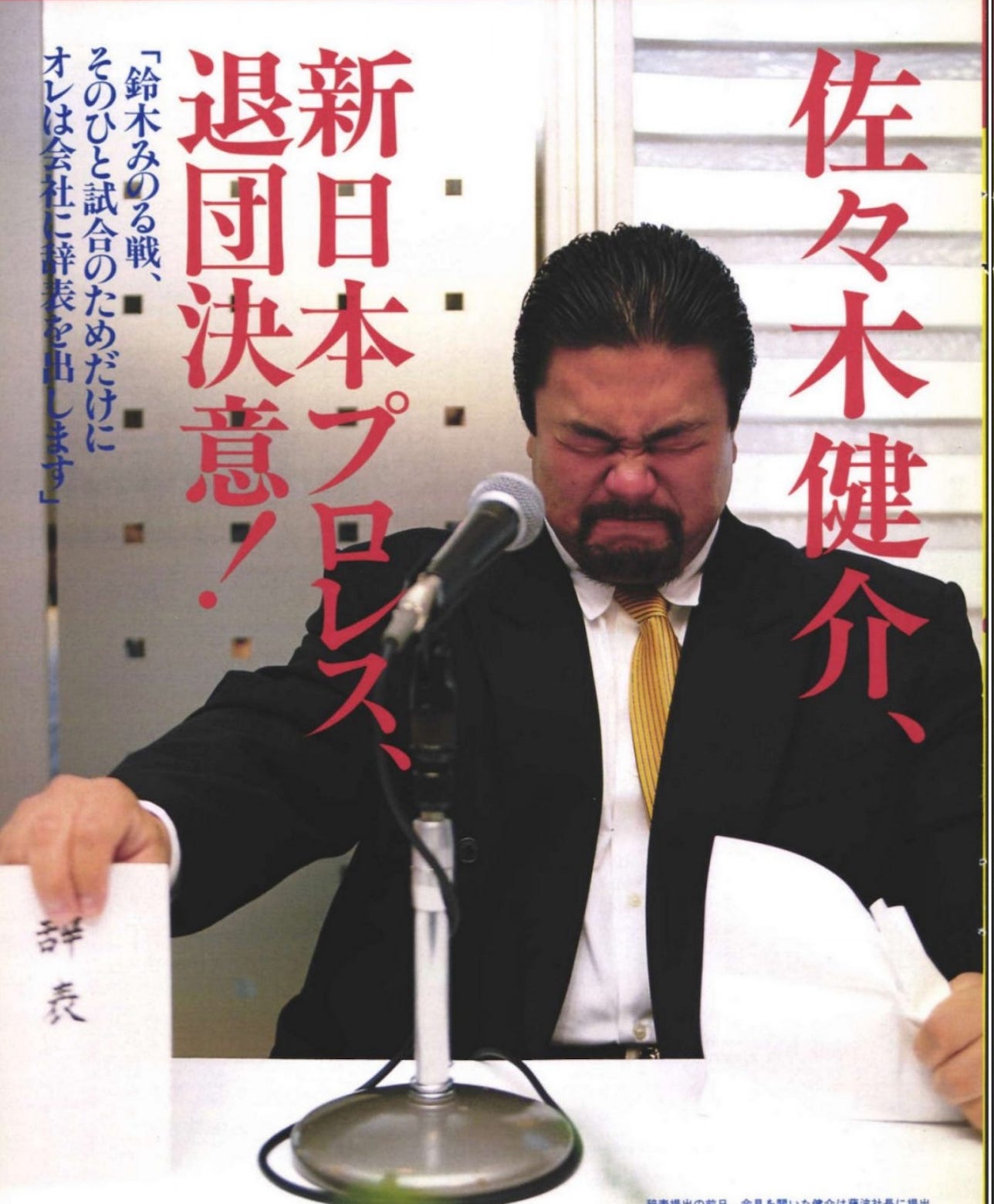
Sasaki viewed this upcoming fight as an otoko to otoko no yakusoku12—a “promise between men”—which represented a private code of honor built on their shared suffering and training. In describing it to the press, he broke down, caught in the hazy memories of his youth.
“I want people to really think about why it has to be me and Suzuki,” he said. “When Suzuki and I were undercard wrestlers in New Japan, we trained together under Fujiwara-san. We sweated together. We said, ‘Right now we’re at the bottom, but we are absolutely going to become strong.’”
Here, Kensuke began to break down.
“We trained with pure feelings. We took what we trained and smashed it into our matches. We competed with each other. We weren’t carrying the huge burdens we carry now. We just wanted to become strong. That was all.”
For a man, a sport, predicated on stoicism and toughness, it was a reminder that even the heroes of the ring are human.
For Suzuki, the match was equally symbolic; he believed it was a chance to see what would happen when the pure, raw emotions of their youth collided with the established fighters they had become.
Suzuki understood the danger of growing up. The question was not whether he and Sasaki had meant what they’d said when they were young. Of course they had. The question was whether the men they had become could still keep the promise the boys had made.
Initially, the corporate machinery complied. Sasaki vs. Suzuki was booked for New Japan’s massive October 14 Tokyo Dome event—the grandest possible stage for personal reinvention.
Then the first exit ramp appeared. In September, New Japan abruptly announced the bout was postponed, blaming a Sasaki ankle injury. Behind the scenes, the backstage coverage was far more cynical.
“Insiders claim that despite the public posturing,” Dave Meltzer reported in the Wrestling Observer, “Sasaki didn’t want to risk his career by losing a shooting match to someone past his prime and much smaller, so wound up with the ankle injury.”
Desperate to salvage something from what was looking like a potential debacle, New Japan proposed moving the fight out of their territory entirely and onto a Pancrase card. But transplanting the match fundamentally altered its DNA. In the Tokyo Dome, the bout could survive as a hybrid myth—part theater, part reality, protected by narrative constraints. Inside a Pancrase ring, it became impossible to domesticate. It was no longer a tribute to a shared youth; it was a traditional heavyweight being asked to step into a shark tank Suzuki had personally constructed.
The private compact was officially co-opted. Dates, venues, rules, and promotional points were being decided by executives. Sasaki watched the emotional purity of the venture evaporate in real time.
“The match between me and Suzuki,” he said, “which should have been a match just for the two of us, became New Japan vs. Pancrase.” Then he sharpened the complaint: “But now, at this point, the organization is stepping in between me and Minoru Suzuki.”
When Sasaki pulled out a second time, the promotional apparatus fractured. With the November 30 show in Yokohama suddenly missing its marquee attraction, Minoru Suzuki was left stranded. The cancellation didn’t just jeopardize a live gate; it left Suzuki with nowhere to direct fifteen years of resentment.
He had trained for Sasaki.
He had aimed himself at Sasaki.
He had built his body and mind around the collision, putting on weight for a collision with a larger man.
Suzuki’s emotions had been summoned, sharpened, and then abruptly denied a destination.
When New Japan executive Fumihiko Uwai and Jushin Thunder Liger arrived at the Pancrase office to offer formal apologies, promotional president Masami Ozaki braced for an administrative disaster.
Instead, the icon stepped forward.
“If I’m acceptable,” he said, “please let me fight him.”
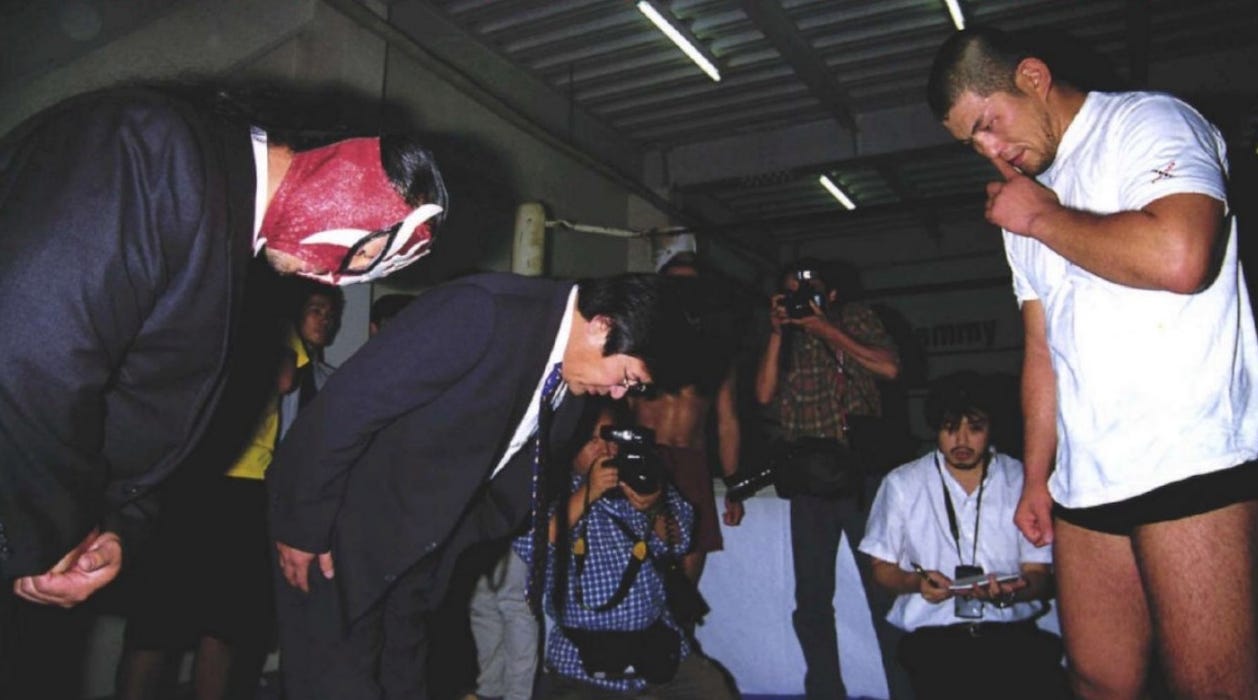
It was not opportunism. It was not a masked star reaching for one more strange headline in a career full of them. Liger understood the debt New Japan had created. He understood Suzuki’s complicated feelings about pro wrestling and New Japan. He knew the man too.
“With things the way they are… then I felt I had to do it myself,” Liger said. “I want to do it. I want to fight in the Pancrase ring. As New Japan, I bow my head over what happened with Kensuke. But as a wrestler, I understand Suzuki’s feelings, and I want to take them on myself.”13
Sasaki had left Suzuki’s challenge hanging in the air, and Liger offered himself as the place where it could safely land. Suzuki, still processing the shock, warned him plainly: “If you’re really going to step into this, come in prepared.”
Liger did not blink.
“I won’t run. I won’t hide. I’ll come straight at you.” The complicated discussions that had plagued the Sasaki fight were immediately pushed to the side. It was a Pancrase ring, Liger said, Pancrase rules were fine by him.
The offer was accepted. The show would go on. But the reckoning, the fallout, was almost immediate. They had solved one problem and created another.
Furious that the defining match of his career's second act had been surrendered, Sasaki called a retaliatory press conference and resigned from New Japan “for the sake of the Suzuki match—for that one match alone.” Liger vs. Suzuki was a dream match, he admitted, but not as an act of corporate salvage—not as his replacement.
Later, when the idea of money came up with the media, Sasaki scoffed at the idea the issue was financial, reducing the whole thing to its purest form: “Fight money? Train fare is enough. I just want to fight Suzuki.”
By then, however, the machinery, powered in this circumstance by two promotional offices, had already begun to move in a new direction. Posters were being printed. Media work had begun. Suzuki’s mind had shifted. He would later say the line from Liger that shook him most was this: “I’m the only one in New Japan who can answer what you’re feeling, aren’t I?”
The old fire, his battle with New Japan, was still alive. But it had changed hosts.
Liger was now the fight.
Although it was initially built around Sasaki, Suzuki did not treat Liger like a consolation prize. If anything, the substitution made the whole thing stranger, more dreamlike, and potentially more dangerous.
“When I saw Liger-san’s eyes,” Suzuki said, “I started trembling. I felt this incredible seriousness from him.”
At that point, Sasaki was firmly in the rear view, the past in the past. Suzuki wanted to fight Liger with everything he had. Somehow, absurdly, the replacement had become more emotionally charged than the original.
“Honestly,” Suzuki admitted, “right now, my motivation is even higher than it was for Kensuke.”
Liger accepted that burden with a wrestler’s confidence, which is to say something just adjacent to madness. He had a full New Japan schedule to maintain, a company to represent, a costume to wear, towns to make, tickets to sell. He was not disappearing into the mountains for a private camp. He was not taking six months off to remake his body for a new sport. He was Jushin Thunder Liger, still working as Jushin Thunder Liger, trying to become something else in the hours left over in the day, which weren’t that many.
But he was not walking in blind.

He got his hands on four Suzuki tapes: the Solar fight in DEEP, a Pancrase bout where Suzuki had been badly beaten by a foreign fighter, another match against a striking-based foreigner, and a catch-rules match with a Japanese opponent. He watched them looking for patterns, habits, some hidden weakness in the man across from him. What he saw, or thought he saw, was a fighter more likely to shoot a takedown than strike, a man whose obvious weapons were the armbar and ankle hold. Dangerous, yes. But legible. Not so far removed from the techniques and lessons of Fujiwara.
A problem that could be studied.
A problem that could be solved.
So Liger built a plan.
He would keep his stance low. He would stay at distance. He would strike first, using his ability to switch stances and hit from either side. If Suzuki came for the takedown, Liger would sprawl, put his weight on him, crush him down, and take the superior position. If Liger hurt him standing, he would shoot himself, take mount, and then, on the ground, maybe find the ankle. Achilles hold. Ankle lock. A classic from the Fujiwara vocabulary. Something that still lived somewhere in the physical memory of Keiichi Yamada.
“Because I’m a wrestler,” Liger said later, “what I really wanted was to take my time and have an exchange of joint locks.”
There was a kind of innocence in that. Not ignorance exactly. Liger understood better than most that the old knowledge was not enough. “The kind of ‘cement’ Fujiwara-san taught us back then — the joint-lock exchanges — and what I’m doing now are completely different,” he said. In the dojo, if danger came, a man could curl up, turtle, protect himself, wait for the next exchange.
“If you do that now,” Liger said, “punches come flying in.” The old Fujiwara school had taught him how to suffer in purgatory. Early Pancrase looked like this too. The new Pancrase, more brutal than ever with an injection of MMA DNA, asked what happened when stolid suffering met flying fists.
That was why Liger humbled himself. The living legend went looking for help from younger specialists. Masayuki Naruse, a veteran of RINGS, was in his corner, practical and calm, checking Liger’s pulse before the fight and finding it a little over 100, just about where Liger wanted it: warm enough to be alive, not so high that fear had taken the wheel. Toru Yano, still early in his own career but already with a serious amateur wrestling base, gave him looks he could not get in ordinary pro wrestling practice. Yano’s takedowns, his weight shift, the small details of balance and pressure — Liger knew those were things he could not simply summon from pride.
He sparred with everyone who had something to give him. Judo people. Striking people. Wrestlers. Men whose special knowledge might exceed his own in their individual worlds. That, too, was part of the strange nobility of the whole thing. Liger did not pretend the mask or his stature in the industry made him invulnerable. He lowered his head and asked to be taught.
Suzuki carried an entirely different burden: absolute pressure. This was his promotion, his ring, his architecture. He had abandoned New Japan to forge this realistic alternative, and now a pure product of that original system was invading his sanctuary. To lose here to a masked senior would not simply embarrass Suzuki. It would call the whole journey into question, invalidate a life’s work.
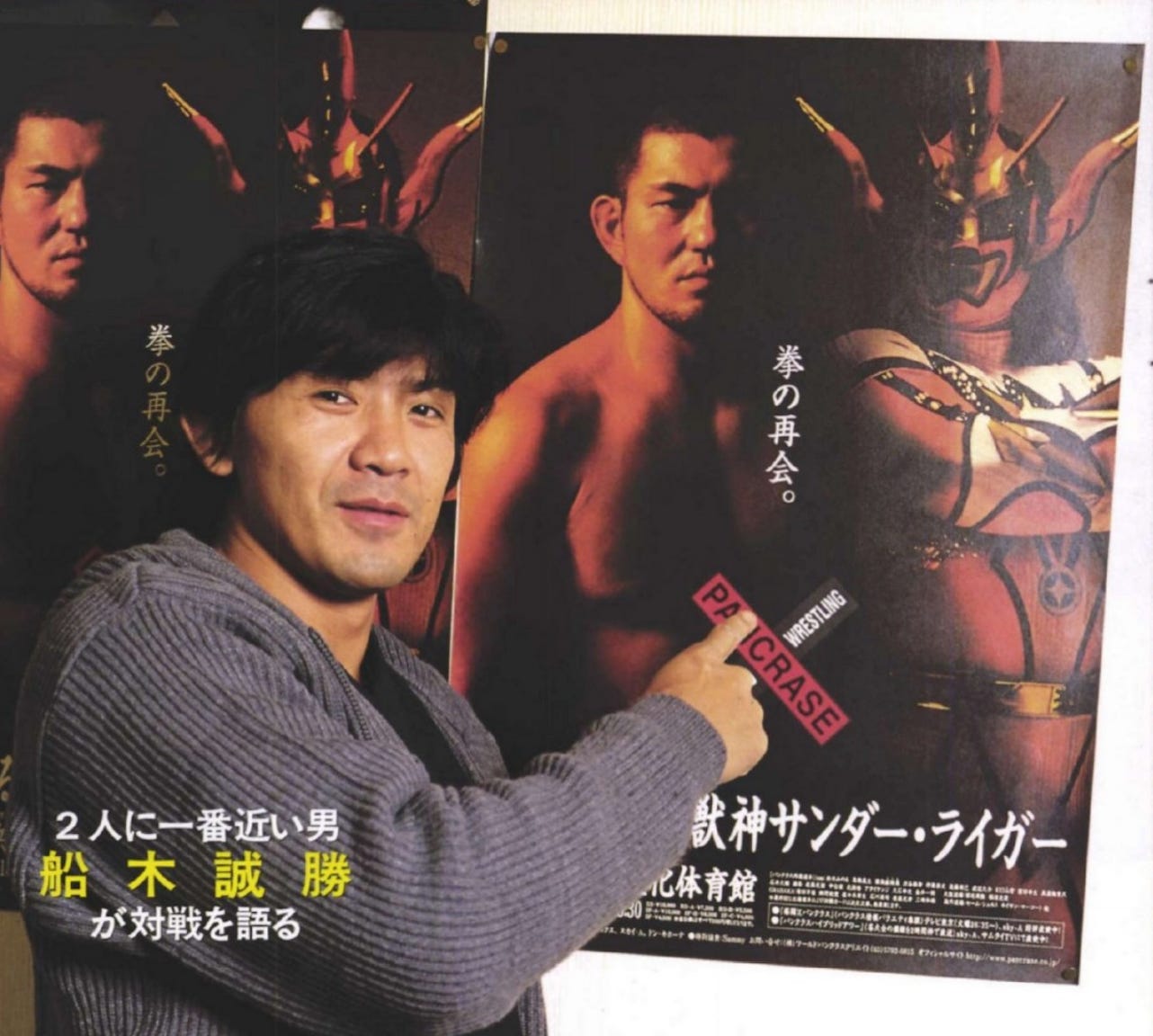
Funaki understood that immediately. For Suzuki to lose easily to “a pure New Japan guy like Liger” was impossible. This was a Pancrase ring. He could not allow it.
So Suzuki trained as if he was the one with something to prove. In Yamanashi, cut away from the usual noise, he rebuilt himself around power. Years of injury had pulled him toward technique, toward smaller solutions and safer answers. For Liger, he wanted the old force back. Submissions were one weapon, of course, but he wanted weight behind them. Collision. Impact. A body that could hit another body and make the room understand.
“This fight is about power against power, heart against heart.”
He wanted to hit Liger head-on. He wanted to smash into him and blow him away. Pancrase, he thought, had drifted too far toward technique, too far from the original hunger that created a new world in the first place. The younger fighters knew the holds. They knew the positions. They knew the science. What they did not know, Suzuki feared, was the spirit that had launched the whole enterprise.
Liger was preparing for Suzuki.
Suzuki was preparing for the possibility that Pancrase itself had gone soft, that the vision wouldn’t survive without the founders. This would be his final lesson for those to follow.
And yet underneath all that pressure was memory. When Suzuki was just starting in New Japan, the opponent he most wanted to fight was Liger back in his unmasked days. By facing him now, a feeling buried under years of dust had come back to life. The more Suzuki became conscious of that meaning, the easier it would have been to become sentimental.
But sentimentality was a luxury he could not afford.
If Suzuki carried even one fragment of nostalgia into the ring, he would not be able to hit Liger in the face. So he had to become exactly what he said his wrestling was: a man whose job was to extinguish the other guy’s light with 100-percent purity.
Then the bell rang, and all the preparation met the one thing no man can completely train out of himself.
Instinct.
The abise-geri was not in the plan. If Liger used it at all, it was supposed to come later, hidden behind strikes and feints, after Suzuki had been made to think about other dangers. But the crowd rose, his name was announced, the air changed, and Liger’s body betrayed him by telling the truth.14 He did not open like a cautious Pancrase novice trying to survive his first real fight. He opened like Jushin Thunder Liger.
He came forward low, behind the jab, and then he flew.
In that instant, the fighter who needed patience to survive, to make a respectable showing, was overruled by the wrestler who had spent a lifetime making impossible things look natural.
“That abise-geri was not in the game plan,” Liger said later. “I got drunk on that atmosphere.15 I got drunk on myself.”
The moment he threw it, he knew. “Oh no. I screwed up.”
The kick caught Suzuki high and did nothing. Suzuki kept his feet, kept his base, and came down on top. Whatever fragile bridge Liger had imagined between the old Fujiwara school and the new fighting world broke beneath him at once.
For a second, the scene read like a fantasy, surreal to all. Suzuki, on top of the man he had once merely imagined fighting, murmured, “Wow, this is like a dream.”
Underneath him, Liger grinned.
“For me too.”
Then the dream ended.
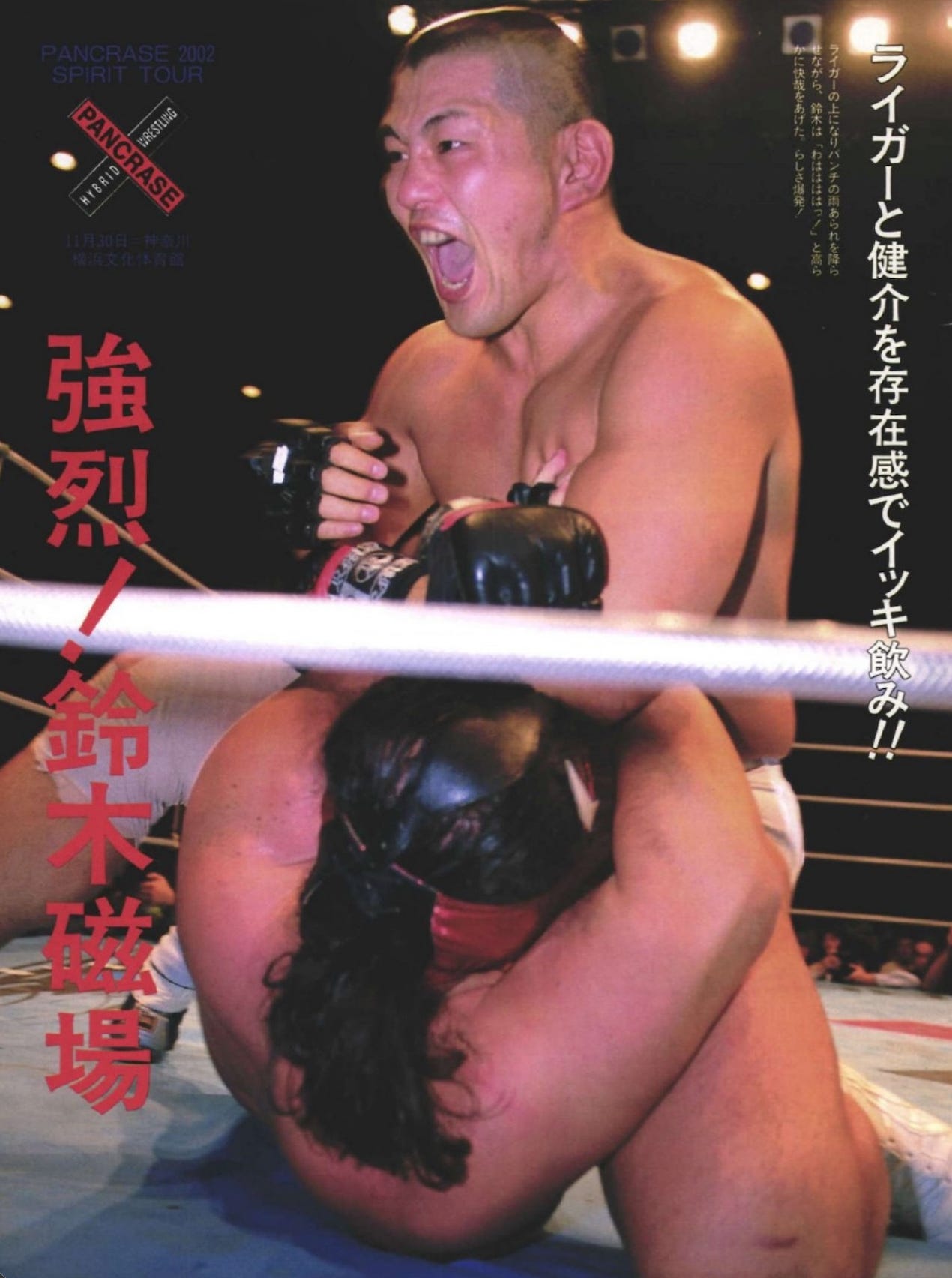
Suzuki began throwing punches like a madman. That was the part theory could not soften. Liger had imagined distance, takedowns, sprawls, maybe even a joint-lock exchange that would let him meet Suzuki inside the old grammar. But underneath Suzuki, with punches coming through, the fight became something simpler and worse. Position. Impact. Panic. Suzuki pressed into him, hit him, forced him to turn, took the back, and found the throat.
There was no room for sentimentality.
The administrative maneuvering had taken months. The execution took 108 seconds.
And yet, somehow, Liger did not disappoint.
That was the strange part. In the American accounting, the fight was a disaster: a beloved pro wrestling legend thrown into a real fight he was never equipped to win, exposed in less than two minutes by a trained shooter on his home ground. That reading was not wrong. It was obvious, even logical.
But the Japanese moral accounting ran on different arithmetic. Liger had accepted the debt. He had walked into the wrong ring for the right reason. He had been beaten, badly, and still something about the act of standing there afterward — tall, proud, undiminished — impressed more than a merely respectable performance might have. One longtime Pancrase fan left the building saying, “I fell for him. Starting tomorrow, I’m a Liger fan.”
Suzuki seemed almost annoyed by the scale of his own admiration for his opponent. “Liger really was amazing,” he said. “He really was a man.”16 Then the ultimate compliment in this world: Liger had lost, and his value had not dropped at all. “Liger really is too amazing,” Suzuki said. “I’m really glad Liger came.”
That was the final reversal. Suzuki had extinguished the light. But somehow, when the smoke cleared, everyone could still see Liger shining as bright as ever.
And then there was Sasaki, the man whose fight had become someone else’s sacrifice. He had spent the whole strange season insisting the Suzuki fight belonged to him — not as a spot on a card, not as New Japan vs. Pancrase, but as a promise.
It was a fight Sasaki needed: not because it would have been safe, but because it would not have been. It was a chance to stake his own claim in this strange new world.
Instead, Liger stepped into the space Sasaki had left vacant. He did not beat Suzuki. He barely survived him. But he answered.
He stood in the wrong ring, paid the debt in public, and somehow walked away larger in defeat. The very thing that might have become foundational for Sasaki’s second act — the dangerous crossing, the raw fight, the adult test of the old promise — became Liger’s strange masterpiece of sacrifice.
Sasaki was left with the role he least wanted: witness.
Afterward, the old feeling flared again. Of course it did. Sasaki watched Liger disappear beneath Suzuki’s pressure and understood, maybe better than anyone, what had been lost. “I’m fired up. I really got fired up. That was a great match. Really. Next, it’s my turn,” Sasaki said as he departed the arena. And, for an instant, the story tried to reassemble itself.
But the moment had already passed.
When Sasaki and Suzuki finally stood across from each other again, two years later, the danger had leaked out of the room. The raw fight had become a wrestling match. The promise remained unfulfilled. The future moved on without him.
Jonathan Snowden is a long-time combat sports journalist. His books include Total MMA, Shooters and Shamrock: The World’s Most Dangerous Man. His work has appeared in USA Today, Bleacher Report, Fox Sports and The Ringer. Subscribe to this newsletter to keep up with his latest work.
Wakamono / Shin-deshi (若手 / 新弟子)
The Japanese texts discuss Suzuki’s cocky behavior as a shin-deshi (new disciple/rookie) and wakamono (young wrestler) during Liger’s 1987 return to the company. In traditional Japanese dojo hierarchies, a shin-deshi occupies the absolute bottom rung of a feudal system, tasked with grueling manual labor, cleaning, and serving seniors before earning basic respect.
Hikaru / Hikari o Kesu (光る / 光を消す)
The “light” metaphor becomes the philosophical center of Suzuki vs. Liger. Liger’s pro wrestling makes both men shine; Suzuki’s pro wrestling erases the opponent’s light and forces him to shine on his own if he can. That makes the match a clash between generous performance and predatory combat.
Abise-Geri (浴びせ蹴り)
Usually rendered as rolling kick, rolling wheel kick, or koppo kick. Abiseru means to pour, shower, or throw over something, and the technique involves hurling the body into the kick. Liger’s regret is not that the move was fake or foolish, but that it came out at the wrong time, before the strategy had begun.
Cement (セメント)
In Japanese pro wrestling, cement means legitimate fighting, hard sparring, or the dangerous edge where a worked match threatens to become real. It does not always mean a full unscripted shoot, but it implies resistance, pain, and non-cooperation. Funaki’s description of Liger as someone who “loved cement” makes him part of New Japan’s shoot-training lineage.
Fujiwara Kyōshitsu (藤原教室)
Literally “Fujiwara classroom,” this refers to the informal real-sparring and submission sessions associated with Yoshiaki Fujiwara. Funaki describes Liger, then himself, then Suzuki as successive men who “monopolized” Fujiwara, turning the match into a fight between men with the same underground education.
Ensei (遠征)
In the Japanese wrestling industry, ensei (overseas learning excursions) are mandatory rites of passage where young talent is sent abroad to Europe, Mexico, or North America to develop their characters and ring work in isolation before returning as polished stars.
Pancrase as pro wrestling made sport.
Early Pancrase borrowed heavily from pro wrestling’s visual and technical grammar — rope escapes, submissions, open-hand strikes, the aura of catch wrestling — but enforced the contest as sport. That is why Pancrase could look like pro wrestling while functioning as a real fighting promotion. It was not pro wrestling stripped of theatrical ancestry; it was pro wrestling’s combat fantasy made literal.
The Three Musketeers (闘魂三銃士)
New Japan’s “Three Musketeers” were Keiji Mutoh, Masahiro Chono, and Shinya Hashimoto, the three generational stars who came to define the company after the Inoki/Fujinami/Choshu era. The nickname echoes Dumas: Mutoh as genius, Chono as cool outsider, Hashimoto as violent charisma. Sasaki was a contemporary and rival of that generation, but never quite part of its central myth, which made his search for a defining second act in the early 2000s all the more urgent.
This tidbit comes from Dave Meltzer’s Wrestling Observer.
Nama no Shiai (生の試合)
Suzuki heavily fixates on wanting a nama fight. While standardly translated as “raw” or “living,” nama in Japanese carries deep sensory connotations of freshness and authenticity (like raw fish or draft beer), emphasizing a desire for a fight free of corporate processing or pre-planned narratives.
Shinken Shōbu (真剣勝負)
Shinken shōbu is a deep-seated samurai idiom translating literally to “a match with real swords,” culturally signifying an absolute, life-or-death, dead-serious commitment where no quarter is given.
Otoko to Otoko no Yakusoku (男と男の約束)
Literally “a promise between man and man,” this phrase carries more weight than a simple verbal agreement. In this coverage, it means a private code of honor rooted in shared suffering, training, and memory.
Kimochi (気持ち)
Standardly “feelings,” but in this context kimochi means resolve, sincerity, pride, emotional burden, and competitive intent all at once. When Liger says he wants to take on Suzuki’s feelings, he is not merely sympathizing with him; he is saying he can physically and morally receive the force of Suzuki’s challenge.
Uketomeru (受け止める)
This literally means to receive, catch, or take something in, but Japanese fight writing often uses it for accepting another person’s emotions or challenge. Liger’s role here is not framed as opportunistic substitution but as uketomeru: he is stepping in to absorb the unresolved force Suzuki had built up for Kensuke.
Karada ga Katte ni Ugoita (体が勝手に動いた)
“My body moved on its own” is a key sports idiom here. It treats the body as more honest than conscious strategy — instinct, emotion, training, and identity acting before the mind can intervene. Liger uses this idea to explain why he threw the abise-geri despite knowing it was not the plan.
Fun’iki ni You (雰囲気に酔う)
Literally “to get drunk on the atmosphere,” this does not refer to alcohol. It means being swept up by the crowd, the stakes, and the emotional charge of the moment. Liger uses it to explain how the fight’s atmosphere overpowered his preparation and turned him back into a performer acting on instinct.
Otokogi (男気 / 男気発言)
Translates literally to a “manly spirit” or “chivalrous code”. In Japanese culture, particularly within combat sports, otokogi implies a self-sacrificing honor where a man steps up to right a wrong, accept a massive disadvantage, or protect others without regard for his own safety or reputation.
No posts
Comments
Nothing yet. Say the first thing.
Sign in to join the conversation.