
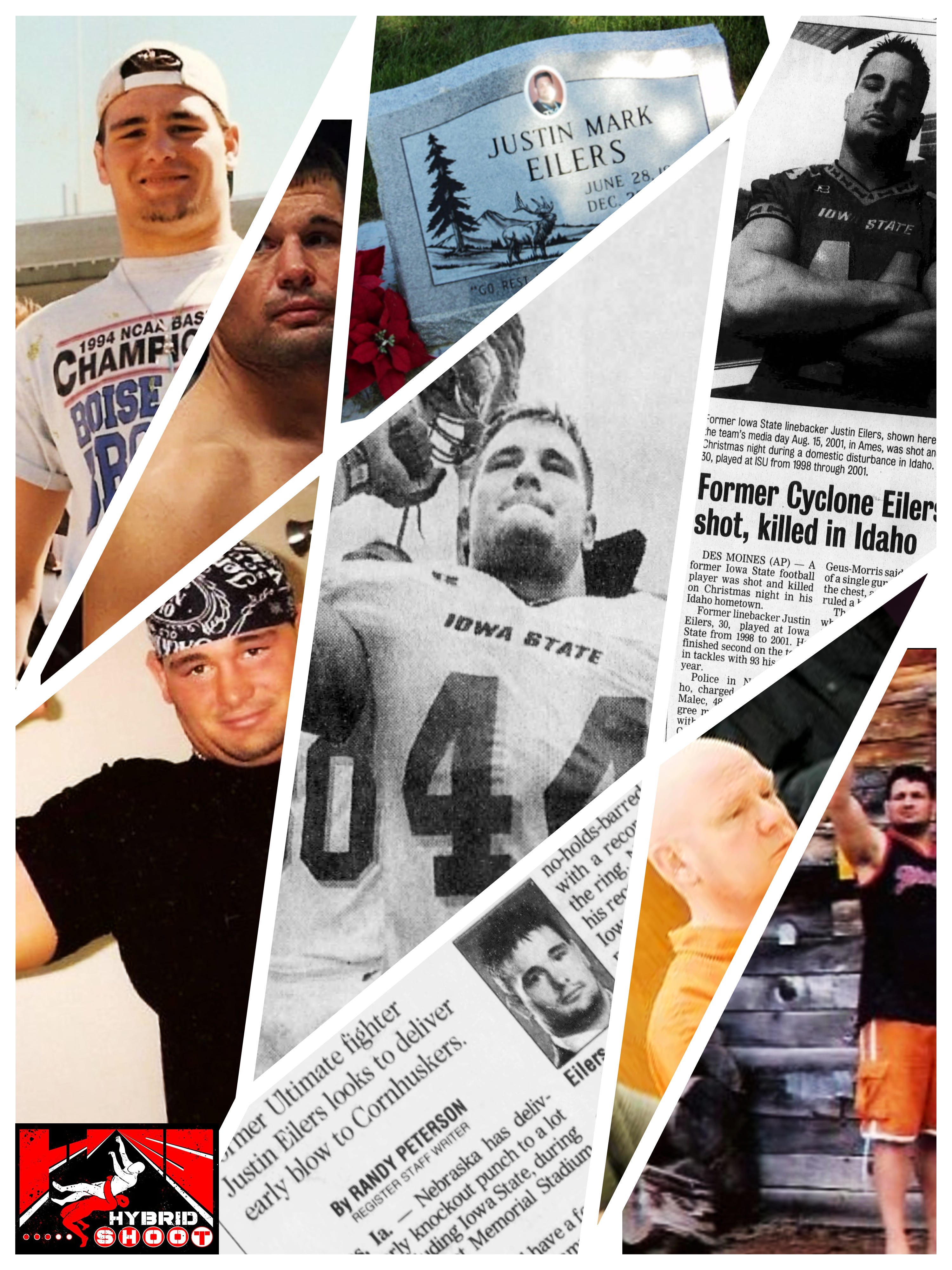
The cold cut through everything in Nampa that night. It was Christmas, 2008, but the holiday cheer had evaporated about fifteen minutes earlier in the driveway of the house on Happy Valley Road. Justin Eilers and his ex-girlfriend, Melanie, were going at it. Screaming about their kid, about parenting, about the things people scream about when the money is gone and the vodka is flowing.
She’d had enough. She walked away, telling the cops later she just couldn’t deal with the yelling anymore. But Justin wasn’t done. He had that heavy, forward momentum that had defined his whole life. He turned back toward the house. Inside, James Malec was doing the dishes, listening to the shouting through the walls, feeling the heat rise in his chest. Malec was a former jailer, a guy who liked order. He didn’t like the noise. He didn’t like the disrespect. And he definitely didn’t like Justin Eilers coming back into his kitchen.
Before the booze and the bad blood, Justin Eilers had been a wrecking ball in shoulder pads. He was a Nampa kid who went to Iowa State and played the game like he was trying to hurt the ground he stood on. He was undersized for a linebacker—six-two, maybe 215 pounds—but he had a motor that didn’t idle.
He was the kind of guy who made teammates nervous on Tuesday afternoons. Jack Whitver, a receiver for the Cyclones, said Eilers was “super intense,” the type of guy who’d knock his own teammates cold in practice just to make a point. Fights on the practice field were a regular occurrence.
“I play hard, I play physical,” he told the papers. “Sometimes guys think I go too hard in drills. They don’t like it, and pushing and shoving matches start, but that’s just the way I play.”
He wasn’t big, but he was loud in the way that mattered. In a game against Ohio in 2001, he racked up 18 tackles. He finished his senior season with 93 stops, helping drag the team to the Independence Bowl.
But the glory didn’t stick. It never does.
By June 2002, the uniform was off, and the trouble started. Eilers was working a landscaping job on campus with a former teammate, a walk-on named Aaron Howard. It got ugly. Howard told the cops Eilers got frustrated, dropped a racial slur, and punched him in the mouth.
When the cops tossed their apartment, they found the gear. Vials of Testanon. Generic steroids. Syringes. Marijuana seeds. Howard told them Eilers was “raging with the intent to kill me,” and that he’d seen Eilers beat up his girlfriend. Coach Dan McCarney had to stand in front of the press and talk about “clean programs” while Eilers skipped town before the cops could put the cuffs on him, heading for the Mississippi River to learn how to hurt people for a paycheck.
He landed in Bettendorf, Iowa, at the Miletich camp. It was the Ivy League of face-punching. Eilers fit right in. He was a scrapper, a guy with heavy hands and an iron chin. He rattled off wins in small shows, beat his childhood friend Mike Kyle, and got the call to the big show, the UFC.
Then came the night that defined his luck. UFC 53. He took a heavyweight title fight on short notice against Andrei Arlovski. Arlovski was a terrifying human being in 2005. Eilers didn’t care. He went out there and got dismantled.
It lasted four minutes and ten seconds. By the time the ref waved it off, Eilers had broken both his hands. He’d torn his ACL. He’d dislocated his knee. His nose was smashed. He flew home in first class because he couldn’t fit his broken body into coach. When a passenger asked him what the other guy looked like, Eilers grinned through the bruises. “Not a mark on him,” he said.
He became a journeyman, fighting for paychecks that got smaller while the opponents got bigger. His last real shot at a belt was in July 2008 against Antonio “Bigfoot” Silva. Eilers weighed 224. Silva was a giant. Eilers got stopped in the second round. The punchline? Silva tested positive for horse steroids after the fight. Eilers lost, Silva cheated, and nobody handed Eilers a refund on the brain damage.
Now it was Christmas night, five months after the Silva fight. Eilers hadn’t fought since. He was broke. He hadn’t bought presents. He couldn’t pay child support. The depression was sitting on his chest like a barbell.
He stood in his mother’s kitchen, drunk on vodka and whiskey, his blood alcohol sitting at .17. He was furious. He swept his arm across the counter, sending glass crashing to the floor.
James Malec was watching him. Malec had a new toy—a .45 caliber handgun he’d gotten as a gift that very day. He told people he carried a gun for “skunks and coyotes” out in the country. But tonight, the varmint was his stepson.
Eilers got in his face. “What you got, old man?” Eilers yelled. “Put one in me. Put one in me.”
Malec wasn’t going to fight a professional cage fighter. He knew better. He’d told people before: if Eilers caused problems, he’d shoot him. Malec drew the .45. He held it in a “high ready” position. He told Eilers to get down.
Eilers didn’t get down. He took a step forward.
Malec fired. One shot.
The bullet hit Eilers in the chest, punching through his lung. The big man looked surprised. He looked at his mother, Gwen, who had been standing right there, feeling the wind of the bullet pass her ear.
“I’m dead,” Eilers said. “I’m dead. I love you, Mom.”
And then he was.
In the Canyon County courtroom, Malec’s lawyer tried to play a DVD. It was a highlight reel of Eilers in the cage, knocking men unconscious, pounding them until they went limp. The lawyer wanted the jury to see what Malec saw: a lethal weapon that walked on two legs.
The judge said no. Too prejudicial. It would just make the jury think Eilers was a brute.
They’d already tried to paint Eilers as trouble. A 230-pound problem that needed solving. But that wasn’t the guy Geno Ray knew. Ray, a fellow fighter, knew the guy who stood in his corner for every single bout, offering tips, encouragement, and a steady voice when the lights were bright. “He never had a big head,” Ray would say. “He was one of the boys. Funny, generous, humble”.
Malec’s self-defense plea didn’t fly. The jury didn’t buy the whole story. They didn’t see a premeditated murder, but they didn’t see self-defense either. They saw a “sudden quarrel”. They saw a stepfather who brought a gun to a fistfight. Even the prosecutor admitted, “Justin Eilers was acting like a jerk, there’s no question. He was ruining Christmas. He was disrespecting the defendant in his own home. But he didn’t deserve to die.”
Malec got fifteen years for manslaughter, eligible for parole in six and a half. He went to a cell. Justin Eilers went into the ground at Kohlerlawn Cemetery. His mom, Gwen, was left with a husband in prison and silence where her son used to be.
“I want my son back,” she said, weeping. “That’s what I want.”
Years before, Eilers had told a reporter about his plans for after the fighting was done. “When I’m 55, I plan on playing in the PGA senior tour,” he’d laughed. He liked golf. He liked grilling steaks. He liked the quiet.
He never made it to the senior tour. He never made it out of the kitchen.
Jonathan Snowden is a long-time combat sports journalist. His books include Total MMA, Shooters and Shamrock: The World’s Most Dangerous Man. His work has appeared in USA Today, Bleacher Report, Fox Sports and The Ringer. Subscribe to this newsletter to keep up with his latest work.
No posts
Comments
Nothing yet. Say the first thing.
Sign in to join the conversation.