
Socrates made one of the loveliest claims in moral philosophy: virtue is knowledge. Nobody does wrong willingly.
Taken seriously, the claim turns goodness into an educational problem. Cruelty is a mistake about value. Cowardice is a mistake about what should be feared. Betrayal rests on a false account of what is worth having. Correct the account and conduct should follow. Fill the mind properly and the person comes right.
It is hard not to love the idea. It makes hope teachable.
The claim is stronger than the mild modern thought that education tends to improve us. Socratic intellectualism holds that if someone genuinely knows what is good, they will do it. When people act badly, they have not been overpowered by desire while knowledge stands helplessly by. What looked like knowledge was incomplete. They did not fully understand the good they were abandoning or the harm they were doing to themselves.
The old reply arrives in Medea’s voice.
Ovid gives her one of the most economical confessions in literature: video meliora proboque, deteriora sequor. I see the better and approve it. I follow the worse.
Twenty centuries have not improved on it. The philosophers call the condition akrasia: knowing and not doing, seeing and not following. It is not an exotic disorder. It is the gap between everything you know about your phone and where your hand is right now.
The small proof is daily. The large one has a date and a guest list.
On 20 January 1942, fifteen senior Nazi officials met in a villa at Wannsee. Eight held doctorates. The meeting lasted about ninety minutes. They did not meet to decide whether European Jews should be murdered; that machinery was already operating. They met to coordinate its implementation across the German state. No one present objected.
These were not men from whom education had been withheld. The education travelled with them into the room and sat there, useful, while they worked.
Whatever education does to a person, it did not stand in the doorway.
That fact does not, by itself, refute Socrates. A doctorate in law or administration is not Socratic knowledge of the good. The men at Wannsee had expertise, credentials and cultivated intelligence. Socrates could answer that they remained profoundly ignorant about what mattered.
But the meeting does destroy the institutional counterfeit of his idea: the comforting assumption that sophistication makes people morally safer. It does not. Education may enlarge conscience, but it may also enlarge capacity. It can refine moral perception. It can also make exploitation more orderly, rationalisation more elegant and obedience more efficient.
David Hume supplied one explanation. Reason alone, he argued, cannot move the will. Beliefs inform us about the world and about the means available to us, but they do not arrive carrying their own motive force. Something else gives the information a direction: desire, affection, fear, loyalty, ambition.
This does not mean that facts never change what we want. They plainly can. Knowledge of suffering can awaken sympathy. Knowledge of consequences can stop a well-meant intervention from becoming a disaster. A new description of another person can dissolve an old hatred. It means only that knowledge comes without a moral guarantee.
A map can guide an ambulance or an invading army. Its accuracy does not choose the destination.
Knowledge is therefore not reliably an improver. It is leverage. It makes benevolence more capable and cruelty more capable. It gives self-deception better vocabulary. It lets us discover the truth, and it lets us construct a more defensible route around it.
A famous experiment by Dan Kahan and his colleagues appeared to catch this happening. People were given a numerical problem about whether a skin treatment improved or worsened a rash. More numerate participants performed better. When substantially the same problem was framed around gun control, however, the most numerate participants became more divided along political lines. Their quantitative ability had not disappeared. It had been recruited.
A large preregistered replication later failed to find good evidence for that numeracy effect, so this should not be treated as a universal law of cleverness. The narrower lesson survives, and it is the one that matters here: reasoning ability does not necessarily float above our commitments. It can go to work for them.
More reasoning power may upgrade the lawyer in your head without doing anything for the judge.
At this point, a defender of Socrates has a serious reply. Socrates did not mean the possession of facts. He meant wisdom: a practical understanding of the good so complete that it reorganises desire itself.
That reply is right, but it changes the question.
By the time of Plato’s Republic, the simple picture had already become more complicated. Reason might recognise what is best while appetite pulls elsewhere. Virtue therefore requires more than cognition. Desire, emotion and habit must be formed so that the different parts of the person can act together.
Wisdom, in its strongest sense, is not information with an honorary title. It is perception, desire, memory, emotion, habit, timing and action brought into some kind of order. It is knowing that has entered the person’s way of being.
Calling all of that knowledge may save Socrates. It also concedes that information was never enough.
Information remains necessary. Goodwill without knowledge of consequences can be catastrophic. The person who discovers that a cherished intervention is entrenching the harm is doing moral work with facts. Ignorance is not innocence merely because it means well.
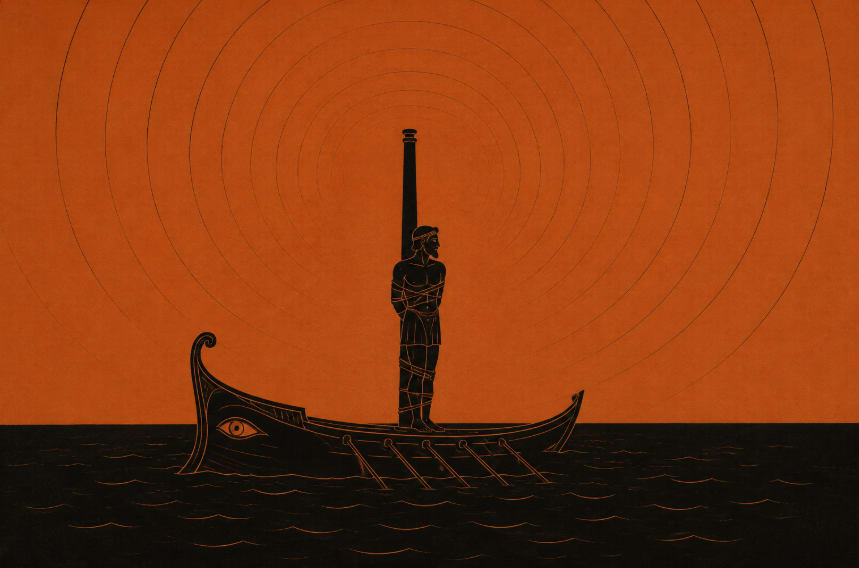
Self-knowledge matters too, particularly when it becomes design. Odysseus does not defeat the Sirens by giving himself a better lecture on maritime risk. He arranges the ropes before the singing begins. He knows that the man making the plan and the man hearing the song will not have the same priorities, so he lets one bind the other.
The mast does not make Odysseus virtuous. It carries him through the interval in which desire changes the vote.
We are formed partly by the reasons we encounter, but also by what we rehearse, imitate, reward, fear, love and make difficult. Character is never merely an internal possession. It is supported or sabotaged by environments. A rule, a ritual, a trusted friend, a locked door, a cooling-off period or an institution willing to impose a cost can all succeed where an additional paragraph of explanation would fail.
For most of human history, instruction and formation have arrived tangled together.
The child who learns a principle and the child who acquires loyalties are the same child, in the same rooms, across the same years. The parent explaining honesty is also distributing approval. The teacher introducing justice is also modelling authority. The student learning an ethical theory is simultaneously discovering what the institution rewards, excuses and punishes.
By adulthood, knowledge and character are so thoroughly interleaved that it is difficult to say what did the work. Every learned person who became generous, and every learned person who became monstrous, arrives as a confounded data point.
Large language models do not give us a clean experiment. They are too unlike human beings, and the word knowledge is too contested, for that.
But they give us an unusually visible dissociation.
This week I put the old question to the machine I think alongside most days. I expected a literature review. Instead, it produced a polished first-person explanation of why its command of moral philosophy said nothing decisive about its goodness.
The answer was compelling. It was not testimony.
A language model does not occupy a privileged balcony from which it can inspect its own construction. Its account of how it was trained is generated by the same system whose status is in question. It may accurately restate public information, but it cannot authenticate itself through introspection.
The useful evidence was not autobiographical. It was architectural.
A frontier model can discuss Aristotle, Confucius, Kant, Hume, Weil, Murdoch and the disputes around them. It can construct arguments about virtue, compare moral theories and identify ethical tensions in unfamiliar cases. None of this causes its developers to assume that desirable behaviour will emerge automatically.
Instead, behaviour is deliberately shaped, specified, tested and revised, through demonstrations, preference feedback, written specifications of desired conduct and evaluation after evaluation. The boundary between acquiring capabilities and shaping conduct is not clean; the stages interleave and blur. But the distinction survives the blur. OpenAI publishes a Model Spec because desired behaviour has to be stated and trained towards rather than assumed from the reading. Anthropic describes the training of its model’s character as a deliberate operation of its own, separate from anything the system absorbed about virtue.
Nobody reaches the end of a model safety case and writes: it has read Kant.
The analogy with human formation has limits. A model is not a child. Post-training is not moral education. Compliant behaviour is not virtue, and an evaluation score is not a conscience.
But the engineering makes a distinction visible that human institutions constantly blur. Exposure to reasons is one operation. Producing reliable conduct under pressure is another.
The machine is an awkward witness because it cannot literally witness. It may have no character, desires or moral life in anything like the human sense. It does not refute Socrates by standing before us as an immensely knowledgeable but wicked person.
Its architecture bears witness instead.
It shows that fluency in moral language can be separated from reliable conduct. It shows that the ability to produce the right reason is not the same achievement as being shaped by that reason. Most importantly, it exposes how often we have mistaken the first for the second in ourselves.
We assume that someone who can define bias will resist it. That a student who passes the ethics module has been ethically formed. That an organisation with a values statement has values. That a model which gives the correct answer is aligned.
The machine makes the mistake easier to see because it performs the discursive part so spectacularly while forcing its makers to itemise everything else.
The machine itemises the invoice.
In a human life, the bill arrives as one total. The books, conversations, affections, humiliations, incentives, examples, habits and institutions are all mixed together. With the machine, the categories are visible: broad learning here, behavioural specification there, feedback here, evaluation there, external controls around the whole arrangement.
The library supplies material for formation. Sometimes it supplies material without which formation would be impossible: language for an experience, evidence against a prejudice, an encounter with a life otherwise invisible.
But the book does not determine the reader’s allegiance. It cannot guarantee what the reader will do when truth competes with belonging, or justice with promotion, or care with convenience.
That is not a failure of the library. It is a refusal to ask information to do the work of an entire life.
Education repeatedly forgets this. A failure occurs and the response is informational: another integrity module, another code of conduct, another responsible AI framework, another values declaration. These can be useful. People cannot act on principles they have never encountered, and shared language makes accountability possible.
But a person can correctly define a conflict of interest and still conceal one. A team can understand automation bias and still accept the machine’s answer because the deadline punishes checking. A student can explain academic integrity and still cheat when failure has been made to feel existential.
The real ethics syllabus is written not only in the curriculum but in workloads, assessment design, promotion criteria, procurement rules, sanctions, exemplars and what happens to the person who says no.
Formation begins where a principle acquires a price.
There is, however, one kind of knowledge that may vindicate something in Socrates, and it is telling that it cannot be accumulated in the ordinary way.
Iris Murdoch gives us a case so small that it nearly disappears. A mother-in-law, M, privately considers her son’s wife, D, vulgar, undignified and tiresomely juvenile. M nevertheless behaves beautifully towards her. Then, over time, she begins to question her own description.
“I may be snobbish,” she tells herself. “Let me look again.”
Nothing new has to happen in D. In Murdoch’s hypothetical, D may even be absent or dead. The change occurs in M’s attention. What she had called vulgar she begins to see as refreshingly simple; what she had called undignified becomes spontaneous; tiresome juvenility becomes youthfulness. Her outward behaviour does not alter because it was already impeccable. Yet Murdoch insists that something morally significant has happened. M has been active. She has attempted to see another person justly and lovingly.
This is knowledge, but not as a stockpile. M does not obtain a new dossier of facts about D. She relinquishes a description that served her pride and undertakes the slow correction of her sight. The knowing and the moral effort are part of the same activity.
It cannot be downloaded complete. It remains particular. It must be performed on this person, in this moment, against this comfortable distortion. It can become a disposition, but never an inventory that removes the need to look again.
A machine can explain Murdoch’s example. So can a human scholar. Neither explanation proves that the act of attention has occurred.
Holding every sentence Murdoch wrote is not the same achievement as attending to one actual person for one actual minute.
So does knowledge make us good?
If knowledge means information, recall, credentials or argumentative skill, the answer is no. These are necessary, powerful and morally consequential. They are not sufficient. They can illuminate conscience, but they can also equip appetite, vanity and power.
If knowledge means a formed practical capacity to see the good, desire it and answer it in action, then perhaps Socrates survives. But he survives because knowledge has expanded to include the very work of formation that the simpler claim appeared to make unnecessary.
The machine has not settled the old argument. It has made one of our evasions harder to sustain.
We gave it access to the language of our moral inheritance and discovered that language was not formation. We still had to specify conduct, supply examples, build feedback loops, test behaviour under pressure and construct an environment around it.
The awkward witness never took the stand. Its design gave the evidence.
Medea still sees the better and follows the worse. Murdoch adds a deeper warning: often we fail even earlier, seeing other people through descriptions that make the worse appear reasonable. Moral formation is work on both failures.
The machine can supply the sentence. It cannot do the looking for us.
Drafting disclosure: This essay was developed by Carlo Iacono with OpenAI and Anthropic tools. Carlo directed the argument and remains responsible for its claims and normative judgements, which remain open to contest and revision. Read Most Evenings for further insight.
No posts
Comments
Nothing yet. Say the first thing.
Sign in to join the conversation.