
Everyone agrees that we are drowning. More words are published in a day than a person could read in a lifetime. Researchers at MIT, tracking rumour cascades on Twitter, found that falsehood travelled farther, faster and deeper than truth. Analysts at RAND gave a name, the ‘firehose of falsehood’, to propaganda that wins not by convincing anyone of a single lie but by producing so many contradictory accounts that checking any of them comes to feel pointless. Open a feed and a court judgment, a joke, an advertisement, a fabricated screenshot and one careful piece of reporting arrive as objects of identical size, and the sizing is the message.
Out of this drowning feeling a history has quietly assembled itself. Once, it runs, there was less. A person opened one newspaper, heard one evening bulletin and lived in a world that held together. Truth was near to hand. Now it lies somewhere under the pile, and attention runs out before we reach it. On this account, no people has ever found it harder to know what is actually true, and the villain is abundance itself.
The feeling is real. I feel it most mornings. The history is not.
I have spent my working life in libraries, which is to say inside the machinery that stands between people and records: catalogues, indexes, licences, shelves, the quiet decisions about what gets kept and what gets found. From that vantage the drowning story rests on a mistake, and the mistake is old. It confuses a quieter information environment with a more truthful one. It reads the silence of the past as clarity, when most of that silence was built.
Walk backwards through the history of information and watch what the quiet was made of.
Start with the world the nostalgia actually remembers, the middle of the twentieth century. For a few decades, whole nations kept the same evening appointment. Usable frequencies were scarce, so governments became landlords of the air, issuing licences and attaching duties to the privilege of broadcasting. A handful of proprietors and editors decided what counted as the day’s events. That order had real virtues. Editors selected, reporters were paid to check, a masthead could be made to print a correction. But its coherence was purchased with narrowness. Ownership concentrated. Official sources set the terms of debate. Whole communities waited decades for airtime. What the shared bulletin offered was not truth; it was legible filtering. The front page was an argument you could watch being made. The editor had a name, an address and a letters column. Being excluded by that world at least told you where the door was.
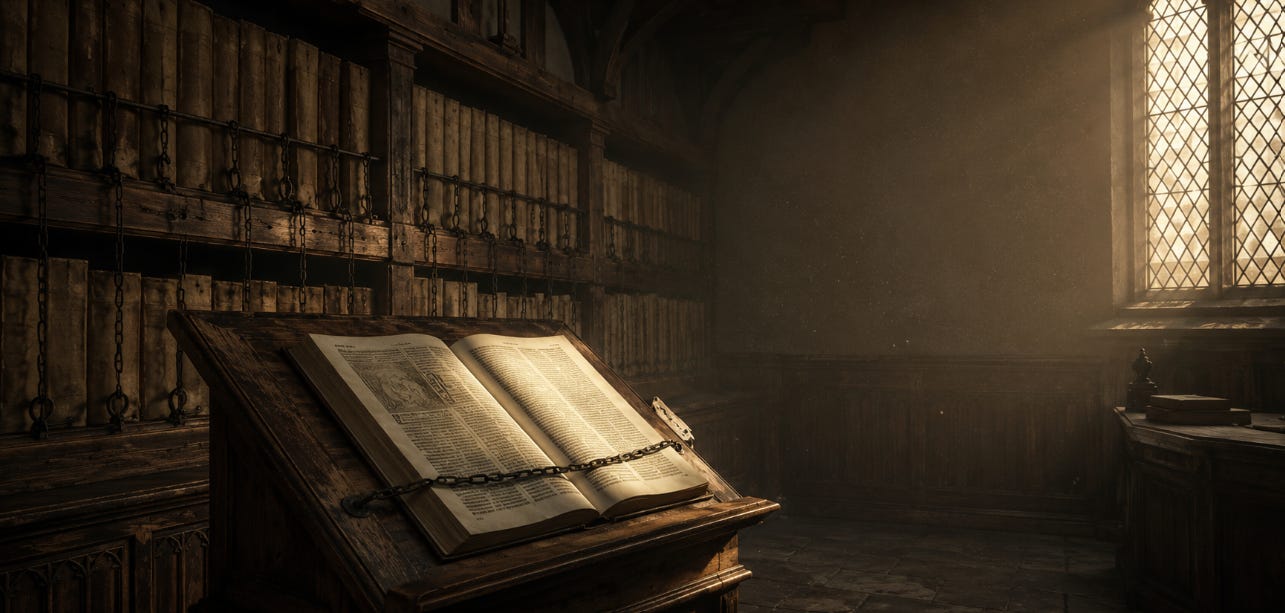
Go further back and the fastenings become things you can hold. In the library of Hereford Cathedral the books are on chains. Each chain runs from a rod along the shelf to a clasp on the cover, long enough to reach the reading desk below, too short to leave it. The books stand with their spines turned inward, fore-edges facing the room, so that a volume can come down without crossing its neighbour’s tether. The fittings date mostly from the early seventeenth century, and to modern eyes the room looks like a small tyranny.
It was closer to the opposite. Before the chains, books this valuable lived in locked chests, consulted by permission, one reader and one key at a time. The chain is what let the book stand out in the room, available to anyone the room admitted. It was a technology of access wearing the shape of a restraint, and it had a virtue nobody thought to advertise: honesty. A reader could see exactly how far a book would travel, and feel the tug at the board when it reached its limit. The other honesty was harsher. The room served the clerical, the male and the Latin-trained, and its openness ended at the door.
Half a century before those chains were forged, the flood had already arrived, at least for the people allowed near the water. In 1545 the Swiss naturalist Conrad Gessner, attempting a bibliography of every known book, complained of the ‘confusing and harmful abundance of books’. The scholars of his century built indexes, summaries, commonplace books and reference works to keep from going under; the historian Ann Blair has catalogued their coping systems, and they read like the productivity literature of our own moment with better Latin. The feeling of drowning is not an invention of the smartphone. It appears whenever production outruns the tools of selection.
What follows abundance is just as regular. In 1557 the English Crown chartered the Stationers’ Company, granting its members exclusive rights over printing and a duty to police the unlicensed press. Two years later Pope Paul IV issued the first Roman Index of prohibited books, a list revised for four centuries before its legal force was finally withdrawn in 1966. Ownership and prohibition, two years apart, twin replies to the same machine. The lesson repeats across every medium since: the moment information begins to move more freely, power moves to the choke points.
The dream of the open channel is not new either. The oldest dated printed book in existence, a Chinese scroll of the Diamond Sutra from 868, carries a colophon dedicating it ‘for universal free distribution’. Korean printers were setting movable metal type by 1377, decades before Gutenberg. The dream of universal free distribution is twelve centuries old. It has never yet been left alone.
And beneath every one of these orders lay the same floor. As late as 1820, by the best historical estimates, perhaps one adult in ten worldwide could read. Literacy tracked power so closely that its absence was sometimes enforced by statute: before the American Civil War, several slave states made it a crime to teach an enslaved person letters. Frederick Douglass learned to read in Baltimore until his master discovered the lessons and stopped them, explaining with unusual candour that reading would make him unfit to be a slave. Douglass later wrote that the prohibition taught him more than the lessons had. He had been shown, precisely, what reading was worth.
Hold that beside the remembered clarity of the past. A world with few competing claims was not a world close to truth. It was a world in which most people were not licensed to make claims at all, in which contradiction was expensive, dangerous or simply unrecorded. Fewer voices did not mean agreement. It usually meant monopoly, fear or the absence of a press. The quiet of the record is not the quiet of the world.
The record itself began as an instrument of the powerful, which is not a scandal, only a fact worth keeping in view. The earliest writing we can read, pressed into clay in the Sumerian city of Uruk more than five thousand years ago, is mostly administration: barley, beer rations, labour, land. Writing detached a statement from its speaker and let an institution remember what it was owed. For most of the time since, ordinary people appeared in records long before they could produce them. You could be an entry for four thousand years before you had much chance of being an author.
Even preservation kept this double character. When Nineveh fell in 612 BCE, the fire that destroyed the Assyrian palace baked the royal library’s clay tablets hard, and archaeologists later lifted some thirty thousand of them from the ruin, the epic of Gilgamesh among them. We owe much of what we know of Mesopotamian thought to a king’s acquisitiveness and a catastrophe. The archive has always protected memory and possessed it in the same gesture, deciding whose acts deserved recording and who might consult the result.
Walk far enough back, in other words, and the story stops looking like scarcity giving way to abundance. Every information order fastens access to something: a priesthood, a guild, a licence, a chain, a literacy, a wavelength, a ranking. What changes is the fastening. Power gathers at whatever the fastening is, and nostalgia, later, remembers the coherence and forgets the fastening entirely.
Which is the thing to notice about the drowning story’s remembered past. Its clarity was mostly the silence of the excluded, catalogued by the admitted. The nostalgia is not for truth; almost nobody in the quiet centuries possessed that. It is for the comfort of uncontradicted belief. And that comfort was cheap for some because speech was expensive for everyone else.
None of this means nothing has changed. Something has, and it is worth stating precisely, because the vague version keeps feeding the bad history.
For most of the human past, the hard problem was getting a text into the world. Within a generation that problem has all but dissolved, and a new one has taken its place: getting the world to look. Publication is no longer scarce. Discovery is. And the machinery of discovery has properties no earlier order possessed.
The newspaper editor composed one front page for a city. A recommendation system composes a different front page for every reader, revises it at every glance, and learns from the twitch of attention rather than from any account of what a citizen might need. In 2025 an audit compared an engagement-ranked feed with a simple chronological one and found that the ranking amplified anger and hostility towards political opponents, and that users, asked directly, did not prefer what it had chosen for them. The system was not serving stated preference. It was farming reaction.
Saturation, meanwhile, has become a technique of the powerful and not merely their headache. A censor once had to find every copy of a document. Now it can be enough to publish faster than anyone can read: surround the report with a dozen rival explanations and let exhaustion do the work suppression used to. You do not need to ban what you can bury. The drowned page is as unread as the banned one, and nobody’s fingerprints are on the water.
Nor have the older instruments retired to make room. States still block sites, shut down networks and jail reporters; the global count of imprisoned journalists has been running above three hundred, and monitors of internet freedom have logged declines for fifteen straight years. The same government can arrest an author, delete a page, seed ten alternative stories and let a ranking system promote the most useful one. Saturation and censorship are colleagues, not rivals, and any account that asks us to choose between them has misread both.
The newest turn is that the index has begun to answer. For five centuries the catalogue’s job was to point: to the shelf, the page, the source. A generative system retrieves, blends and speaks, delivering a fluent paragraph in its own voice, the synthesis arriving ahead of the provenance, if the provenance arrives at all. I will not pretend the gains are unreal; I watch them daily. A student working across a language barrier, a reader with a print disability, a researcher facing a literature too large for any human week: for them the new machinery lowers walls the old orders never bothered to notice. The answer machine admits people the chained room never would, and it moves the fastening somewhere new, into training corpora, retrieval contracts, ranking weights and moderation rules, layers no reader can inspect from the outside. The mediation has not disappeared. It has moved from furniture you could point at into an ecosystem you stand in.
It has never been easier for one person to locate a document. It has rarely been harder for a society to make a document count.
Watching this from inside a library has changed my view of what the scarce commodity actually is. The drowning story pictures truth as a correct file, lying somewhere under the noise, waiting for the right search term. But most truths have to be made before they can be found. Somebody reports, measures, translates, testifies, preserves. A journalist cultivates a source for a year. A laboratory exposes its method to strangers paid to break it. A court takes evidence under rules and writes its reasoning down. An archive keeps the losing side’s account long after the winners would prefer the shelf space. These institutions carry prejudice, fashion and money, and their honesty lives not in purity but in correction: the retraction, the appeal, the visible scar. Verification is a social practice before it is a personal virtue.
That reframing changes where the cost of knowing comes from. It is not set by the volume of noise. It is set by design: by what a society funds, protects, indexes and keeps, and by how much of the labour of checking it leaves each citizen to perform alone. Careful reading is paid for in time, and time is not evenly issued. A nurse coming off a night shift should not have to reconstruct the ownership of six websites to learn whether the water is safe to drink. When we answer the flood with instructions to read more carefully, we convert a public condition into a private examination, one that people with hours, training and subscriptions will pass and most people will fail through no fault of their own. A public that must privately re-derive reality every morning is not a public. It is an audience of exhausted analysts.
This is the move in the drowning story I cannot follow. Its diagnosis contains something real: repetition can exhaust judgement, and a feed can make checking feel pointless. But its conclusions run in two directions, and both leave the fastenings exactly where they are. One direction is elegy, mourning a clear past that never existed, which treats a built environment as weather and hands the builders their alibi. The other is self-rescue, the attentive minority reading harder, subscribing better and quietly grading everyone else, which does not repair a shared world so much as price admission to a smaller one. An aristocracy of verification is still an aristocracy. The interests that profit from the noise could not design a more convenient opposition if they tried: one wing writing eulogies, the other buying better seats.
In Hereford you can still lift a book down from its shelf. The chain follows, drapes across the desk, and stops you at the length the seventeenth century decided a reader could be trusted with. The restraint is iron and exact. You can see who forged it, measure it, feel the pull at the board when you reach its limit. Whatever else that room withheld, it never disguised the withholding.
Our fastenings weigh nothing. They run through ranking weights, licensing deals, training data and moderation rules, and much of the work they do is useful, which is one more reason they go unexamined. A fastening you can see can be measured, argued over, re-forged. A fastening you cannot see simply becomes the shape of the world. Most of what we read now reaches us at the end of chains we have never been shown and could not measure if we tried. The tug never comes. That is not the same as being free.
Drafting disclosure: This essay was developed by Carlo with OpenAI and Anthropic tools. Carlo directed the argument and remains responsible for its claims and normative judgements, which remain open to contest and revision. Read Most Evenings for further insight.
No posts
Comments
Nothing yet. Say the first thing.
Sign in to join the conversation.