
In 1926, on the 150th anniversary of the adoption of the final text of the Declaration of Independence, Calvin Coolidge gave a speech in which he said,
“About the Declaration there is a finality that is exceedingly restful. It is often asserted that the world has made a great deal of progress since 1776, that we have had new thoughts and new experiences which have given us a great advance over the people of that day, and that we may therefore very well discard their conclusions for something more modern. But that reasoning can not be applied to this great charter. If all men are created equal, that is final. If they are endowed with inalienable rights, that is final. If governments derive their just powers from the consent of the governed, that is final. No advance, no progress can be made beyond these propositions. If anyone wishes to deny their truth or their soundness, the only direction in which he can proceed historically is not forward, but backward toward the time when there was no equality, no rights of the individual, no rule of the people. Those who wish to proceed in that direction can not lay claim to progress. They are reactionary. Their ideas are not more modern, but more ancient, than those of the Revolutionary fathers.”
There are some concepts that are final, and there are others that are not.
Currently, science is often taught as if the concepts are final and those who question the finality of certain concepts that are considered “settled science” are labeled as deniers.
The sufficiency of anthropogenic carbon dioxide emissions in causing climate change is one of these concepts.
The sufficiency of natural selection in explaining the origin of species is one of these concepts.
The materialist explanation of the origin of life is one of these concepts.
I find that my students at Cornell University are dumber than they used to be. They do not have the breadth of knowledge, the depth of knowledge, nor the habits of studying, including the will and the ability to question that the previous generations of students had. I teach approximately one-half to three-quarters of the content I used to teach, and privately, other professors tell me the same.
The decline in student quality coincides with the introduction of the Next Generation Science Standards that steered their K-12 science education. In order to ensure equity, the Next Generation Standards reduced content, which made passing exams easier, but it did so at the expense of presenting the students with the actual richness of the scientific material that facilitates engagement, curiosity, and develops the skill and will to ask questions.
The decline in student quality is not across the board. I find that students who obtained their K-12 education outside the United States more often than not have superior scientific knowledge.
I also find that most of the American nonscience majors do not major in science because they see science not as an exciting search for truth, but as a subject where you memorize answers, turning bullet points on PowerPoints into test points, even if they find the justification of those answers wanting. The students raised on the Next Generation Science Standards find that questioning the answers or asking for the justification of the answers will result in lower grades or worse.
No wonder the students are dumber. The Next Generation Science Standards generate no wonder.
There are solutions.
Firstly, the National Association of Scholars and Freedom in Education have produced the Franklin Standards that stimulate curiosity while presenting content-rich science so that students are taught science as methods to pursue objective truth.
Secondly, I know of one Classical Christian School that teaches the Next Generation Science Standards for one quarter of the year and spends the rest of the year developing curiosity and teaching students how to use their classical education to recognize truth.
Thirdly, I teach a course for non-majors called Light and Life. While I intended the course to be for first-year students, in general seniors who have put off taking a science requirement because they dislike science are the ones who take Light and Life.
At the beginning of the course, I tell them (see syllabus):
I will unapologetically defend Western Civilization which has made the freedom to do science possible. My teaching philosophy is in line with that used in the Freedom Schools of Mississippi. “Notes on Teaching in Mississippi” written by The Student Nonviolent Coordinating Committee (SNCC), began with, “This is the situation: You will be teaching young people who lived in Mississippi all their lives. That means that they have been deprived of a decent education from the first grade through high school. It means that they have been denied free expression and free thought. Most of all—it means that they have been denied the right to question. The purpose of the Freedom Schools is to help them begin to question.”
“The purpose of the Freedom Schools is to help them begin to question.”
In their 1915 Declaration of Principles, the American Association of University Professors put it this way: “he should cause his students to become familiar with the best published expressions of the great historic types of doctrine upon the questions at issue; and he should, above all, remember that his business is not to provide his students with ready-made conclusions, but to train them to think for themselves, and to provide them access to those materials which they need if they are to think intelligently.”
Do not believe anything I say!
My job is to help you begin or continue to question. I will provide you with enough firsthand experience and primary texts so that you will have access to the available facts and the interpretations of those facts. I want you to develop a relationship with the facts, question the interpretations of those facts, and make up your own mind on important issues. I will encourage you to use the knowledge you learn in this class to be able to explain the line of reasoning that brought you to your answers with conditional certainty. It is possible for each person to answer exam questions differently and still get full credit. I will not “encowardice” you to be mental slaves and merely spit back interpretations that you do not believe to be true.
My lecture notes (1745 pages with lots of pictures) can be found here. They are searchable, so put in any search term you like and see how I cover the material.
I require my students to write 18 “dinner conversations” where they discuss any aspect of science they want with people whose work I have presented in class.
This is the assignment:
Dinner Conversations (360 pts). Choose the person who is most interesting to you in each set of lecture notes. For each set of lecture notes, write a one-page script of a dinner conversation between you and that person where you discuss the issue that is most meaningful to you and ask a question. Like any conversation, it may be deep, witty, funny, argumentative, as well as informative. The Socratic dialogues can serve as a model. The Socratic dialogue is a method to stimulate critical thinking though asking and answering questions that test any underlying assumptions. You must pass in 18 conversations (20 pts each). Each conversation is due at 8 AM in the morning—just before the lecture. These are human conversations and must show your natural intelligence, so do not use ChatGPT or any other AI program to write these conversations. If you do, you will get 0/360 for the dinner conversations.
The students get to know at least eighteen scientists “personally,” and find out how and why they do science. They also get a chance to question their conclusions—sometimes having conversations with two other people who hold opposing views. In general, the students have not heard of seventy-five percent of the people they converse with in these conversations, and a whole world of truth-seeking science is opened up to them.
At the end of the semester, the students want the chance to read the conversations that the other students had and to share the ones they had. We bind the conversations together into a pdf and make them available to share with anyone. With their permission, I can also share them with you here.
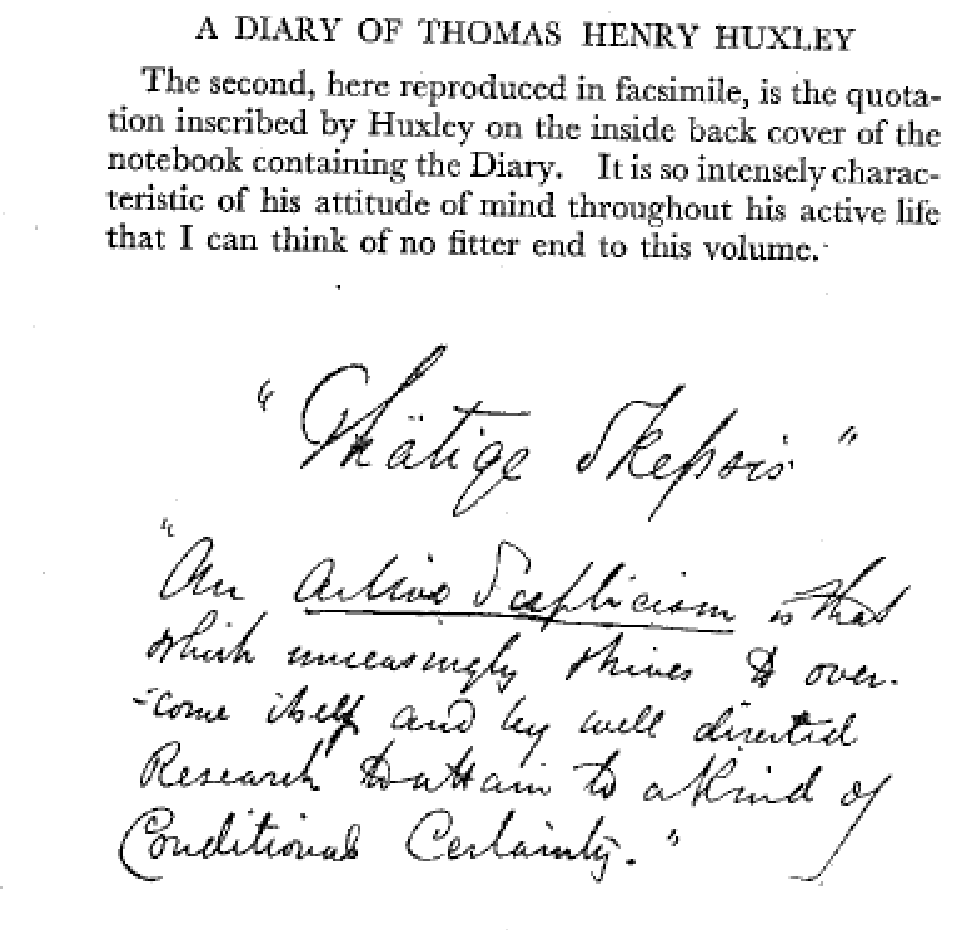
As you will see, the students learn to evaluate assumptions, evidence and interpretations before they accept scientific conclusions with conditional certainty or to use Goethe’s phrase, Thatige Skepsis, which was defined by T. H. Huxley as “An Active Skepticism in what which unceasingly strives to overcome itself and by well directed Research to attain to a kind of Conditional Certainty.”
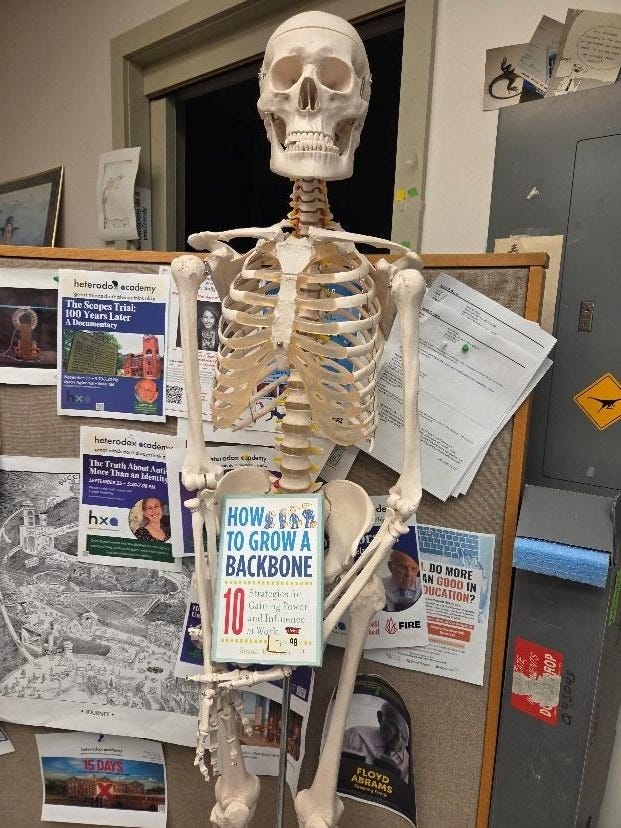
I also encourage the students to build a “line of reasoning” for each of their arguments and to never just give “talking points.” This leads to them building a firm foundation of critical thinking that gives them courage. Their courage is clearly expressed when they participate in two Braver Angels debates at the end of the semester. Perhaps it helps that I keep a skeleton in the classroom as a reminder that we are vertebrates.
It takes a semester to get students to realize that science is not just bullet points to memorize. If they want, at the end of the semester they can write a letter to their “January self” encouraging him- or herself (I teach with binaries) to think for themselves. With their permission, these letters can be found here.
To go back to the question posed in the title, the answer when it comes to science is emphatically “no.” Just ask my students who are also always happy to say, “Don’t believe anything Randy says.”
No posts
Comments
Nothing yet. Say the first thing.
Sign in to join the conversation.