
This is the third in a series examining how modern medicine’s instinct to intervene can, in certain circumstances, work against the very people it intends to help.
The first piece looked at overdiagnosis - the transformation of normal human variation into pathology.
The second examined the financial relationships that shape clinical guidelines, and the iatrogenic harm that follows when those guidelines expand treatment into populations unlikely to benefit.
This piece looks at the statistical language used to present evidence. Language that is technically accurate, routinely misleading and almost never challenged in the consulting room.
There is a number that appears regularly in medical headlines, drug trial summaries, and the conversations people have with their doctors after a worrying test result. It is presented as evidence of benefit - clear, quantified, scientific. It sounds significant. It is designed to.
It is called the relative risk reduction and understanding what it actually means and what it conceals, may be one of the most useful things you can do for your own health literacy.
Two ways of saying the same thing
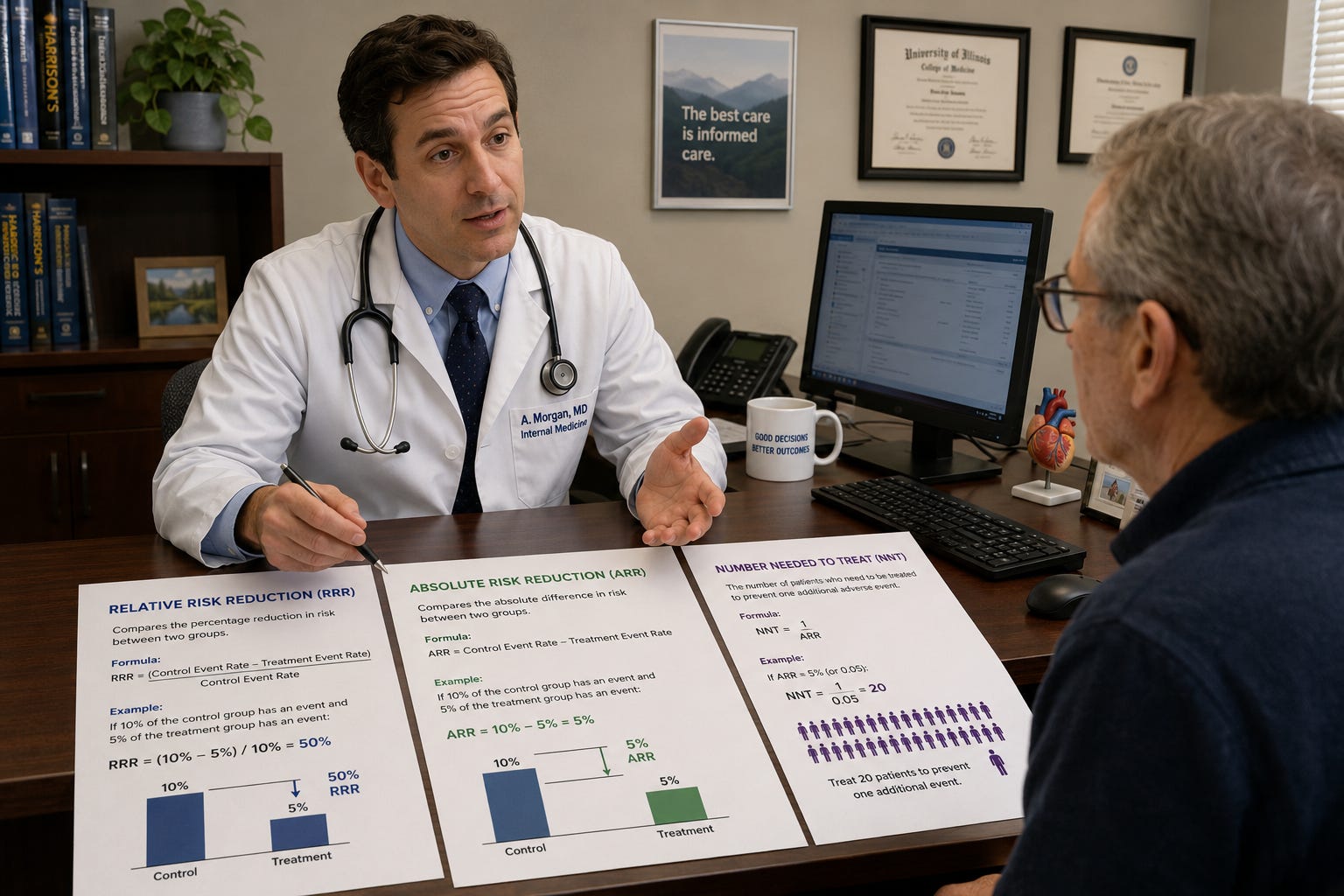
Start with a simple example, because the principle is not complicated. Imagine a drug trial in which two groups of people are followed for five years. In the group receiving no treatment, 2 in every 100 people have a heart attack. In the group receiving the drug, 1 in every 100 people has a heart attack.
The drug manufacturers - and the guideline writers who rely on their data - will report this result as follows: this drug reduces the risk of heart attack by 50%.
That is mathematically correct. The risk went from 2% to 1%. One is fifty percent of two. A fifty percent reduction.
But here is the other way of expressing the same finding, the way that rarely makes the press release:
for every 100 people who take this drug for five years, one heart attack is prevented.
The first figure is the relative risk reduction. The second is the absolute risk reduction (RRR vs ARR). They describe identical results. But they produce entirely different emotional and psychological responses which is precisely why one is routinely reported and the other is routinely buried.
Fifty percent sounds like a transformation. One in a hundred sounds like what it is: a modest benefit, meaningful for the person whose heart attack is prevented, but one that must be weighed carefully against the cost, inconvenience, and side effects of treating the other 99 people who derived no benefit whatsoever.
The number needed to treat
There is a third way of expressing this same result, and it is perhaps the most illuminating of all. It is called the number needed to treat, or NNT, the number of people who must receive a treatment for a given period of time in order for one person to benefit.
In the example above, where absolute risk falls from 2% to 1%, the NNT is 100. One hundred people must take the drug for five years to prevent a single heart attack.
This is not a fringe calculation or an obscure academic exercise. It is a standard tool in clinical epidemiology, taught in medical schools, and almost never communicated to patients. If it were communicated routinely - if every prescription came with a plain-English statement of what the NNT actually was - the conversation about treatment would look very different.
For many of the most widely prescribed drugs in the world, the NNT figures are sobering. For statins used in primary prevention in people who have not yet had a heart attack, NNT figures for preventing a cardiovascular death over five years typically range from around 100 to over 200, depending on the population.
That means that for every person whose life is extended by the medication, somewhere between 99 and 199 others take it daily, experience no mortality benefit, and are exposed to the full range of side effects. For some of those people, the side effects are mild. For others, they are not.
The NNT is not an argument against treatment. It is an argument for honest treatment, for presenting the genuine likelihood of benefit alongside the genuine likelihood of harm, and allowing the person sitting in the chair to make an informed decision about their own body.
Share HWSS Newsletter & Healthcare News
Why relative risk dominates
It is worth asking, at this point, why relative risk reduction remains the dominant language of medical reporting, given that it is so consistently misleading. The answer is not difficult to find.
Clinical trials are predominantly funded by the companies whose drugs are being tested as the previous piece in this series explored. Those companies have a commercial interest in presenting their findings in the most favourable possible light.
Relative risk reduction reliably produces larger, more impressive numbers than absolute risk reduction. It is the difference between a headline that reads
drug slashes heart attack risk by 50%
and one that reads
drug prevents one heart attack for every hundred people treated over five years.
The first generates prescriptions. The second generates questions.
The same dynamic plays out in cancer screening literature, in vaccine efficacy reporting, and in almost every domain of medicine where population-level statistics are used to inform individual decisions. The relative figure, reported alone, strips away the context that would allow a patient to understand what the finding actually means for them personally.
A treatment that reduces relative risk by 30% sounds impressive in almost any context but if your baseline risk is 0.3%, a 30% relative reduction brings it to 0.21%. The absolute difference (0.09%) is less than one in a thousand. The NNT, over five years, would be over 1000. Whether that trade-off is worth it depends entirely on the side effect profile of the treatment, the impact on quality of life, the person’s own values and priorities and an honest conversation about what the numbers actually mean.
That conversation, in most consulting rooms, does not happen.
Baseline Risk: The number nobody mentions
Embedded in all of this is another figure that receives remarkably little attention: baseline risk. The size of a relative risk reduction is meaningless without knowing the baseline from which it is being reduced. And yet baseline risk, your actual, personal, starting-point probability of experiencing the event in question, is almost never the first thing communicated in a medical consultation.
This matters because the same relative risk reduction produces radically different absolute benefits depending on the population to which it is applied. A drug that reduces relative risk of stroke by 20% is genuinely transformative for someone with a baseline risk of 20% per year - it prevents one stroke in every 25 people treated annually. The same drug, applied to someone with a baseline risk of 1% per year, prevents one stroke in every 500 people treated annually. These are not comparable situations. They should not be presented in the same language.
Age, sex, smoking status, existing conditions, family history — all of these shift baseline risk substantially, and all of them should inform how statistical evidence is communicated and understood. When a doctor says “this drug reduces your risk by 30%” without specifying what your risk was to begin with, they have given you a fraction without a denominator. The answer is incomplete. It may be, for your specific situation, deeply misleading.
What to ask
This is not a counsel of suspicion toward medicine or toward the clinicians who practise it. Most doctors are, within the constraints of a system that does not train or incentivise this kind of communication, doing their best. The problem is structural, in the way evidence is reported, the way guidelines are written, and the way time-pressured consultations leave little room for statistical nuance.
But armed with the right questions, a patient can change the terms of the conversation. There are three worth remembering.
What is my absolute risk of this event happening without treatment?
This establishes the baseline, the denominator that gives the statistic its meaning.
What is the absolute risk reduction if I take the treatment?
Not the relative reduction. The absolute one. How many percentage points does my personal risk actually fall?
How many people need to be treated to prevent one event?
The NNT, stated plainly. If the answer is ten, the treatment is likely highly effective. If the answer is two hundred, a more careful conversation about side effects and individual circumstances is warranted.
These questions are not aggressive or distrustful. They are the questions of a person who understands that their body is not a population-level statistic, and that a decision made about it should reflect their specific situation, honestly appraised.
The language of persuasion
There is something worth naming directly here, because it sits uncomfortably at the intersection of science and commerce. The consistent preference for relative risk language in medical communication is not a neutral choice. It is a rhetorical one.
It produces impressions of benefit that are systematically larger than the reality, in a context where those impressions drive prescriptions, expand treatment populations, and generate revenue.
This does not mean that every drug reported in relative terms is ineffective or that every guideline built on such evidence is corrupt. It means that a system in which the language of evidence is shaped, at least in part, by those with a financial interest in its persuasive power will tend to produce communication that persuades more than it informs.
Patients, who enter that system in good faith, trusting that the numbers they are given reflect the whole picture, deserve better.
Health literacy is not a luxury. It is not the preserve of the medically trained or the statistically confident. It is a basic requirement for genuine informed consent. The principle that a person cannot meaningfully agree to a treatment whose actual likelihood of helping them has been obscured behind a number designed to impress rather than enlighten.
Reading the small print
There is a quiet revolution in evidence communication that has been slowly gaining ground in academic medicine for two decades, led by researchers, statisticians, and clinicians who believe that patients are entitled to the full picture.
Absolute risk. NNT. Number Needed to Harm. Confidence intervals. The honest acknowledgement that population statistics describe averages across thousands of people, not certainties for any individual.
This movement has produced better tools, clearer infographics, and a growing body of evidence that patients who receive information in absolute terms make different — and arguably better-informed — decisions than those who receive it in relative terms. They are neither more nor less likely to accept treatment. They are more likely to understand what they are accepting.
That, perhaps, is the simplest possible summary of what good medical communication should achieve. Not compliance. Not fear. Not the management of a statistic. Understanding, so that the person in the chair can make a decision that reflects their own values, their own risk tolerance, and their own life.
The numbers exist to serve that person. When they are presented in ways that obscure rather than inform, something has gone wrong — not in the science, but in the translation of it. The first step toward fixing it is knowing which question to ask.
No posts
Comments
Nothing yet. Say the first thing.
Sign in to join the conversation.