
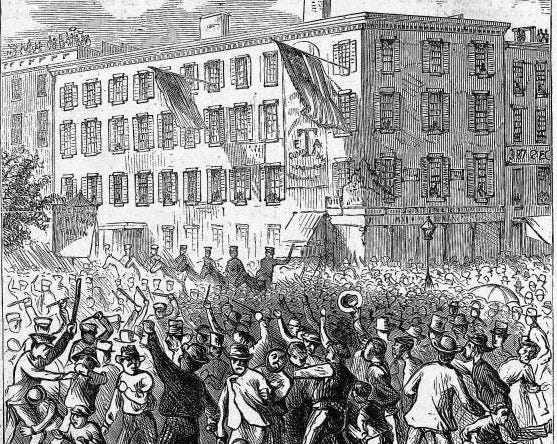
“Sad, sorrowful, sickening sights met the eye in every direction,” declared a reporter for the New York Herald. “The walls on both sides of Eighth Avenue from Seventy-fourth to Seventy-seventh Street were covered with bullet holes and marked as with the smallpox. Window blinds were riddled, and behind more than one the valiant conquerors’ bullets found a foolish mother with her innocent child, and made corpses of both.” The reporter was writing ironically. He didn’t consider the shooters valiant at all.
“The shutters of the closed up stores, the coal bins on the corners, the sign boards, the side posts and upper door posts of the houses were every one picked by Minie balls, and the water spouts and shoots were shattered. Crowds of angry men, pale-faced and demonstrative women and gaping boys and girls of all ages and sizes filled the streets and sidewalks and paddled in the pools of coagulated human blood that covered the flagways. Red streams ran along the gutters and down the neighboring basement steps and into the sewers.”
The carnage was even more gruesome farther south. A house at the corner of Eighth and Twenty-fifth had seen a massacre. “The basement of this house was occupied as a barber shop, and the steps leading down to it from the Eighth Avenue side were smeared and slippery with human blood and brains, while the landing beneath was covered two inches deep with clotted gore, pieces of brain and the half-digested contents of a human’s stomach and intestines.” The reporter still shuddered thinking about it. “The sidewalk in front of the door was thickly coated with a red mud, and the clammy way in which it stuck to one’s boots made living men’s hearts cold and sick.”
New York had experienced violence during the Civil War, culminating in a riot against the military draft that lasted five days. But this outburst occurred during peacetime, or what passed for peace six years after the Confederate surrender at Appomattox. It reflected not the extraordinary politics of sectional secession but the ordinary—for New York—politics of immigrant sectarianism.
Until the 1840s New York, like most of America, had been overwhelmingly Protestant. But famine in Ireland following failure of the potato crop drove more than a million Irish Catholics to America. Most of them landed in New York and many stayed there. As their numbers grew, they asserted themselves in city politics. Recent Irish immigrants who felt neither allegiance to the Union nor animosity against the Confederacy were the first to riot against the draft when they received conscription notices in 1863.
Some New York politicians catered to the Irish, offering support and services in exchange for votes. Others displayed the distaste and suspicion with which the Irish were viewed by many native-born New Yorkers, especially those of Protestant faith. Most hostile were the so-called Orangemen, Protestants from Northern Ireland who had fought the Catholics in Ireland and were ready to fight them in New York.
A group of Orangemen applied for a permit to stage a parade on July 12, 1871, to commemorate the victory of the Protestant English king William of Orange over an Irish Catholic army at the 1690 Battle of the Boyne. The parade was intended as an expression of Protestant pride. If the Irish in New York interpreted it as an affront, all the better.
The city authorities hesitated to issue the permit. Violence had accompanied Orange Day celebrations in the past. The city decreed that no parade would be allowed.
The decree provoked an uproar. Orangemen alleged that the authorities were succumbing to Irish intimidation. They demanded their constitutional rights to assemble and to convey their political views.
The New York governor, less beholden to Irish votes and more to Protestant ones, overruled the refusal. The parade would go ahead.
To prevent Irish residents of New York from interfering, regiments of the New York militia would accompany the paraders.
This inflamed the Irish Catholics, who contended that they were the ones being subjected to intimidation, by the military arm of the government, no less.
The day of the parade was sunny and hot. Irish Catholics by the hundreds of thousands lined the parade route on Eighth Avenue and clogged the streets on either side. They hurled epithets at the Orangeman and the soldiers. Then they hurled produce and bricks and stones. The paraders ducked but the soldiers shouldered weapons. Someone shot first, whether from the crowd or the soldiers was unclear.
The soldiers, fearing for life and limb, opened general fire into the crowd. Some sallied forward with bayonets. Confusion inspired mayhem, which increased the confusion, which multiplied the bloodshed.
More than sixty died as a result of the Orange Day violence. Another hundred were wounded.
While relatives buried the dead and building owners hosed away the blood and gore, everyone blamed everyone else. The complaints against the city government were the most telling. William M. Tweed—“Boss Tweed”—the leader of the Democratic organization known as Tammany Hall, had managed to skate ahead of corruption charges for years, but the Orange Day massacre made him vulnerable as never before. His enemies allied against him. His friends abandoned him. He was tried, convicted, released. He was charged again. He fled the country, was arrested abroad and was returned. He died of pneumonia while in jail in 1878.
No posts
Comments
Nothing yet. Say the first thing.
Sign in to join the conversation.