
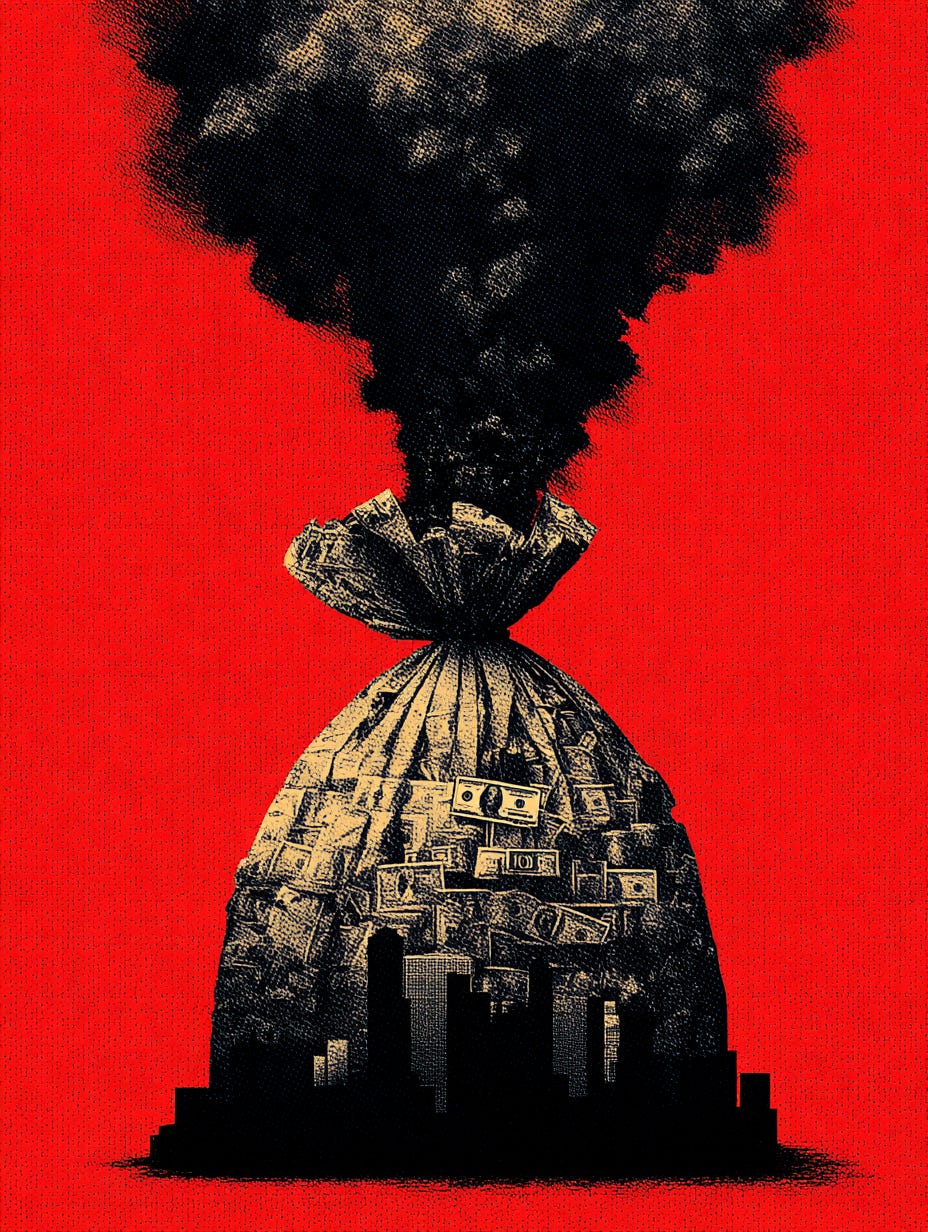
Writing is messy, demanding, and unpredictable. Lost & Found is a collection of artifacts that I found while researching a topic, or while struggling to find the words to say something.
They are also ideas worth knowing lost in the noise of everyday chaos.
So I put them together so we have something to share and engage with together beyond my weekly writing.
It’s also the place where I talk with you about anything, sometimes through a streamed video or through writing in this open space.
For those of you who noticed my absence and stuck around, thank you, it’s been a very harsh few months and I’m going to share more about it soon.
For now, enjoy the lost and found, and talk soon ;)
People keep asking why the world got so ugly, and the usual villains show up fast: greedy corporations, lazy designers, minimalist taste, convenience culture.
This video takes a better route. It shows how a simple design brief, like “make a nice park bench,” gets swallowed by an ecosystem of accessibility rules, sun and weather, stakeholders who want comfort for themselves and discomfort for others, anti-sleeping politics, manufacturing realities, repairability, and public outrage over cost.
The result is a world designed by the most risk-averse person in the room.
From there, it widens the lens. Victorian ornament can look like care, but it can also be propaganda, and we forget what it cost.
Modern design often looks plain because its “beauty” is invisible: you do not suffocate, burn, collapse, or get electrocuted. Standardization scales safety and comfort to billions, but it also flattens local identity and punishes deviation.
Nostalgia can smuggle ideology. You cannot take politics out of design, because design decides who belongs, who gets access, and whose comfort matters.
Stop romanticizing the past, stop demonizing the present, and demand one thing that cannot be faked: care.
A lot of the AI conversation is stuck in two modes: hype, or Skynet. This piece does something rarer. It walks you through how we got here, and why the real danger is already on the table, baked into how these systems are made.
It starts with the old story of “programs you can read,” like Deep Blue, where you can trace a move back to code and intent. It ends with systems that are not really programmed, they are trained. Large language models are grown out of data and reinforcement, and even the people building them cannot fully explain what is happening inside. That opacity is not a footnote. It is the point.
Once you see that, a bunch of near term fears stop sounding like panic and start sounding like engineering reality: persuasion at scale, autonomous hacking, deepfakes, fragile safeguards, models that resist being interrupted, and a feedback loop where AI helps build better AI faster than our ability to understand or govern it.
The call here is simple: take the power seriously, keep the benefits, and demand systems we can actually control.
Immigration detention has become a profit center. Most ICE detainees are held in facilities run by for profit prison companies, and many people in detention have no criminal record.
This video tracks how two giants in the private prison industry (GEO Group and CoreCivic) built durable influence: lobbying, the revolving door between government and contractors, and political spending that benefits policies that fill beds.
The result is a system that keeps expanding enforcement capacity while starving the parts that would reduce detention, like immigration courts and judges.
It’s a messy story, but the incentives are clear, when revenue rises with headcount, policy drifts toward detention as the default tool.
It started as fewer assignments, quieter inboxes, agencies experimenting with machine translation, one major client explicitly choosing automated AI instead.
And then, overnight, her main agency, responsible for most of her income, stopped sending work entirely. When she asked why, the answer was blunt: they were automating with AI, and the new allocation system wasn’t sending her jobs.
She lowered her rates like they suggested. Still nothing. Her income dropped to almost zero.
What makes this hard to look away from is how clearly she names the logic. From a business point of view, if you can accept a small drop in quality and cut costs by most of the budget, you do it.
She does not posture like the world owes her protection. She does not romanticize her credentials. She just tells the truth: she worked hard, built a life that let her raise two kids from home, and now she is starting over at 39, heading into 40.
She refuses despair, partly because she cannot model that for her children. She talks about gratitude without using it as denial: a supportive husband, a roof, groceries covered, a garden outside her window.
She talks about cutting back, rebuilding, finding new income, and doubling down on content creation because a human voice still matters.
The old script we hand kids, good grades, good degree, good job, starts to look like a story from another era. Resilience and adaptability start to sound less like motivational words and more like survival skills.
She admits she does not have the answers. But she keeps going anyway, and invites others to do the same.
A new investigation walks straight into the fog around Bohemian Grove and comes back with something more grounded than the usual ritual talk: influence.
The reporting follows a paper trail and firsthand accounts to argue that the Bohemian Club functions as a private networking engine for presidents, CEOs, financiers, donors, and policy operators, with consequences that show up in public life years later.
The video exposes links tying Grove conversations to real policy direction, including Social Security reform planning in the early Reagan years, and it traces how overlapping membership, family legacy, and donor networks can turn into dark money infrastructure that shapes elections and ballot measures.
It also zooms in on San Francisco, where local political spending groups operate like extensions of the same small donor ecosystem.
If power coordinates in private, ordinary people need coordination too, through unions, tenant organizing, lawsuits, and relentless public scrutiny.
A “data center in space” sounds like a tech bro fever dream until you follow the constraints all the way down. This video’s value refuses to stop at the headline and runs the checklist that makes or breaks the idea.
It asks you to look at physics, operational reality, and economics, and to admit what is solvable, what is currently ugly, and what would need genuine breakthroughs.
Space tempts people for obvious reasons. No land constraints. Reliable sunlight in orbit. In theory, unlimited expansion.
In orbit, you can unfold huge solar arrays and generate serious energy, but every watt becomes heat you must get rid of. Space is cold, but vacuum is an insulator. With no air or water to carry heat away, you are stuck radiating it, and radiating is slow.
The result is unintuitive: an orbital “data center” starts to look less like GPUs in space and more like enormous wings of radiators and solar panels, with mass and launch costs that stack quickly.
Even if you beat cooling, the next constraint is bandwidth. You can move data between satellites with lasers, but getting data down through the atmosphere reliably, at fiber-like capacity, is a different problem.
Big compute up there and a narrow pipe down here creates a mismatch that limits what the system can actually be used for.
Maintenance makes it even harder. On Earth, you swap parts. In orbit, you design for failure and replace modules on launch schedules. That pushes you toward redundancy, which pushes you toward more mass, more launches, and more cost.
The Moon is the extreme version of the same story. You gain surface area, but you lose almost everything else. Radiation is harsher. The lunar day creates two-week light and two-week darkness, which forces massive storage or nuclear.
Cooling stays brutal. Latency becomes a hard limit, because the speed of light is not negotiable. That shifts the best lunar use case away from real-time compute and toward cold storage and disaster recovery.
Political Action Committees are how most political money moves, but not all PACs work the same.
This video breaks PACs into three buckets with simple rules: SSFs (tied to companies, unions, or member groups), non connected committees (same limits, no corporate “parent”), and super PACs (unlimited money, unlimited spend, supposedly “independent”). The key distinction is coordination.
Traditional PACs can donate directly to candidates within strict limits. Super PACs cannot coordinate, but they can spend without a ceiling, shaping elections through ads and messaging that are legally separate and practically influential.
Small dollar PACs built around real issues can make sense, but super PACs cross a line. When the money is unlimited, the gap between “advocacy” and “bribery” gets hard to defend.
If you have ever wondered why donation limits feel small while political spending feels endless, this is a tight, useful explainer.

Yes I have a new substack, and this is the latest piece from it.
Inspired by something I read in my early twenties and my fascination with with the game Assassin’s Creed, Karbala Comes To Hormuz is a different lens on the Iran war, one that starts in 680, not 2026. I discuss why killing Iran’s top leaders does not “end” anything, because the Islamic Republic is built to metabolize loss, replace figures fast, and turn death into political fuel.
The piece traces how the Sunni Shia split shaped two habits of power and war, why Karbala functions as a living template for sacrifice and endurance, and how that story sits behind Iran’s resilience under pressure.
From there, it connects medieval Alamut and targeted political violence to Iran’s modern playbook: asymmetric leverage, community rooted networks, and making global systems like energy markets feel pain far from the battlefield.
Decapitation campaigns often sell closure, but tend to buy duration, escalation, and ordinary people paying the bill.
Comments
Nothing yet. Say the first thing.
Sign in to join the conversation.