
The inevitable next step after removing a president is to find a new one – according to the constitutional procedures, the National Assembly has 30 days to elect a new president after the ousting of President Sulyok. So in about three weeks (if you read this newsletter upon publication), Hungary will have a new president.
This president, according to the constitutional amendment that removed Sulyok, will be temporary until a new Constitution is enacted (but their term will end after five years at the latest). That Constitution, which is supposed to be written with the involvement of the people, will decide on whether Hungary will keep its indirectly elected presidency, or change to direct presidential elections.
What Tisza Could Have Done
I think the most straightforward way to choose a new president is to nominate an independent-minded Tisza politician as temporary president. The presidency, despite its much-quoted function of representing national unity, is a political office and post-’89 presidents have been politicians or former politicians when elected, with the exception of Tamás Sulyok. Make of this fact what you want. And all presidents (including László Sólyom, more on that later) have been elected either as a consequence of parliamentary deal-making or as the appointees of majority governing parties. So the constitutional precedent is clear here, even if you disregard the Orbán-era. Internationally, too, indirectly elected presidents tend to be politicians who, at best, command the respect of both sides of politics, not outsiders.
The problem with this idea is that Hungary doesn’t have such politicians. After 16 years of Orbánism, many citizens and especially Tisza-voting intellectuals see political appointees as attempts to undermine the independence of institutions. As stupid as it is to see a politician appointed to a political office as problematic, it is an understandable overreaction to the Áders and Nováks of this world. And second, while there very likely are independent-minded Tisza politicians who could stand up to Magyar if needed, none of them have proven that to the public. And the suspicion would have been, even among many Tisza supporters, that a Tisza figure elected to the presidency would serve as Péter Magyar’s puppet.
An alternative could’ve been to elect a non-politician able to command respect and who isn’t an obvious Tisza loyalist. I agree with Egon Zsiros on the problems of lawyerocracy, and I find it truly stupid that after 16 years of lawyers in charge, anti-Orbánists believe that a legal degree makes you a more serious politician than any other, however, an independent lawyer serving as the guardian of constitutionalism, even if not the non-existent integrity of the Basic Law, would have been a logical choice.
Alternatively, Tisza could have gone all in on democratising the presidency and could have made it a directly elected office through a constitutional amendment. Such reform would have also made a great excuse to remove Sulyok, to boot. Amend procedures so that the Speaker of the National Assembly Ágnes Forsthoffer could remain acting President as long as a new one is elected, and announce a presidential election in October. While not without risks, as Orbán might make a comeback as President (though this seems incredibly unlikely nowadays), and as Tisza still needs to build the political profile of most of its politicians, it would be a clear sign of democratisation and would ensure the independence of the President through their direct popular mandate. If you want to make it even more participatory, announce a Tisza primary, too.
What Tisza Did Instead
Unfortunately, Magyar announced that the new President would be chosen through an unstructured process where citizens are asked to recommend candidates. That only a day after Judit Polgár was nominated, belied this process, but especially after Polgár refused the nomination, these shenanigans (more on which in Egon’s piece) seem secondary to the larger problem with this nomination process: that it is deeply antidemocratic.
In theory, appointments made by a political party representing the majority of voters should carry popular democratic legitimacy. In practice, to put it mildly, things are more complex than that. Hence the pressure to democratise decisionmaking through participatory procedures and, in many cases, direct democracy. And it is a good thing, in general, but carries the risk that instead of making decisions more aligned with popular preferences, it opens the door to those with a loud voice and a large platform – the rich and powerful, the academic and cultural elite – to dictate political decisions.
For this reason, participation alone is not necessarily democratic: it needs procedures that ensure that everyone (or at least a wider group of people) actually takes part in the process. To give a good example, a recent consultation of Airbnb regulation in the Budapest district where I live was able to draw the various anti-Airbnb grievances and positions of citizens into the process and thus muffle the pro-Airbnb lobby. This resulted in stricter regulation. Maybe the process wasn’t ideal in representing every strata of local society, but it highlighted the problems of residents over the interests of capital. In other words, it helped the (relatively) powerless to shape political decisions.
This presidential nomination process, on the other hand, seems to be about groups of intellectuals with high profiles throwing in other famous intellectuals for Magyar to consider: members of the cultural elite nominating their own. This makes the question highly depoliticised and personal. What matters? Law degree? Principled stand against Orbán pre-2024? Impressive personal achievements? Ability to unite various political camps? Being respected?
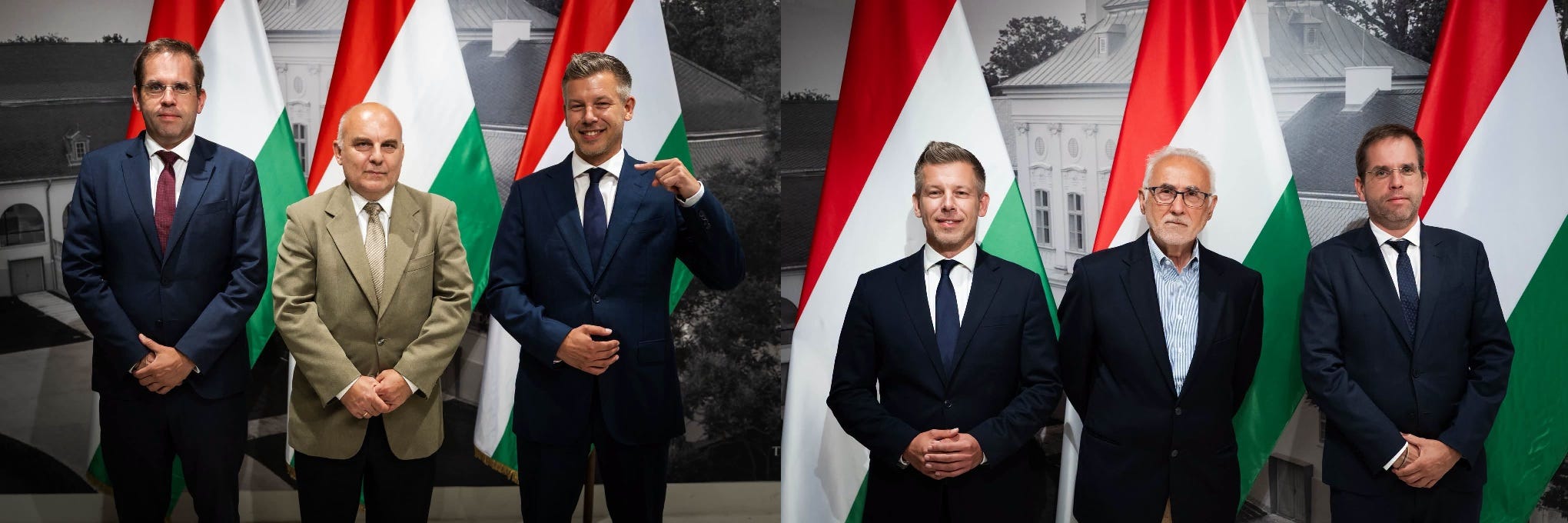
As of writing, two such nominees, the lawyer Botond Fülöp, known for his involvement in breaking the Clemency Scandal, and the historian Ignác Romsics, had already met Magyar. But further details about how the final nominee will be chosen remain unclear. If the dynamics of Polgár’s nomination foretell anything, the process will also be heavily influenced by the same intellectuals’ online reactions. In other words, not only will we hear names from people with huge public followings, they will also hold veto powers. This creates the worst of both worlds, combining the opacity of decision-making among elected politicians with the unaccountable, arbitrary and intransparent nature of elite group decisions.
There is one – supposed – precedent for this selection process. In 2005, intellectuals from across the political spectrum supported the nomination of László Sólyom, former President of the Constitutional Court, for the presidency. While Sólyom (a syncretic figure with conservative and green politics and liberal views on the Constitution) was this way drawn to the attention of the parties, his election also required significant parliamentary machinations, including Fidesz ensuring that the governing Socialist Party kept their own, horrible candidate running. In other words, far from being a depoliticised nomination with bottom-up dynamics, Sólyom, arguably the best post-89 president, was elected for political reasons: that he was more acceptable to liberals than his main opponents and that the political right had played their cards excellently in Parliament.
One can hope that the next president of Hungary will be worthy of his office. But one hopes even more that their successor will be chosen through a truly democratic process, as opposed to pseudo-democratic elite politics.
Iván Merker
No posts
Comments
Nothing yet. Say the first thing.
Sign in to join the conversation.