
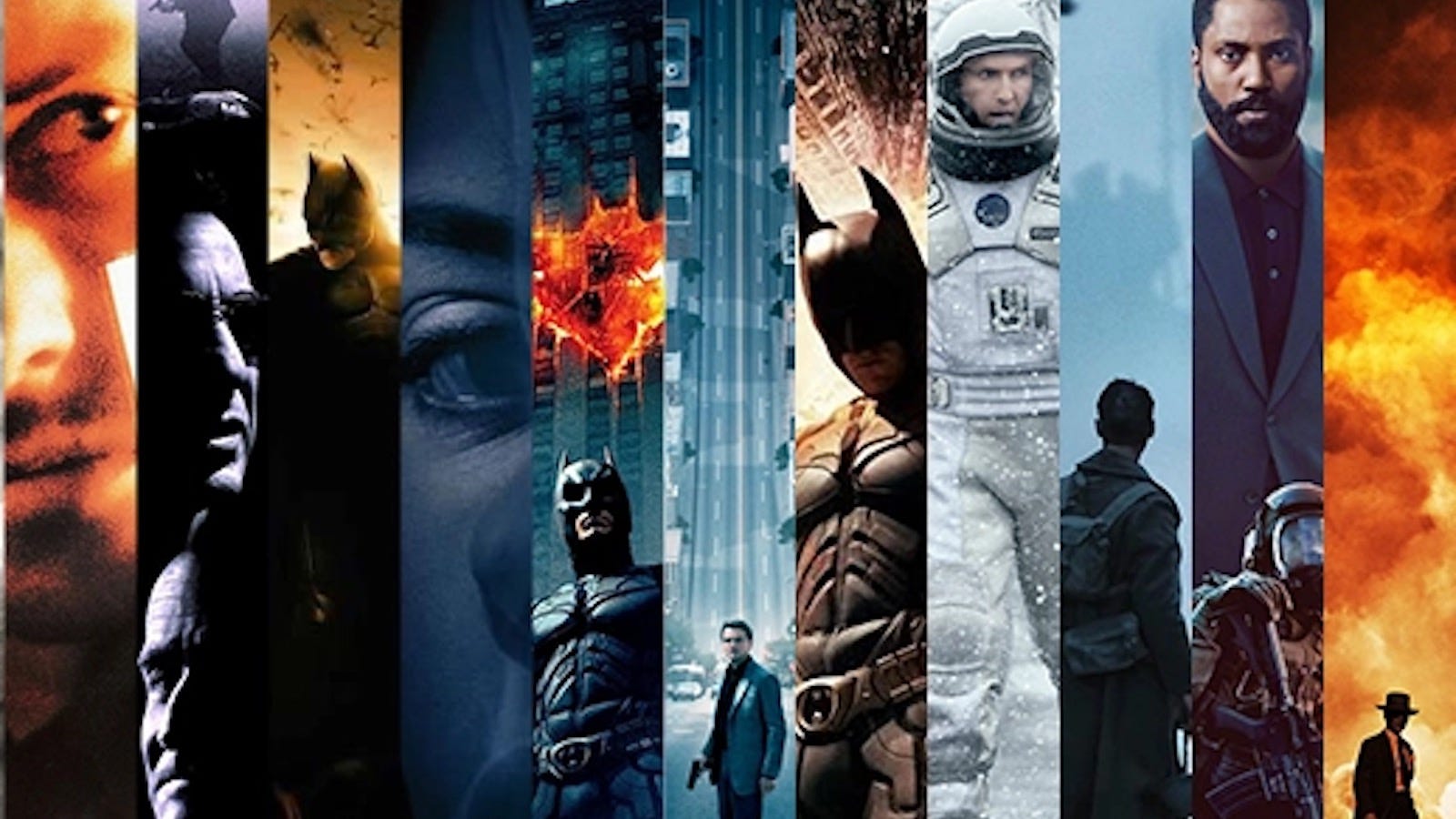
Every generation, filmmakers come along that become “larger than life” in a sense. Their projects never fail to pique people’s interests, and can develop rabid fanbases adamant on consuming every second of their original content. Examples include Alfred Hitchcock, Sidney Poitier, Stanley Kubrick, Steven Spielberg (even if I wasn’t the biggest fan of his latest work, “Disclosure Day” you cannot deny his incredible track record) and of course, the man of this retrospective, Christopher Nolan.
If you’ve been reading any of my work over the past few weeks, you probably know that I possess nothing but high praise for the guy with thirteen creatively distinct concepts over the years. Given his vast resume, it’s important to ask: what are his greatest films of all time?
Naturally, this all boils down to individual interpretations. So, in the spirit of subjective analysis, I decided to partner with Substacker DJ , who finds Nolan’s range fascinating & believes that he along with Denis Villeneuve, P.T.Anderson and David Fincher are the most influential Hollywood filmmakers of the last 25 years.
As a student of cinema, DJ focuses on films new and old, looking for deeper themes and connections between films. DJ uses the medium of film to understand life and the human experience. He believes that the best films at any point in life are the ones that speak to something deeply personal or a commentary on the world at large.
As a disclaimer: just because movies were left off our lists, that does not mean we hated it. It just means we liked certain ones better than them.
We have so much to cover, with only a limited amount of time. So…
Without further perspective, let’s get to this retrospective!
DJ #3 - The Prestige (2006):
The Prestige is a story of obsession, of escalating lengths to which driven men go to beat their rival, of professional rivalry turning to hatred. The two men in question are rival illusionists, and they are competing for primacy in the eyes of the audience, in 19th century London.
Alfred Borden (Christian Bale) and Robert Angier (Hugh Jackman) start off as mentees of John Cutter (Michael Caine). Professional rivalry takes a turn to bitter hatred when Angier’s wife Julia dies in a drowning trick, Borden mistakenly tying the wrong knot so she cannot escape. This leads to a set of escalating attempts to sabotage each other’s magic tricks. Borden loses two fingers of his hand and his wife, a huge price to pay for professional rivalry. Not to be thwarted, Angier is obsessed with Borden’s new showpiece: “The Transported Man”, an illusion of teleporting oneself from one side of the room to another.
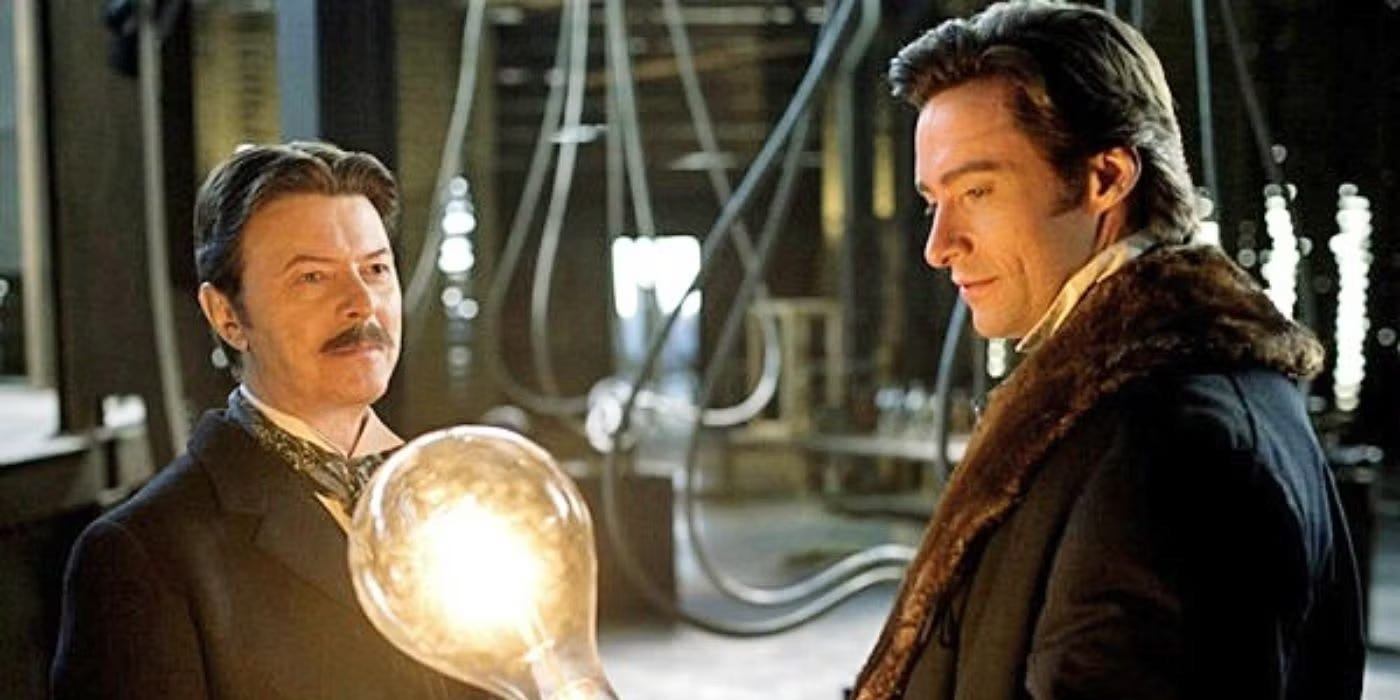
David Bowie provides an electric turn as Nikola Tesla. While he has maybe ten minutes of screenplay, this musical legend absolutely dominates the screen. When Angier hires Tesla to build him a teleporting machine to one-up Borden, Tesla recognizes the underlying obsession, cautions Angier to put aside his pursuit of a machine that essentially clones humans: it’s a staggering moral cost! Implied in this is that any clone created must be eliminated to maintain the integrity of the illusion. Tesla has some of the best lines, “I recognize obsessions; at first they reward me, and then I become their slave.” Tesla urges Angier to “destroy the machine, drop it to the bottom of the deepest ocean, such a thing will bring you misery.” Needless to say, his words have no impact on someone who is blind with hatred and seeks vengeance.
In addition to the high human and moral cost of obsession, Nolan is touching on a theme that has echoes in the rest of his filmography. The characters of Einstein in Oppenheimer, or Mr. Fox in The Dark Knight make valiant attempts at grounding the protagonists on the implications of technology misuse. Their passionate pleas ultimately fall to deaf hears. This is an implicit truth in scientific progress that Nolan recognizes. Humans are innovative and find ways to use any revolutionary technology for both harm and good. The harm often far exceeds the benefits. We see this today in the optimization of weapons to create unprecedented destruction, the race to dominate A.I. with no ethical guard-rails, the creation of synthetic opioids. The list is long and continues to grow.
Tesla’s words prove prescient. Both men lose themselves and their humanity in pursuit of victory. Borden’s version of the Transported Man involves the use of his identical twin brother. When Borden loses his fingers, his twin’s fingers are also amputated. Angier bears the cost of killing scores of his clones, in addition to standing by while Borden is executed for a crime he did not commit. Any sense of perspective or moral decency is well in the rearview mirror. When Angier finally uncovers the truth, in his dying moments, he realizes he doesn’t know which version of himself is the last man standing, he’s lost his humanity.
Christian Bale is the star of the show, conniving, shrewd, always a sly smile when appropriate. He plays the role with an air of mystery that fits his profession. Hugh Jackman is more showman than illusionist, the role is a good fit for his talents. Michael Caine does the job, much like his roles in the Dark Knight films. Unfortunately, the female characters don’t have much to add, Rebecca Hall and Scarlett Johansson somewhat wasted in these roles.
For a director who has made film development at scale almost a part of his identity, it’s illuminating to revisit an older, more intimate piece. A few years ago, I wouldn’t have placed this so high on my list. On rewatch, I found that while smaller in scope, the experience is no less rewarding, twists and turns at every corner. In other words, trademark Nolan, you can see him developing themes and craft that will be used on a much larger scale in the decades to come.
This cautionary tale of obsession and the price of competition ends with a rare needle drop. Michael Caine’s monologue fading into Thom Yorke crooning “Analyze”. Thom Yorke and David Bowie in a Nolan movie? Now that’s the real magic trick.
Hundred Tomatoes #3: Dunkirk (87/100 Tomatoes)
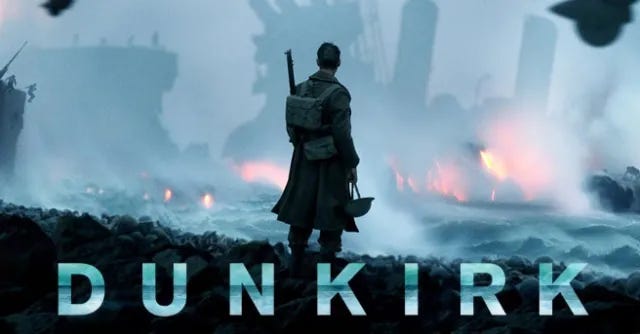
Every once in a while, an absolutely beautiful illustration of humanity’s courage gets brought to the big screen in ways you never quite thought possible before. “Dunkirk” fits that bill perfectly in my mind. Between the hauntingly beautiful cinematography, the action sequences, Hans Zimmer’s big orchestral score that masterfully builds tension and/or triumph behind every waking moment while also innovatively incorporating synthesizers and Nolan’s POCKET WATCH of all things, this film gives you chance to not just dream, but to once again remind yourself of humanity’s propensity for selflessness in times of hardship.
Of course, aesthetically, words can barely describe the immersive authenticity of the scenery that unfolds across the course of the runtime. The scenes on the beach with all the soldiers, the views from out at sea, along with everything they do with planes showcases a range that keeps you engaged throughout, while remaining in awe of the spectacle. The best part: They use practical effects for every interaction in this film, getting vintage planes and actual functioning war ships in the process. The scale to which they go to create the sense that you are fighting these battles right alongside the soldiers is nothing short of extraordinary.
All these observations above only scratch the surface in terms of the technical marvels found within this film. The sound in this absolutely electrifies. Between the plane crash, gunshots, the ship noises, the bombs going off, and more that fails to come to mind at the moment, you can tell a lot of diligence goes into ensuring that every encounter sounds lifelike on a number of different levels.
Cinematographically, we see so many incredible shots that get amplified in their beauty by the IMAX technology they utilize. The lighting usage is immaculate as they naturally illuminate the most important details whilst incorporating other common war elements such as fog and smoke. You get a full spectrum of luminosity from start to finish. Much like “The Odyssey”, “Dunkirk” relies on real life environments for the brunt of their scenes, including the decision to capture everything where the ACTUAL events took place. What a novel concept.
The editing in this also deserves a massive shout out. To cover three various perspectives of the battle of Dunkirk (land, air and sea) in such a non-linear fashion, yet finding ways to not only effortlessly interweave between the three so as to create three distinctly fulfilling arcs, but then lead to it all coming together in such creative fashion requires meticulous planning and attention to detail. Not to mention the fact that they use everything at their disposal (the authentic sounds, beautiful cinematography and score) to beautifully re-capture the sense of urgency everyone surely felt during these dire times. An underrated component also stems from the fact that they mostly treat the Germans as an invisible enemy throughout. They say that often, the scariest monster is anticipation. Editor Lee Smith cleverly embodies this mantra throughout the majority of the runtime to add greater tension.
If there’s one thing I admire, it’s tech marvels interweaved with some degree of sentimentality. “Dunkirk” accomplishes both of those components masterfully, helping us re-imagine what a great movie about war (a genre with no shortage of classics) could look like.
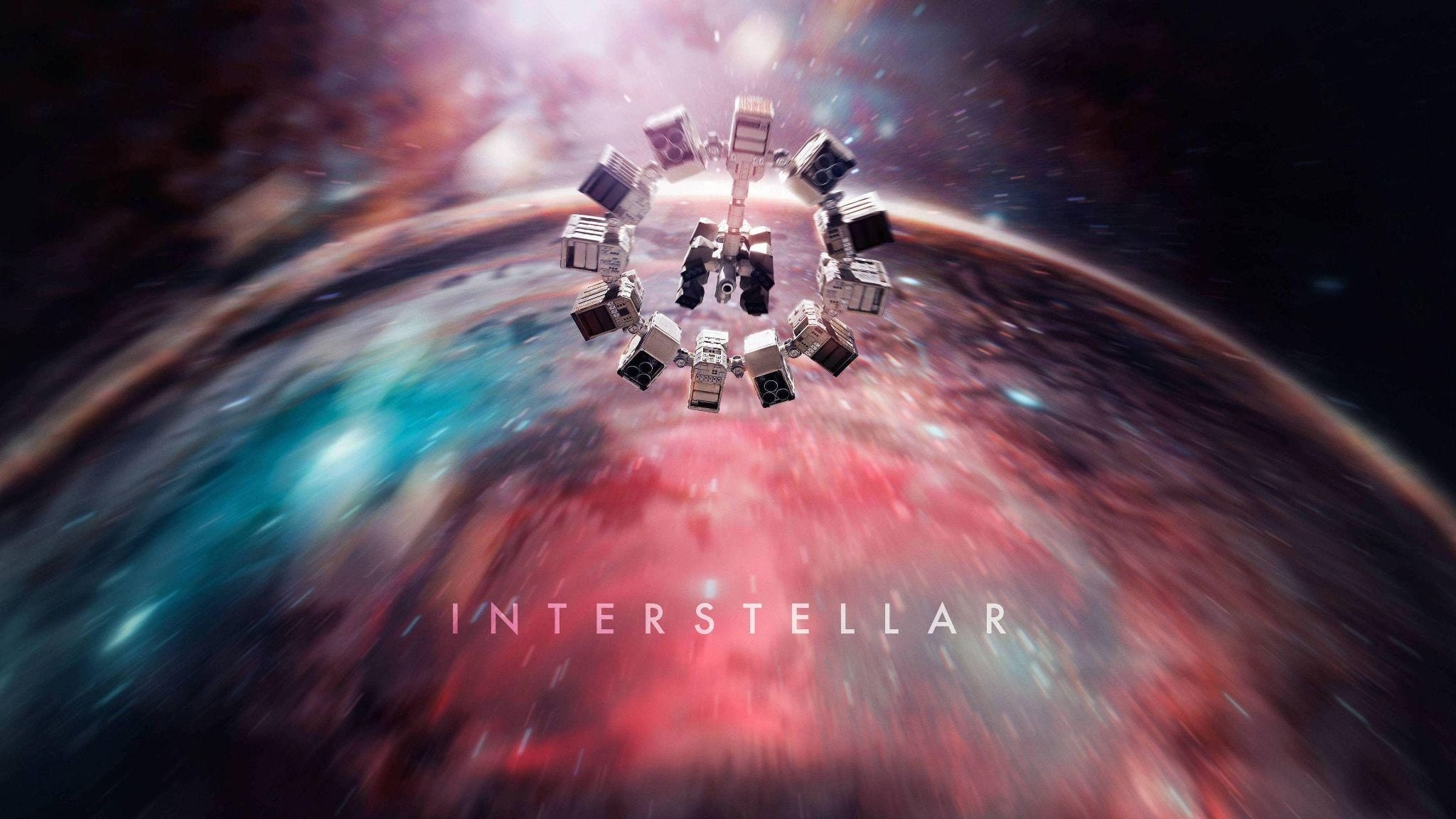
DJ #2 - Interstellar (2014): Interstellar is a roller coaster ride through time and space, modulated by Christopher Nolan’s trademark frequency. It checks all the boxes of the genre: dystopia, stunning visuals, scientific leaps of faith, strange planets and futuristic superpowers. Add in the yearning of man to explore, the love of a parent for his children, the high-stakes facing humanity in a doomsday scenario where the end of life on earth is near.
While Nolan has gone on record saying that the DNA of the Odyssey is there in most of his work, this for me is the most obvious candidate. In its simplest reading, it’s a father’s attempt to return home to his children and save the future of humanity. Beyond that, the film asks us to consider the path we are on, a planet hurtling towards disaster thanks to human action (or inaction, as the case maybe).
In this dystopian near future planet Earth is near uninhabitable. Nolan models this future on the dust bowls of the 1930s that led to great economic ruin. Scientific discovery is de-prioritized, resources focused on increasing agricultural output, which is a losing cause. Anti-intellectualism, that has only grown stronger in the last decade, becomes more rampant, the moon landing is debunked as a state conspiracy, the space program is ended.
In the film, humanity needs to find a new home, or risk extinction. Nolan argues that abandoning the first principles of human progress: curiosity, innovation, discovery, wanderlust will lead to our ultimate demise. The solution to our problems is to embrace our humanity, warts and all, re-embrace science and use our ingenuity to find a path forward.
In Matthew McConaghey, (who plays Coop) Nolan found the perfect star to anchor this emotional journey. His rugged features, twang and his twinkling eyes are reminiscent of a relic of an era past. His skills as a space pilot are decidedly anachronistic in a world that shuns scientific discovery. As Coop eloquently says, “We used to look up at the sky and wonder at our place in the stars. Now we just look down and worry about our place in the dirt.”
Anne Hathaway as Amelia Brand is the perfect foil to Coop’s emotion and exuberance. She brings calm and scientific clarity in difficult situations. Jessica Chastain (Murph Cooper) displays her wide range: passionate, methodical, impulsive. One of my favorite modern actresses delivers a fine performance.
The standout supporting performance is Matt Damon as Dr. Mann, who is stationed on one of the planets that is a candidate for human settlement. Dr. Mann has falsified data to make his planet look attractive for our brave space travelers to visit. It’s a ploy driven out of desperation, the fear of dying alone in a far away world. He is the primary villain of the piece. Damon plays this with steady calm, evil calculation lurking just beneath the surface. It’s reminiscent of his work in Talented Mr. Ripley, which remains one of my favorite Damon performances.
Mann’s villainy triggers a chain reaction of events in space, mirroring disaster on Earth. This sequence at approximately the midpoint of the film raises the emotional stakes: journey back home will be impossible thanks to Mann’s evil plan; Earth is burning, Coop’s children are in conflict, the world is literally going to hell. This sequence culminates with the best set piece of the film. The emergency docking sequence: the stakes for our protagonists and humanity have never been higher. Coop needs to execute a high risk maneuver to dock to the Endurance. He proclaims, “It’s not possible, it’s essential!” The visual effects, performances and score are in perfect synchronicity in this sequence. We join Amelia in her giggle when victory is achieved. I’ve always enjoyed this in a theater where the roar of the crowd drowns out what’s on screen. The emotional payoff is magnificent.
The cinematography and visual effects are absolutely fantastic. Hoyt Van Hoytema & the visual effects team have created sublime images with a combination of IMAX camera innovations and practical effects. Hans Zimmer’s score is sweeping, always enhancing the emotional ride, never distracting.
Great homage to Kubrick both in themes: an alien super intelligence leaving a portal to aid humanity in their next leap forward; the look and design of the Endurance, as well as the fields of color as Coop traverses the black hole.
The one aspect of the movie that doesn’t always work for me is the happy ending. An alternate ending where Coop delivers the data to Murph and dies drifting in space would lead to a tighter film, and a more poetic, tragic end to our hero’s journey. I’m probably in the minority!
I find that most Nolan’s movies are emotional shades of grey, reflecting the themes involved. Interstellar on the other hand is a full spectrum emotional experience. The thrill and joy of a chase through the cornfields. The beauty of the stars, planets and black holes. The misery of life on an extremely uninhabitable planet Earth. The despair of being trapped in space. The relief of finding a way back. The anger at the duplicity of unscrupulous humans. And humor, both human and robotic. It’s a treat for the senses.
Hundred Tomatoes #2: Oppenheimer (88/100 Tomatoes)
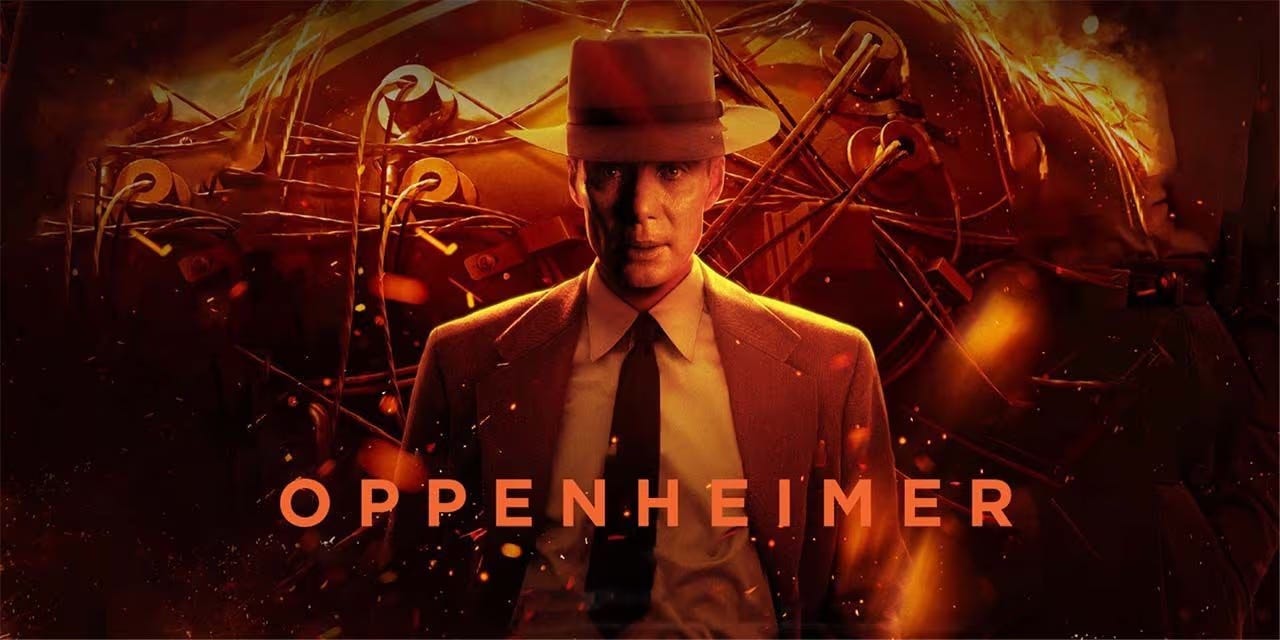
The phrase that immediately comes to mind when thinking about Christoper Nolan’s “Oppenheimer” is “well-oiled machine”. Which ironically, describes the operation to build the nuclear bomb in a nutshell. From a machinery perspective, the 65mm film used to record this biopic (coupled with the black in white footage rarely seen with that type of film in today’s day and age) helped the cinematography pop in a unique way. Several components, such as the sound behind the nuclear bomb, the unique editing style, visual effects and cinematography combine to create technical marvels on a number of levels.
The seven Oscar victories for this film reflects the fact that this film from top to bottom brings a LOT to the big screen. The artistic decision to put confirmed factual scenes in color, but the ones with Nolan’s interpretation of the events in black and white creates a unique aesthetic that keeps me intrigued throughout.
The acting in this really sells me on this film. Everyone involved gives extremely compelling performances. Looking back on it, the cast was stacked: Robert Downey Jr, Matt Damon, Emily Blunt, Cillian Murphy, Florence Pugh, Casey Affleck and Josh Peck are some of the best in the acting business. Especially Josh Peck. Why else would they put his character in charge of detonating the first nuclear bomb? “Drake and Josh” was a television MASTERPIECE, that’s why they did that.
In all seriousness, every actor in this showcases next-level credibility in their performances, which creates the drama needed to prevent a long runtime from feeling like a drag. The deposition scenes specifically create a nervous tension that leaves me on the edge of my seat. From a movie magic perspective, the scene where they deposed Oppenheimer’s wife, played by Emily Blunt, couldn’t help but make me laugh, while also nodding in agreement with her observations.
There are tons of powerful moments throughout Oppenheimer, especially from both Robert Downey Jr. and Cillian Murphy, but an important point to remember is the sheer depth this movie possesses in terms of its ability to leave a lasting impact from scene to scene, to the point where the supporting cast could create something memorable as well. Nearly every character at some point shines in one way or another. My personal favorite dynamic involves the General played by Matt Damon and Robert Oppenheimer played by Cillian Murphy. Their personalities contrast well, engaging in some great banter.
Something Christopher Nolan films deserve all the credit in the world for are their editing capabilities. “Oppenheimer” is no exception. The ability to merge all kinds of different footage together in this one, coupled with the fact that they needed to incorporate countless flash forwards and flashbacks to give proper context to everything made this an extremely difficult edition task to pull off. It is nothing short of astounding that they could make this movie make sense with all the content it needed to cover. My hat goes off to the team working on this project.
Everything comes together to create a seriously incredibly character arc on Oppenheimer as you see him fighting with his internal demons of creating a weapon with such mass destruction capabilities. The film explores several moral dilemmas in such thoughtful fashion, prompting you to take a step back and examine the destructive nature of humanity, coupled with the importance to try to defend and protect those around us that we truly care about when wrongdoing is done upon them.
All in all, this is an excellent production from top to bottom. Not quite my favorite, but an excellently well-oiled machine nonetheless.
DJ#1 - Oppenheimer (2023): In the spirit of full transparency, my #1 is a tie between Oppenheimer and Dunkirk. Please read my detailed review of Dunkirk!!
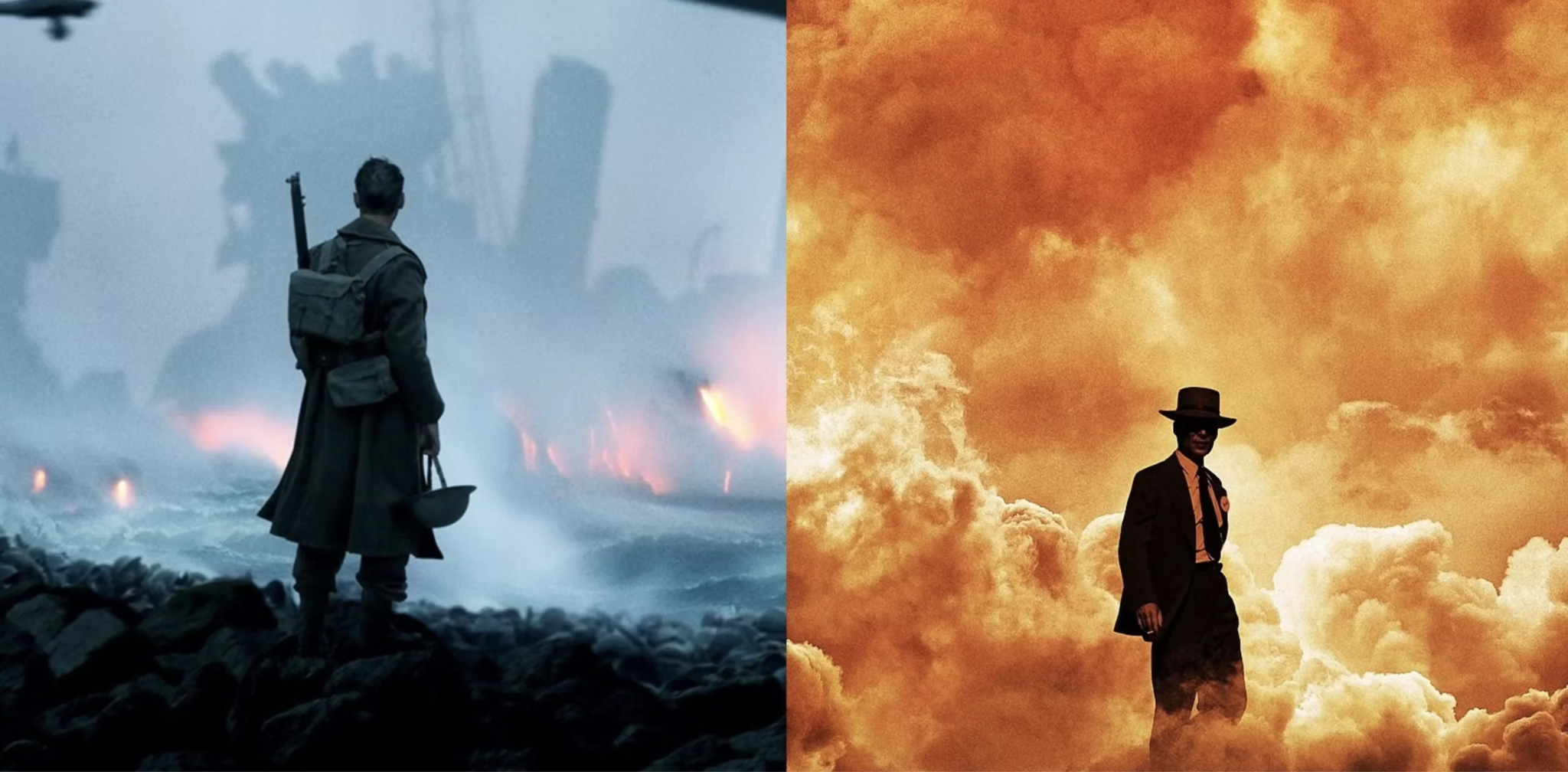
Oppenheimer is an examination of the human condition: of innovation under pressure, pride, sacrifice, hubris and guilt. It also happens to be about the invention of the atomic bomb that put an end to World War II, accounting for a quarter of a million lives and injuring tens of thousands of innocent civilians.
Oppenheimer (Cillian Murphy) is presented as a tormented genius, an intellectual, a philosopher and a flawed hero. He is evidently well read, urbane, born into privilege, idealistic. These are all attributes that lead to his meteoric rise as the father of the atomic bomb, while being directly responsible for his rapid fall from grace. Wracked by guilt in his role in killing innocent civilians, he becomes a prominent advocate in a push to reduce nuclear proliferation, a set of views unpopular with the calculus of the Cold War. His principled stand leads to his disgraced exit from the national stage. It’s a wonderful performance by Cillian Murphy, capturing the sheer weight of responsibility, the quiet joy of success and the aftermath: a worn-out celebrity grappling with his legacy.
While being an influential voice in scientific circles, Oppenheimer barely understands human nature. Lacking street smarts, he believes he floats above his peers, that societal norms don’t apply to him.
His hubris is reflected in his romantic liaisons, almost all unconventional, marriage not really viewed as a significant commitment. That same characteristic is well portrayed in his public humiliation of Lewis Strauss (Robert Downey Jr.). What should have been a simple policy discussion became a triggering event in his eventual downfall, his inability to understand Strauss’ persona proving fatal. He is as much Icarus as he is an American Prometheus, not comprehending the greater power of the forces he is dealing with.
Perhaps the best example of his naivety is his encounter with Boris Pasch, played by great malevolence by Casey Affleck. Oppenheimer cooks up a story about a leak and security violation, simultaneously trying to be a good citizen while valiantly protecting those he cares for. His belief that simply offering up this information will give him latitude with the hardened military intelligence in a time of war is astounding in its absurdity.
The shrewdest judge of human character in this film may well be General Leslie Groves. Matt Damon plays the role with charm while always reminding the audience who the alpha in the room is. He understands the immense logistical and technical hurdles to win the nuclear race; he needs Oppy’s unique leadership skills; he reads and plays him beautifully. Gives him the illusion of control, while still having him under his thumb. It’s a strange bromance, of two widely different temperaments who deliver extraordinary results in a very short period of time.
Oppenheimer leans on two characters for strength and moral clarity as he gets lost in the labyrinth of life. David Krumholtz steals the show as a jocular, insightful Isidor Isaac Rabi, a fellow nuclear physicist. He is steadfast in his loyalty to Oppy, while being clear eyed about the moral consequences of the Manhattan project. My favorite interaction is when he asks Oppy to get out of military clothing: reminding him he is a scientist first. The second significant support is his wife Kitty played with alternating charm and ferocity by Emily Blunt. She is the fire to his ice, always strengthening his resolve, pushing him to greater heights, protecting him against his own worst impulses. Her duel with the special counsel Roger Robb plays like an incredibly tense tennis game. Emily Blunt is excellent in this role.
I’m quite unmoved by two other critical characters. Personally, I felt Robert Downey Jr. is miscast as Lewis Strauss. The performance is a bit one-note, uniformly antagonistic, doesn’t reflect the cunning, calculating personality responsible for Oppy’s downfall. As a thought, Christian Bale would have been wicked in this role. The character of Jean Tatlock is severely underdeveloped. Florence Pugh does what she can with the role, but there is no chemistry between the characters, it’s unclear why she is so important to the protagonist.
The vast, ensemble cast is uniformly solid. The cinematography, editing and music score are top notch, Nolan and team have it down. And as always, the practical effects are a wonder to witness, especially the showcase of the Trinity tests, which is the big bang at the 2/3rd mark of the film. It’s not what stands out for me personally, despite fully enjoying these technical details on the big screen.
What makes this one of my favorites of Nolan’s filmography is that it’s his clearest, most coherent articulation of a common theme that repeats across time. About systems & organizations that need mercurial talent to do the impossible, and the slow, but inevitable decline in personal stature once the goal has been achieved. We as society lionize intellectuals, artists, scientists, politicians when their talents align with the current zeitgeist, only to discard them and move on when we have no further use for them.
This is amplified by the character of Albert Einstein (Tom Conti) who personifies the past to Oppenheimer’s present. Dismissed as an “has been” by Oppenheimer, he is the consistent reminder to the protagonist and the audience that history repeats itself. Both famous men are flaming comets tamed by the state and its relentless need for control. Strauss is simply a tool of the system, if it wasn’t him there would be someone else. The fall is guaranteed; it’s just a matter of the how and the when.
I tend to think of this as a partner piece to two movies that I hold dearly: Michael Mann’s “The Insider” & Ben Stiller’s “The Secret Life of Walter Mitty”. They are wildly different films but tap into the same emotions within me. Reminds me that to be human is to scale great heights, while gravity always wins. The best one can hope for is to be true to yourself and enjoy the journey while it lasts.
Hundred Tomatoes #1: The Dark Knight (94/100 Tomatoes)
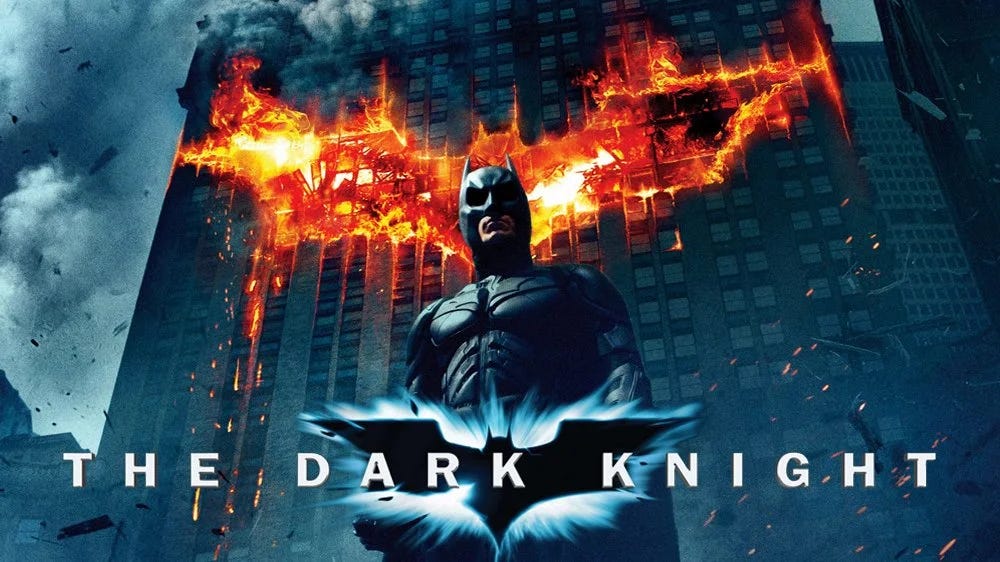
I could probably write entire articles dissecting the genius behind various scenes in this movie, especially the opening heist that introduces the Joker in such a legendary way, whilst beautifully incorporating his overarching anarchist worldview that drives his behavior. Unfortunately, if I walk through every single moment of “The Dark Knight”, it will span eight hundred pages, and ain’t nobody got time for that. I will stick to the top-level highlights instead.
First and foremost, The Joker in this rendition might be one of the best written movie villains of all time. I do not say that lightly. On the surface, he seems like a run of the mill crazy person, but behind the chaos exists a meticulous method to his madness that makes everyone question their sanity. All his actions not only set him apart as a mastermind that enables him to stay one step ahead of the curve, but they also embody a certain worldview that continually attempts to showcase that human beings like to pretend they operate by a certain civilized moral code, but when push comes to shove, will abandon that if it means survival. In many cases, people prove him right.
He tries to introduce anarchy in everyone’s lives in hopes of watching Gotham burn, and in some respects does so successfully. His antics create a sense of urgency, creating deep fears in viewers minds, along with characters in the movie. They eventually best him, but at what cost? His thought processes possess so many underlying motives that it does a number on everyone well after his eventual demise. It leaves a remarkable impact that is everything you want in a villain and more.
The way the Joker operates gives Batman/Bruce Wayne a massive character transformation, putting him through an existential crisis that pushes him to the brink. At certain points, he almost loses this battle but eventually comes to the realization that heroic actions go beyond doing what people want in the moment. He turns into a martyr of sorts, in hopes of keeping hope in Gotham alive through unconventional means. He even needs to act unethically to an extent catch the Joker. He keeps his main principles intact, but does so through immense struggle. The last lines in the film provide a beautiful mic drop moment that describes his role perfectly: he is a silent guardian, a watchful protector, a dark knight. It goes beyond the typical black and white views of “good” and “evil” with such profundity.
That is not to include all the other excellent character arcs that occur. People fixate on the Joker so much (and rightfully so) that it is easy to forget that Harvey Dent/Two Face starts out as an idealist ready to lead the way in Gotham, only to succumb to the Joker’s anarchist tendencies. The love triangle between him, Rachel and Bruce present a unique dynamic that creates additional levels of internal strife amongst them all. The way the Joker manipulates this individual as part of a grander scheme in the battle for the soul of Gotham creates additional intrigue.
Theme wise, this anarchism vs. idealism chess match that occurs throughout makes you deeply contemplate human nature, along with the various characters actions well beyond the viewing. While the Joker assumes the worst in others, seeking to tap into that amongst the public (and watch the world burn), Batman wants to bring out the best in the city by showing the importance of adhering to a moral code. The fire and ice dynamic, coupled with the underlying tension between Harvey Dent and Jim Gordon that encompasses the philosophies mentioned above, all concoct this insightful commentary on human behavior that brings out the worst in people, but also the best at the same time. I adore the thoughtfulness behind it all.
Along with all of this: the stunts, the hauntingly beautiful score (especially with the subtle mosquito like noise with every scene the Joker sinks his claws into) and world building all come together nicely. My only small knock is that the production design could be stronger. It does not feel uniquely Gotham enough.
Of course, I would be remiss not to discuss the acting. Heath Ledger puts on a performance of a lifetime as the Joker, bringing an unhinged derangedness that captivates you from start to finish. Not to mention his menace making you wonder where he is even in moments you do not see him on screen. Christian Bale, Aaron Eckhart, and Michael Caine also all beautifully bring compelling range to the screen as well.
“The Dark Knight” reels you in at the start, and never lets you go until the goosebump-inducing final scene. It is a one-of-a-kind cinematic experience that I am not sure will ever get replicated in the future. The iconic line said by Harvey Dent, “you either die a hero, or you live long enough to see yourself become the villain” carries its way throughout the course of the film, playing out over several character arcs. Most importantly though, I hope this heroic movie never dies, because it is a timeless classic. And not only my favorite Nolan film, but one of my favorite films of all time.
Well there you have it, our favorite films from Christopher Nolan! Be sure to check out DJ’s work when you get a chance. Also, which works of the man in question are your favorites and why? Feel free to comment below.
Comments
Nothing yet. Say the first thing.
Sign in to join the conversation.