
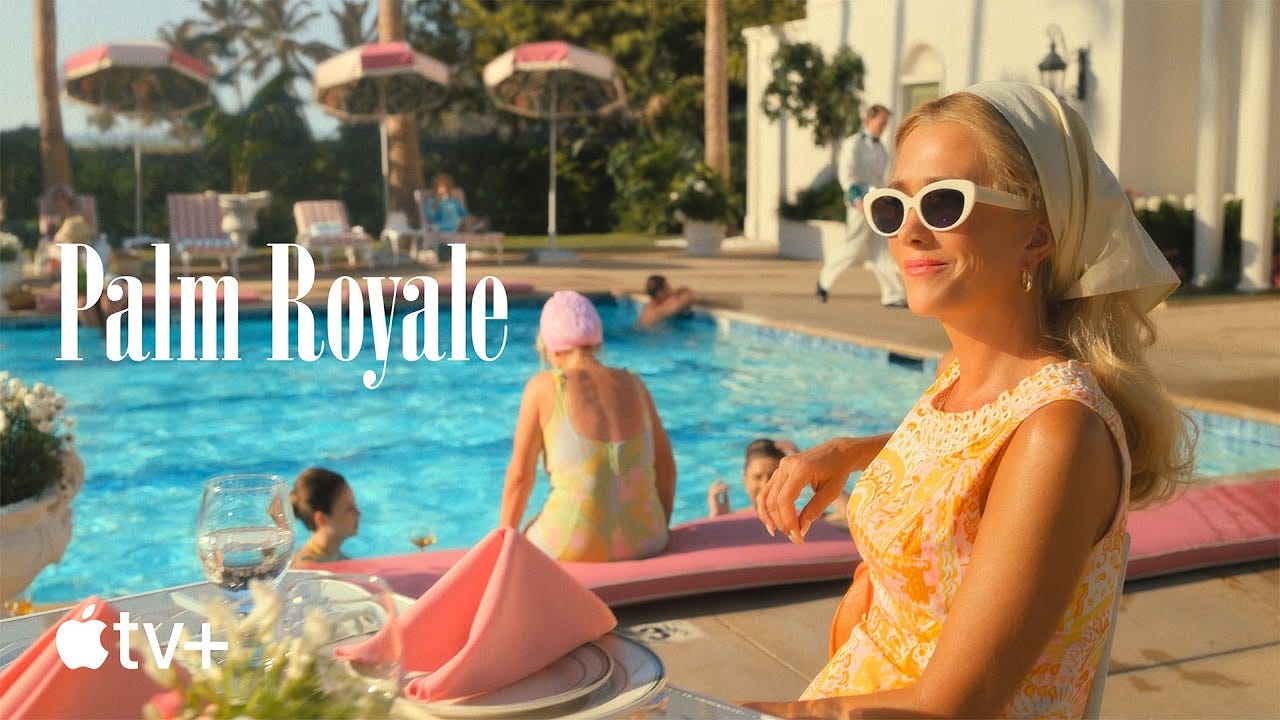
What do you get when you cross a star-studded cast featuring the likes of Kristen Wiig, Carol Burnett, Laura Dern, Julia Duffy, Alison Janney, Ricky Martin, Josh Lucas, and a ton of other high-profile names with an all-encompassing environment straight out of the 60s?
The answer: You get Abe Sylvia’s Palm Royale, a series on Apple TV that follows Maxine Simmons (Kristen Wiig), an ambitious outsider trying to break into exclusive Palm Beach high society. As she schemes to secure her place among the elite, she navigates hidden secrets, betrayals, and a high-stakes power struggle centered around the ailing socialite Norma Dellacorte (Carol Burnett).
The concept clearly intrigued people. According to data from Luminate, within its first week of release, it accumulated nearly 263 MILLION minutes watched, placing it in the top ten most watched streaming shows upon its initial release. Not only that, but the show landed a whopping eleven Emmy nominations for its first season and eight for its second one.
In a lot of respects, the 60s kickstarted top tier entertainment innovations, not just from a movie perspective, but also from a music perspective. The distinct styles from that era require a top tier composer who can bring it all together in a uniquely smooth, captivating manner.
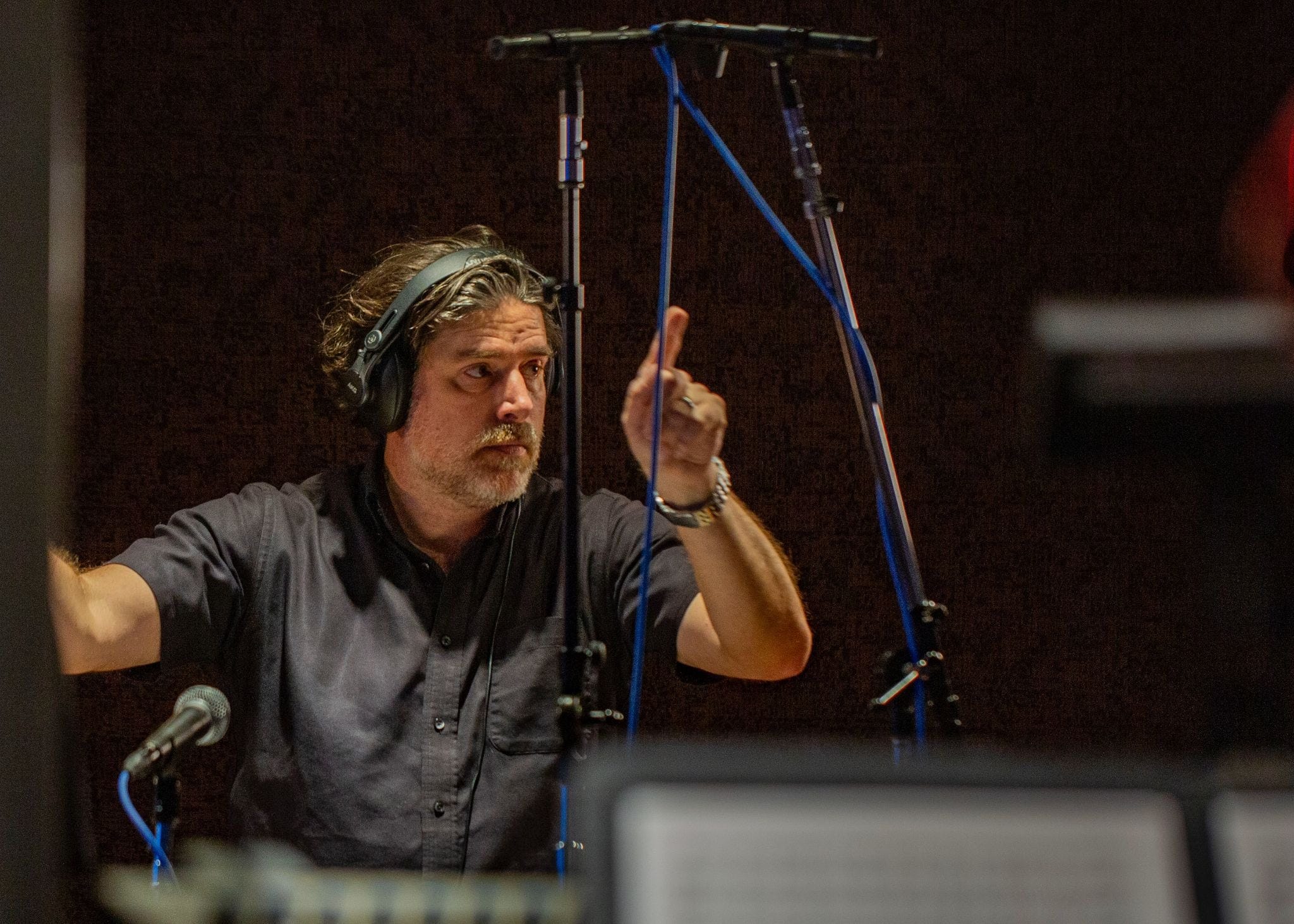
Which is why I’m excited to introduce composer Jeff Toyne, whose work on the show won him the award for Outstanding Original Main Title Theme Music at the Emmys back in 2024.
As a proud Canadian, Jeff blends orchestral virtuosity with cutting-edge technology to tell stories with a distinctive musical voice. His recent score to Apple TV’s Palm Royale (Kristen Wiig, Laura Dern, Carol Burnett) effortlessly combines jazz, Latin, and orchestral elements to evoke the late 60’s in a modern cinematic way.
Alongside this show, film credits of his include “Daughter of The Wolf” (Richard Dreyfuss), “9/11” (Charlie Sheen), “Life on The Line” (John Travolta), “How to Plan an Orgy in a Small Town” (Jewel Staite), and “Dirty Girl” (Juno Temple and Milla Jovovich).
For television, Toyne scored Fox’s “Filthy Rich” (Kim Cattrall), DirecTV’s “Rogue” (Thandiwe Newton) and “Hit the Road” (Jason Alexander).
As someone who frequently collaborates with Patrick Stump, Toyne did string arrangements for Fall Out Boy’s latest album, “So Much for Stardust”.
Over his career, he has orchestrated over one hundred Hollywood releases including “The Super Mario Bros. Movie” and “District 9.”
A Sundance Composers Lab alumnus, Toyne is one of Playback Magazine’s “Ten to Watch”. He composed “Splendor Sine Occasu”, the March of the British Columbia Brigade, for the Canadian Armed Forces.
Jeff was incredibly fun and insightful to talk to. I hope you all take away as much from this conversation as I did.
Without further ado, let’s get to this interview!
What inspired you to become a composer?
My composing career started to take shape as my performing career started to lose shape. I started a music degree at university with a secretly held hope that I would eventually become a performer. My instrument was piano. In the first year or two, I started to develop tendonitis, but I also began to get some clarity about the reality of what would be required of me and what I was working with technically.
So piano performance wasn’t going to be realistic. But in that environment, I was exposed to courses in counterpoint, harmony, and form, and I really found an aptitude for that material. That’s how my composition career began to take shape as an undergraduate.
The music that I liked to write for the concert stage had a dramatic sensibility and a very eclectic set of influences. I saw how all of that could lend itself well to film and television.
But more than that, there were two things. First, I saw films as being very similar to what Wagner saw his operas as. He called them Gesamtkunstwerk, these total artworks. Here’s a place where artists from all sorts of disciplines are coming together to create an experience for an audience that’s more than the sum of its parts. I was really interested in that. I also really enjoyed being an audience member for film and television.
More than that, film and television seemed like a place where I might get more opportunities to be in a room with an orchestra than I would as a concert composer. Writing music and having it performed by an orchestra is a transcendent experience. That’s the rush that I’m addicted to. I love anything that gives me an opportunity to write music for a big group of players.
What would you say separates the best composers from the rest?
I think, for a long time, we really remembered the composers who gave us melodies that stayed with us. Those melodies captured the essence of the characters, the shows, and the stories, and they were something that audiences could take home with them.
I personally have a soft spot in my heart for composers who were great melodists. That isn’t to say there aren’t other tricks to the trade that I’m a big fan of, but if I could only be good at one thing or aspire to one thing I think that’s where the real money is.
I got to spend time on Palm Royale, and when we were doing background research, the inspirations for the show were in the ‘60s. That provided a terrific opportunity to dig into the repertoire of composers like Henry Mancini, John Barry, Michel LeGrand, Bernard Herrmann, and Lalo Schifrin.
There were so many fantastic composers working in the ‘60s, so it was a real treat to go back and enjoy their work. Mancini comes to mind as somebody who has some real bangers. His melodies have a great way of being full of character while also being incredibly earwormy. They really stay with you for a long time.
I think all of those are great examples, and I definitely caught a lot of the ‘60s influence within the Palm Royale score.
What’s something about composing for film and television that audiences may not know, but that you wish they did?
I suppose people really have a lot of exposure to stand-up comedians these days, especially the ones who do crowd work. Those comedians are making things funny by reacting in the moment and making jokes about things that are happening right off the top of their heads. They have incredibly quick wit.
It’s easy not to be aware of just how fast you have to be at writing music in order to write music for film and television. Compare that to music composers who write for the concert stage, where they might have an unlimited amount of time to write a piece. In those cases, you can take all the time you need to get it right.
Film and television are a different animal. The deadlines are ever-present, and they really shape the way the music comes to be. Being a film and television composer means being a composer who can write music on demand. You can get something requested Wednesday, but it’s due Monday.
So, when it’s good, it’s amazing that someone came up with that idea and did it quickly. That’s something you’re not necessarily aware of as an audience member.
Palm Royale is obviously a big project that you’ve been working on. What about it, conceptually drew you into it?
The people making it were the first draw. I was a huge fan of the creator and showrunner, Abe Sylvia. I’ve known him going back many years. I worked on his student films when he was at UCLA. He’s a joy to work with and has a fantastic creative vision that all his department heads can attest to. He creates a really fertile creative environment for his shows. He had me at hello when the phone rang.
But the show itself also boasts all kinds of exciting opportunities. Number one was the opportunity to work with this murderer’s row of actors and actresses. It’s a fantastic cast, and they’re firing on all cylinders on screen. It really was just my job to keep up with the high level of production.
The way the show looks, from the costumes to the set design, hair and makeup, and the way it’s shot: everything about it is beautiful and appealing. It’s really nice to work on something that looks so great.
Then there’s the subject matter itself. Because the show was a period piece, Abe had this idea that we should make the show as if we were making it in the late ‘60s. For me, musically, that didn’t mean limiting myself technically to whatever recording technology was available back then.
What I took it to mean was that we were going to create a score that was very melodic, colorful, orchestrally vibrant, and energetic. It was going to lean into some pop influences from the ‘60s, like jazz and Latin music, while also speaking to the geographic setting of the show. The opportunity to write that kind of music to support this kind of show was really exciting when they brought it to me.
When Abe first brought it to me, the only thing he gave me to describe how he wanted the music to sound was a photograph by Slim Aarons. He said, “I want the music to feel the way this photograph feels.”
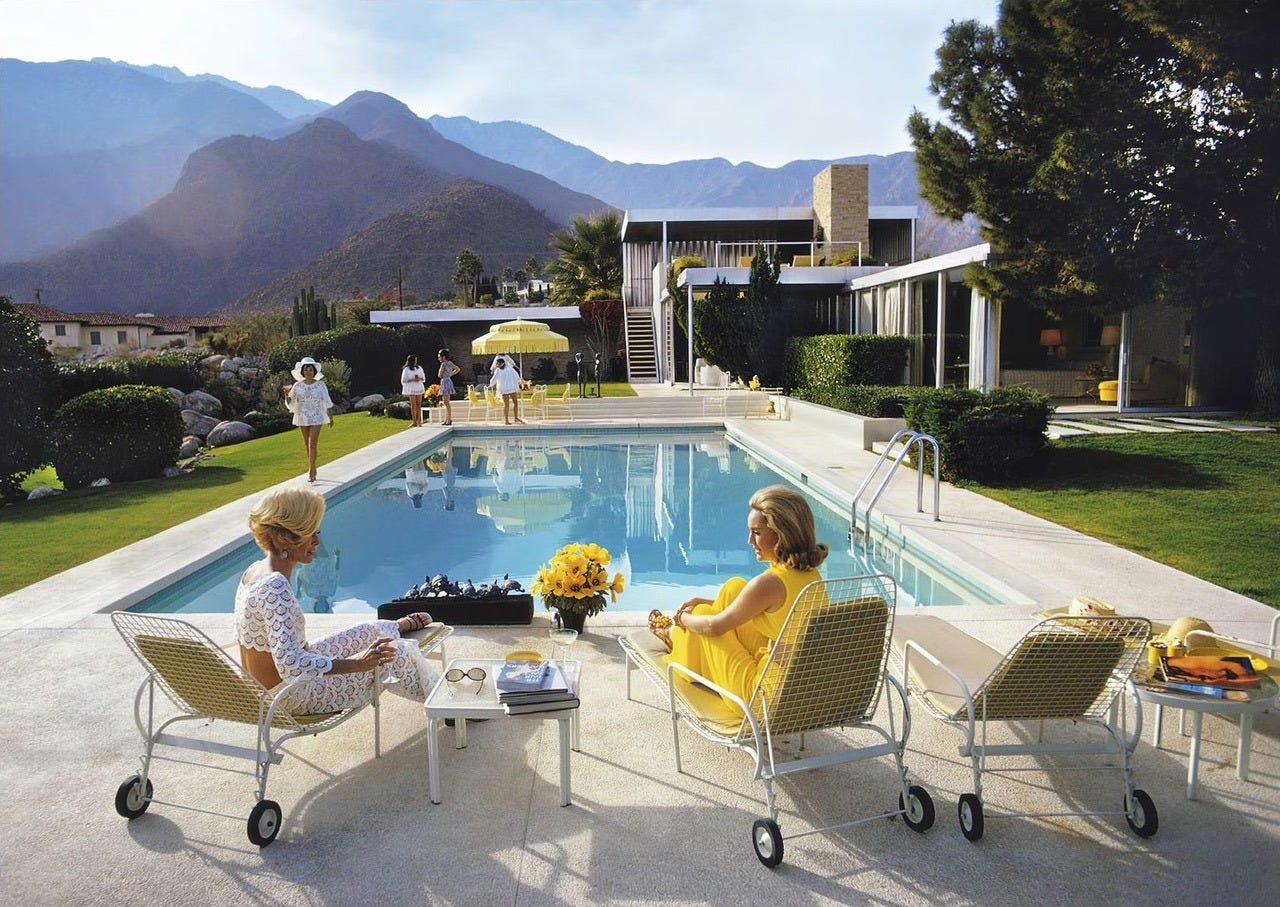
I said, “Come on, man. We’ve known each other a long time. You can’t give me anything more than this?”
And he said, “No, man. You’ve got to run with this.”
Then, later, to see the show and see how they took that photograph and brought it to life… It was incredible. He clearly had a plan.
That was one of the most unusual briefs I’d ever received when I was first told about a project. Interestingly enough, there are scenes in Palm Royale that really ended up looking like that photograph.
What was the collaboration process like between you and the showrunners?
I leaned on that relationship with Abe because the style of music we were undertaking was music that relied on jazz and improvisation. It really comes to life in the studio when the musicians work their magic on it.
It’s very challenging to make a computer demo or mock-up of this music in advance, which is the most common way we’ll do things. You put together a sketch or an idea of what you think the music should be, and we’re now required to have our demo mock-ups be very convincing and sound almost like the finals.
But with this kind of music, if you’re going to have incredible musicians utilize their strengths, you have to leave room for them to improvise a little bit. That required a little bit of trust. My demo wasn’t going to have everything in it. There was going to be an extra level when we got to the recording session.
The time constraints of the regular television process don’t really allow for much of that. So, Abe was able to listen to something and say, “oh yeah, this is a demo. I know this is going to be more. It’s going to be better.”
I also worked closely with some jazz musicians to play in my studio and made demos with just one or two musicians on a cue. But these are large ensemble pieces, so it was very challenging to create demo mock-ups of jazz. It kind of just happens when you record it.
Our time machine was in the shop unfortunately, so it was very difficult. We had to make some uneducated guesses and have a little faith that it was going to be great. Luckily, the musicians we were working with were fantastic.
You won an Emmy recently for your work on the opening theme of the show. How did you go about composing that?
When I came onto the show, I didn’t come on early. I came on late in the process. So, I had to generate a lot of material quickly.
Something that people don’t realize is this: while it’s not the same on every show, as other composers’ mileage may vary, I’ve had the experience a lot that when you get hired to do a show, that doesn’t mean that you’re hired to do the main title. The main title was just an option.
You might also do the main title, but you may not. They may decide that they want to use a song instead. Or there’s shows where, the composer of the main title just does the main title only, and then somebody else does the rest of the score for the show.
So, I’m hired to do the show, but I’m kind of pitching to have my music also be in the main title. There’s a calculus that the more time I spend trying to win out for the main theme, that’s time that I’m taking away from a job that I actually have, and those deadlines aren’t going anywhere. It’s not a sure thing. It can become quite dangerous to spend too much time on it while letting other works slip through the cracks.
But I was really hopeful because I do feel that if you are able to be the composer and you get to start setting the stage musically right from frame one with the main title, then carry on through, I feel that that’s a more satisfying artistic exercise. You really get to stay with the audience. You start with them and then you carry on with them. Luckily, that’s how it went. We carried those themes throughout the rest of the show after we introduced them in the main title.
One of the first things I did was come up with theme ideas for the different characters and ideas in the show. I generated as many ideas as I could in a short period of time and presented those. Abe was like, “I like this one better than that one,” or “I think this one could work here but not there.”
What we came to realize, or maybe it was just me, was that I wasn’t going to be able to have one theme for Maxine. Maxine was such a big character, played so amazingly by Kristen Wiig. She’s a three-dimensional character with different aspects to her personality.
For me, it was easier to have themes for different parts of her personality rather than one overarching theme that contained everything.
Those themes all ended up in the main title. The main title became, in a way, is a portrait of Maxine. We had a theme for Maxine aspiring: she’s always rising. We had a theme for Maxine sneaking around and being mischievous or Machiavellian. And then we had a theme we’d call Maxine winning.
So, in the opening, all three of those ideas come together. One of the things about the main title is that it’s not really a monolithic, singular piece of music. It’s a little bit episodic, even though it’s only a minute and fifteen seconds. But it does encapsulate all of Maxine’s dimensions.
That’s how it came together. Those were the themes, and in retrospect, I guess it makes sense that the themes for the main character would make sense as the main opening title for the entire show. This really is Maxine’s journey. It’s her show.
From an Emmy perspective, what was that experience like leading into the day you received it, and even in the aftermath?
Composer: That was a really wonderful, surreal experience. It was very rewarding to be lauded by my peers and acknowledged. I also felt that it was an acknowledgement of the role that all of the live musicians we used on the show played. I think that really had something to do with the impact the music had on people. I think there’s really a place for live players and live music in this exercise.
The ceremony itself I was a part of doesn’t really get seen by the public, but it is very similar to the one they televise. Everybody’s wearing tuxedos and nice suits, people are wearing beautiful dresses, and it’s all on the same stage.
You have to remember that that evening, Palm Royale was up for 11 Emmys. All the crafts were represented, and I think Carol Burnett or Kristen Wiig were nominated for acting as well.
As the night goes on, music is near the end. That’s one way to know where you sit in the order of the awards. By that time, every Emmy Palm Royale had been nominated for had gone to “Shōgun”. It was a behemoth of a show and was walking away with everything. Sometimes that’s just the way it goes: one show can start accumulating awards and then gets this kind of gravity that pulls everything towards it. It was a fantastic show, so I get it.
The showrunner, Abe, was sitting in the audience, right down front and center, next to Kristen Wiig. He was watching all these awards go to another show. Then, when they finally announced that we had won for the main title, he was so excited. He let out an audible expression of vindication. I think the people around him thought he was the composer because he was so visibly excited.
I made my way from the side and went up. You get to give a speech, and it’s quite challenging. They tell you that you have 45 seconds. You have to figure out how to thank all of these people in that time. I’ve been doing this for a really long time before I ever had to conceive of giving a thank-you speech like this. There’s a lot of people to thank when you start thinking about it, and it goes back a number of years. But you’ve got to keep it down to 45 seconds.
Then, when we got there that day, they said, “Oh, did we say 45? We meant 30.”
So think about how difficult it is to take a 45-second speech and get it down to 30. I thought to myself, “how do I make sure to thank everyone? Can I use collective nouns for people? How can I get this even shorter?”
The one thing I did write down was who I wanted to thank first. I was pointing a lot. I pointed right at Abe in the front row and said, “The first person that I want to thank is my wife,” and pointed way over to the other side of the room.
The cameras actually went over to her. It was really great.
So that’s what I got. I felt like maybe I was kind of faking him out, like I was starting here and then went over there, but we definitely came back to him, so it all worked out.
I got to start by thanking my wife, and I was very glad I got that right. My wife is a film composer as well. I’m bouncing ideas off her all the time, and she’s supporting me on my shows while I’m supporting her on hers.
She worked on Palm Royale too, in a bunch of different roles. She’s also like my editor, constantly telling me, “No, no, no. Go back in and do another version. You’ve got to do that again.”
She’s really unforgiving when it comes to telling people how something went. If it’s good, she’ll tell you, but if it’s not, she’s very honest about it. I’m really lucky to have somebody who can give me real, honest feedback and criticism about the work I’m doing.
You’ve now had two seasons under your belt with Palm Royale. How has the score changed or evolved from season one to season two?
For starters, the show changed from season one to season two. It took a little bit of a darker turn in terms of the storylines. They spend a lot of episodes trying to prove that Carol Burnett’s character is a serial killer. So, there are some darker subplots and storylines.
At the beginning of the season, Abe said that he wanted to change our original brief. For season one, it was, “Mancini meets Bernard Herrmann, but Latin.” In the second season, they said, “We really want to lean more into Bernard Herrmann.”
They were referencing some hagsploitation horror films. I’m not sure if you’re familiar with that genre. To be honest, I wasn’t familiar with it at the outset, but once I looked it up, I was like, “Oh… Okay. Let’s get to work.”
In the ‘50s, ‘60s, and even the ‘70s, there was a trend where they would get really famous actresses who were no longer working as much because they were older and cast them in these horror movies. Think “Whatever Happened to Baby Jane?” or “Hush... Hush, Sweet Charlotte”. It’s a subgenre of horror that stars these grand-dame actresses.
Abe had that as an influence, so he wanted to lean more into Bernard Herrmann. I felt like there were already shows out there leaning in that direction. I think what makes this show special is the fact that we’re leaning into Mancini, because I think that’s a little rarer.
There were fewer moments in season two where that was appropriate dramatically, though. So we wanted more and more and more of the big orchestra with very dramatic and melodramatic music.
In addition to that tonal shift toward the darker side, season two also gave us more opportunities for on-screen performances. I had started really late in the process of season one. With season two, we could see it coming well in advance.
I was involved in the on-screen performances, and they wanted more of them. Season one only had one major on-screen performance in the tenth episode, when Kristen sang “Is That All There Is?”
In season two, the show opens with a big Ricky Martin number. Carol Burnett sings a number. Kristen Wiig sings a number. Allison Janney joins her at the end of that number. And then Patti LuPone has a number.
There are all these big song-and-dance numbers on screen. As the composer of record, I was involved in the arrangements and recordings and in producing all of that. That required me to be on set for a number of days while they were shooting those sequences.
That was a really exciting bonus. Normally, they come looking for you when everything has been shot and they’re already deep into editing. This was an exciting opportunity to interact more directly with the on-screen talent.
Usually, we don’t get to see them except maybe at an awards show or the premiere. And the cast and crew had a real family feeling, a real esprit de corps, on the set. It was really exciting to see that in person.
You mentioned you got to work directly with the cast, which is awesome. Generally speaking, what would you say have been some of your favorite moments working on Palm Royale?
Being in the studio with these legends was absolutely up there. Recording Carol Burnett and Patti LuPone, Ricky Martin, and Kristen Wiig were all unforgettable experiences.
You don’t think of Kristen as a chanteuse. She comes into the studio very demure and reserved. Then, she gets into the booth and just belts out this Broadway showstopper. And then afterwards, she’s like, “was that good?”
And I’m like, “Yeah, that was great. Where have you been hiding that?”
So those opportunities to record and collaborate with the stars of the show definitely rank up there.
One of the recordings we did with Patti LuPone was this Americana number, a little bit bluegrass, based on an old Patsy Montana song. The music supervisor, George Trecu, said, “Wouldn’t it be fun if we had a jug band to back her up?”
Sourcing a jug band wasn’t easy. It wasn’t easy to find a jug player in L.A. While I was trying to find someone, I thought, “Well, I better get the instrument myself.”
I like to come away with an instrument, even if I’m not the one playing it in the session. It’s easier for me to write for an instrument if I have it and can get my hands on it. I like to have at least an amateur level of familiarity with it. So as I was trying to find a player, I also found myself the instrument.
By the way, it’s not that easy to do a Google search for “jug.” That’s not what comes up first. And if you’re buying one, you’ve got to really read the fine print. Otherwise, you end up with something that’s four inches high, and that’s not what you’re after.
So, I bought myself a jug. When I found a terrific jug player named Arnold Leach in Portland, I asked him when he did his recording, if he could take a little video of himself so I could show the filmmakers how the instrument works.
People don’t realize how the instrument is played. They think you’re blowing across the top like a woodwind, but that would only give you one note.
The way it’s actually played, is by using the same kind of embouchure that you would as if you were playing a trombone, but without a mouthpiece. You make that kind of sound with your mouth, and the jug amplifies it.
So the jug player in a jug band can play any notes. They can play moving bass lines and essentially any pitch you want them to play. He played a written part, and when I got the video back, I was delighted that he had the exact same jug that I did. They were made in the same factory.
I was excited to explain this to the filmmakers. I said, “You’re never going to believe it. I have the jug, and I have the jug player.”
And they said, “Oh, great. Well, when we shoot it, she’ll have the band behind her and you’re the only guy in L.A. with a jug. So you’re it.”
So, if you look closely and see a guy play a jug in the background of season two, episode five: that’s me.
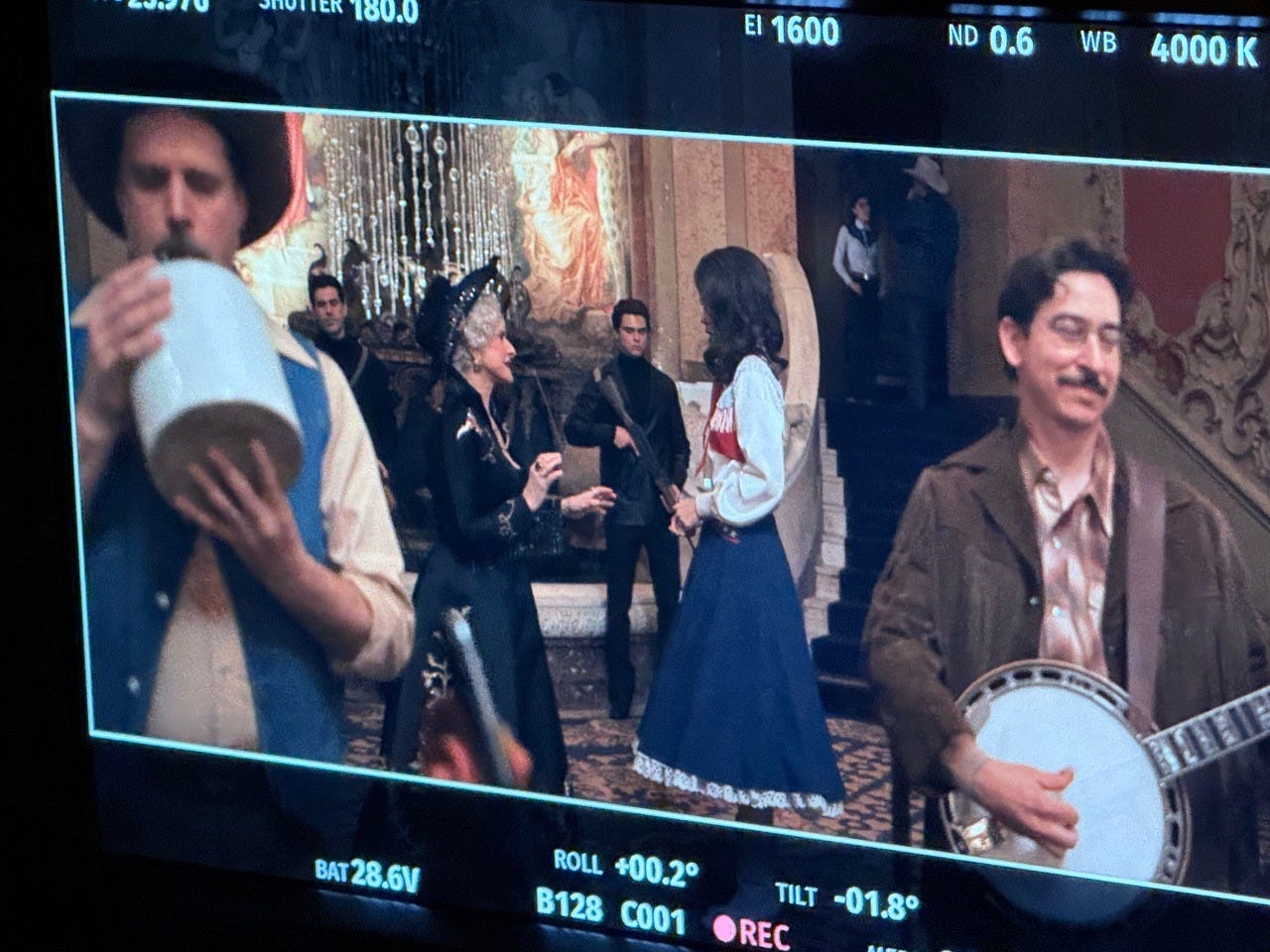
It felt different being up at 6 a.m., doing hair and makeup, putting on the costume, and getting ready. It’s one thing to be on set, but it’s something else to be on set and actually be folded into the production as a member of the ensemble. That was a treat.
You talked about the jug, which is such a great story. I’d love to learn about the decision-making behind some of the other layers within your score. You mentioned the ‘60s influence, what were some of the specific instruments you chose to use and why?
One of the instruments we used is an autoharp. It’s pretty common and used by a lot of folk players. You press the button, which gives you a chord, and then you can strum it.
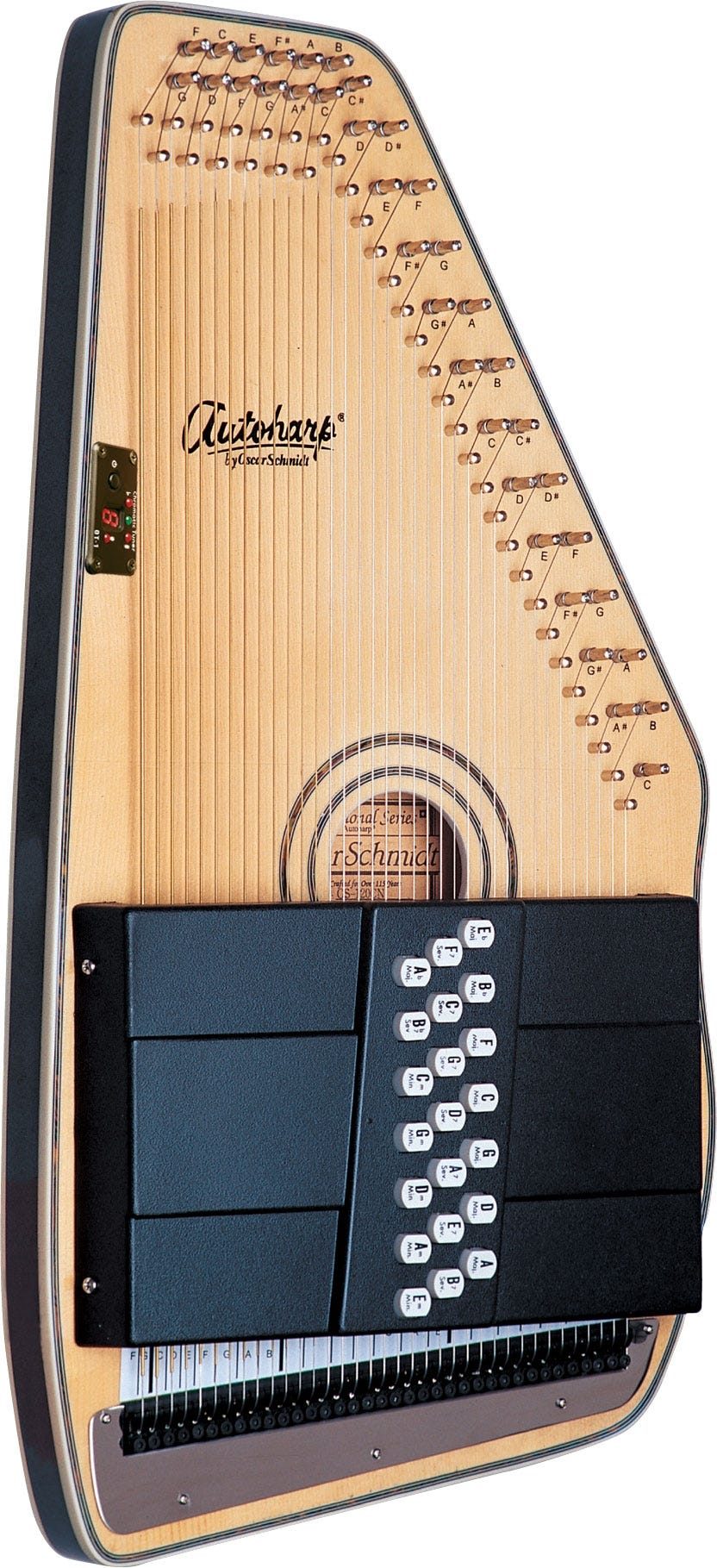
In season one, in addition to a couple of other instruments, I wanted to develop Maxine’s instrumental palette. I made the choice to attach specific instruments to specific characters.
I like the idea that, in addition to playing their melodic theme, you could also use their instrumental color to suggest them. That allows you to make some more connections. You can ask, “What if we’re playing Douglas’s theme, but we’re playing it on Maxine’s instrument? What does it all mean?”
So, in addition to their melodic themes, the characters also had instruments attached to them.
For Maxine, there’s a line in the first episode where Carol Burnett’s character says, “You don’t have that do-or-die sparkle.” I really wanted Maxine’s instruments to sparkle and have this light quality.
So, we had high piano, harp, celeste, and this autoharp. It’s also inspired by Mancini’s use of the instrument in “Experiment in Terror”. He actually put it to good use.
Then, when we got to season two, they started talking about Carol Burnett’s character, Norma, and her childhood in the Alps. I took that as an opportunity to be inspired by Anton Karas in The Third Man.
If you haven’t seen it: check it out. It’s an old black-and-white film, one of the first film noirs. The entire score for that film is played on this instrument called a zither.
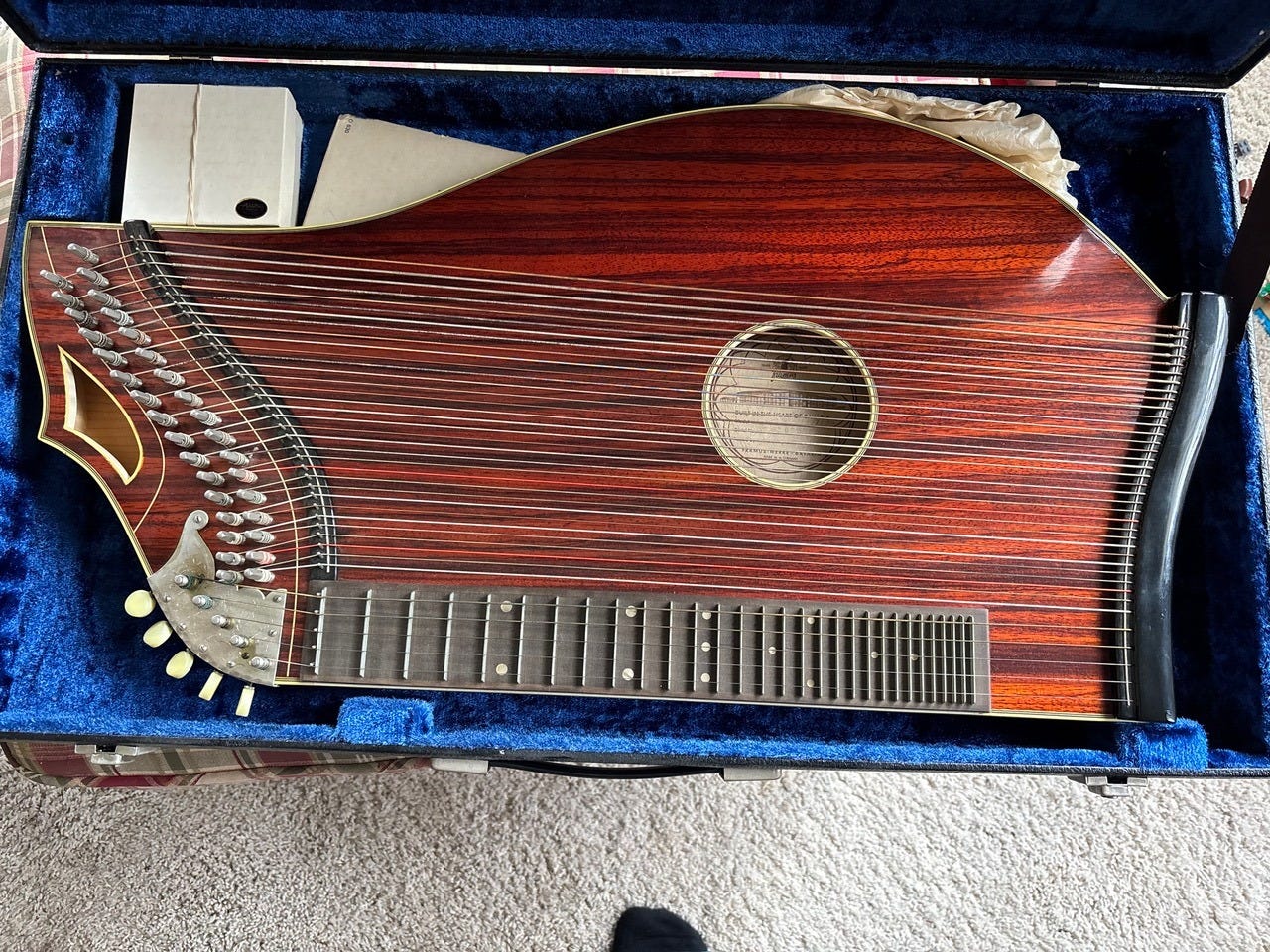
Almost all countries have their own version of the zither. The one I used was a Bavarian zither. You can see that this instrument has something in common with the autoharp. You can see how one might have evolved into the other. They have some similarities in the way they make sound.
Finding one of these was a challenge. By the time I found it, I think I had to go to Craigslist and I found somebody in Portland who sold me this one.
But finding someone who could play it was even more challenging. I had to go all the way to Bavaria to find somebody to play this instrument. I found a fantastic player, probably one of the world’s best, named Tomy Temerson.
We ended up finding a way to use this instrument. Norma and Maxine are members of the same family. Norma is her mother-in-law and I wanted to draw a connection between the two of them.
It was also a chance to bring this instrument to the forefront. It has a real character to it and draws back to an older time and a continental European setting. So that was one of the sounds I thought would be fun to draw on in the second season.
Other characters have more straightforward instruments. Ricky Martin’s character is an ex-Marine, and there’s a scene where he’s playing trumpet. Trumpet was a very natural choice. He plays trumpet on screen when he’s serenading Norma in season one, so it was natural to have his theme be a trumpet-played theme.
From there, it went out.
I think it’s really the orchestra, though, that bewitches. I endeavored to have a woodwind-heavy sound for season two, inspired by the older Bernard Herrmann recordings, which lean more heavily on woodwinds.
Strings are ubiquitous. A very modern sound is to have a string orchestra with very few winds and very little brass, lots of percussion, but strings, strings, strings.
Strings are a very common film and television palette. They work really, really well and sit transparently under dialogue. It’s much more challenging to get woodwinds to sit under dialogue.
Because of that, I took it on as a challenge. I endeavored to have a big orchestra with triple winds: three flutes, three clarinets, three oboes, and three bassoons. That’s 12 woodwinds all playing in the orchestra.
The challenge is arranging them, so they don’t stick out. They have lots of color, and they can draw your attention away if you’re not careful. You want them to be working without drawing too much attention.
That was particularly useful when we were doing film noir or horror elements. Those instruments were really helpful.
Shifting forward, what would you say are some of your future goals that you’re hoping to accomplish?
There’s no guarantee that any of this continues. I’m really blessed to be able to make a living doing music for film and television. I’ve been doing that for a couple of decades now.
I’m hoping to continue doing so. Things are changing fast. There are a lot of external forces at play these days, and the industry changes quickly. I’m looking forward to simply being able to work on great projects with great people and bring music to support those projects.
More specifically, I do like to work on projects that are going to bring the orchestra in. Those tend to require a certain budget level so we can support a large ensemble. I’m keen to do work of that nature.
Movies, too. I’m working on a film right now that I’m excited about with Abe Sylvia again, so I’m delighted to continue that collaborative relationship.
What would you say are your biggest pieces of advice for people who are trying to break into the industry, either from a composition perspective or just generally?
There’s an assumption people make that when you get an opportunity, you’re going to have the talent and the skills to back it up. They assume that you already have the ability and the talent, and that all you need is the opportunity. Then, when preparation meets opportunity, that’s the magic moment.
I don’t know why people always make this assumption that you’ve already put in the work, that you already have the ability, and that you’ve already done the homework to make yourself as knowledgeable in your craft and as skilled as possible with the tools of your craft.
Yes, you do have to find opportunities, but there’s plenty to be done to make sure you have the goods when you get the call. There’s plenty of preparation we can do to become really, really good at what we do, so that when we find an opportunity, we have the tools we need to do terrific work.
Study. Become a terrific musician. Become a terrific composer. Do the work so that when somebody needs a good composer, you can be that good composer. The moment you feel like you’ve learned everything there is to learn, you’re no longer that good composer they’re looking for. We should never finish learning.
Jeff, thank you very much for your time today. It was an absolute pleasure to learn all about your background and creative process! Be sure to check out Palm Royale on Apple TV when you get a chance.
Comments
Nothing yet. Say the first thing.
Sign in to join the conversation.