

Happy Sunday,
Humphrey here! I'm sitting at the airport in New York, waiting to board my flight home. I spent the past few days here, the main reason being the TIME100 Honoree Event, which your boy was featured in (haha). I also filmed a YouTube video with fellow creator Taylor Bell, where we go over 10 purchases she thinks are worth the money. Other activities included getting a famous NY Bagel, Van Leeuwen Ice Cream, a Broadway show, and some good dinners with friends and my girlfriend!
I’m currently working on a new show where I help people with their finances. We are closing in on 1000 subscribers over there if you’d like to check it out, and my plan is to bring the show to be recorded in person, instead of over video chat! If you’re interested in being a guest of the show and to get your finances audited by me, you can check out any video’s description and there will be a form to apply.
Enjoy the weekend!
- Humphrey

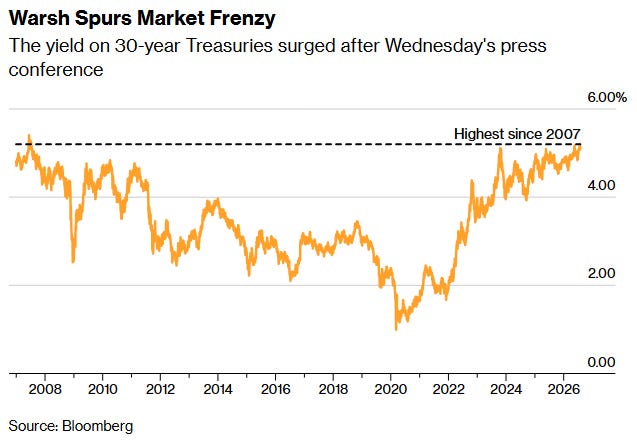
Kevin Warsh’s second press conference as Fed Chair rattled markets in an unexpected direction. Rather than signaling imminent rate hikes, he praised rising bond yields as a sign that markets are “doing the heavy lifting” for the Fed and suggested interest rates might not be the primary tool needed to control inflation.
Investors responded by dumping 30-year Treasuries and dialing back rate hike expectations, the opposite reaction from what inflation hawks had anticipated.
The Fed voted 9-3 to hold rates steady, but Warsh declined to explain the dissents or signal what conditions would trigger a hike, leaving economists across the spectrum puzzled.
Critics noted that his apparent comfort with market-driven tightening rests on shaky foundations as markets are only pricing in Fed hikes because other officials are signaling them.
If Warsh keeps holding and the data stays hot, that “passive tightening” narrative could unravel quickly, potentially forcing a more aggressive response later.
Adding to the communication uncertainty, the New York Times reported Friday that Warsh is now considering reducing the frequency of FOMC meetings, currently eight per year.
The AI boom is minting paper millionaires and billionaires at an unprecedented pace, and Wall Street’s private banks are racing to capture that wealth before it goes public.
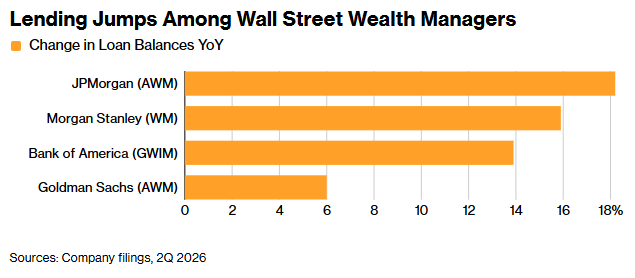
Loan balances at Goldman Sachs’s private wealth management in San Francisco are up 50% since 2023, while JPMorgan’s private banking lending demand has surged tenfold globally in recent months, driven largely by founders and early employees at AI companies seeking to unlock cash from illiquid pre-IPO stock.
Lending to a pre-IPO founder builds a relationship that can translate into a coveted underwriting role on the IPO itself, plus decades of wealth management fees afterward.
Morgan Stanley captured more than $70 billion in net new assets at its wealth management business in Q2 alone, largely tied to the SpaceX IPO, and is projected to generate over $100 million annually just from managing SpaceX employee wealth.
JPMorgan plans to double its San Francisco private banking headcount to over 200 people in the next five years to keep pace.
For investors and observers of the broader financial system, the surging appetite for pre-IPO lending raises familiar risk flags.
These loans are collateralized by illiquid private company shares whose valuations can evaporate quickly. pandemic-era startups that last raised in 2021 traded at an average 68% discount last year.
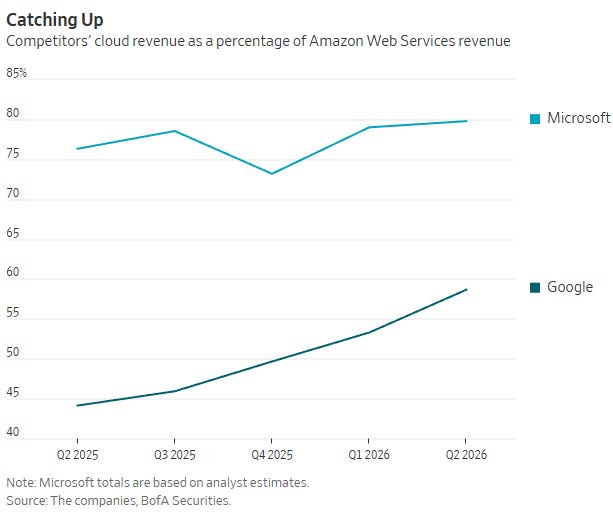
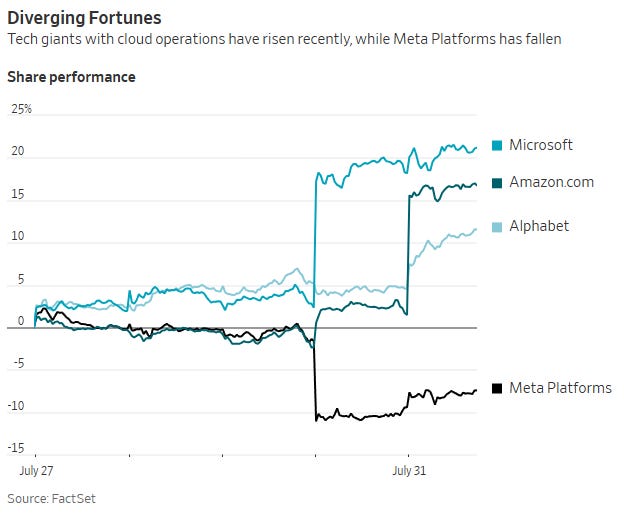
After weeks of investor anxiety about whether Big Tech’s massive AI capital expenditures would ever generate commensurate returns, the Q2 earnings season delivered a compelling answer: cloud computing.
Amazon Web Services reported 37% revenue growth, well above the 31% analysts expected, with a 39% operating margin and contracts averaging over five years in length, allowing CEO Andy Jassy to credibly sketch a path to $1 trillion in annual AWS revenue.
Microsoft’s Azure grew 43%, and Alphabet’s Google Cloud surged 82%, both beating estimates. The two companies combined added roughly $950 billion in market cap following their reports, with Alphabet recovering its earlier post-earnings losses almost entirely.
The financial model is straightforward and increasingly well-understood: buy computing infrastructure, rent it to AI labs and enterprises at premium margins, recoup the investment in under three years, and collect on long-term contracts.
AI spenders with cloud businesses are now viewed very differently from those without. Amazon, Microsoft, and Alphabet can point to concrete, high-margin revenue streams already scaling rapidly to justify their capex. Meta, by contrast, saw its stock slip after raising capex guidance with no equivalent cloud business to show for it.

Webull is running a promo: deposit $100, and they hand you between $36 to $3,600 in free stocks. Worst case, you just made 36% on money you were already going to invest. Best case is 36x that.
I use Webull to dollar-cost average into my boring stuff — mostly VOO. Fractional shares, no commissions, set it and forget it.
No posts
Comments
Nothing yet. Say the first thing.
Sign in to join the conversation.