
Sirāt is a strange film, it is one that hits every mark it aims at, and then, having sailed its audience into waters uncharted, decides that we must return, in plain speech, in almost happenstance, to salvation.
Sirāt is a movie about a man looking for his daughter; after hearing word that she may be at a rave in Morocco, he and his son set off to search for her. When they learn she may be at another rave deep within the Moroccan desert they follow a group of ravers hoping they’ll lead them to her. The film rests on this thin plot, providing little worldbuilding outside of it. We know through the van radio that the world is breaking out into a kind of third world war but we see little of it.
I do not enjoy Sirāt, that is not to say that I did not enjoy Sirāt. In singular beats it works quite well, it winds the meaningless violence from winding road to flat plain and its obtrusion, both sensory and emotional, left me feeling fulfilled. It is not an easy feat to fulfill and then disappoint. Where Sirāt fails is in the way the film holds up in retrospect; poorly. The nature of the film is one of vibes as Brian Tallerico writes in his 4/4 star review for www.rogerebert.com, Now I don’t care much for Roger Ebert, less so for the people who now run his site in their names, but I want to draw attention to the widespread adoration of Sirāt that it’s currently experiencing from Western audiences, they love the vibe. The vibe of Sirāt is shock; the value that shock provides is one that can only be experienced fully once; you will never get the same frazzled shout that the brain sends out when it sees something unexpected. The first time may harden your spine but the second jolt is usually limper. This flaccidity is not guaranteed, the measure of a jump is metered by the technical and narrative elements that support these shocking moments.
For example; Michael Haneke’s Funny Games (the first one) is endlessly enjoyable on a rewatch because the narrative and technical elements are wedded in a harrowing slow ramp of tension; exhalation of that tension in perceived salvation; and then, impossibly, Funny Games, at the most crucial moment of exhalation, containing no air in your lungs, having expended all that air on the effort of relief, it grabs a leaf blower and fills you right up again. While Haneke’s film does the narratively impossible, the structure that it creates, the film grammar that it builds up brick by brick allows this all to be true, allows the shock to be just as potent the second time around albeit for different reasons.
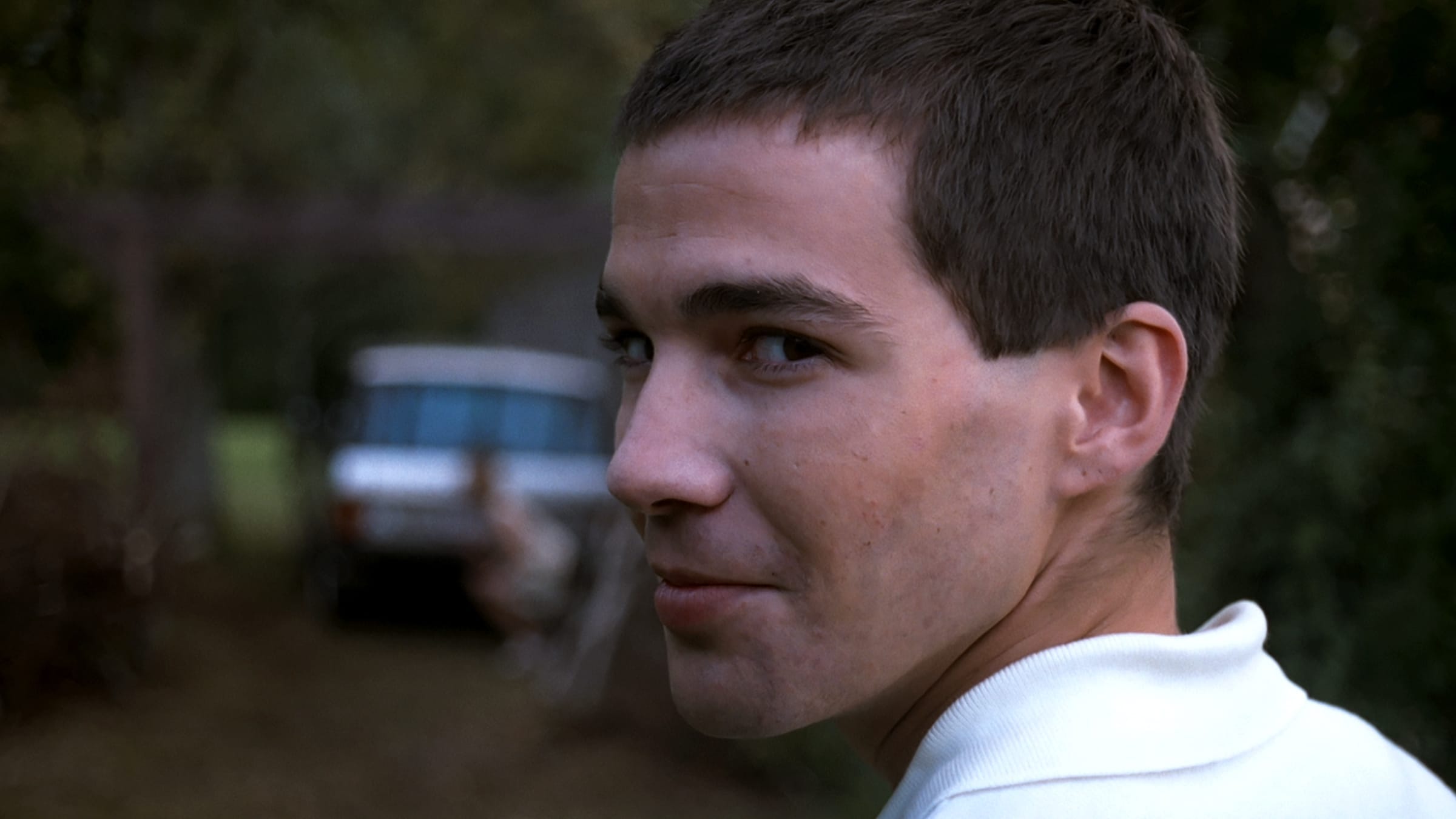
One doesn’t need to look only to Haneke for a shock facilitated by narrative/technical structure, William Friedkin is a master at this, his characters are never safe. With Friedkin, the camera is the main character. His stories spare no sympathy for what gets in the way of human nature. All of his shock is necessitated by a narrative structure that follows not people, but events. The narrative’s life-ending comes jarringly because Friedkin eschews the typical protagonist driven structure of most films. In a Friedkin film, a supporting character is just as likely to die as they are to become the main character.
Sirāt contains none of this elegance; and while part of its charm lies within this lack of elegance, the shock of the film; much like the industrial techno that scores it, is at first intrusive, attention grabbing, but after repetition becomes dull and tiring. See, Sirāt doesn’t really have a plot. It’s a hangout movie about the worst hangout that’s ever been hung. I love hangout movies, I loved swaths of Sirāt because of its structure as a hangout movie, despite knowing next to nothing about our characters, their mannerisms and quirks made me fans of them. Then bad things start happening to them and there’s only so much the surface level character work can do for them. None of them unravel in interesting enough ways to make their characters truly engaging when things go from bad to worse.
Sirāt plays no tricks, it gets worse, and then it gets worse, and then it gets worse, and then it makes a horrible choice of an ending and sets our heroes free. Sirāt at its worst functions as an idiot plot, a story that only progresses out of the vapidity of its main characters’ fated misery. By lending so much miserable realism to his characters, director Oliver Laxe reminds us that pulling the rug from under an audience only works when you can convince them to keep standing on the same rug. Laxe is a horrible rugs salesman.
The hollow feeling you get from Sirāt is not the kind of hollowness a viewer might feel from the climax of Gaspar Noe’s Climax, but rather a byproduct of the lack of good intention within Sirāt‘s storytelling. Whereas Climax ends with all for nought, Sirāt ends with all for, well I guess maybe something for someone but who can really integrate back into everyday life after that and there’s a world war going on so what’s it really matter? I dislike this film, I resent it, it annoys me, Laxe is making fantastically choreographed misery go to waste out of his insistence that he choke the charm and empathy from his film.
What keeps me thinking about Sirāt, more than the films technical triumphs, the sorry nature of its storytelling, the characters of which there are none (all characters in Sirāt exist only to suffer, be confused on the nature of their suffering and then most likely die, a fact that the film seems to relish, sending our characters into further agonizingly avoidable situations; on an open road, one can always turn back.), the score (which is decent). The thing that brings me back to Sirāt is Letterboxd1.
Laying around at home after driving home from the theater I found myself flicking my fingers back and forth on the Sirāt Letterboxd page; reading reviews in English (almost all in total praise) and copy-pasting-translating reviews in Spanish (almost all in abject hatred). I spent a long time reading these machine translations, figuring out the commonality in dislike, trying to figure out what was afoot.
What I parsed out from these reviews of Sirāt (that mostly sat around the half star mark, one if generous) was that Oliver Laxe is a bum. The most popular negative review begins by mocking Laxe’s understanding of geography (hilarious thing to criticize someone for regarding a film), and then ties that mocking from geographical to political; criticizing the European casts intrusion deeper into North Africa in pursuit of pleasure as the world ends around them; kino-colonialism if you will. In these reviews, Laxe’s failures are not only related to the narrative and the technical execution, but the political dialogue it attempts to spur. Laxe’s flaw, a flaw that reverberates throughout the entire film is that his attempted satire is so poorly executed it comes off as offending.
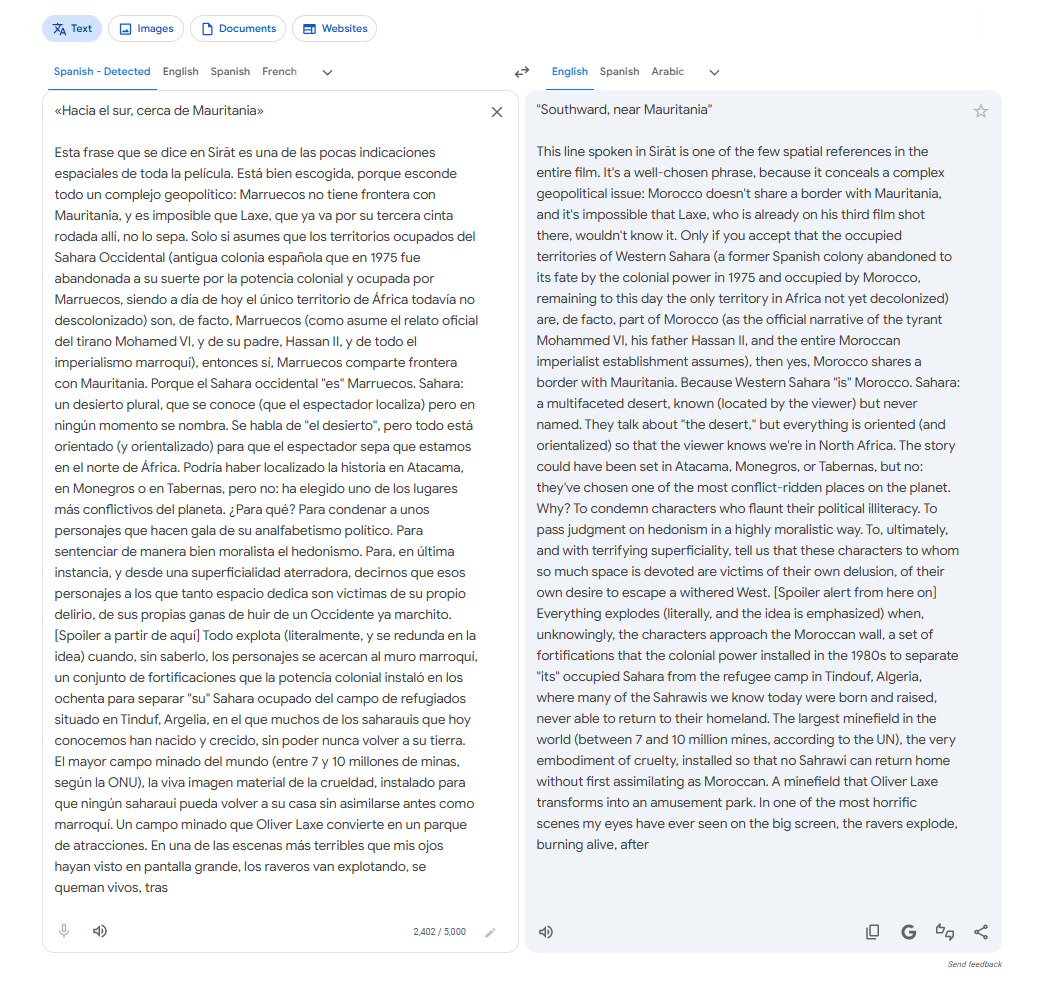
Despite having no understanding of the geopolitical situation in Morocco and the land surrounding it I can still feel the dissonance that reviews critical of the film mention. Sirāt is a film that approaches the narrative from an angle of shock but because it only approaches from that angle, never expecting empathy for its characters and so never giving them any; it means that the film can only do so much, and if done well can only say so much. To approach film from only one angle is to approach a corpse, a corpse can be shocking, a corpse can be interesting, but a corpse cannot live (barring resuscitation of course, for my purposes I discuss the medically assured slabs in the morgue). Sirāt‘s incongruence is its main flaw, the shock that works so well within the film cannot work outside of it. When I think of the events, the beats within it, I cannot help but feel that all that filmmaking feels like a big waste of time that Laxe intentionally decided to waste. There are films I love that are flush with wasted time, but they all use that time to show the indentation of what’s causing that wasted time. Dazed and Confused slumps around for an entire night in a small town and while nothing really happens, it’s managed to cement itself an emotional powerhouse, the slumping around is the point. With Sirāt the slumping feels tedious.
It is a difficult thing to criticize poorly done political work, it’s much easier to brush it aside and discard it as just another bad movie. When criticizing, one risks being perceived as against the politics espoused even that execution is just poor. One also risks bogging themselves down in cyclical conversations regarding the identities discussed by these films rather than the dialogue about the films handling of these identities.
Sirāt knows how to frame beauty, the shots of the vans driving through the night have a tantalizingly aquatic feel to them. Sirāt knows how to be a film, but it is not the one that it thinks it is. What Sirāt critically fails to do, the most important part of a film perhaps, is to act in tandem with itself, to acknowledge the dynamics between the shock and the resonance that shock leaves behind and create the neccesary scaffolding to support the story it wants to tell.
The ending speaks volumes on the intentions behind Laxe’s work; a spoiler follows. After our ravers are whittled down, by cliffsides, minefields, and thought (real plot point) they finally clear the immediate explosive terror and find themselves in a vast, impressively empty desert. The film cuts from this ultra wide shot with nothing in sight directly to a train winding through the desert, the train carries Africans, the first black faces we’ve seen since the first Rave. The camera lingers on these faces; black faces, one after another, tension mounts, have our protagonists survived? Then boom! White boy spotted! Then it cuts back to a few more black faces, then boom! White girl spotted, it repeats once again for our final face. Intact somehow, incongruent faces in incongruent settings. White beside black, African beside European. Laxe’s worst trait may be his complete lack of imagination, the final scene is just the last nail in the coffin.
The film’s political failings are firmly wedded to its narrative failing in this final scene. I would have preferred it end on the expansive desert, doomed to an expanse, only a slim chance of survival, I know these Europeans are out of their depth, I don’t need a visual confirmation of this in a ham-fisted fashion. If you want to punish them, moralize at them for their drug use, for their colonial ignorance, of their gullibility in their own capabilities, in their idiocy in not pulling handbrakes, then condemn them to their fate. Do not swoop them out of damnation. A more granular annoyance is Sirāt doeing some loose worldbuilding around a third world war. Are we supposed to believe that there is a third world war and the trains still run?
It’s a cop-out.
May be writing something big about comment sections, something about how we interact with each other on the internet and how that then reverberates into our irl lives. Let me know if I should fast track it or keep sleeping on it.
No posts
Comments
Nothing yet. Say the first thing.
Sign in to join the conversation.