
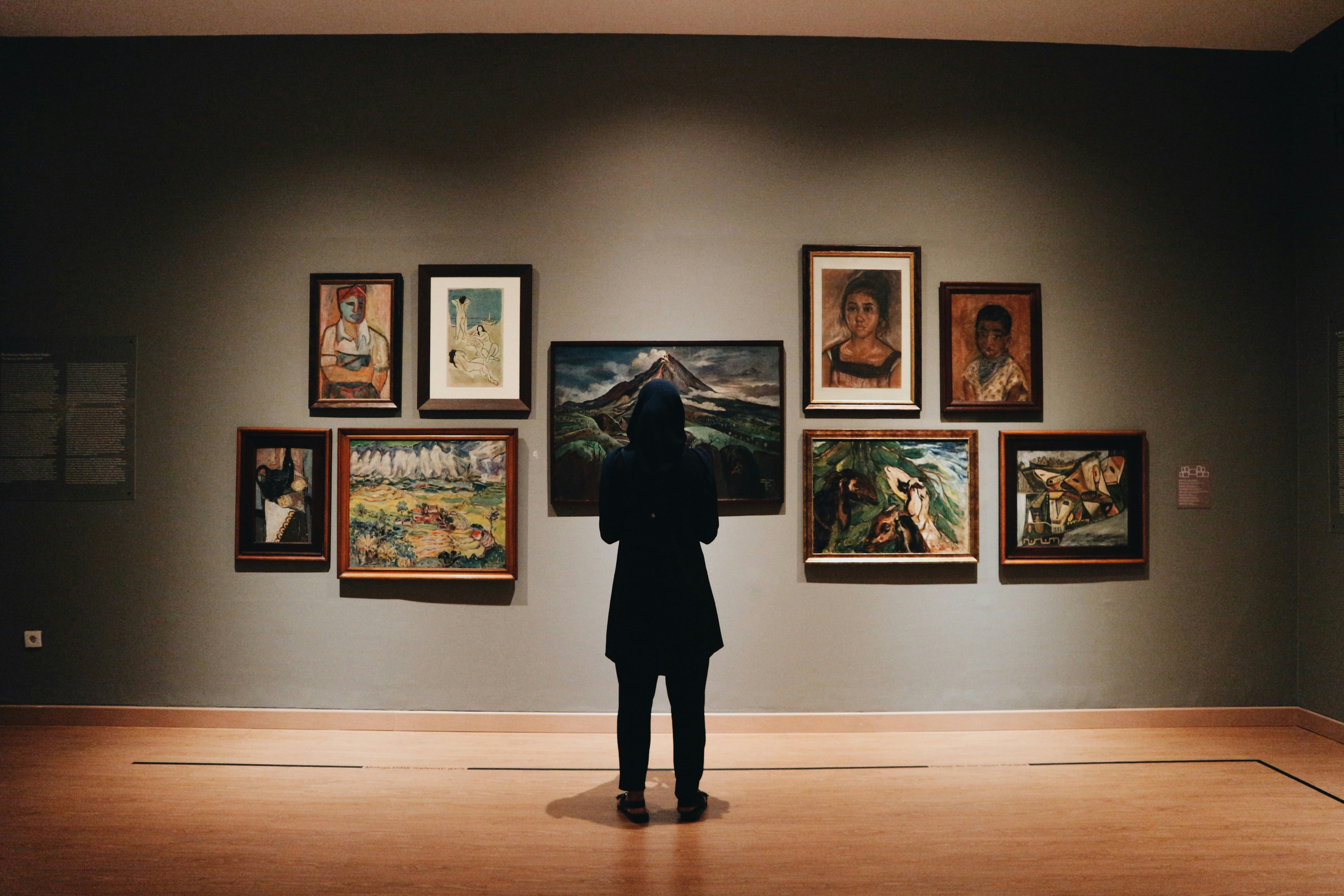
Photo by Zalfa Imani on Unsplash
Chapter 15
I recently attended a very special event - the opening of an art gallery. Even more special, the art gallery was being named after the friend who had invited me to attend. In terms of achievement, that’s surely way up in the stratosphere: likewise, in terms of legacy. To a large extent owing to the life and efforts of my friend, there is a new art gallery for future generations to enjoy.
You might think that my friend could rest on her laurels, take a back seat and, with a great sense of self-satisfaction, think, ‘Hurrah! I have done enough - I have made many a significant contribution to the world, the art gallery being only one - now I can relax!’ On the contrary - my friend has said that she suffers from imposter syndrome, that dreadful condition in which we feel that we are in some way fake or unqualified and any day now, we will be exposed as the charlatan we actually are.
Do not ever be fooled, therefore, into the idea that the next achievement will clinch it - we will finally feel like we have done enough and we will sink into our deckchairs with the sense of a job well done. Far from it - we are talking addiction here, so there is a real danger that every achievement will suggest the next and the next and the next.
Yet again, then, we wrestle with the question of how to solve the problem. How do we free ourselves of this scourge and feel comfortable with ourselves? We have looked at many possibilities: here are the main ideas again.
Becoming aware of our core beliefs/internalised rules and their origins and challenging them
Working within our values, rather than being goal-orientated, using the principles of Acceptance and Commitment Therapy
Becoming aware of the impact of our neurochemistry
Learning to accept discomfort
Being present in the here and now
Becoming aware of the messages of education within a meritocracy
Accounting for the power of the Protestant Work Ethic and the rise of Capitalism
Challenging the concept of Growth Mindset
Learning to seek Eudaimonic happiness
Noticing if we are covetous and of whom
Choosing not to see sex as performative
Practising ‘not-doing’ and learning from the Tao Ching
Challenging the narrative around ADHD
Becoming aware of our ‘script’ and learning from the principles of Transactional Analysis
We have touched in passing on the teachings of some of the world religions, perhaps most noticeably on those of Lao Tzu in the Tao Ching and of Jesus of Nazareth in the New Testament. There is a great deal more to learn from ancient writers.
With a group of friends, I am currently studying the Gnostic Gospel of St Thomas, which is a fascinating read. I am always struck by how much of it sounds very familiar, almost identical to Jesus’ New Testament teachings, but also how much is completely new. Scholars speculate that this additional material came from the Gnostic tradition but since estimates of the date it was written vary from AD 60 (very close in age to the earliest New Testament writings) to AD 250, who knows? These may be some of the collected words of Jesus or they may have emerged from the wisdom of the Gnostic community. Does it matter? In the Quaker tradition, one is asked: ‘Are you open to new light, from whatever source it may come?’
Let’s be open minded and see what the Gospel of Thomas has to say. The Gospel is divided into sayings called logia, singular logion. Please bear in mind that the first logion reads: ‘These are the hidden logia’. Rather like the Tao Ching then, the sayings can be interpreted in different ways. These are two of my favourites and, I think, are relevant to our discussion. My interpretation, however, is only one of many.
Logion 50: 16 - 18
It they question you, ‘What is the sign of the Father in you?’ say to them, ‘It is a movement with a repose.’
Logion 60: 16 - 19
‘You yourselves, seek after a Place for yourselves, within Repose, lest you become corpses and be eaten.’
The first, in particular, I find profoundly moving, in a secular world which has junked the concept of a Sabbath. It is telling me that the sign of God within me (you may prefer to substitute an alternative, non-theistic concept here, such as ‘higher self’ or ‘inner spirit’) is a balance between action and rest, not an endless, unremitting pouring out of myself in order to justify the privilege of my existence, a script which I fear I have absorbed. On this, I love what Oliver Burkeman writes in his recent book ‘Meditations for Mortals’. He says that we have:
‘the feeling that we need to get things done, not only to achieve certain ends, or to meet our basic responsibilities to other but because it’s a cosmic debt we’ve somehow incurred in exchange for being alive.’
Yes, thank you, Oliver, that’s exactly how I feel. My life is a privilege and I should pay for it and the payment will never be enough. Do I hear the credo of Capitalism here? Oh yes, very much so. And some exacting version of Christianity? Yes, probably that too:
‘Much is required from those to whom much is given for their responsibility is greater.’
Luke 14:28, The Living Bible.
Let us pause and note here that ‘Much’ does not mean everything! And also that, whatever debt we think we are trying to pay off, we didn’t choose it. We weren’t born with ‘informed consent’, we arrived because that is the way nature works. Trees bear fruit, flowers bloom and animals have babies. My dogs, bless them, however naughty I sometimes find them, are far better signs of the Father than me - they certainly know how to balance movement and repose.

My dogs ‘reposing’!
Logion 60 is more scary. What a warning that is! If we don’t find a place within Repose, we will become corpses and be eaten. I have seen enough people ‘eaten up’ by addiction to work or worry about achievement to take that seriously. Recently, a client told me about three men she knows who are approaching retirement. All three have been given terminal cancer diagnoses: one is expected to live a maximum of three months, the others maybe eighteen. They have all worked very hard at stressful jobs and have done well in financial terms but just when they were looking forward to signing off and enjoying their retirements, the axe has fallen. I think this experience has had more of an impact on my young client than any of our work together. Suddenly her priorities - her work and her perfectionism - have changed dramatically.
To quote Jesus again: ‘No one knows the day or the hour.’ Matthew 24:36
At the end of our days, what will really matter? I am not wanting to diminish my friend’s achievement in leaving behind an art gallery, named after her. That is a wonderful achievement and she is a wonderful person. My concern is for those who drive themselves relentlessly so that there is no balance between Movement and Repose: they have been so bound up with ticking the next achievement off the list, that they haven’t given themselves the opportunity to enjoy the life nature has given them.
Does a tree compete with the other trees to produce the best fruit?
Do flowers strive to make the best flower?
Do we need to grow up and prove ourselves to be the best baby?
Put like that, it sounds ridiculous, but that’s the bind that so many of seem to accept.
Today then, I’d like to embrace the wisdom of the Gospel of St Thomas. Let’s find a balance between movement and repose. Next time, we’ll visit another of the ancients - the great Stoic, Epictetus.
No posts
Comments
Nothing yet. Say the first thing.
Sign in to join the conversation.