

Image by Esmonde Yong on Unsplash
Chapter 9
Walking with a friend in bright sunshine, a glorious antidote to the physical and political gloom of this particular January, I was reminded of the conversation which pushed me into starting this exploration into Gold Star addiction. My friend is struggling with episodes of utter inertia - a complete lack of motivation to get out of bed and get on with what is on her 'job list'. Instead, she finds herself lying in bed reading or watching television, until the episode passes. Not only is she very puzzled by what's going on but she feels bad about it - after all, we all have essential things that we don't want to do. Why can't she just crack on and get them done?
Do you remember my opening paragraphs with another friend lamenting her guilt if she wasn't working? Guilt is the common factor. Both the person who is frenetically doing more and more work and the person who can't get herself out of bed are feeling guilty because they believe they are not doing enough.
I have another friend, a committed Christian, who has retired and told God that what she wants to do in her retirement is pray and read. That's all. I had a long-standing lodger who earns as much as he needs to live off and no more and every couple of years goes to India for a few months to travel, hang out with friends he has made, paint, take photographs and generally enjoy being alive. Neither seems to have a problem with guilt. Neither thinks they should be 'doing more'. We are definitely in the area of core beliefs here. Two of my friends essentially believe that there is lots of work to be done and we should be getting on with it. The other two do not. They have managed to free themselves from what I increasingly see as a very pernicious set of beliefs embedded in Western Culture - the Protestant Work Ethic.
It's a phrase in common parlance and, because it sometimes gets referred to as the Puritan or Calvinist Work Ethic, I assumed its origins were somewhere in the 17th Century. In a sense they are - but no one used the phrase until Max Weber wrote his hugely influential book 'The Protestant Ethic and the Spirit of Capitalism' in 1904/5.
Wikipedia tells us that, according to Weber:
'Protestant ethics and values, along with the Calvinist doctrines of asceticism and predestination, enabled the rise and spread of capitalism.'
It is one of the most influential and cited books in sociology, although the thesis presented has been controversial since its release. In opposition to Weber, historians such as Fernand Braudel and Hugh Trevor-Roper assert that the Protestant work ethic did not create capitalism and that capitalism developed in pre-Reformation Catholic communities. Just as priests and caring professionals are deemed to have a vocation (or "calling" from God) for their work, according to the Protestant work ethic the "lowly" workman also has a noble vocation which he can fulfil through dedication to his work.
I am no political theorist but it seems to me that whoever is right about the origins, we are still talking about the rise of capitalism being underpinned by a doctrine that work gives us worth.
Some of us will have been hood-winked into being drones to capitalism because we've been brain-washed by the Protestant Work Ethic. Others will have been hooked in by other means. We will have been brought up with beliefs about 'fulfilling out potential' or 'the poor only being poor because they don't make an effort' or our screens will have simply been awash with tempting material goods since we were tiny and convincing advertisements will have convinced us they are necessary. If we are not to stoop to crime and we are not born with a silver spoon in our mouths, we will have to work for these essential goods. One way or another, here in the West, we have been programmed to be capitalists. Just think about how, here in Britain, we have a culture in which a clear marker of status is whether you own your own home. Think of the amount of energy, airtime and newsprint that goes into that topic and how it sways government policy.
I worked for seven years in a highly competitive boys' school. I lost count of the number of boys who came for counselling because they were so anxious about doing badly in their exams. Their thinking was catastrophic. Bad grades would mean a bad university, which would mean a bad job - and a bad job would mean that they wouldn't be able to buy a nice house and would end up in the gutter - not so much homeless, as houseless - and that would mean that they were complete losers.
In schools and work places these days, it's very popular to talk about Growth Mindset versus Fixed Mindset. If you haven't come across it, it's a pretty simple concept.
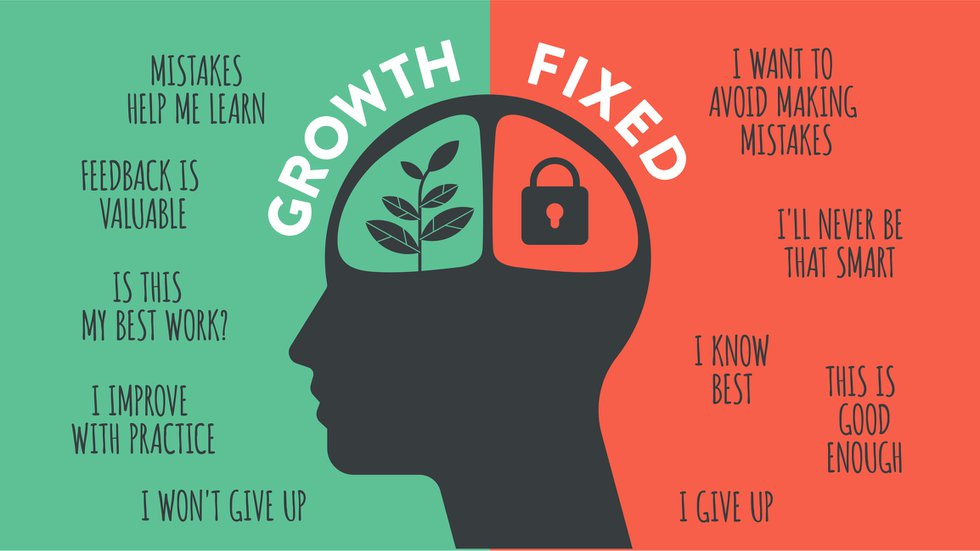
A growth mindset means that you believe your intelligence and talents can be developed over time. A fixed mindset means that you believe intelligence is fixed—so if you’re not good at something, you might believe you’ll never be good at it.
We are told, of course, that it's better to have a Growth Mindset. Our intelligence and talents can keep growing and growing - what's not to like? If we have a fixed mindset, we are condemned to having the measly minds we think we have.
Well, frankly, there's quite a lot not to like. Let's take one of my pet hates. Ten pin bowling. I am awful at this game. I can barely lift the bowls, I have pretty lousy aim, I hate hanging out in places which are noisy with people I scarcely know (the usual set up, I find!) and any food provided in such places is universally nasty. But if I only had a Growth Mindset, believed I could get good at this game and used to hanging out in noisy, badly built bowling alleys, whilst practising my social skills, I could be...hmm...what? Better at ten pin bowling? Would that make me happier? I don't think so - I think I would have wasted many hours of my life which I would have preferred to spend doing almost anything else!
I have seen far too many young people who can't wait to give up one of their nastier GCSEs, being nagged about their lack of Growth Mindset. Could we possibly give them permission to (ssh!) give up on one of their subjects?
The concept of Growth Mindset has its place, I'll admit, but I also see it as a sneaky bit of capitalist brain-washing. That word 'Growth'. It's such a good thing, isn't it, growth? Children grow, trees grow, my puppy is definitely growing - we associate it with nature and all sorts of good things. What we all need is growth. But bad things grow too. Cancer, black mould, waiting lists, the number of rats nicking food from my chickens, to name but a few!
We are fed the line that our economy needs to grow and to that end, as good little capitalist drones, we have to work hard to make the money to buy the stuff that will make it do so. We will feel that we have achieved something. In our lovely homes, with all our precious accoutrements and our string of qualifications that have helped us on our way to this earthly paradise, we can count up our Gold Stars and be content. Except that we never are. There's always the next thing and the next, encouraged as we are by the High Priests of Capitalism to never be satisfied with what we have or who we are.
Let's not get carried away here. There are clear benefits to living in a capitalist society and there's nothing wrong with buying things and doing what we need to do. I've just shelled out the money to go on a second course on relationship therapy - the psychosexual bit this time. I'm doing it because I think it will help me to help my clients. All I want to do here is to expose the link between capitalism and our need for Gold Stars. We have been brought up to be compliant drones in a capitalist system - and one big driver to keep us on that relentless treadmill is Gold Stars. Work hard and you will be rewarded. Work even harder and you will be even more rewarded and you will stand out from the other drones - and that will make you feel you are worth more.
What's the antidote? Maybe it could be Degrowth. My oldest child, Phineas Harper, together with colleagues Maria Smith, Matthew Dalziel and Cecilie Sachs Olsen, curated the 2019 Oslo Architecture Triennale on the theme 'Enough. The Architecture of Degrowth' https://www.oslotriennale.no/archive/2019 Phineas has written in The Guardian too, about how we can reuse and recycle in the built environment, rather that destroying and starting again. And that's just architecture. You can also follow Phineas on Instagram at The Architecture of Repair.
Enough. I'm already rather uncomfortably thinking of a long of list of what we think we don't have enough of. Clean water, hospital beds, peace, just for starters.
But perhaps we also need to get rigorous about what we do have enough of and learn to jump off the capitalist, work ethic band wagon. Perhaps we need to develop a Degrowth Mindset. Let's face it, we probably have more than enough Gold Stars.
I was listening to the Nomad Podcast Nomad podcast the other day (a podcast I'd highly recommend to anyone who hasn't completely given up on Christianity but is wanting some fresh air!) and the two presenters were reflecting on how they had been brought up on a diet of sermons which, essentially told them each week that they should be doing more - that whatever they were doing, it wasn't enough - and, ultimately, how bad that made them feel.
What would it mean to us to commit to degrowth within ourselves - to not always be thinking about how we could do more and be better? To decide that we are enough as we are?
Let me leave with you a poem written and performed by Adam Roa: I am enough. I invite you to watch it. It gives me the tingles.
No posts
Comments
Nothing yet. Say the first thing.
Sign in to join the conversation.