
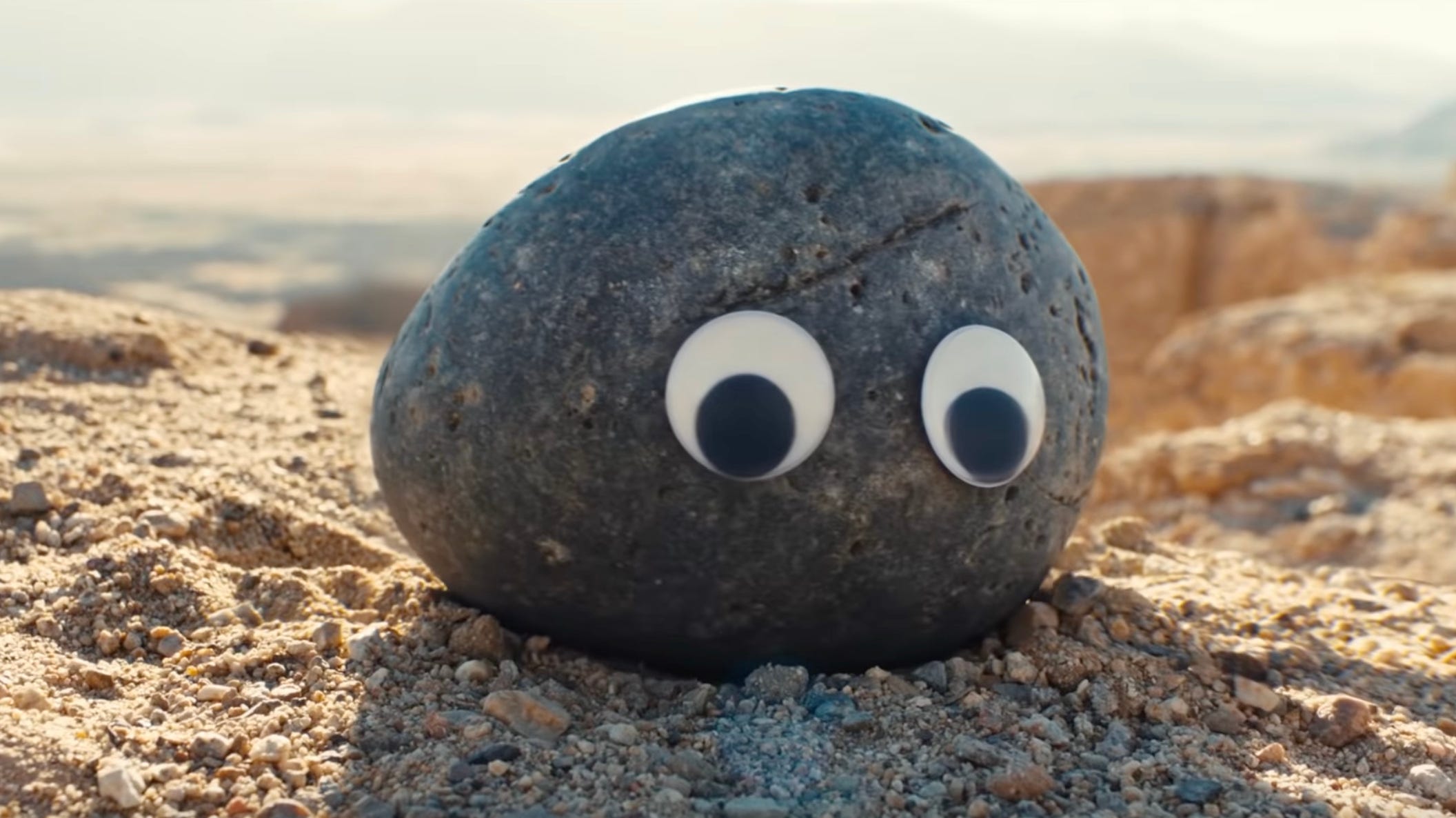
A few ideas have popped up over and over again a few times in the last couple of weeks that I have given some further thought to. It’s about the idea of “constraints breeding creativity” but also that access and budget to fewer constraints are creating a moral divide in creative fields, a productivity gap in entrepreneurial fields, and a shift in authenticity and consumerism.
This past week I received my copy of Project Hail Mary on 4k Blu-Ray and one of the features talks about how when deciding to build the character Rocky, they had the opportunity to build it fully in CGI. But they chose differently. Instead, they built many physical models and puppets to act out the scenes and in some cases, used the puppets caught on film to serve as starting points to add CGI on top of. In almost every case, people talked about feeling more emotion out of the physical puppet. You can watch it here. But also you should consider buying the 4k Blu-Ray which is excellent.
So here I was contemplating the merits of choosing to do practical effects and then yesterday I received in the mail a copy of the 1979 Disney movie: The Black Hole on DVD. What a thrill. I remember seeing this film as a kid and then while in kindergarten buying a book about it at the book fair. Rewatching the film was great but before I did that I watched a documentary that was included in the Special Features section learning about the massive matte work done on this film and a great story about how they used paint and a propeller in a plexiglass tank to create the black hole effect. Worth a watch.
When you think about practical effects, constraints breeding creativity, and film you will always be forced to mention Steven Spielberg’s Jaws. His mechanical sharks didn’t work as intended which caused him to change the way he shot the shark. No wide shots. Just a fin. And guess what? It made it even more terrifying.
So here’s my thought:
Give an artist infinite tools and they’ll default to maximum spectacle. Take those tools away and they’re forced to actually think about what the story needs instead of what the budget allows.
Somewhere between Jaws and now, there was a thing that used to separate a great filmmaker from a mediocre one. It was the vision and ability to solve a problem (realizing that vision) with what they had at their disposal. There was a belligerence and a cockiness that forced an artist to realize the vision they had in their head.
Sort of a tangent but while I am always a “Re-release the theatrical release of Star Wars and Han Shot First” Camp, I have grown to better understand George Lucas’ desire to create the Special Editions. Only he knew what was in his head when he created the films…and I guess he wanted to re-litigate it with more modern day tools when he was able to.
Anyway, over time, these constraints got partially replaced by something else: the size of the check and the length of your financier’s patience. If your idea requires a realistic dragon (*cough Smaug *cough), a hundred extras in an alien landscape, a de-aged actor, you don’t need a better idea. You need a bigger budget. And if you don’t have it, your best idea might simply never become the thing you saw in your head. Not because you lacked the vision. Because you lacked the buying power to render it.
That’s a new kind of ceiling, and I think it’s a moral one, not just an economic one. It used to be that talent could outrun money. A resourceful director with a broken shark could out-create a studio with an intact one. Now, for a whole category of ideas, money isn’t a helpful constraint to work around. It’s the precondition for the idea existing at all. We still talk about “creative merit” as if it’s a pure measure of vision, but increasingly it’s a blended measure of vision and access. And we don’t have good language yet for how much of the blend is which.
Everything Everywhere All at Once may be the counterexample because it makes the divide visible instead of invisible. It came out the same year as 3 Marvel movies: Doctor Strange in the Multiverse of Madness (May 2022), Thor: Love and Thunder (July 2022), and Black Panther: Wakanda Forever (November 2022).
EEAAO was made for $25M. Doctor Strange? $415M. Thor? $250M. Wakanda Forever? Also $250M.
EEAAO had a visual effects team of five people working partly from their bedrooms during the pandemic. There was nearly 500 effects shots built in After Effects and Blender by artists who, by their own account, didn’t have the computing power to attempt what a Marvel movie does by default.
Their explicit north star was “less Marvel, more Ghostbusters”: treat it like something that could’ve been made in the ‘80s with tricks instead of horsepower. It won seven Oscars and is one of my favorite movies of the decade.
Notice what made that possible: they still had five skilled artists, a year and a half, and a studio willing to bet $25 million. That’s not nothing. It’s a fraction of the ceiling, but it’s still a floor most people don’t have.
The moral divide isn’t really “big budget versus no budget.” It’s that there’s a threshold of access below which your idea simply doesn’t get a chance to prove itself at all, and that threshold has quietly become the real gatekeeper of whose creativity gets to exist in public.
The same shape shows up outside of film, but it’s slightly different. In this case, AI isn’t the thing removing the constraint from a lucky few. It’s the thing supercharging a specific kind of person. It supercharges the ones who were already wired to spot a gap in the market. That instinct used to take years to turn into a product: capital, a team, a manufacturing run, a slow crawl from idea to shelf. Now the entrepreneurial mind that’s constantly scanning for “nobody’s built this yet” can go from noticing the gap to shipping a polished, professional-quality version of the answer in a fraction of the time. Not a rough MVP. A finished thing.
I consider myself one of those benefitting from this opportunity. I am always thinking about opportunities in the market and how to fill them. But in the past, there have been constraints that fizzle that momentum. My notebooks (now my Remarkable) is filled with sketches, brainstorms, ideation exercises of ideas that I thought would “totally kill” and yet 99% of those ideas ended up just being thought starters. Why?
Some of it was the lack of development, coding, and engineering knowledge. In 2010 I had an idea for an iPhone app. I sketched out the concept, built high-fidelity designs for the screens and then was met with a $40k fee from a developer to build an MVP. That’s just to get it to a state where I could see if it worked as intended and people liked it. This gap has now narrowed almost completely thanks to tools like Claude Code. I’m about to launch my first iPhone game in a couple of weeks and it cost me 2 months of Claude Pro ($40 total) to build. (more on that announcement later)
Some of it was the complications of setting up corporate entities and domains and emails and bank accounts at scale. The maker culture, gig economy, internet, and digital form submission process has eliminated that gap.
And finally, the production gap has narrowed too. I remember having a great idea for a t-shirt in college. I couldn’t afford to produce them at t-shirt printing shops with their impossible to justify minimums. I figured a way to color Xerox a printout onto iron-on paper and then pressed it with an iron onto a shirt. Now? I can use my Cricut to cut our iron on designs with precisions. Or use a DTF printer and do full color intricate designs at quantities of 1. Or upload the design to a Print-On-Demand shop, order exactly how many I want and even sell them with no overhead. What once required real capital to do, now requires no capital.
This is not a small shift. It means the bottleneck on entrepreneurial success is moving away from capital and execution and toward something more like pattern-recognition and taste. It’s now more about the ability to actually see the gap in the first place. Which sounds almost fair, until you notice that it also means the gap between someone with that instinct and someone without it is widening fast, because the instinct now compounds instead of just accumulating. The person who spots ten opportunities a year and can build all ten to a professional finish is playing an entirely different game than the person who spots one and spends a year building it by hand. Both of them are “entrepreneurial.” Only one of them is now operating at a completely different clock speed.
And finally there’s what happens on the other side. To the people encountering all of this as consumers. I think this is the part that’s moving the fastest and that we understand the least.
Consumption of content is splitting into two camps. One group is still genuinely dazzled by generative AI output. They may even be impressed by it, sometimes fooled by it, engaging with it as if it carries the same weight as something a person labored over. The other group has gotten fast and cynical, and has started dismissing anything that smells AI-made as “slop” on sight, sometimes correctly, sometimes not.
In theory, both camps are looking at something that’s technically “authentic to the maker”. After all, someone did make a choice, prompt, curate, select. But in practice, a hierarchy of respect has formed almost overnight: handmade carries more weight than AI-assisted, regardless of the actual quality of either.
You can watch this happen in real time on Etsy, of all places. My wife and I have run a shop there for years. The entire founding premise of that platform was handmade goods, made by an actual person, in an actual workshop. Now it’s flooded with Temu-sourced drop-shipped inventory and AI-generated designs slapped onto mugs and shirts, sitting in the same search results as something someone spent a weekend sewing.
The platform hasn’t formally changed its promise. But the promise has been diluted by volume, and the searches have been flooded with keyword-optimized listings of non-handmade listings. Shoppers who actually still care have had to become detectives: squinting at listings, checking seller histories, trying to figure out who actually made the thing they’re about to buy.
That detective work is new. It didn’t used to be necessary. The label “handmade” used to be sufficient information. Now it’s a claim that has to be independently verified, which is its own quiet collapse.
I don’t think the moral is “small and scrappy beats big and expensive.” That’s too easy, and it’s not always true. Plenty of low-budget work is just cheap and thin. Plenty of well-resourced work is genuinely great. Scale can be the argument, not the crutch. Constraint doesn’t automatically produce brilliance. It just removes the option of covering for a weak idea with money, which means whatever’s left has to carry the whole weight.
That’s the actual thread running through all three of these: creative fields, entrepreneurial fields, consumer trust. Technology and capital are supposed to be in service of an idea. Somewhere along the way, for a widening set of pursuits, the relationship inverted: the idea now has to justify itself to the price of admission, instead of the other way around. And the people priced out of proving their idea was any good aren’t lazier or less talented. They just never got the version of the story where their broken shark forces them into greatness. They got the version where the shark simply never got built at all.
Meanwhile, on the other end, a widening group of makers (entrepreneurial, artistic, or just an Etsy seller trying to keep the lights on) are all being graded against the same rising bar, whether or not they had access to the tools that moved it.
I guess there’s always my paintings to go back to. Actual paint with no undo button. There’s just what my hand can do with what’s in front of me, wrong turns included, and the wrong turns are usually where the painting starts telling me something I didn’t already know I meant.
Maybe that’s the only honest test left, in art or in anything else. It isn’t about whether the tool is analog or digital, cheap or expensive, scarce or abundant at all.
It’s whether the tool is still forcing you to find out what you actually think, or quietly doing your thinking for you and handing you back something that only looks like an answer.
No posts
Comments
Nothing yet. Say the first thing.
Sign in to join the conversation.