
I am Adham Nimr Ballal, a resident of the village of Susiya in Masafer Yatta, where we live in a reality that is becoming more and more bitter by the day. Living here is no longer just a challenge to resilience, but has turned into a struggle for survival, given the dramatic and systematic rise in settler attacks targeting our livelihoods.
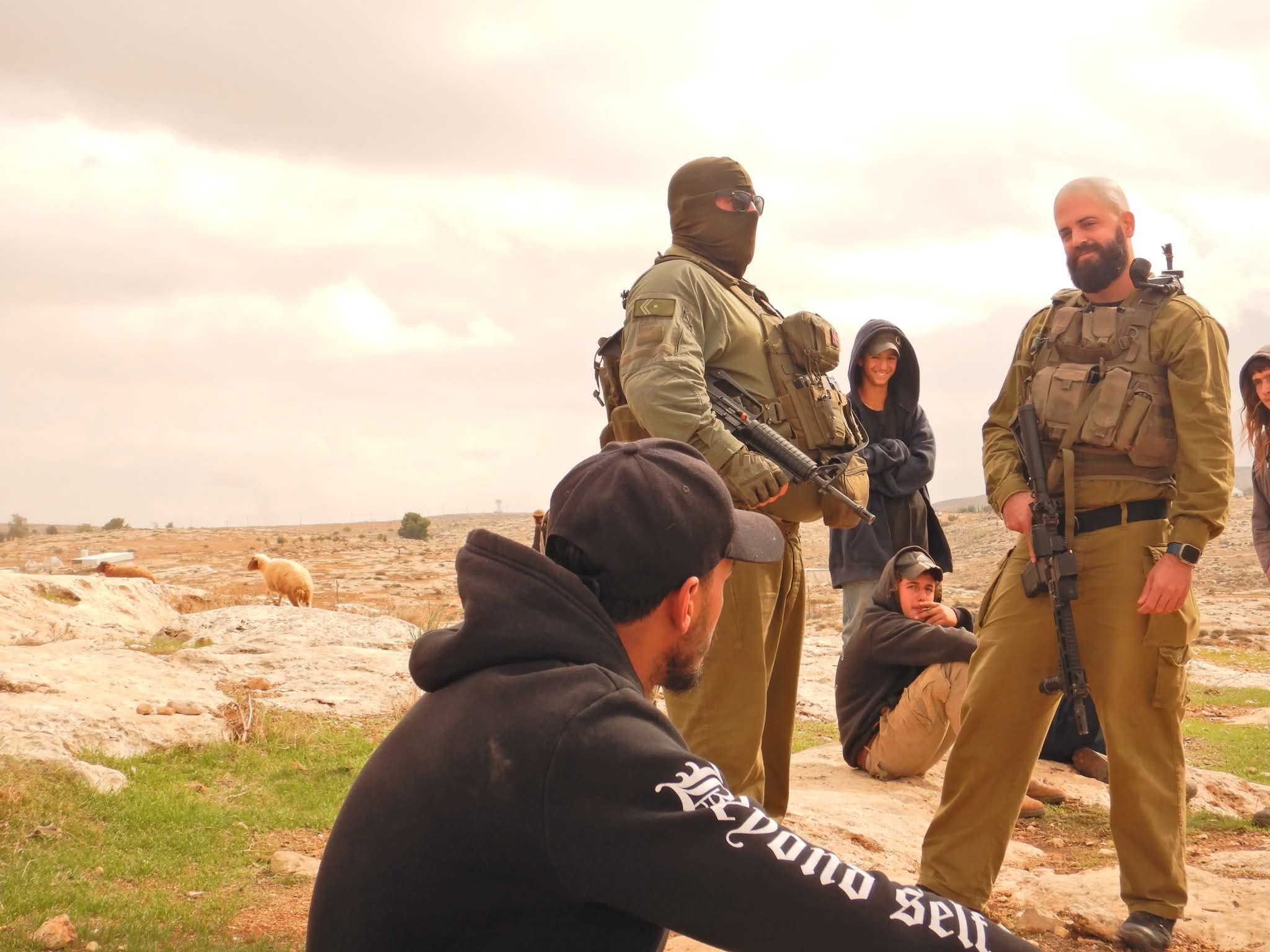
The land was our lifeline; for generations we cultivated it and harvested it to put food on our tables as well as to feed our livestock. Today, we have been denied this right. This year, with the arrival of the tilling and planting season, as soon as we started working, the settlers attacked us under the protection of the occupation soldiers, preventing us from reaching our land on the grounds that it is a “closed military zone”. The bitter irony here is that we can no longer distinguish between the soldier and the settler – as since the outbreak of the war in 2023, the settlers have been wearing military uniforms and practising army duties.
But the matter does not stop with our lands and fields – life inside the home itself is no longer safe either. In March 2025, specifically during the holy month of Ramadan, while we were waiting for the Maghrib call to prayer to break the fast, the silence of the place was suddenly interrupted by the sounds of smashing and breaking.
We rushed to investigate, and were shocked by dozens of settlers storming the village under the protection of the army forces, or those who look like soldiers; again, they are in fact settlers in military uniform, who do not leave the settlers’ side and act as a protective shield for their crimes. Among them was the notorious settler, Shem Tov Lusky.
Because my uncle Hamdan is an activist and Oscar-winning filmmaker who dedicates his time to conveying the suffering of the people of Masafer Yatta to the world, the settlers harbour a great grudge against him and know him well. As soon as they saw him, Lusky along with two soldiers attacked and severely beat him at gunpoint, using rifle butts and sharp objects. Not only that, but they also fired two bullets past his ears to terrorise and abuse him physically and psychologically.
When we tried to intervene, the army fired live bullets at our feet to prevent us from advancing, leaving the settlers to continue their brutal assault on my uncle.
After half an hour of abuse, the army forces arrested my uncle Hamdan, despite his bleeding and severe injuries, and without allowing the ambulance that was there to even examine him. My uncle was absent for a full 24 hours, during which we lived in indescribable anxiety, a scene I will never forget, especially since his clothes were covered in blood when he was kidnapped.
We were later able to locate him and he was released. But what happened that night was not just a passing incident, it is part of a series of attacks aimed at breaking our will and displacing us from our land: a microcosm of what the residents of Masafer Yatta live daily under the weight of intimidation. To wake up in the morning to your grandmother screaming, “The settlers... The settlers!”. You get out of bed and have not yet grasped the shock, you feel overwhelmed, you have no means of defence but using your phone to film what is happening. But the bitter irony is that documenting abuses can cost you a minimum of two years in security prison.
An almost identical thing happened to my other uncle Hamoudi, Hamdan’s brother, in February. My grandmother woke us in a panic, so we rushed to document the assault of the settler – once again, it was Shem Tov Lusky, who was roaming around with his herd of cows in our yard in all his arrogance.
We did nothing but film and call the Israeli police. However, the army arrived before the police, and instead of stopping the attack, the soldiers exchanged a warm greeting with the settler before confiscating our identity cards.
When the police arrived, we showed them a decision from the Israeli civil administration that included a map barring anyone with Israeli citizenship from entry. Although they admitted that the map was correct, the army suddenly arrested my uncle Hamoudi for no reason in front of the police. When we asked the police why he was being arrested, the response was, “This is the army’s work and we have nothing to do with it.”
They tied his hands with zip ties, covered his face with a black mask, and took him to a nearby military camp, where they held him for five hours at the gate. He was beaten, kicked, and subjected to various methods of humiliation. Hours later, they threw him by the remote village of Huwara, far from Palestinian communities and near an Israeli outpost. They left him there still blindfolded, uncertain of where he was. If it were not for God’s protection, he would have been an easy target for the settlers there. Fortunately, my uncle was eventually able to contact our family who came to his aid and brought him home safely.
It is clear for anyone to see that the structural support provided by Israel to the settlers is only getting stronger. Under the constant, round-the-clock shield of the Israeli army, a few settlers are allowed and even encouraged to storm and raid our villages, emboldened by the absolute certainty that they are protected by an entire state apparatus. The bitter irony is that we, the ones being attacked in our homes, are the ones being led away time and again to prison.
— Adham Nimr Ballal
No posts
Comments
Nothing yet. Say the first thing.
Sign in to join the conversation.