
TLDR
Last September, fifty+ people across generations and continents gathered online to define what it actually means for an organization to be human-centered. What emerged became the foundation for the H Corp — an emerging standard for organizations that commit to human flourishing over pure efficiency. Together we will gather in San Francisco, as part of Human+Tech Week, we’re hosting a World Café working session to test those principles against reality — and to soft-launch the H Corp Foundation, the institutional body that will make them operational. The research backing this up is substantial, and the evidence cuts both ways: organizations that chose humans won. Organizations that replaced humans are paying $1.27 for every dollar they thought they saved. We’d like you in the room. Register here.

The Invitation
On Wednesday, May 13th at noon, we’re gathering in San Francisco as an official Human+Tech Week partner event for an intimate World Café working session: small groups, generative questions, honest conversation about what human-centered leadership actually looks like in practice — not in theory.
This isn’t a panel. Bring your experience, your skepticism, and your vision. Lunch is on us. Seats are limited.
📍 San Francisco · May 13 · Noon PT · Human+Tech Week
Where This Began
On September 17th, 2025, fifty leaders, educators, researchers, and practitioners from multiple generations and continents gathered for an online World Café dialogue with a single question: what does it mean for an organization to be genuinely human-centered — not in its marketing, but in its decisions, its technology, and its structure?
Using Thinkscape technology that enabled anonymous small-group conversations across thirteen simultaneous think tanks, hundreds of insights emerged — and organically converged. Not because we designed them to, but because the concerns are genuinely shared across cultures, industries, and generations.
We wrote about what happened in two posts that are worth reading before Wednesday:
The Four Principles of the H Corp →
From the beginning, we called this the H Corp — the human-centered organization, a concept analogous to a B Corp but built around human flourishing rather than broad stakeholder accountability for public Benefit. The name felt right because it captured something precise: an organization that has made a formal, verifiable commitment to human empowerment as an operating principle, not a tagline.
Separately — and this is worth a brief note — we adopted the name H Corps for our broader community movement, inspired by the spirit of the Peace Corps and dedicated to human flourishing across society. Two related but distinct ideas that now share a name temporarily. We’re working on clarifying that distinction publicly. For now, H Corp is the organizational pledge, standard, and one day certification. H Corps is the movement.
What Emerged: Four Three Principles
From the September dialogue, four principles emerged as the constitutional foundation, which we are reducing to three core values:
Human Empowerment — Organizations exist to empower humanity, not replace it. AI augments human capability; people remain at the center, driving decisions and growing in their work. The question H Corp leadership asks isn’t “how can AI do this instead of a person?” It’s “how can AI help this person do their best work?”
Sustainable Prosperity — Long-term human thriving over short-term efficiency extraction. When AI increases productivity, we reinvest those gains into human development, wellbeing, and growth. Eliminating human workers eliminates consumers. The math of extraction eventually consumes itself.
Intentional Integration — Deliberate, transparent, inclusive adoption of AI, where ethics are foundational and all voices shape the outcome. We refuse to let AI happen to us. We ask “should we?” as rigorously as “could we?”
The Pledge
While this is still a work in progress, and the event in SF will help inform this further, the current draft of the pledge is below. We ask that every H Corp member organization will begin with a public commitment:
We commit to treating human agency — the practical capacity of our people to make meaningful choices — as a design constraint on how we build, deploy, and manage technology and organizational systems.
We commit to AI augmentation over AI replacement: technology in our organization exists to amplify human capability, not to substitute for human judgment in ways that diminish dignity, autonomy, or livelihood.
We commit to human flourishing as an organizational purpose alongside — and in service of — sustainable profitability. We reject models of profit that depend on systematic extraction from the people who create our value.
We commit to transparency, accountability, and continuous improvement in how we operationalize these principles — not as a one-time declaration but as an ongoing practice.
Announcing the H Corp Foundation
Wednesday’s event marks the soft launch of the H Corp Foundation — the institutional body that will govern the standard, issue the seal, and build the Business Council where leaders across industries collectively define what human-centered AI governance looks like in practice.
The Foundation is not just a business council where we will shape the standards and learn together how to operationalize the principles. Ultimately, we intend to become a 501(c)(4), which means it can do something most standards bodies cannot: formally engage in regulatory processes, submit public comment, and shape the legislation that will define the next decade of work. The seal is a license, not a trophy. It can be revoked. Membership dues do not purchase impunity. The integrity of what we’re building depends on the credibility of what it represents.
Wednesday May 13 is the next step of that community forming and gathering in person — and we want the people who’ve been part of this conversation from the start to be in the room when it does.
What the Research Shows
We’ve begun to gather the evidence and do the research. The data is now substantial — and it cuts sharply in two directions.
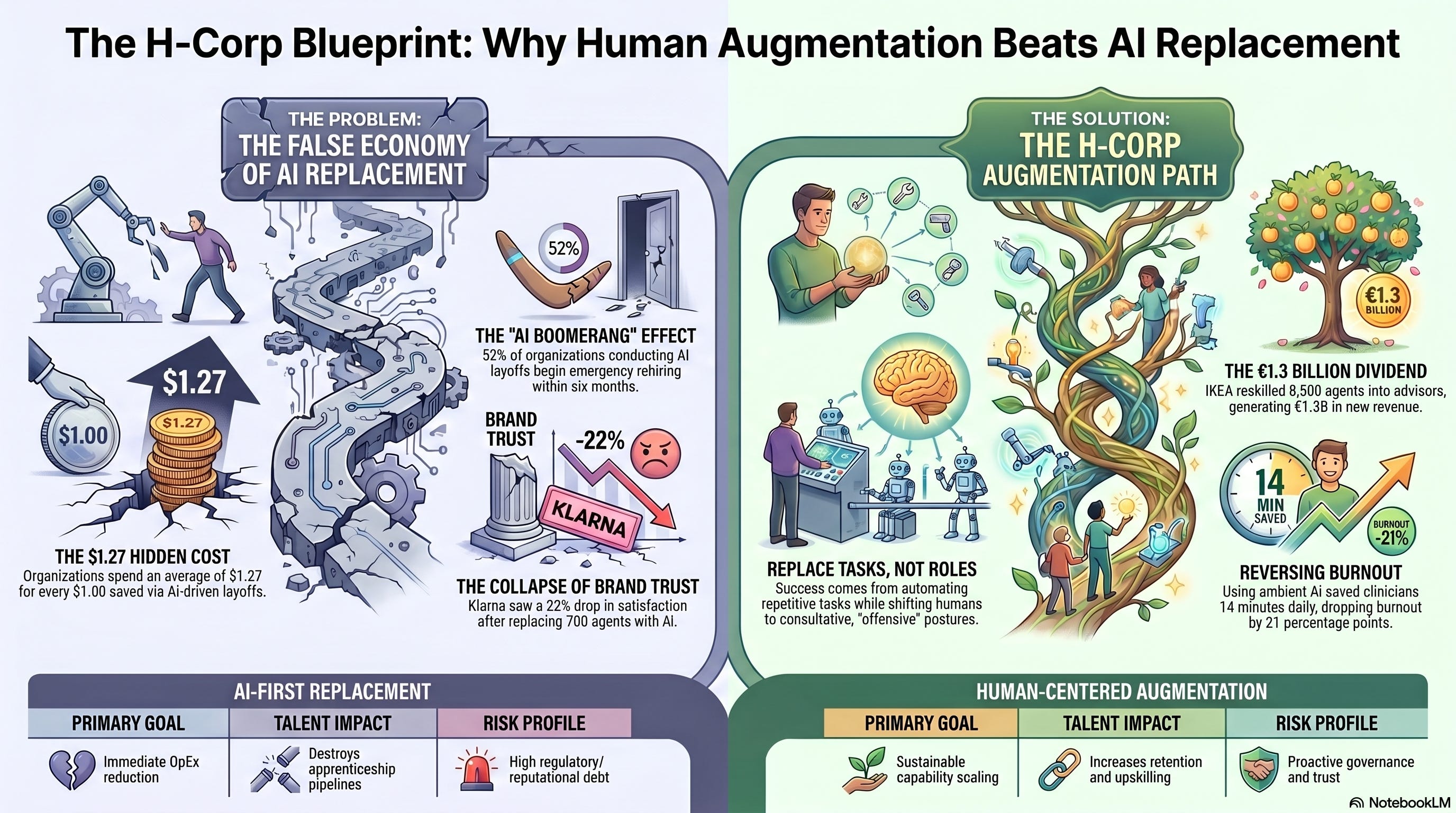
Organizations that went AI-first — replacing workers to cut costs — are living through what researchers are calling the AI Boomerang. Forrester Research found 55% of employers now regret those cuts. Orgvue’s analysis of Fortune 500 workforce reductions found organizations spend $1.27 for every $1.00 saved once severance, lost productivity, and rehiring costs are fully accounted for. Two-thirds of companies that conducted AI-driven layoffs were already actively rehiring for the eliminated positions within months.
Organizations that chose human-centered strategies — like IKEA, which retrained 8,500 workers rather than replacing them — built revenue, retained talent, and generated compounding returns that cost-cutting simply cannot match.
Chris Heuer published two LinkedIn posts this week that lay out both sides of this story in full, including the research, the case studies, and the videos produced by NotebookLM from our findings:
The Human-Centered Case: What IKEA and others got right →
The AI-First Case: What Klarna, IBM, McDonald’s and others got wrong →
Each post includes a short video produced from our research. Worth watching before coming to our event.
Come Build This With Us
The September dialogue was a seed. Wednesday is the next root taking hold.
If you believe the answer to AI disruption is human-first — not AI-first — and you want to be part of building the standard that makes that choice credible, verifiable, and consequential for organizations of all sizes, we’d like you in the room.
Not a panel. A World Café. Small groups, honest conversation, real practitioners. Lunch included.
📍 San Francisco · May 13 · Noon PT · Human+Tech Week
Please note all of this is a work in progress. The Foundation web site is not fully functional or complete. The structure, nature, and offerings are not finalized. The pledge is still a work in progress. We believe in co-creation, which is why we want you there, to help shape this from multiple perspectives, generations, and experiences.
No posts
Comments
Nothing yet. Say the first thing.
Sign in to join the conversation.