
Human Inference is about solving social problems while building a sustainable business with AI.
It’s building in public, not as another tech startup solving a B2B market problem, but as a venture aimed to solve a societal one. It’s lessons about building for non-tech users, on how to solve when the system itself is the problem, while guided by a firm belief shaped by lived experience that what will save us isn’t AI or tech - but what makes us come alive as humans.
You’ll find a home here if you’re tired of working for profit companies that claim to change the world but only within the limits of what their shareholders want.
If you’re an idealist who wants a practical way to make change - real change - that demonstrably improves lives through greater social justice and systemic changes.
You want to improve the world and improve your quality of life at the same time through a business you own, leveraging the latest AI tools or building your own.
That’s what I’m doing here.
I don’t promise to have the answers yet. This isn’t written from the perspective of someone who already had many years of success and forgotten what it’s like to be at the beginning, struggling through the middle, before anything took off.
Instead, you’ll get something better and more useful: A front-row seat experience into seeing someone creating something new, swinging at intractable problems. At how I apply my background in anthropology, business, product, and my lens as someone with ADHD, to problems in a new domain after a decade of success turning around seemingly doomed-to-fail programs in corporate environments.
It didn’t start this way. It began with my first post, “So why write?” I asked if anyone wanted to talk about AI and society:
“Most of my thoughts these days are around - how do we build the kind of world we’d prefer to live in? AI could make it possible - shouldn’t we explore it?”
I didn’t realize how prescient that question was. I also didn’t realize how it would end up defining my journey over the last several months, a journey that began with an odd ache about the things that seemed wrong with the world.

I would call myself apolitical. I do not like engaging in political discussions, which I find full of negativity and confusion in America’s culture. I have always focused on what it meant to live a fulfilling life and was more concerned with having a satisfying career I was proud of.
But the straw that broke the camel’s back came after neighbors’ ACs went out in the Texas heat because of Greystar. I left my apolitical bubble and started looking for real ways to fix broken systems.
Most people can see that a lot is broken about our American system. What’s missing is clear information on what we’re supposed to do about it. I honestly do not think anyone has the answer.
Writers and tech leaders keep asking how we build a better world before AI makes everything worse. They offer thoughtful proposals. Then the conversation usually stops. Having the right idea is treated as enough. The hard part, getting anything real to happen, gets left out.
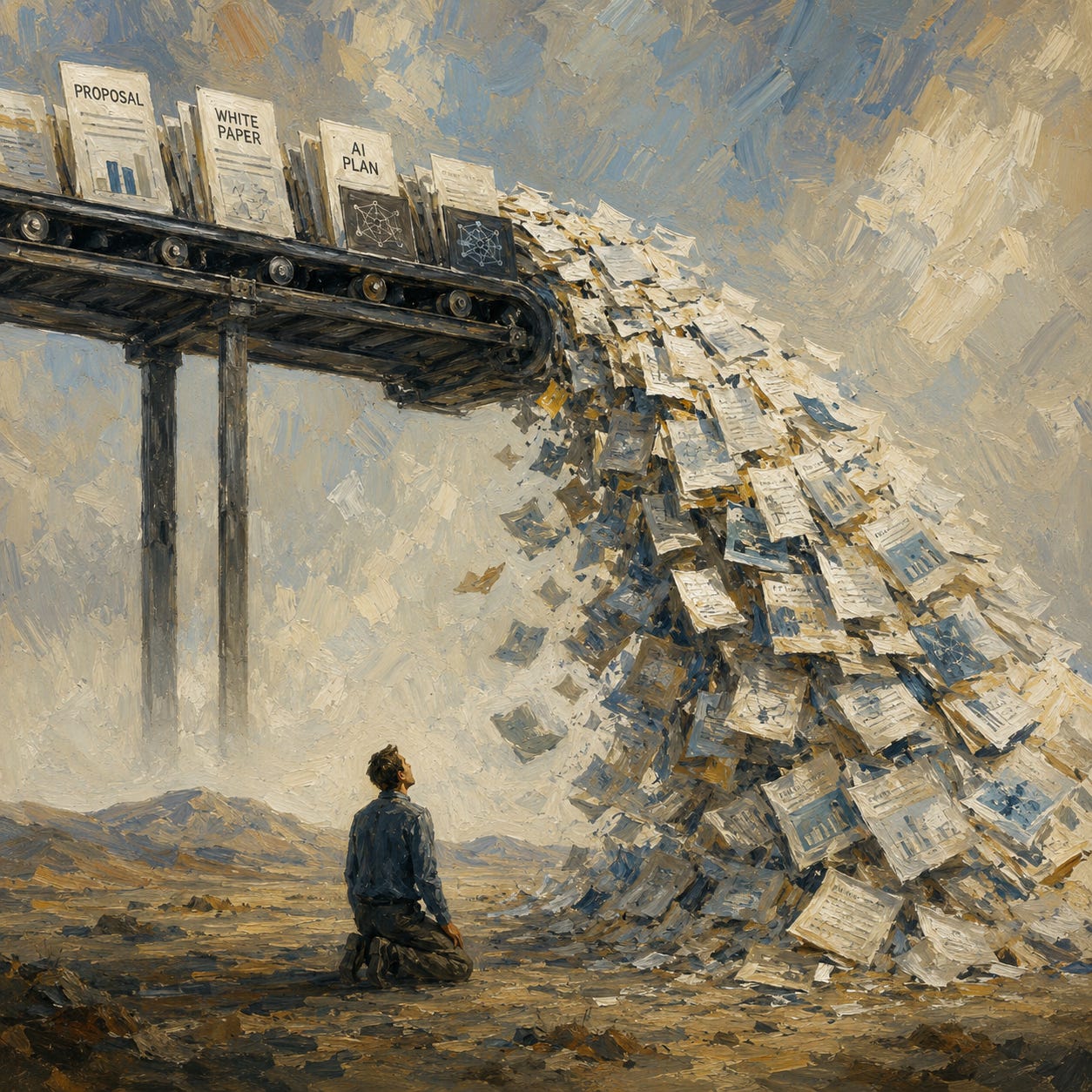
Tech and venture capital often focuses on high margin opportunities - B2B SaaS and enterprise businesses get most of the attention. What it leaves out of its skyrocketing valuations are all the problems that 99% of the country deeply care about solving: Housing, wealth inequality, generational decline in social mobility.
There’s a deep sense that the system is broken - or worse, rigged. Yet no world-changing startup from the Bay Area seems interested in solving these problems.

There’s a long-standing assumption that civic tech is an unattractive market, and it curbs any would-be entrepreneur from attempting it. But two things are buried in this assumption:
That the only customers are the public institutions. However, these are not the people who are experiencing the pain - it’s the citizens who have the pain and who we should be building for.
What doesn’t interest venture capital is not the same as saying there’s no market. A VC cares more about exiting a unicorn at sky high valuations to cover its portfolio of bets.
We are now also questioning the very need for high upfront capital for many companies. AI-native companies can now operate and build a product at a fraction of the cost. The backlash against AI slop now require community, distribution, and brands to have far more human connection and authenticity to stand out, and these aspects can often be tainted by shareholder interests in many venture backed firms.
I’m leaning in on this crack in the illusion.
I come from a product background with an MBA and training in Anthropology. I have a knack for spotting assumptions and turning failing programs around. I applied those skills to tackling a problem in society - the power of money over American politics, which is eroding our democracy.
It led me to building a voting app to help citizens assess standing members of Congress and candidates based on voting and donation history. My thesis is that we can weaken the relationship between money and who gets elected if voters stopped voting based on what heavily fundraised campaigns pay for.
No voter data will ever be sold to an institution. It is meant to only be a tool that empowers the people who care about democracy the most - its citizens.
It is my current focus for building a business that solves a systemic social problem.
Human Inference will chronicle the AI-powered solopreneur journey of blending social change and business models.
The current season is focused on the voting tool and money in politics, but it will also include background on what it takes to build a better society, how can ordinary people take action, and how an entrepreneur with a product and ADHD mind can contribute while simultaneously building a business. Perhaps this journey can serve as an example for others looking for more fulfilling ways to build careers when their values don’t fully align with the conventional professional world.

The name Human Inference describes how I work: I draw from experience, training, a particular brain, and am more apt to trust actual lived human experiences over theories and dead frameworks. It’s from this dataset that I infer what is happening; the human experience, lived and felt, the kind of data that has not been converted into binary and fed into a machine learning training set.
Thanks for reading to the end. I look forward to what’s next and sharing what I find. Help me prove solving social problems can be a business by sharing or subscribing.

Comments
Nothing yet. Say the first thing.
Sign in to join the conversation.