
The one big promise of America is that anyone can pursue their happiness here. That is, if you believe that happiness meant making lots of money, having high status, and owning lots of things.
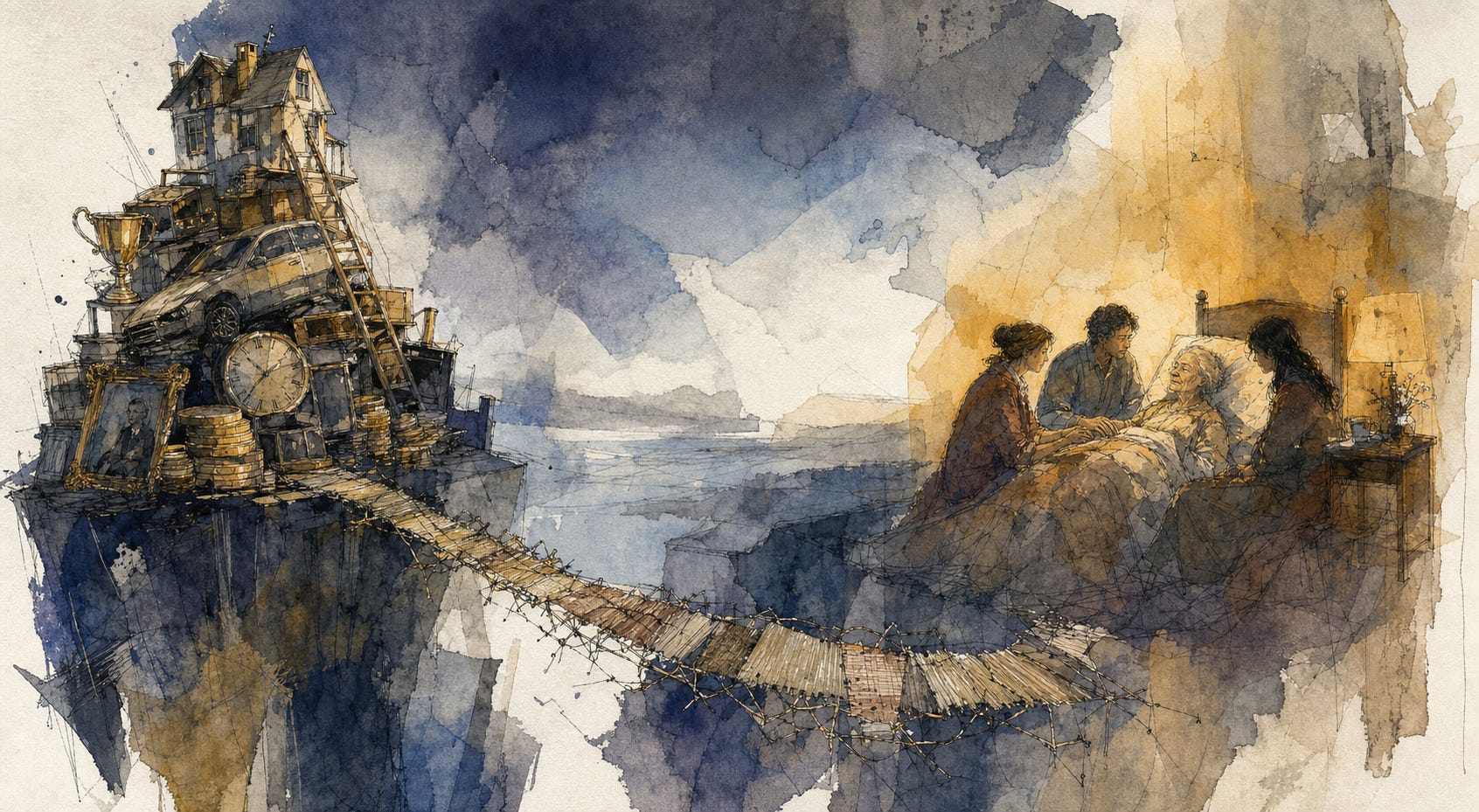
Yet accounts from people nearing death often describe the biggest regrets in people’s lives as having nothing to do with money, working harder, or things they couldn’t buy. Bronnie Ware’s account of her palliative-care work describes regrets about living lives under others’ expectations instead of what they dreamed of, letting a romantic interest go un-pursued, and not daring to let their spirit and courage live as free as they wanted to.
It was the biggest fear of my young adult life to have a career that drained me, and I spent countless years trying to find my passion to avoid a life unexamined and full of regret. But along the way, I realized the most fulfilling moments in my life had little to do with self-satisfying activities - they were ones in which I felt a part of something bigger than myself, a sense of mission towards the shared well-being of others and of society as a whole.
Happiness, at least to me, meant financial stability and work towards that ideal world that has yet to become: The kind that artists and writers and musicians write songs about, one that is free and just and courageous in the pursuit of happiness, for everyone.
There’s a term I learned recently that describes this kind of happiness: Eudaimonia. A happiness derived from human flourishing and living ethically rather than for mere pleasure. It makes me wonder how much of America’s ills come from an understanding of happiness that focuses too much on mere pleasure - even mere ambition - than from an understanding of happiness that derives from a deeply soul satisfying sense of eudaimonia.
An American’s purpose in life seems to be achieving happiness, and we defend the freedom to do so with laws, ideologies, and a collective acceptance that this is the way. If happiness is defined as acquiring wealth, status, stuff, and feeding one’s self interests, we’d continue to justify any means to that end - at the expense of community welfare, democracy, kinship, and the social fabric that makes individual freedom possible and lets us live together at all.
This quote keeps coming up to my mind: “Man cannot live on bread alone.”
I’m not Christian, but I heard it’s a quote from Jesus, who responds to the Devil’s offer of food while being tested in the desert. I’d always thought it meant humans had spiritual needs as much as they had biological ones.
C. S. Lewis comes to mind as well. I believe it was he who said that the thing his spirit yearns for must be real, because it’s impossible to ache for something that doesn’t exist. I’d suppose he meant god, or the equivalent of that thing which makes everything seem right with the world.
I think the reason these keep coming to mind is because living in the world today feels like a version of that desert - but without Jesus and his spiritual strength. If there was a just God distributing rightful punishment and merit - let’s just say there’s not nearly enough smiting going around.
Yet it seems deeply human to care about these things. One has to wonder why the hell should we care about justice and morality if it causes us so much grief when reality falls short and corruption is all too easily unpunished. And yet we do.
I believe one evolutionary explanation of this is that it stems from living in social structures. Enforcing fairness helps to ensure that one’s own provisions aren’t grifted, so by helping society maintain right and wrong one is indirectly ensuring their own benefit.
For a long time I figured it was a harmless byproduct of something never intended for survival, that it just happened to exist in our brains. Like an appendix that served no obvious purpose, but never had a reason to be rooted out either.
But lately, I’ve been starting to feel as though Lewis had a point.
That there is something that exists beyond our understanding, for which we yearn, as much of a human need as thirst or hunger, that we cannot live without if we wish to live fully.

There’s this limitation I and others have found with AI writing - it can find patterns, but it doesn’t find the point. Maybe that’s just a current model limitation that will soon be surpassed in another few months. But it makes me wonder if there is a connection human beings have to that which we do not yet perceive in our 3D reality with our current science and tools.
There are times when I’m writing where it feels like something is writing through me. Ruth Stone described something like this to Elizabeth Gilbert, who recounts it in Big Magic. Sometimes a poem came toward Stone like a galloping horse, and if she barely caught it, she would pull it back by the tail and write it from the last word to the first. That’s kind of how it feels to write sometimes, from a space that I cannot tell exists.
I won’t call it consciousness by name or claim it even exists - but I wouldn’t dare to close the door on it, either.
Going back to Jesus and the bread in the desert.
It’s still possible that we have this sense of morality because we haven’t out evolved primitive tribal social structures, or it’s a weird appendage that just exists. But sometimes, I wonder if Jesus was right - that we can’t live on bread alone.
There seems to be something that drains us whenever we encounter something wrong. Just to name a common and innocuous example most people have experienced: the brain-dead meeting that should never have happened, listening to bullshit being treated like wisdom.
The opposite is true: something that elates and invigorates us when someone chimes in to correct, speak truth to power, and brings more truth back into the situation.
Why is it that these things bring us a kind of joy, satisfaction, peace and wholeness that no simple biological fulfillment can?
I don’t know, either. I find it curious that we have such inclinations at all, given how troublesome they are.
To yearn for something that has no form to sustain the body, that distributes benefits to everyone instead of accruing to oneself, and despite its social costs and inefficient use of caloric resources, one cannot live without. It’s not something I expect everyone to experience, but I think there are those who understand what I mean.
I took a bet on myself this year to create what was calling to me, despite the fact my business brain told me it wasn’t monetizable, career-optimized, and every professional influencer online was doing things ‘the right way.’ I wish I could simply keep my head down and earn a great salary as a product professional, but I just couldn’t let this go. I had a yearning for more than bread.
I’m happy to finally announce my site Human Inference - where narratives are challenged, actions are taken for social change, and tools are built to make it easier and scalable.
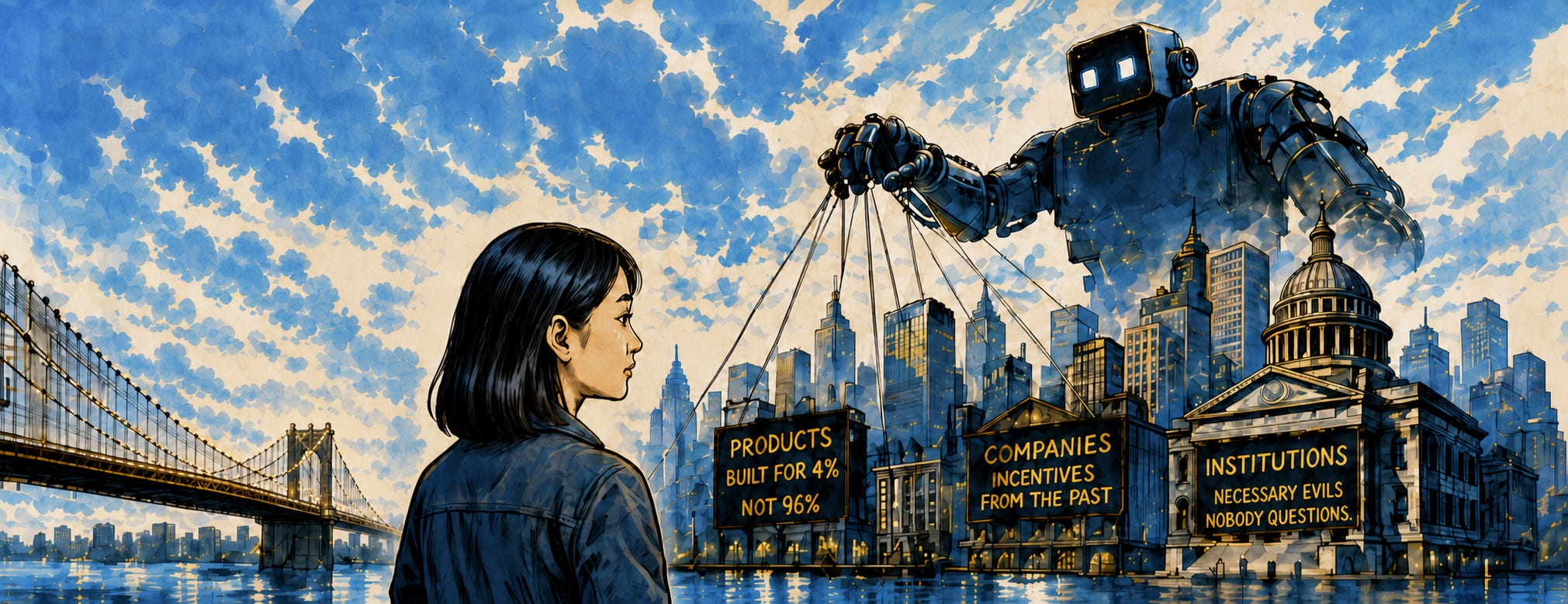
AI will only build what we tell it to, and if we don’t take a look at the beliefs behind our decisions, we’re at risk of accelerating all the problems we’ve failed to address: Climate change and the ‘externalities’ of share-price-driven corporate governance, legislative capture and the corrosive influence of money in politics on democracy, greater decline of social mobility and wealth inequality nearing the levels of pre-revolutionary France.
If AI is making anything seem possible, then I want to believe it’s possible to have the kind of society in America we all deserve.
If you’d like to support my work, visit https://humaninference.ai/build 🙏
There’s one more thing I think of.
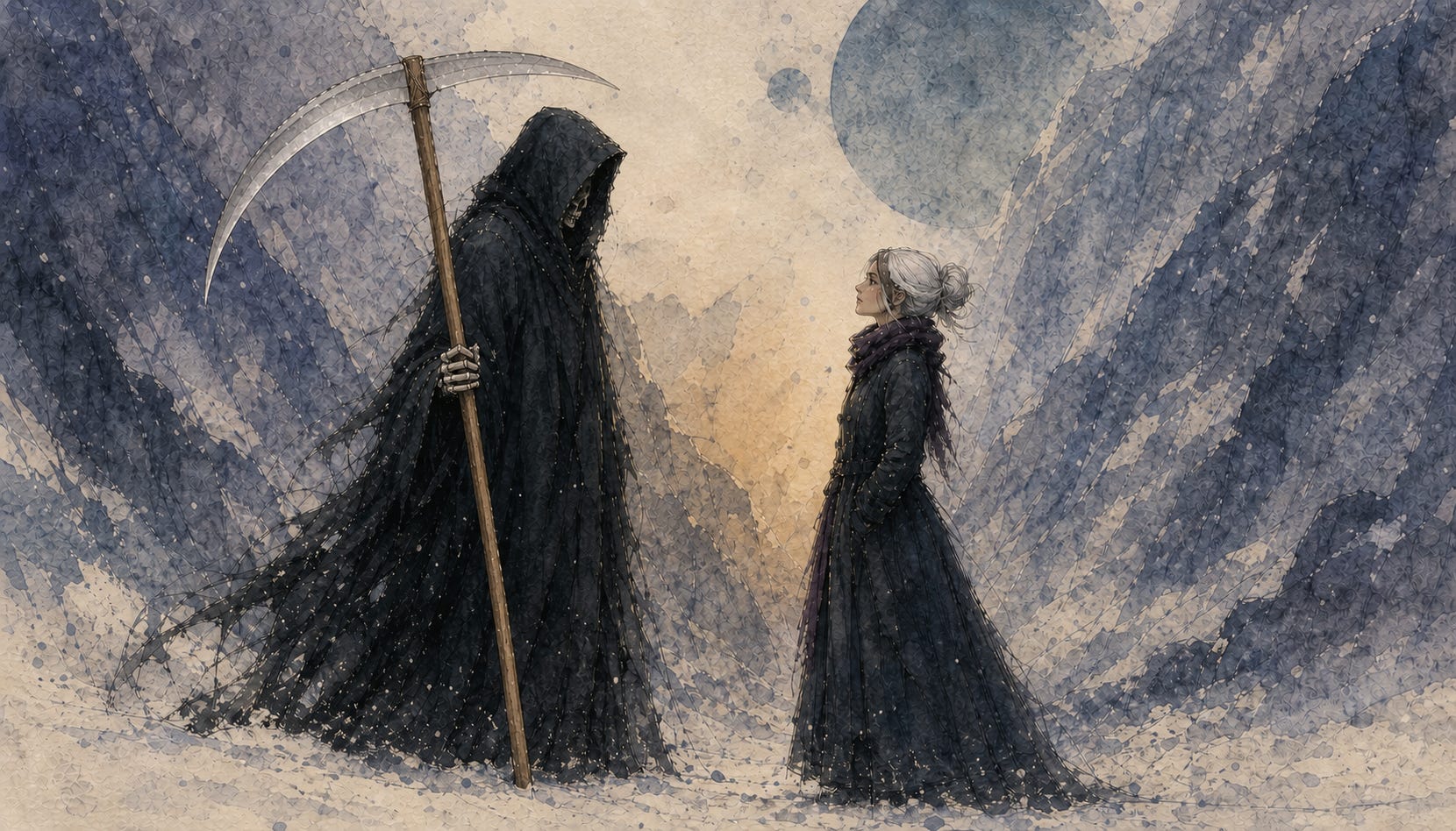
In Terry Pratchett’s Hogfather, Susan asks Death why he went through all the trouble to save the figure equivalent to Santa Claus.
“You have to start out learning to believe the little lies,” he says.
“So we can believe in the big ones?”
“Yes. Justice, mercy, duty, that sort of thing.”
“Those aren’t the same at all.”
“No? Then grind the universe down to the finest powder and sieve it through the finest sieve, and show me one atom of justice, one molecule of mercy.”
“But people have got to believe in those things. Otherwise, what’s the point?”
To which Death says, “You have to believe in things that aren’t true. How else can they become?”
I think about that a lot these days, in a world where AI superpowers, capital incentives, and politics seem to be racing towards a world with more exploitation and power concentration - and I wonder what’s the point of it all. Would those who stand to win at the end of all this finally experience something they’ve been looking for?
Will they have avoided the regrets of the dying?
Or will it never satisfy, because such things never could?
More than bread indeed.
If this post meant something to you, consider sharing, subscribing, or leaving a tip 🫶

Bronnie Ware on the regrets of the dying. The Top Five Regrets of the Dying, based on Ware’s experience as a palliative-care nurse. Source
Aristotle on eudaimonia. Nicomachean Ethics, Book I, on happiness as human flourishing and activity in accordance with virtue. Source
“Man cannot live on bread alone.” Luke 4:1-4, with the passage drawing on Deuteronomy 8:3. Source
C. S. Lewis on unsatisfied desire. The passage comes from Mere Christianity, Book III, chapter 10, “Hope.” Context and source
Human cooperation and morality. Michael Tomasello and Amrisha Vaish, “Origins of Human Cooperation and Morality,” Annual Review of Psychology (2013). Article
Ruth Stone and the poem’s tail. Elizabeth Gilbert’s retelling in Big Magic, chapter “The Tiger’s Tail.” Book
Terry Pratchett on belief, justice, and mercy. Hogfather, as reflected in the 2006 television adaptation transcript used for the wording in this note. Transcript
Comments
Nothing yet. Say the first thing.
Sign in to join the conversation.