
tl;dr: At 20:13:27 UTC on November 14th 2025, LinkedIn implemented Project Big Blur, and it ruined the day (and the operating model) for a lot of data scrapers. No longer can you easily proxy yourself to profile information by masquerading as a logged out user. If you’re a data vendor trying to refresh tens of millions of profiles you’re business just got much more complicated; if you are a customer of one of those services, talk to us.
On November 14th at 20:13 UTC, something broke.
The data vendors and workforce intelligence platforms didn’t announce it. The updates looked the same. But underneath, the refresh engines that keep workforce data accurate started falling behind.
We see this from both sides at Live Data Technologies. We track employment status and job changes for roughly 160 million people. We talk to the companies buying this data for competitive intelligence, for investment signals, for talent tracking. And we've watched a slow-motion quality crisis unfold across the market as LinkedIn's enforcement infrastructure finally caught up with the vendors who'd been scraping it for years using a seductively simple tactic.
LinkedIn’s late 2025 enforcement was different in kind, not just degree.
We’re calling it the “Big Blur.” Visit a profile without logging in and you no longer see employment history (see mine below). Just a name, maybe a headline, then a login wall. The simplest way to collect workforce data at scale was always crawling public profiles without authentication. That door is now closed.
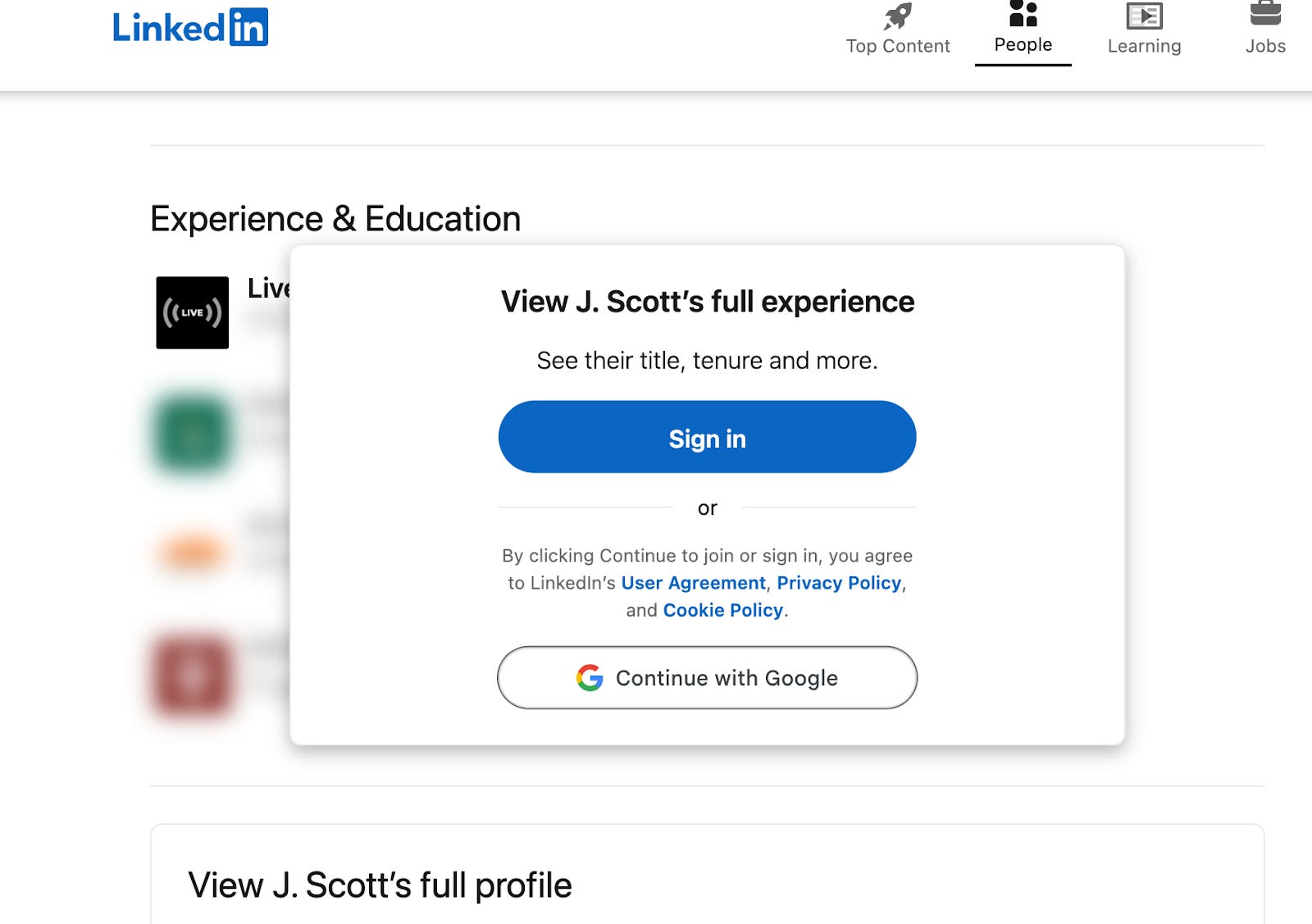
The detection systems have gotten sophisticated. LinkedIn’s scripts check whether browsers are lying about what they claim to be, cross-reference GPU signatures against claimed operating systems, and verify CPU core counts match claimed hardware. They distinguish human browsing patterns from bot patterns through behavioral analysis.
According to LinkedIn’s Transparency Report, their automated defenses now block 97.1% of fake accounts proactively. A sales rep enriching 50 leads daily will be fine. A vendor needing to refresh tens of millions of profiles every few weeks cannot sustain the math. The mouse is losing.
Workforce data rots. The BLS says median tenure is about four years, meaning roughly 25% of the workforce changes jobs annually. In tech and finance, it’s faster.
A workforce database is only as good as its refresh rate. Touch every profile every two weeks and you stay ahead of decay. Stretch to 180 days and you’re selling stale data.
Before November 2025, vendors could brute-force this: crawl aggressively, rotate infrastructure, scale up. That approach is now breaking down.
The market has a widening quality gap. On one side: vendors with diversified collection infrastructure who don’t depend entirely on LinkedIn. On the other: vendors optimized for coverage numbers watching their quality erode.
Both are still selling. But end users (competitive intelligence platforms, investor feeds, talent tracking tools) are noticing something feels off.
If you’re an investment firm using workforce data as an alternative signal, you need freshness to be predictive. When refresh cycles quietly stretch to 90-180 days, you’re getting stale confirmations, not leading indicators.
Stop asking “how many profiles do you have?” Start asking “how quickly do you detect job changes?”
Below is a screen cap of the verification log of a person we randomly picked from our file. Notice the refresh cadence and verification the information was compiled from public information. (When the person’s information is Private the white dot will be red.)
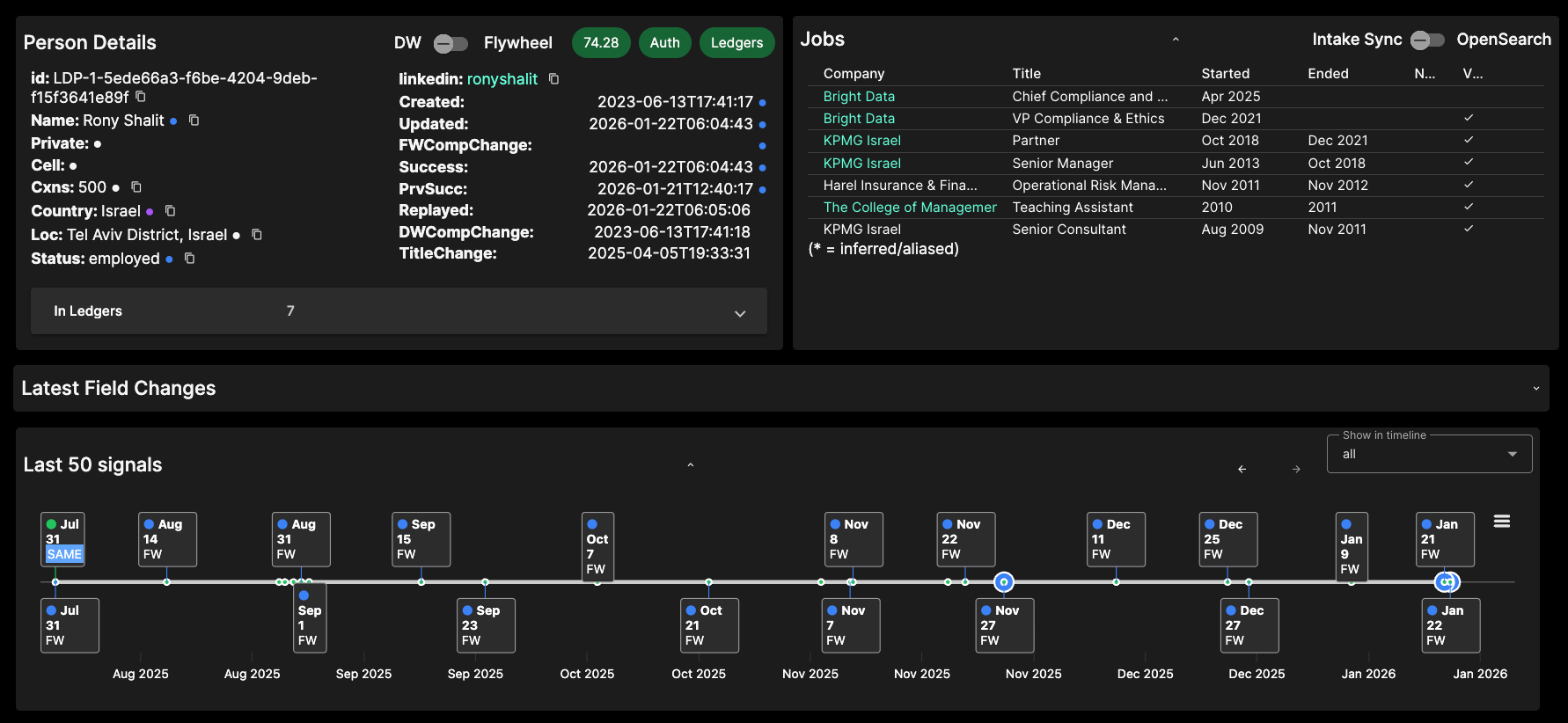
The best test of data vendors isn’t match files (those are easy to fake). It’s a real-time review of verification logs. Get on a call and ask your vendor to randomly browse through their logs while you watch. Look for date stamps and refresh cadences. If they don’t have ready access to this data, ask why.
We’re biased, obviously. Live Data Technologies never built our infrastructure around scraping LinkedIn, so these enforcement changes aren’t affecting us. We source from the open web without relying on any single platform. We validate 100% of the records in our file every 10-14 days, and the verification logs (as shown above) to prove it.
The questions we suggested are questions we’re happy to answer. Send us your data and we’ll validate it against ours. Ot we’ll walk you through our log files if you prefer.
LinkedIn’s enforcement pressure won’t ease. Vendors built on aggressive scraping face a structural problem that worsens daily. Some will adapt, some will narrow coverage, some will quietly accept lower quality, some will exit.
The workforce intelligence market is repricing around data freshness. For buyers, the question isn’t whether workforce data is available (it is). The question is whether your vendor is on the right side of the quality gap that’s opening up.
Comments
Nothing yet. Say the first thing.
Sign in to join the conversation.