
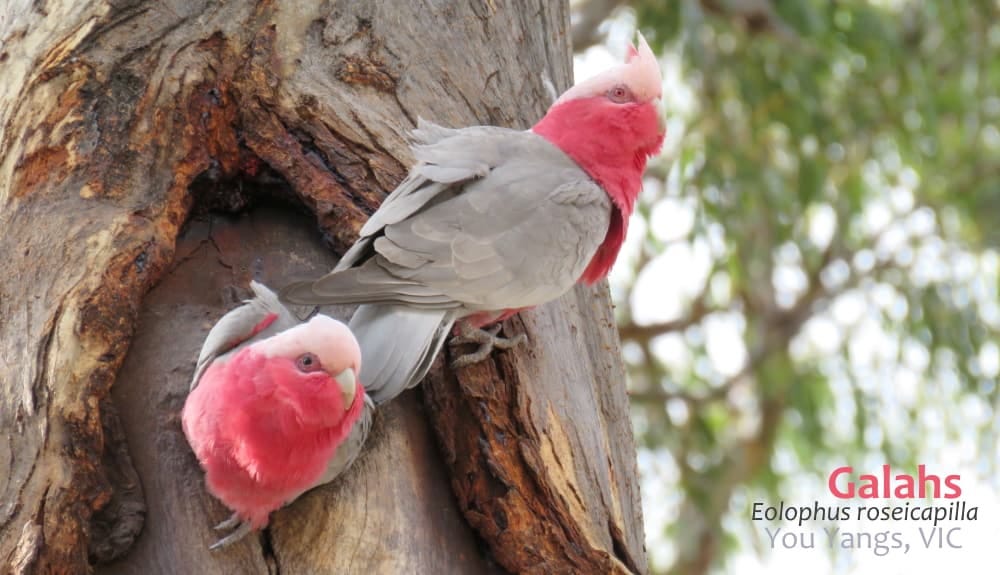
What sort of flamin’ galahs would seek to deliberately kill 15,000 of the most beautiful birds in the world using rat poison?
How is it that this thought lives in their mind?
And what kind of garish galah government grants a permit to do this?
The galah – for those who don’t live in Australia – is a gorgeous, goofy, Australian pink and grey cockatoo found throughout our continent. Not just strutting across the grass in city parks as if he owns the place, but swinging upside down through the trees using his powerful beak.
This playful bird even flourishes in the harsh Australian Outback where it gathers in large numbers in what Aussies call proudly “a mob of galahs”.
Named by Aborigines near Lightning Ridge, the galah combines bright rose pink and delicate grey marle in equal measure, with a white head: something nature hasn’t thought of anywhere else on earth.
As Winston Churchill would have said: “I look all around the world and have not seen his like elsewhere”.
Galahs thrive because they form loving relationships in which both the male and female take turns incubating the eggs, and looking after the chicks.
One Easter, I was left alone and palely loitering at home over the four-day holiday break, newly single at the age of 36, and Brisbane was deserted.
Everyone else was living it up at the beach.
The only thing that saved me from the sin of despair was the mob of galahs that visited the grounds of Indooroopilly High School across the road. I watched as they boisterously grappled on the grass, rolling over each other like pink puppies let loose for the first time.
A few years later, a Reuters foreign correspondent who I’d worked with in our Saigon office during the Vietnam War, Bob Hart, flew into Brisbane from his home in London.
Over lunch, I inquired why, of all the places in the world available to him, he had chosen Brisbane.
“I’ve always wanted to see galahs in the wild, can you tell me where I can see some?” the Englishman replied.
The galah is so important in Australian culture that it has become an integral part of the local lingo: so frisky, loud, and spirited that Aussies have chosen to refer to anyone carrying on like an idiot as “a galah” or a “right galah”.
Or, if the mob is large enough, “stupid bloody galahs”.
Yet, while Australia’s human population has grown rapidly and exponentially to 28 million, some would have us reduce the number of galahs!
On the grounds that these birds — not us — are “too numerous”.
The Australian Broadcasting Corporation (ABC) revealed in May that the Northern Territory government had granted a permit to a remote 4,000-square-mile central Australian cattle station.
The permit allowed “the manual euthanasia of 15,000 galahs”.
The Northern Territory government authorised the cattle station – Newcastle Waters – to use alpha chloralose (a rat and mice poison) to bait and kill the birds, saying the bird population has reached “unsustainable levels”.
“Unsustainable”, a word used often in politics these days when trying to explain away dodgy decisions.
The ABC reported that the Consolidated Pastoral Company (CPC) had already tried the “stupefying agent” to “successfully” kill 30 galahs on Newcastle Waters.
The aim of the poison programme was to “mitigate the impact of the galahs on crops, equipment, on workers’ mental health, and on bio-security”.
Staff were having trouble sleeping.
And, shock, horror, there was a “future possibility” of bird flu (anything is “possible” and there is no bird flu, yet, in Australia).
The galahs had damaged “trees, and vehicles, and electrical infrastructure”.
The cattle station argued that 15,000 galahs was way too many “for the environment” — although interestingly, that number of galahs is only one-sixth the maximum number of cattle on the property.
This horrific story was news, but only on the publicly-owned ABC and in an Alice Springs newspaper— there was no outcry that I saw, or heard, elsewhere.
Bird lovers strongly objected once the ABC’s story escaped the Outback, and, soon after, the UK-based parent company of CPC, Terra Firma (a private equity firm) intervened.
The UK has a history of stoutly defending its birds and wildlife and Terra Firma said it was “previously unaware of these plans” and had instructed Australian staff to “cease any culling plans immediately”.
But, according to the ABC, the company made the announcement “in a social media post”: presumably so as not to face a press conference where difficult questions might be asked.
The ABC carried this Terra Firma announcement in a follow-up story which, strangely, never mentioned the phrase “rat poison” … instead it used the company’s preferred euphemisms “cull” or “culling” eight times.
Fifteen thousand dead! That isn’t a “cull” it’s sounds more like War.
Sad that the English find our galahs more precious than we do.
No posts
Comments
Nothing yet. Say the first thing.
Sign in to join the conversation.