
I am not a devout football fan. I do follow the World Cup. Since it is played every 4 years, that makes doing that a somewhat easy task.
For one of the most watched global sports, the World Cup has its share of scandals. Some would say “more than its fair share”.
There was the 2015 “FIFAgate” that exposed decades of systemic bribery and money laundering for over $150 million.
It led to a dramatic Swiss police raid on a luxury hotel and arrests of dozens of FIFA officials. The FIFA president resigned in disgrace.
For those who don’t know, FIFA stands for Fédération Internationale de Football Association. Unofficially, FIFA has come to stand for FIFA Is Fraudulent Again, one common satirical acronym used by football fans.
The World Cup also never lacks on-field controversies and cheating.
The most famous one is Maradona’s “hand of God” in the 1986 quarter-final between Argentina and England when Diego Maradona punched, with his hand, the ball into the net.
Maradona nonchalantly claimed later it was scored “a little with the head of Maradona and a little with the hand of God.” I don’t know whether England concurs.
The Argentine national hero proved a repeat offender. During the 1994 tournament, Maradona was sent home after testing positive for ephedrine. A football “bad boy” is par for the course.
Another scandal, from my younger days when I had more passion for the sport, was the 1982 semi-final when West German goalkeeper Harald Schumacher brutally charged into France’s Patrick Battiston.
That charge left the French player unconscious, missing three teeth, and with cracked ribs.
Shockingly, the referee did not even call a foul, and Schumacher went on to win the match for his team in a penalty shootout.
That kind of ruined the sport for me.
But 2026 saw world football and FIFA hitting a new low.
On July 1, 2026, during a Round of 32 World Cup match between the US and Bosnia/Herzegovina, US striker Folarin Balogun received a mandatory red card following a Video Assistant Referee (VAR) review for a foul tackle.
Under standard FIFA disciplinary codes, an outright red card triggers an automatic, non-negotiable one-match suspension for the subsequent match.
What followed, however, was an unprecedented intervention that shattered the illusion of sporting meritocracy.
Donald Trump, the US dealmaker-in-chief and boss of all things West, who claims he “know more about football than anyone”, called FIFA President Gianni Infantino for a bit “revision”, i.e. bending the rule for “the Leader of Western Democracies” and “the Greatest Country in the History of the World”.
As a result, FIFA’s disciplinary committee invoked an obscure loophole within its disciplinary code. The committee suspended Balogun’s mandatory one-match ban under a probationary period, effectively clearing the US star to play against Belgium.
The decision triggered immediate international uproar among players and fans worldwide.
To be fair, the whole thing was really just a storm in a teacup. It pales against FIFA’s long-running corruption, and the US team, with Balogun on the team, lost its next match 4-1 to Belgium.
The episode has changed more about the perception of integrity and fairness of Western-led institutions, such as FIFA, than the outcome of the World Cup itself.
This is hardly the only example of FIFA bending its own rules to accommodate the “leader of the West”.
The Balogun incident was merely the culmination of a broader pattern of institutional double standards that plagued the 2026 tournament from its inception.
Historically, FIFA imposes strict, non-negotiable guidelines upon host nations, demanding guaranteed, non-discriminatory entry for all qualified athletes, match officials, and ticket-holding international fans.
When developing nations host global events, any failure to comply with these baseline infrastructure and immigration demands results in severe institutional penalties or the threat of tournament relocation.
Qatar, who hosted the last World Cup in 2022, was severely reprimanded by FIFA and Western media for its treatment of immigrant workers who built the stadiums and other facilities.
Yet, when the US enacted highly restrictive immigration protocols for the 2026 World Cup that directly violated the spirit of an open global tournament, FIFA chose to modify its own stance rather than hold the superpower accountable.
The US government expanded its visa restrictions to cover 39 nations, creating insurmountable administrative hurdles for fans traveling from countries such as Haiti, Iran, Senegal, and the Ivory Coast.
More egregiously, US border authorities denied entry to Somali referee Omar Artan—the first individual from Somalia ever selected to officiate a World Cup—despite his possession of a valid visa.
Over a dozen Iranian team officials were denied entry, forcing their national team to establish a training base in Tijuana, Mexico, and commute across the border strictly on match days.
Striker Aymen Hussein of Iraq was subjected to a gruelling 7-hour interrogation at a Chicago airport.
Faced with these flagrant breaches of host-country expectations, FIFA’s leadership abandoned its traditional regulatory authority.
Rather than issuing reprimands, FIFA publicly deflected responsibility, stating that the organization is entirely detached from host-country immigration processes and that sovereign governments maintain absolute dominion over their borders.
I guess they overlooked such “customary” bylaws when criticizing Qatar and Russia, which hosted the Cup in 2018.
FIFA President Infantino, the coward Trump called and ordered to stand down, went further, actively shielding Washington from scrutiny by arguing that FIFA cannot dictate border policy to a global “superpower”.
He certainly knows his place – on his knees in front of the “emperor of the West”.
The FIFA subservience was compounded by the stationing of ICE agents inside World Cup stadiums, prompting civil rights organization ACLU to issue travel advisories warning international visitors of potential racial profiling and unjustified harassment.
The message was unmistakable: the rules governing international hosting are absolute for the weak, but entirely negotiable for the powerful.
By overriding standard protocol to appease Trump, Zurich-based FIFA signals that its regulations are “flexible” when confronted by sufficient geopolitical weight or potential nasty insults from the man-child in the White House.
Such fawning and disgraceful behavior is hardly unique to FIFA or Mr. Infantino.
Just last June, Mark Rutte, the NATO Secretary General and long-serving Dutch prime minister, called Trump “daddy” in front of the press during the NATO summit.

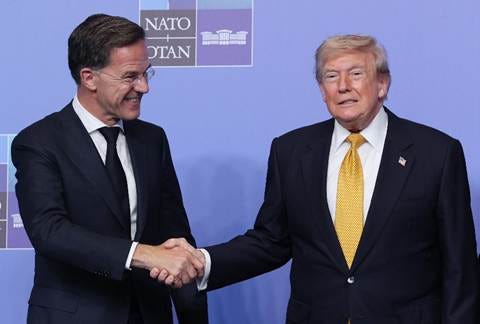
The shameless Dutchman then wrote a series of servile school-girl love letters to Trump, “Congratulations and thank you for your decisive action in Iran, that was truly extraordinary and something no one else dared to do. It makes us safer.”
Some more charitable commentators argue this is a means to win Trump’s favor and improve European security.
But putting lipstick on a pig can go only this far. Trump never hesitated for a moment to debase and humiliate the Europeans by ordering the heads of states of NATO countries and the EU to sit a semi-circle facing him in the Oval Office, like some disciplined second graders on their visit to the principal’s office.
His campaign team immediately started to push merch featuring the sycophant “daddy” quote on mugs and T-shirts.
JD Vance and Marco Rubio, along with other members of Trump’s cabinet, repeatedly referred to the knee-bending of the Europeans in their argument of Trump’s “greatness”.
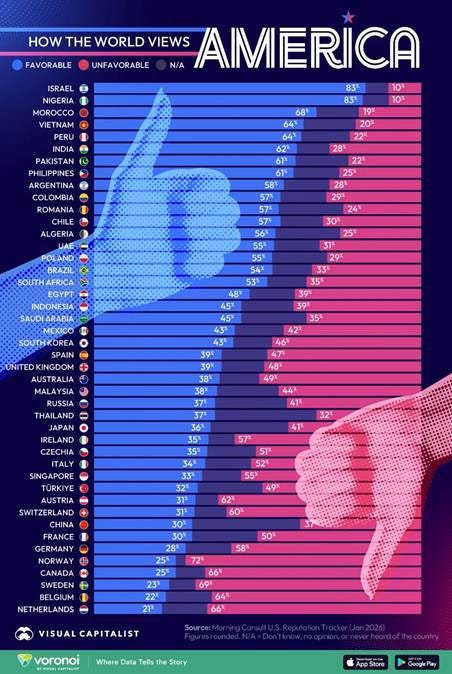
I guess this explains, at least partially, the rock-bottom Dutch favourability of the US globally. See the last chart in this article showing how 45 countries view the US.
Surprise, surprise, Israel is the country that has the most favorable view of the US. One wonders why (clue – some masters view their servants fondly).
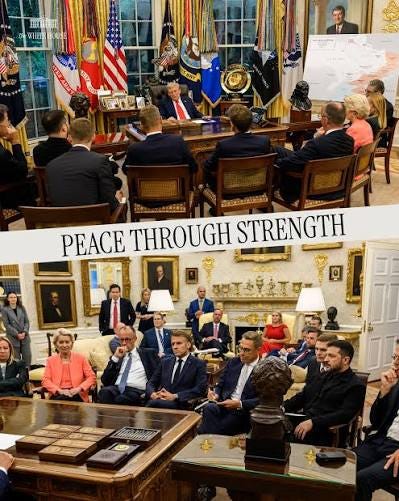
Rutte and Infantino’s disgraceful acts are not limited to White Europeans.
Other US “allies” offer similarly spectacular gestures of servility and subordination, often to the humiliation of their own citizens and the amusement of the rest of the world.
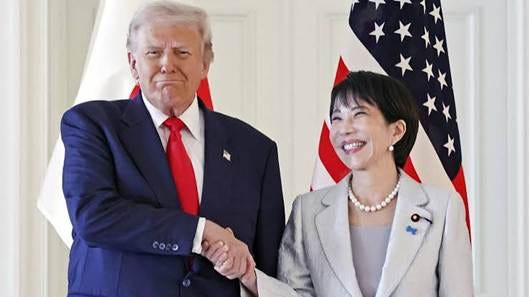
Whenever Takaichi meets Trump, the Japanese prime minister flashes her geisha smile and looks at her lord and master like the love-struck spinster that she is.
But the whorish fawning met with Trump’s cold invocation of Japan’s sneaky Pearl Harbor attack, while she was sitting right next to him - speechless and with a wooden expression. The despicable lap dog gets a good kick by its master.
In last week’s NATO summit, Trump talked excitedly how he bombed “the Islamic Republic of Japan”. Maybe a Freudian slip?
Prostituting personal dignity and national honor doesn’t pay – that is the best free lesson Trump gives. Perhaps he should have it printed on the marketing brochure for Trump University 2.0.
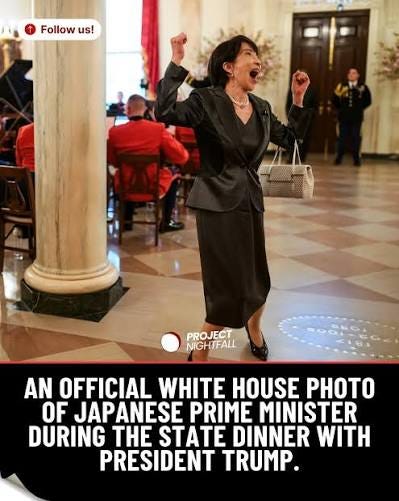
Takaichi was also caught dancing and flailing in wild excitement during a state dinner with Trump. I guess a proper amount of enthusiasm is required when dining with her master – but it’s unbecoming.
Her weird dance moves met their match with Yoon Suk Yeol, South Korea’s last president.
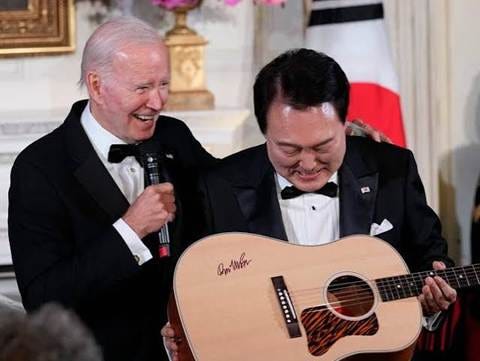
Yoon went to the White House and performed a heart-felt, overly enthusiastic rendering of the song American Pie to his master Sleepy Joe, earning him the moniker “national shame” by millions of Koreans.
The effort failed to move the senile Biden to soften the impact on Korean businesses with the Inflation Reduction Act and the Chip Act.
Yoon’s later self-coup attempt might well be a valiant move to savage his reputation. That didn’t quite work out, did it?
He was recently sentenced to life in prison by his own government.
In similar fashion, other Western-led institutions such as the World Bank, IMF, the Bank of International Settlement (BIS), SWIFT, International Atomic Energy Agency (IAEA), and the OECD have long been tools of the West to control the world, applying the “rules” to the weak, and bending them for the powerful.
The double standard “rules-based international order”
For decades, the architectural framework of Western governance—both domestic and international—has been publicly marketed under the banner of a “rules-based international order.”
This system purports to champion the universal application of law, the sacredness of national sovereignty, and the moral imperative of institutional integrity.
Yet, beneath this high-minded rhetoric lies a far more cynical, asymmetric reality.
Many people have astutely pointed out that in reality, it is a system of “we (meaning the West) make the rules and give others the orders”.
When the mechanisms of global authority are tested by the raw leverage of a dominant superpower bully, the veneer of principled governance rapidly dissolves.
The 2026 World Cup has exposed the structural subservience embedded within international bodies.
I actually don’t view the episode as an indictment of Trump’s bullying.
That is a given, well documented and accepted by now. What he did was entirely in character, however despicable.
What is revealing is the episode shows the moral capitulation and bankruptcy of Western institutions, officials, and politicians.
It shows the debasement and humiliation of the hypocritical group of Western ruling elites that speak as moral giant and act as spineless dwarf.
The interplay of hard power, economic/political dependency, and systemic hypocrisy has hollowed out any moral authority of Western institutions.
It has transformed “independent” heads of state into compliant political vassals, and catalyzed a historic collapse of public trust across the Western world.
The West singles out China, Russia, Iran, and North Korea as its “adversaries” who don’t want to follow its “rules-based order”.
I suspect they vastly underestimate how many other sovereign states in the developing world despise and resist the hypocrisy.
Many ordinary people living in the West similarly reject the legitimacy of such so-called “order”.
They may not have the hard power to push back on the neocolonial international system and the domestic rentier plutocratic rule set up by the Western elites, but they hardly believe in the rhetoric and the equity of the “order”.
The Vassalization of “allies”: naked performative subservience for the world to see
This pattern of institutional capitulation is not confined to the realm of international sports; it mirrors the broader geopolitical landscape of Western alignment.
The behavior of FIFA executives closely reflects the actions of sovereign heads of state within major Western alliances like NATO, as well as Asian dependents like Japan and South Korea.
The relationship between Washington and its global “allies” is increasingly characterized by a dynamic of performative subservience, where foreign leaders adopt a deferential posture to manage the volatile, transactional US leadership.
The world has seen, over and over, heads of states in the West bypass traditional diplomatic channels in favor of direct flattery and public submission.
Whether it is a European prime minister adopting highly deferential language when addressing a US president, or NATO heads of state assembled in Washington like school children awaiting instructions, the imagery conveys a stark hierarchy.
Just like Trump said when he walked into this year’s G7 summit, “the boss is here”.
In East Asia, this dynamic is even more humiliating since Asians are known for their penchant to preserve “face”, i.e. a modicum of dignity. But the “boss” couldn’t care less about the servants’ feelings.
Servile public displays are frequently condemned by domestic audiences as humiliating, unprincipled pandering that diminishes national dignity.
But unfortunately, beggars cannot be choosers. These countries are US technological, military, and political dependents – vassals at best, colonies at worst.
Such displays provide clear evidence that US “allies” are not merely junior partners, but lackeys with little agency.
A nation cannot claim true sovereignty if it cannot independently dictate its own trade policies, secure its borders, or manage its military without seeking validation from Washington, a foreign capital.
For instance, Japan, South Korea and the Netherlands have all been systematically pressured by the US to restrict lucrative semiconductor exports to China, directly harming their own domestic tech sectors to align with Washington’s demand.
When a superpower can compel “sovereign” nations to act against their own economic self-interest, the term “strategic partnership” becomes a euphemism designed to conceal an uncomfortable reality of geopolitical subordination.
Putting lipstick on a pig won’t save the day
Some defenders of these alliances argue that viewing these actions as mere “slavish servitude” misunderstands the brutal logic of international relations.
From the perspective of cold realpolitik, these diplomatic displays are not driven by weakness or a lack of national pride, but by a highly calculated survival strategy.
By outsourcing a substantial portion of their defense infrastructure to the US military umbrella, these nations have historically saved trillions of dollars.
This defense bargain allows them to reallocate resources for domestic benefits.
Second is the reality of economic co-dependency. The global financial system remains anchored by the U.S. dollar and access to the American consumer market.
A single hostile tariff, trade sanction, or financial restriction issued by Washington can destabilize a foreign economy overnight, including its so-called “allies”.
Third is the utility of flattery as a low-cost asset. Within a transactional political framework, traditional diplomatic protocols are often ineffective.
Politicians calculate that public praise, symbolic deference, and performative alignment are highly valued by American leadership, especially a vane insecure non-entity like Trump.
To a foreign prime minister or a sports executive, absorbing a temporary, superficial blow to personal pride is an incredibly cheap price to pay if it successfully secures binding security guarantees, averts catastrophic trade wars, or preserves billion-dollar investments.
Therefore, what looks on screen like a humiliating surrender is defended by its performers as sophisticated “damage control”.
I can see why this line of argument is used by the servile Western politicians and their population to make looking into the mirror somewhat easier.
After all, you don’t get to be a big shot politician without a thick skin. And honor is indefinitely less valuable than the perceived “benefits”.
But putting lipstick on a pig cannot hide the structural dependency and subordination of these states to the reigning hegemon. And the US is not ignorant that its dependents are riding on its coattail and free-loading.
More importantly, such rationalization won’t save them when the hegemon decides these vassals have exhausted their utility before casting them aside.
Even worse, these vassals who have internalized their subservient positions will be much more easily turned into “cannon fodder” or “frontline battlefields” once hostilities break out with the hegemon’s adversaries.
History tells us the fate of slaves never has a happy ending.
Structural decay and the disappearance of leadership
It didn’t used to be like this. Europe produced strong post-war leaders from de Gaulle, Conrad Adenauer, Helmut Kohl, and Olof Palme.
The contrast between the fiercely independent statesmen of the past—such as de Gaulle, who famously withdrew France from NATO’s integrated military command in 1966—and the compliant politicians of today highlights a profound structural shift in the nature of Western leadership.
Today’s politicians are largely incapable of replicating de Gaulle’s defiance, not merely due to a deficiency in personal courage, but because the empire has consolidated its control to the point genuine independence by the vassals is simply impossible.
During the Cold War, leaders possessed significant strategic leverage. They could exploit the geopolitical rivalry between the United States and the Soviet Union, playing the two superpowers off one another to maximize national autonomy.
Furthermore, twentieth-century states maintained strict control over their domestic economies.
Today, that structural latitude has vanished. Modern Western economies are inextricably woven into a hyper-networked financial grid dominated by Wall Street, the dollar, and the SWIFT banking system.
Any sudden attempt at defiance risks triggering instantaneous capital flight, stock market liquidation, and artificial economic panic engineered by corporate interests under the hegemon’s control.
The archetype of the political leader has evolved too. Figures like de Gaulle were forged in the existential crucible of war and national independence struggles; they viewed themselves as historical actors charged with safeguarding national destiny.
Modern Western politicians, by contrast, are predominantly career technocrats, media managers, and lawyers. They are not statemen; they are “managers” or even “short-order cooks”. The music chair of UK prime ministership is a perfect example.
Steeped in group-think and short-term public relations, they operate within 24-hour news cycles and narrow electoral horizons.
For a contemporary manager-politician, standing up on principles of absolute sovereignty represents an unacceptable political risk with no immediate return.
This constraint is reinforced by Washington’s unmatched technological and intelligence dominance, which monitors global information flows and provides massive leverage over foreign political establishments.
Remember Edward Snowden’s whistle-blowing of pervasive and persistent US surveillance over its “allies”, including tapping the personal mobile phone of Angela Merkel.
Lastly, US influencing machines such as USAID or NED, let alone shadowy organizations like CIA and NSA, have made sure only vested compradors get to ascend for the top jobs in the “allied countries”.
The unravelling: collapse of public trust
This persistent gap between high-minded democratic rhetoric and transactional, submissive practice has led to what many view as a profound moral, ethical, and systemic atrophy across the West.
At this point, the West’s hypocrisy almost feels quaint and harmless.
By enforcing international law stringently upon weak developing nations while treating it as entirely optional for itself, the West has degraded any moral authority.
Such institutional hypocrisy has not gone unnoticed by the citizens of the rest of the world. Indeed, it is also painfully realized by their own populations in the West, culminating in a historic collapse of public trust.
Data from major independent tracking organizations—including the Pew Research Center, the Edelman Trust Barometer, and Eurobarometer—quantify this profound internal decay.
The global trust divide highlights a stark polarization between developed and developing societies. Developing nations have higher trust in their institutions than people in developed countries.
The average trust index across developed nations has stagnated at a distrustful 49%, contrasted sharply with a resilient 66% optimism found in developing nations.
This distrust is intensely stratified by class; the gap in institutional confidence between high-income elites and low-income citizens has more than doubled in the West, reflecting a widespread belief that the system operates exclusively for the wealthy.
Long-term data from the Pew Research Center reveals that public trust in the US federal government has experienced a devastating multi-decade slide, plummeting from approximately 75% in 1958 down to a meagre 30% in 2026.
65% Americans believe that politicians run for office solely to advance their personal, self-serving interests.
Externally, a majority of countries now view the US unfavourably, even amongst many of its so-called “allies and partners” in Europe and Asia.
In Western Europe, the June 2026 Eurobarometer survey reveals that 71% of European citizens consider corruption to be rampant within their respective countries.
69% explicitly agree that high-level corruption cases are systematically ignored or inadequately prosecuted.
Finally, this systemic disillusionment has triggered a collapse in media credibility.
The 2026 Edelman data indicates that an overwhelming 70% of individuals in the West are now hesitant or entirely unwilling to engage with or trust the “mainstream media”.
Less than 30% of citizens across “Western democracies” still believe that the next generation will enjoy a better financial or social future than their parents.
Where we are today
The red card incident involving Folarin Balogun and the immigration scandals of the 2026 World Cup are not isolated administrative errors.
They are highly visible symptoms of a broader, systemic reality: a Western political order that has prioritized raw pragmatism, financial interest, and superpower appeasement over the very rules and moral values it claims to uphold.
Whether this current state of affairs is interpreted as a recent, tragic degeneration of Western ethics or simply the unmasking of an enduring, historical realpolitik, the consequences remain identical.
By transforming international law into a tool that binds the weak while exempting the powerful, Western institutions have eroded their own credibility both abroad and at home.
The modern politician, operating as a risk-averse manager within a centralized global hierarchy, may successfully avert short-term economic or security crises through performative submission to Washington.
However, the long-term cost of this strategy is paid in the steady, measurable erosion of personal dignity, national sovereignty, institutional legitimacy, and the foundational trust of the citizens they govern.
It is time for the world to tell the hypocritical Western institutions and politicians – “Red Card, you are out”.
Thanks for reading Hua’s Substack! This post is public so feel free to share it.
No posts
Comments
Nothing yet. Say the first thing.
Sign in to join the conversation.