

For the next few weeks I’m going to be focused on launching my book, Reds: A Global History of Communism. I’ve put three years work into the book which is a big physical chunk of paper: to preorder in the UK click here and quote REDS2026! to get 50% off. Meanwhile, here’s a riff on a new report from economists studying global fertility rates, which raises alarming questions about the future of capitalism….
It turns out that the most salient fact about global population is that you can only have children in integers of 1. Though total fertility rates (TFR) are declining fast, to around 1.8 children per every two adults, all numbers after the decimal are statistical, not human realities.
As Jesus Fernández-Villaverde and Patrick Norrick write, it only takes a few more people to decide against having kids than at present to get the population shrinking fast. If the number of childless women grows from, say, 15 out of 100 to 23 in their model, the total fertility rate (TFR) slumps to 1.3.
In their UPenn paper, Terra Incognita: The Economics of a Shrinking World, the authors predict that “unless trends change, world population will peak at roughly 9 billion around 2056 and then start falling, first slowly, then fast”.
We are living through a second demographic transition, which deaths are going to exceed births and population will fall.
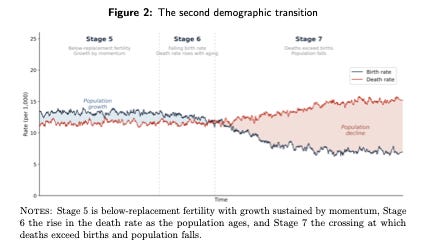
Once thought to be a phenomenon of the developed world, and triggered by a mixture of rising income and female access to education, falling birthrates are now a feature of societies across the global south, and are falling faster among the poor than the rich.
Mexico, Tunisia, Colombia, Thailand, Iran and numerous other middle income countries are recording total fertility rates way below those of Europe and North America.
At a loss for provable single causes, the authors conclude the reason is simply “modernity”. We are all living in organised societies, with structured economic and social relationships, which make having kids expensive, and the more you have than two, the more you are going to suffer financial and career consequences.
That, they say, is the safest explanation for why birth rates among low income and poorly educated women are falling faster than for those higher up the scale.
Whatever the cause, say the authors, it’s unlikely to be reversed. There is no economic scenario in which couples voluntarily start producing more than 2.1 children again. And if they’re right… here’s what the population of three major power blocs would look like in 2100.

There are upsides to this. Falling populations will place less stress on resources and maybe help achieve and sustain Net Zero faster.
But the economic downsides predominate. In mainstream economics, output growth equals rising productivity plus rising numbers of workers, or hours worked. Once you start shrinking the workforce, the productivity side of the algebra has to work overtime just to stand still.
But – in normative or “endogenous” theories of capitalism – rising productivity is the consequence of new ideas and the diffusion of new technologies. But with fewer young people you get fewer new ideas, and indeed there is a (highly abstract) model in which you end up with no growth and no new ideas at all.
Long before that however, you get the mismatch that’s perplexing Britain’s OBR: between rising debt – due to welfare systems catering for the old and sick – and falling numbers paying tax. Since most modern states service welfare systems out of current taxation, eventually those systems break, and long before that, so does consent to be governed.
And though humanity’s demographic retreat doesn’t begin, at the earliest, until the 2050s, you can begin to see rational expectations forming among lenders who intend their money to be around in that decade.
Today’s news of surging global 30 year bond yields, triggering extraordinary actions by the Fed, may be driven by short term fears of inflation. But lurking behind them must be the fear that population de-growth leads to economic degrowth, with a massive pile of stranded debt.
This is the first time in the history of the world that rising human capability – what Marxists call “productive forces” – has driven population shrinkage rather than growth.
And it poses an interesting question for critics of capitalism. In all forms of historical materialism – which considers a system like capitalism to be likely time limited due to its endogenous contradictions – there is a model of change that works as follows:
Technological change drives rising expectations; at some point the structure of society can no longer support the existing distribution patterns; dynamism fails; revolution – either political, social or cultural – overthrows the existing elite and a new one forms, around a new distribution deal (or in the case of communism, equality).
For ecosocialists, this sequence is complicated by the intrusion of a third factor: the limits of what the planet can withstand. Instead of straight clash between productive forces and the social “superstructure”, it is global warming that brings the once-dynamic system to its denouement.
I think the UPenn paper means we have to consider a third way that capitalism might end: at the point where its core growth dynamic – more productivity plus more people – simply breaks down because that 1.8 number trends towards 1.3 or below.
We end up with ghost cities, bankrupted states, motorways depopulated of the automobiles that once clogged them, and the innovation process narrows.
There’s a potential solution – of course – and it’s artificial intelligence. If AI can achieve the spectacular productivity hikes promised by its quasi-religious advocates, and the falling birth rate actually spurs us to replace people with machines, you can theoretically have decent GDP growth with a falling population, though you still don’t overcome the problem of how the taxes of the decimated workforce cover the welfare bill.
But in the AI productivity miracle scenario, you also have to explain how consumption is sustained, since a shrinking population and lower wages puts a crater in that metric as well.
This rapidly falling birthrate problem is new, and was not anticipated when we first noticed the climate change problem. Likewise, the addition of climate as a “limit to capital” – on top of the internal dysfunctions observed by Marx, Schumpeter, Keynes, David Harvey etc – is relatively new. And the “AI destroys the market, innovation, entrepreneurship and work” hypothesis, which I’ve covered here before, is also new.
As a result, when we think about capitalism and its future (a subject driving neoliberal economists crazy as hell because Chiara Cordelli had the temerity to foreground the system’s critics in the Stanford Encyclopaedia of Philosophy) we may have to factor in four highly unpredictable dynamics.
The first question is: can capitalism go on working, given the exogenous shocks marching in like waves on a surfing beach. Can the old routine of morphing into a new regime of accumulation, so well documented by Kondratieff, go on working forever.
When I wrote Postcapitalism: A Guide to Our Future I was pretty sure that it could not, because of the network effects of information technology.
The second question is: can capitalism solve, on the terrain of an economy regulated by market forces, the challenge of Net Zero. Compared to 2015, when I wrote the book, I am now far more certain that it can.
The plummeting cost of solar panels, the imminent breakthroughs in nuclear fission, the EV revolution… sure there are bumps in the road ahead, concerning the problem of electrifying economies built around oil, coal and gas, but I think it’s doable. A post-carbon capitalism will look very different, and may have to be quite small scale, but it could conceivably be a mixture of state and market.
The third question concerns AI and robotics. I think there are serious doubts as to whether capitalism as a complex adaptive system can cope with the agentic and post-agentic phases of neural networks. It will destroy not only brainwork jobs; it could automate innovation, destroy the basis for intellectual property per se, long before it automates housebuilding and elderly social care.
The fourth question is that posed by Fernández-Villaverde and Norrick: can capitalism survive the first strategic shrinkage of the world’s population?
If the answer is no, then the transition to what comes next is not a one- but four-dimensional dynamic. We have to solve the problems of debt, low productivity and stagnating growth; the problem of Net Zero; the problem of automating jobs and tasks faster than we create new ones; and the problem of shrinking populations.
If you map their interconnections, to me it points to one, common strategic logic: create smaller and more sustainable communities.
If “modernity”, with its demand for years of education, university fees, a tight career ladder and the frenetic city, is what’s turning people off from having more kids, then just stepping back from it – in a technologically progressive way, rather than as in the fantasies of the ecofascists – might be a feature of what comes next.
The 15 minute neighbourhood – again detested by the right, but an essential part of the Net Zero transition – gains new attractions once you factor its potential benefits in terms of care for the elderly, and care for the young.
If we built slower, smaller, more sustainable communities, with nurseries and supervised playgrounds, the people in them might be inclined to have two children per adult.
I have never been emotionally drawn to this vision: I love living in a mad, frenetic city, zipping along in a cavalry charge of e-bikes in the rush hour and fighting my way to the bar of my teeming local pub.
But if it has to happen, it has to happen.
Please share and comment. Thank you to all subscribers. Once again, please preorder my book here, use the REDS2026! discount code, and if you like it please leave a review on Amazon to counteract the crazed MAGA and Stalinist reviews that will no doubt follow.

Comments
Nothing yet. Say the first thing.
Sign in to join the conversation.