
[I’ve removed the paywall on this for wider sharing.]
A group called demilitarise Education (dED) has put out a statement denouncing Labour’s formation of the Defence Universities Alliance, an initiative to voluntarily align a group of universities with government defence research objectives.
As someone who proposed this policy while Labour were in opposition, and advocated it in this think-tank report, I am delighted that the DUA is about to launch, and I welcome the opportunity to debate with the signatories of the dED statement.
Stop the War, which has signed the statement, would not recognise the principles of moral philosophy even if a resurrected Saint Augustine wrote them out in crayons.
But Quakers in Britain, Action on Armed Violence (AoAV) and People & Planet – each of whom has also signed the protest - do good work, and their arguments deserve to be considered.
The principles here are very simple.
First, should there be a state, with the duty to defend its citizens, and should that state have the moral and legal right to go to war?
The UN Charter answers yes. And most world religions subscribe to theories of just war, which prescribe specific reasons for going to war and specific strictures on how to fight them.
But the answer is no, full stop, then it would be logical to deny the right of Ukrainians to defend themselves against Russian aggression (as Stop the War do by trying to halt arms supplies), and to oppose all military spending and any presence of defence manufacturers on campus.
The Quaker position is absolute, and I respect it. Yet the Leninist re-enactors who run Stop the War have a very clear just war theory, based on Lenin’s theory of imperialism. And AoAV is run by people who support Ukraine’s right to resist, while People & Planet mobilises activists for whom the absolute free-riding position of religious pacifism is not high in the mix.
If we accept there can be a state with a monopoly of armed force, and the legal right to use that armed force under the UN Charter, and that as socialists we aspire to win elections and govern such a state democratically, the second question is:
Is there a threat that requires not only a standing army and a defence industry, but the use of science and technological innovation to deter aggression against us?
Here’s what UK’s National Security Strategy says – a document drawn up after thousands of hours of study and consultation with expert groups, including from across academia:
“Threats are proliferating. We are entering a period in which we are likely to face indirect and potentially direct confrontation with adversaries, the intensification of strategic competition – including the increasing salience of nuclear weapons in the policies, doctrines and approaches of our adversaries…”
It points out that Russia’s war against Ukraine has been accompanied by
“a campaign of indirect and sub-threshold activity – including cyber attacks and sabotage – by Russia against the UK and other NATO allies and the use of increased nuclear rhetoric in an attempt to constrain our decision making.”
The NSS is not a party-political document: it is the most rigorous analysis the state can make and publish, written by civil servants.
Since it came out the Russian military buildup in Belarus and around St Petersburg and in the Arctic circle has continued. Russian submarines are actively scanning and rehearsing the destruction of the cables and pipelines our entire system of survival depends on.
So if you accept there is a state, that there is a rising threat that Russia will attack the UK or one of the NATO allies we are bound by treaty to defend, and that there can be a just war, why would you oppose some universities – the government’s initial target is 20 – voluntarily aligning their science and career pathways with government national security efforts, and building partnerships with companies that make the ships, aircraft, satellites and software we need to defend ourselves?
The Defence Universities Alliance was conceived as a democratic British response to Russia’s emerging war economy and China’s civil-military fusion doctrine.
Seven Chinese universities – known as the Seven Sons of National Defence – have their research entirely aligned with the demands of the People’s Liberation Army; on top of that there are 160 Chinese universities with a privileged relationship with the military.
Chinese universtiy science is, in this respect, neither independent nor ethically sound – and for this reason there is no way the UK could ever emulate such military-civilian fusion, even in wartime. Every principle of academic freedom militates against it.
Yet the Ukraine war shows that, in a war against an authoritarian, militarised state, only by innovating faster than the attacker can a smaller country defend itself.
The wars of the 21st century will be fought and won with intelligent machines and software. If we don’t at the very least keep pace with the scientific arms race China and Russia have begun, we will lose our ability to deter them from attacking us.
The DUA aims to do this through voluntary agreement and incentive, which as we will see is a fundamental principle in British higher education.
Let’s now take dED’s arguments one by one. They claim that by defining universities as part of the Defence Industrial Base, the Labour government is:
“treating campuses as extensions of military infrastructure rather than spaces for independent inquiry and the pursuit of knowledge that serves humanity”.
This is totally mistaken. The Defence Industrial Base (in the EU called the Defence Technological and Industrial Base, or DTIB) is just a term in economic policymaking.
Labour has also defined the trade unions as part of the DTIB, and invited them, together with universities, to sit on the first ever joint industrial council, with a voice in policy and priorities.
Are the unions – GMB, Unite and Prospect, all of whom have agreed to sit on the industrial council – “an extension of military infrastructure”? Have they lost the ability to set their own policies on war, defence spending etc? Clearly not.
In fact, it is precisely because Labour prizes the independence of science, and wants to produce “knowledge that serves humanity” that it designed a voluntary scheme.
The problem is that, given China’s record of intellectual property theft and espionage, some of what UK universities are producing is going straight into the Chinese DITB, where there are no ethical checks and balances at all.
One outcome I hope will arise from the DUA initiative is that institutions will begin to take greater care over research security, and be more aware of potential malign tech transfer to the dictatorships in Beijing, Moscow and Tehran.
And the amount of Defence funding going into universities is tiny compared to the MOD’s overall spend.
The Defence Science and Technology Labs (Dstl) spent £461.1 million on research contracts in 2023–24, but only 4.8 percent was awarded to universities, (roughly £22.1). Navy Command spent £130.85 million on research contracts, but only 1.3 percent went to academia, which is about £1.7 million.
So there is a massive opportunity for UK universities to take part in the innovation surge that’s going to be necessary to keep the UK capable of defending itself in the era of AI, robotics, quantum computing and tactical nukes.
The dED declaration claims the DUA is bad because it is:
“Redirecting research priorities away from addressing pressing social, environmental, and humanitarian challenges toward military applications.”
Anyone with a cursory knowledge of the UK university scene knows that is simply untrue. There is massive societal/environmental/humanitarian benefit from e.g. the space innovation, materials science, avionics and pure maths and physics involved in defence research.
Here’s one example: a Dstl funded project to make artificial blood that doesn’t need to be refrigerated. Would you drive that project off campus because it is MOD-linked?
dED further alleges that the DUA is:
“Compromising institutional independence by making universities dependent on arms/military funding and strategic alignment.”
Well, right now, almost every university in Britain is dependent on funding from the Chinese state, via student fees – and to a far greater extent than on MOD funding.
Since the DUA is voluntary it is hard to see how it compromises institutional independence, since university governing bodies can vote to leave it at any time.
The dED statement further claims the DUA is:
“Creating ethical conflicts for researchers and students whose values oppose war and militarisation.”
Again, it is hard to see how this stands up. First, one of the most important aspects of the DUA is the insistence that defence research is carried out under the rigorous standards.
Secondly why assume people involved in defence research do not “oppose war”. Do you think the programmers running Ukraine’s autonomous drone programme right now “supported war” before 24 February 2022?
If it’s wider “corporate influence” people are worried about, fair enough – start big pharma, the oil majors, the banks etc – all of whom have relationships with HE institutions – but be prepared for the massive loss of funding, expertise and functionality of the sector. In fact, be prepared for the return of the polytechnic.
Running throughout the dED statement is the idea that “military priorities” and “real human need” are different things. It’s facile.
One of the most fundamental human needs is physical security. To switch on the lights in your university dorm you need electricity and gas: which comes through cables and pipelines Russia is targeting right now.
There is a different issue, which is the presence of defence firms and the military on campus, and at recruitment fairs. But this has been going on for years – and all the DUA does is allow some universities to brand themselves as aligned with Britain’s self-defence and deterrence efforts, and to actively shape government priorities in this sphere, rather than being passive bystanders.
I understand the initial call for 20 DUA members has been massively oversubscribed, so it’s clearly an attractive offer at a time when many institutions face financial penury.
The statement is also confused about Labour’s £182m Defence Technical Excellence college initiative. This has nothing to do directly with universities: it is creating engineering training places for working class kids in some of the poorest places in Britain – creating pathways into jobs that are, on average, paying £10k more than their equivalent on the rest of manufacturing.
The dED signatories want students at all universities to oppose DUA membership full stop.
I would argue, instead, that we need a mix of HE institutions – some of which are overtly aligned to government priorities, others which do defence work on a contract-by-contract basis, while others might explicitly state that the do no defence related science.
Pacifist-inclined students could readily enrol at the latter, secure in the knowledge that someone else is defending them against the possibility of kinetic and nuclear attack, and that the defence firms, Silicon Valley and the rest will likely take their research dollars elsewhere.
But we’re in a world where priorities matter. The armed forces are there to defend our country – upholding the lifestyle and freedoms that allow dED to exist.
So it should be a condition of all universities’ licence to operate that the armed forces can recruit there and have a public presence on campus.
As for corporations: by all means hold individual defence firms to account for the countries they sell to and the ethical standards they uphold; there are some defence firms in the world that I would not want on a British campus. And by all means question defence firms’ involvement with Israel or other countries that break the laws of war.
But a blanket opposition to collaboration with firms employing tens of thousands of Brits in good, unionised jobs seems perverse.
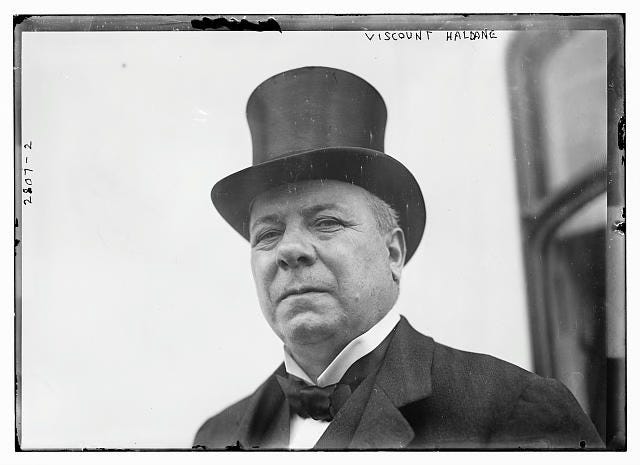
Finally, it seems to have escaped the notice of the drafters of this protest that the entire concept of the modern British university, with its academic freedom guaranteed from short-term government diktat, was designed by the same man who came up with the Officer Training Corps, the Imperial General Staff, the university Military Education Committee and the Territorial Army.
Richard Burdon Haldane, a liberal peer, insisted in 1907 that universities should be set free from elitist hierarchies and religious influence, and led the massive expansion of what we today call the Russell Group universities, opening them up to working class students in the process.
In a 1918 report, Haldane spelled out the principle that “decisions about what to spend research funds on should be made by researchers rather than politicians”.
That is exactly the government’s intent. It’s why the MOD’s research bodies put out tenders, not instructions. So the Defence Universities Alliance is fully rooted in the Haldane Principle.
And it is because we run our universities as sites of intellectual challenge, not the rote-learned totalitarian bullshit that shapes politics at the PRC’s “Seven Sons”, that we will hopefully turn out better quantum, space, autonomy and materials science graduates, and be able to better deter aggressors and defend our democracy from those trying to destroy it.
Finally dED calls for “public lectures, workshops, and teach-ins about the ethics of militarised academia and the history of resistance to military-academic complexes”.
Great, let’s start with the Seven Sons of National Defence and work back from there. While we’re at it, maybe Stop the War can host a session explaining what happened to “resistance” in the militarised universities of Assad’s Syria, Putin’s Russia and Khamenei’s Iran?
The fact is that in the UK, from Haldane onwards, Defence is just part of what universities do, and what they’ve always done.
So if you meet someone who wants to reverse more than a century of collaboration between universities and Defence, at the very moment when threats to UK national security and democracy are at their highest since 1991 – and they’re not a religious pacifist – it’s worth asking them the question: cui bono?
In the unlikely event that we expelled the armed forces and defence firms from all our campuses, and terminated every university research contract with the MOD, who would benefit?
I dunno what the motivation of AoAV and People & Planet is for signing up to an initiative alongside Stop the War, but I can guess precisely what StW’s controllers in Counterfire and the SWP want to do: move people engaged in justified solidarity with Palestine into entirely unjustified agitation against the armed forces of their own country.
Once again, comrades: cui bono?
Given this is a public interest issue I will lift the paywall after 24 hours. Please share and if possible subscribe…
Comments
Nothing yet. Say the first thing.
Sign in to join the conversation.