
Australia’s nine-wicket defeat to Bangladesh in Darwin was too complete and too historically jarring to be filed away as a freak result. The top-ranked Test side was bowled out for 198 after choosing to bat, conceded 426, trailed by 228 and made 284 second time around despite Cameron Green’s century. Bangladesh then chased 57 for one wicket to record their first Test win in Australia.
Yet one upset does not prove a downfall. Before Darwin, Australia had won 18 of their previous 23 Tests and had just completed a 4-1 Ashes demolition of England. They entered the Bangladesh series on top of the World Test Championship standings. The more uncomfortable question is whether those results have been concealing deterioration underneath.
Marnus Labuschagne is the clearest statistical warning. From 2019 through 2023, he scored 3,793 Test runs at 53.42. Since the start of 2024, that output has fallen to 937 runs in 40 innings at 26.03. His last Test hundred came at Old Trafford in the 2023 Ashes. Darwin extended the pattern: 1 and 31. Jake Weatherald made 23 and 0 and has now been dropped after six Tests at an average of 20.36. Australia have recalled Matt Renshaw, 30, who has not played a Test since 2023.
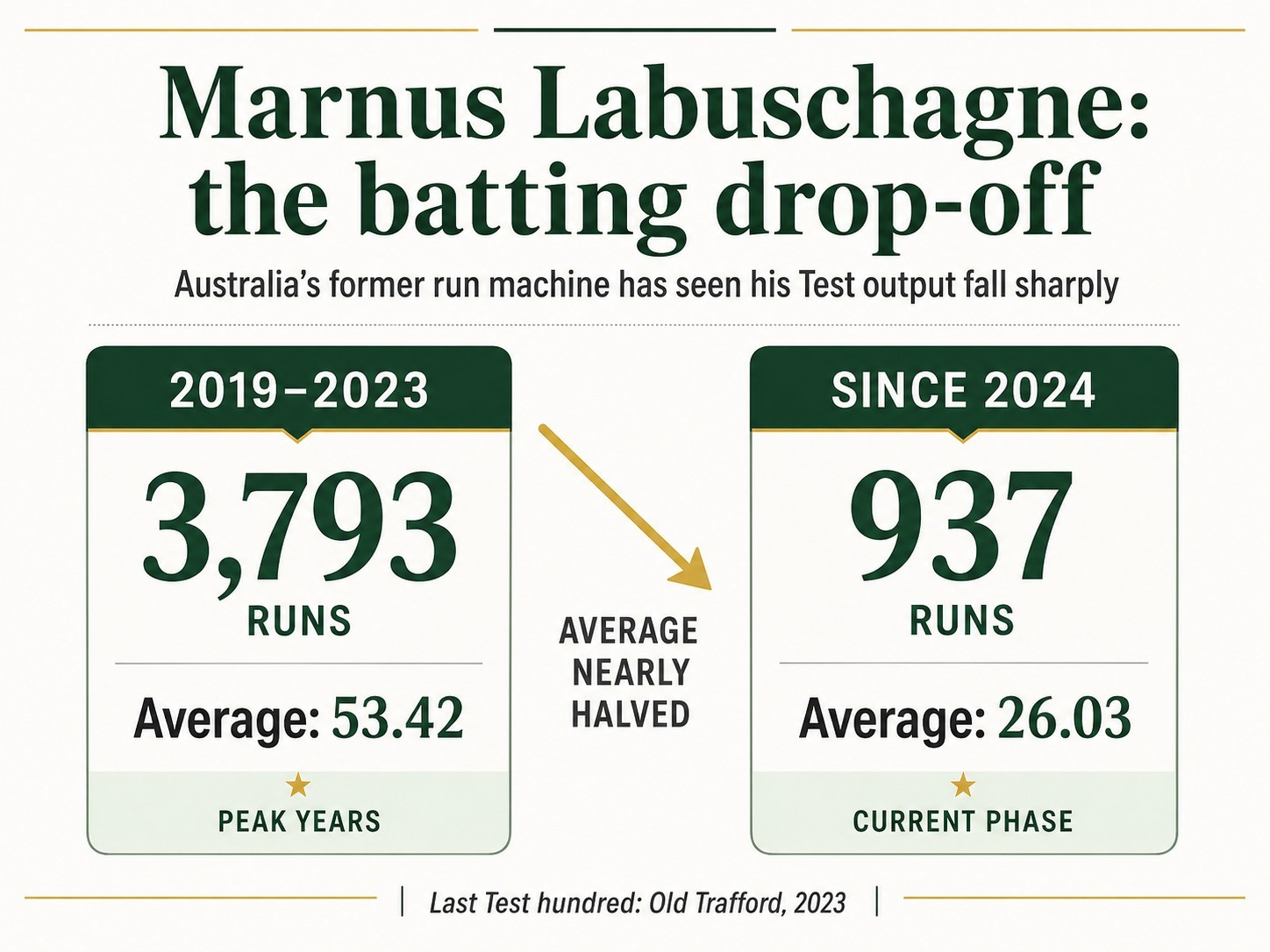
That is not a settled top order. It is a side searching for answers while Steve Smith, now 37, remains one of its few established batting pillars.
The bigger issue is what sits underneath the Test team. Peter Handscomb topped the 2025-26 Sheffield Shield regular-season run charts with 688 runs — the lowest total by a season-leading scorer in 53 years. The Shield’s runs-per-wicket figure also fell to its third-lowest level of the past decade in 2025-26. Cricket Australia is examining whether seam-friendly pitches and competition incentives are producing short games rather than batters capable of constructing long first-class innings.
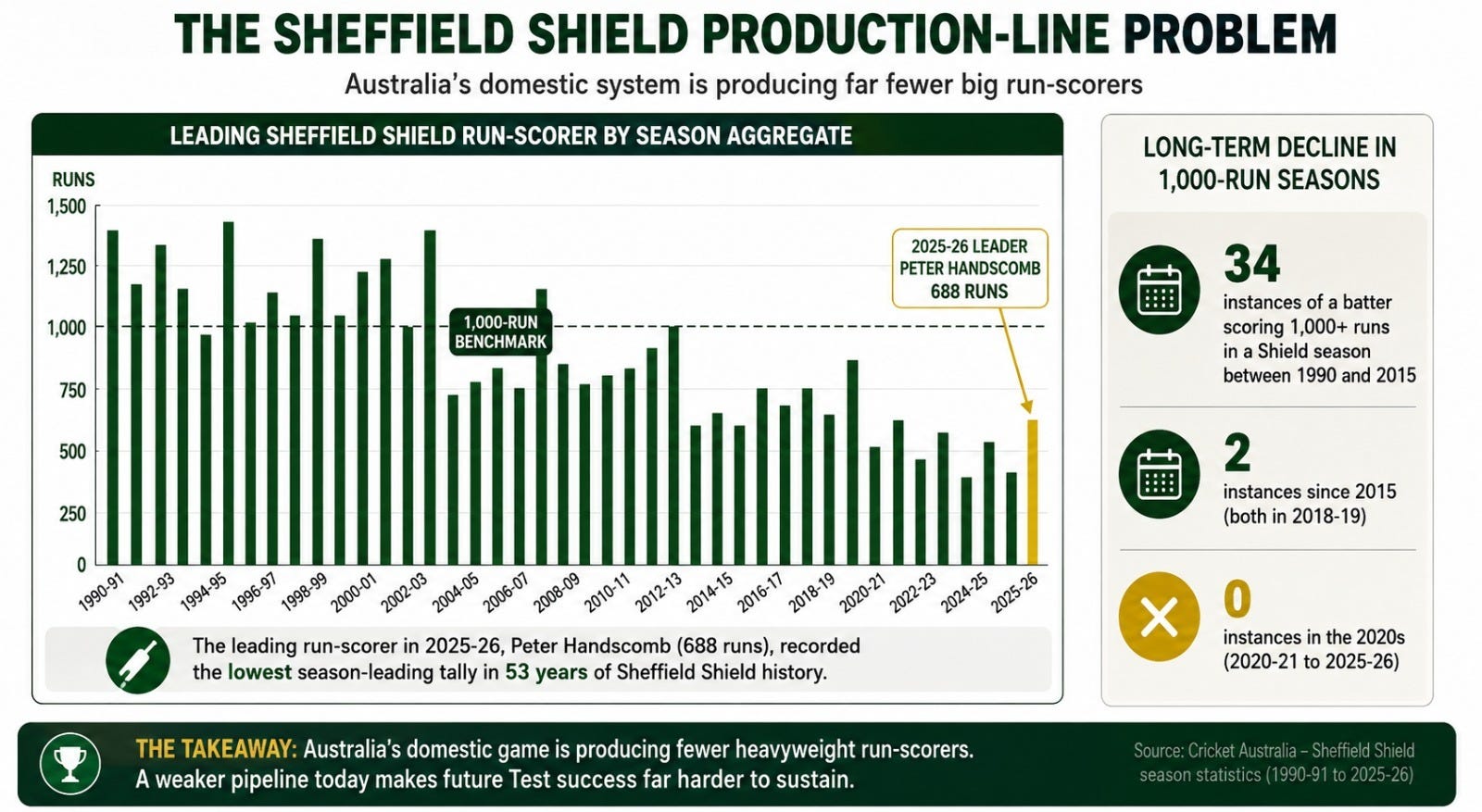
Australia’s historic advantage was depth. Today, selectors are returning to Renshaw because no young run-machine has made himself impossible to ignore.
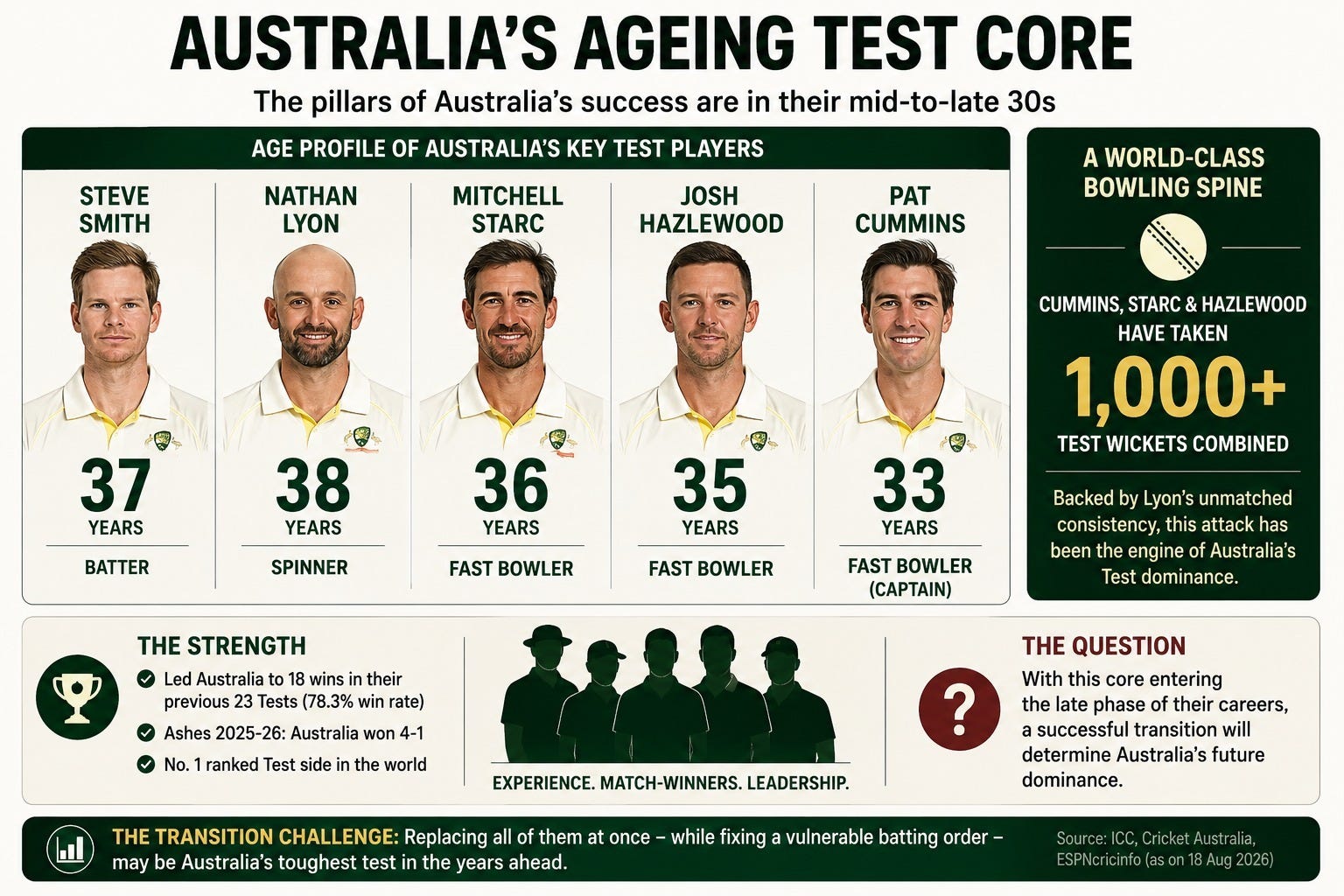
Australia have remained formidable partly because their bowling has repeatedly compensated for batting failures. Cummins, Mitchell Starc and Josh Hazlewood have more than 1,000 Test wickets between them, with Nathan Lyon providing another enormous body of work.
Australia’s last men’s ICC title came at the 2023 ODI World Cup. Since then, they missed the semi-finals of the 2024 T20 World Cup, lost the 2025 Champions Trophy semi-final to India, lost the 2025 World Test Championship final to South Africa and failed to reach the Super Eight at the 2026 T20 World Cup.
Bangladesh have now hurt them twice in 2026. Before Darwin, Australia lost a three-match ODI series in Bangladesh 2-1, their first bilateral ODI series defeat to them. Individually, none proves collapse. Together, they show an Australian side converting its reputation and resources into trophies less frequently.
Calling this the downfall of Australian cricket today would still be premature. They remain No.1 in the Test rankings, won 18 of 23 Tests before Darwin and crushed England 4-1 only seven months ago. Green is 27 and produced a century under severe pressure.
Australia could thrash Bangladesh in Mackay and then succeed in South Africa, making Darwin look like an extraordinary outlier. There is still too much elite quality in the side to write its obituary. But rankings are backward-looking. Transition problems often become obvious only after the veterans masking them disappear.
That is why Bangladesh’s victory matters beyond the scoreline. Australia did not lose because of one freak spell. Their malfunctioning batting was exposed, their ageing attack could not rescue them, and selectors immediately responded by dropping an opener.
The data points to a more nuanced conclusion: Australia are not yet declining by results, but they are showing several characteristics of a team approaching a dangerous transition — falling output from a key batter, instability at the top, weaker domestic run production, an ageing bowling spine and diminishing returns at global tournaments. Darwin is not proof that Australian cricket has fallen. It may be the first result that made the cracks impossible to ignore.
No posts
Comments
Nothing yet. Say the first thing.
Sign in to join the conversation.