
The biggest real estate development of the week was not the launch of a new project or a marquee property transaction; it was the notification of the Master Plan for Delhi 2047 (MPD 2047), a 535-page blueprint that could reshape where and how the capital grows over the next two decades.
Notified by the Union Ministry of Housing and Urban Affairs, the fourth master plan for Delhi sets out a long-term framework for housing, mobility, infrastructure, redevelopment and economic growth. It seeks to prepare the capital for a population projected to reach 3.2 crore by 2047, against an estimated 2.4 crore today.
The ambition is to develop 30-40 lakh new homes, increase the use of public transport corridors, redevelop ageing neighbourhoods, plan urban expansion, and, potentially, dramatically alter the Delhi skyline.
For the real estate sector, MPD 2047 is less about a single headline provision and more about a fundamental shift in how Delhi can use its scarce land.
Perhaps the most striking change is the plan’s opening for landmark tall buildings of more than 100 floors.
For the first time, the master plan explicitly defines structures above 100 floors as ‘tall buildings’ and envisages them as landmark developments that could strengthen Delhi’s skyline. Such buildings are expected to come up in areas with adequate infrastructure, particularly along mass-transit corridors and in major commercial and mixed-use centres.
The plan also removes general building-height restrictions across much of Delhi, although several areas remain excluded, including the Lutyens’ Bungalow Zone, Civil Lines Bungalow Area, Connaught Place and its extension, Zone ‘O’, land pooling areas, low-density areas and locations restricted by the Archaeological Survey of India or the National Monuments Authority.
The policy shift is significant, but it does not mean 100-storey towers can suddenly come up anywhere in Delhi. Infrastructure capacity, statutory approvals, planning controls and structural safety will determine where such development is actually viable.
That distinction will be particularly important in a city located in seismic Zone IV.
MPD 2047 adopts two broad approaches: brownfield redevelopment in existing built-up areas and greenfield development through land pooling and planned expansion.
The strategy includes:
Redevelopment of existing group housing, DDA and government housing, with the minimum area requirement reduced from 40,000 sq m to 3,000 sq m. The plan estimates this could generate around 7 lakh additional dwelling units.
Around 18 lakh affordable homes through development along Metro corridors and TOD zones.
Housing for more than 17 lakh residents of jhuggi-jhopri clusters through dignified rehabilitation.
Additional FAR incentives for workers’ housing on larger industrial plots.
Affordable rental housing, supported by a 50% FAR incentive, aimed at students, working professionals, migrant workers and low-income groups.
Affordable housing along high-density corridors.
While the larger aim is to bring housing closer to jobs, transport and infrastructure rather than allow disconnected expansion, experts say the target of 30–40 lakh homes raises a more fundamental question: How will the land be amalgamated, and will there be enough infrastructure to support such large-scale development?
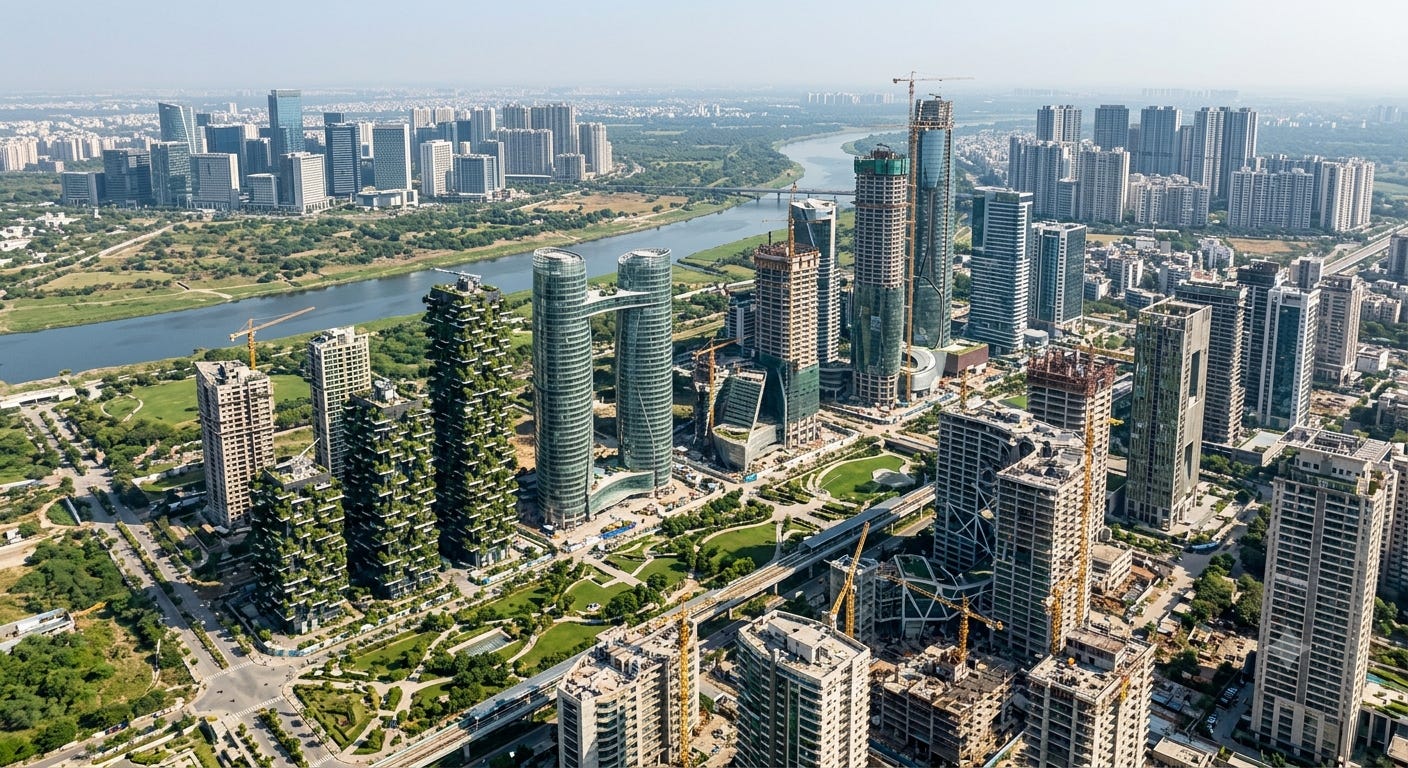
Transit-oriented development is central to MPD 2047. It is an urban planning strategy that promotes compact, mixed-use, and high-density growth within a 500-m radius of public transit corridors, such as Metro and RRTS stations, to reduce travel time and vehicular pollution.
This could change the value equation for several parts of Delhi.
The plan also seeks to make it easier for individual plots within TOD corridors to participate in consolidated development. Leasehold individual plots forming part of a consolidated TOD plot could be deemed freehold, subject to applicable conditions and clearance of dues.
The Delhi Development Authority will act as the nodal authority for approving TOD projects and sanctioning building plans.
For developers, the attraction is clear: higher density, stronger connectivity and greater development potential. For homebuyers, the proposition is equally straightforward: homes closer to mass transit could become increasingly valuable as commuting patterns evolve.
Not all of Delhi’s future growth will come from new land. A significant part could come from rebuilding what already exists. MPD 2047 proposes a regeneration framework for old government colonies, ageing housing societies and planned residential neighbourhoods. Projects could be undertaken on plots of at least 3,000 sq m, with properties allowed to be merged or reconstituted.
Redevelopment could receive construction rights of up to 1.5 times the base FAR, potentially allowing residents to rebuild with more floor space while upgrading roads and civic infrastructure.
For group housing societies and DDA colonies, resident welfare associations, societies or federations would need to undertake redevelopment collectively.
The framework also brings an infrastructure requirement. Redevelopment projects would need to incorporate measures such as water reuse, decentralised sewage treatment, waste segregation, renewable energy, multi-level parking and wider internal roads. In other words, the plan is not simply offering residents more built-up area, it is attempting to use redevelopment as a tool to modernise entire neighbourhoods.
The other major piece of the housing puzzle is land pooling.
MPD 2047 identifies around 200 sq km for planned urban expansion. Under the land pooling policy, the DDA plans to facilitate the construction of around 12 lakh new homes, supported by an infrastructure-first approach.
The plan envisages a road network of around 600 km, with the DDA developing 30-metre and wider roads upfront to support planned growth. This is potentially one of the biggest opportunities for Delhi’s future housing supply, but also one of the biggest tests of implementation.
The land pooling policy was introduced to bring privately owned land into planned development, with landowners and the DDA participating in the process. Till July 2026, more than 7,615 applications had been received, and over 7,885 hectares of land had been registered and pooled, as per data shared by the Authority.
The numbers indicate participation. The next challenge is converting that participation into actual neighbourhoods, roads, utilities and homes.
MPD 2047 also seeks to create new economic and institutional centres.
Narela is positioned as an education hub, with 138 hectares reserved for universities, while Dwarka is envisioned as an international gateway with infrastructure aimed at attracting IT, start-ups, data centres and industrial parks.
Such employment and institutional anchors matter to real estate because housing demand rarely develops sustainably without jobs, connectivity and social infrastructure.
For real estate developers, the plan creates opportunities on two fronts: redevelopment within established Delhi and new development on its expanding edges.
The emphasis on mixed-use development, TOD, regeneration and infrastructure-led growth could create new residential and commercial clusters. Higher development potential around transit corridors could also make underutilised land more valuable.
For homebuyers, the biggest potential change could be the widening of housing choices within Delhi. More affordable homes, rental housing, and redevelopment could provide alternatives for buyers who currently look to Noida, Greater Noida, or Gurugram.
But supply alone will not determine the outcome. The critical question is whether Delhi can deliver the infrastructure needed to support that supply. Roads, Metro connectivity, water, sewerage, parking, schools, healthcare and employment centres will determine whether new housing becomes a functioning neighbourhood or simply another development on paper.
This is where the impact of MPD 2047 becomes more nuanced.
If large volumes of affordable and mid-income housing are delivered in Delhi at competitive prices, some buyers who currently consider Noida or Greater Noida could potentially return to the capital.
But this does not necessarily mean falling property prices in neighbouring markets. Delhi, Noida and Gurugram increasingly serve different buyer requirements.
Delhi’s new supply is likely to come largely through brownfield redevelopment, TOD corridors and land pooling. That could work particularly well for mid-income and price-sensitive buyers.
Gurugram and Noida, meanwhile, have built strong propositions around large-format apartments, gated communities, clubhouses, parking, corporate offices and premium residential developments.
Gurugram’s residential market, in particular, is no longer simply a spillover market for Delhi. Its demand is increasingly supported by employment centres, corporate occupiers and luxury housing. A buyer looking for a large 3BHK or 4BHK in a gated township with extensive amenities may continue to choose Gurugram or Noida even if Delhi adds substantial housing stock. The result could therefore be market segmentation rather than a broad-based price correction across NCR.
MPD 2047 provides Delhi with an ambitious framework. But a master plan is ultimately only as effective as its execution. The biggest question for the real estate sector is no longer what the plan proposes. It is how quickly those proposals can translate into actual homes, roads, infrastructure and functioning neighbourhoods, say urban experts.
Land pooling will need to move beyond registration and participation. Redevelopment will require residents, developers and agencies to coordinate. TOD will need infrastructure and faster approvals. And high-density development will have to be matched by adequate transport and civic capacity, they say.
For a land-constrained capital facing a rapidly growing population, the direction is clear: build more, build better and build around infrastructure. If implementation moves at scale, MPD 2047 could create a new generation of residential and commercial growth centres within Delhi and bring some housing demand back from NCR.
If execution remains slow, Noida and Gurugram are likely to retain the advantages they have built over the past decade. For now, MPD 2047 has initiated the conversation. The next two decades will determine whether it changes the city itself.
No posts
Comments
Nothing yet. Say the first thing.
Sign in to join the conversation.