
Hi there 👋
Today, we look at a preprint from a single case study of 1000 days of HRV data, published by Amin Sinichi et al. from the Vrije Universiteit Amsterdam (link here).
I’ve been in contact with Amin for 4-5 years and previously discussed his research, e.g., when looking at the terrible accuracy of wearables to capture HRV outside of resting conditions (discussed here).
In his latest pre-print, Amin looks at 1000 days of his own HRV. Amin’s data shows large changes in relation to a number of stressors, with the largest reduction in RMSSD occurring during a multisource acute stress period that included travel, exposure to a war zone, concurrent respiratory illness, and the death of a close family member.
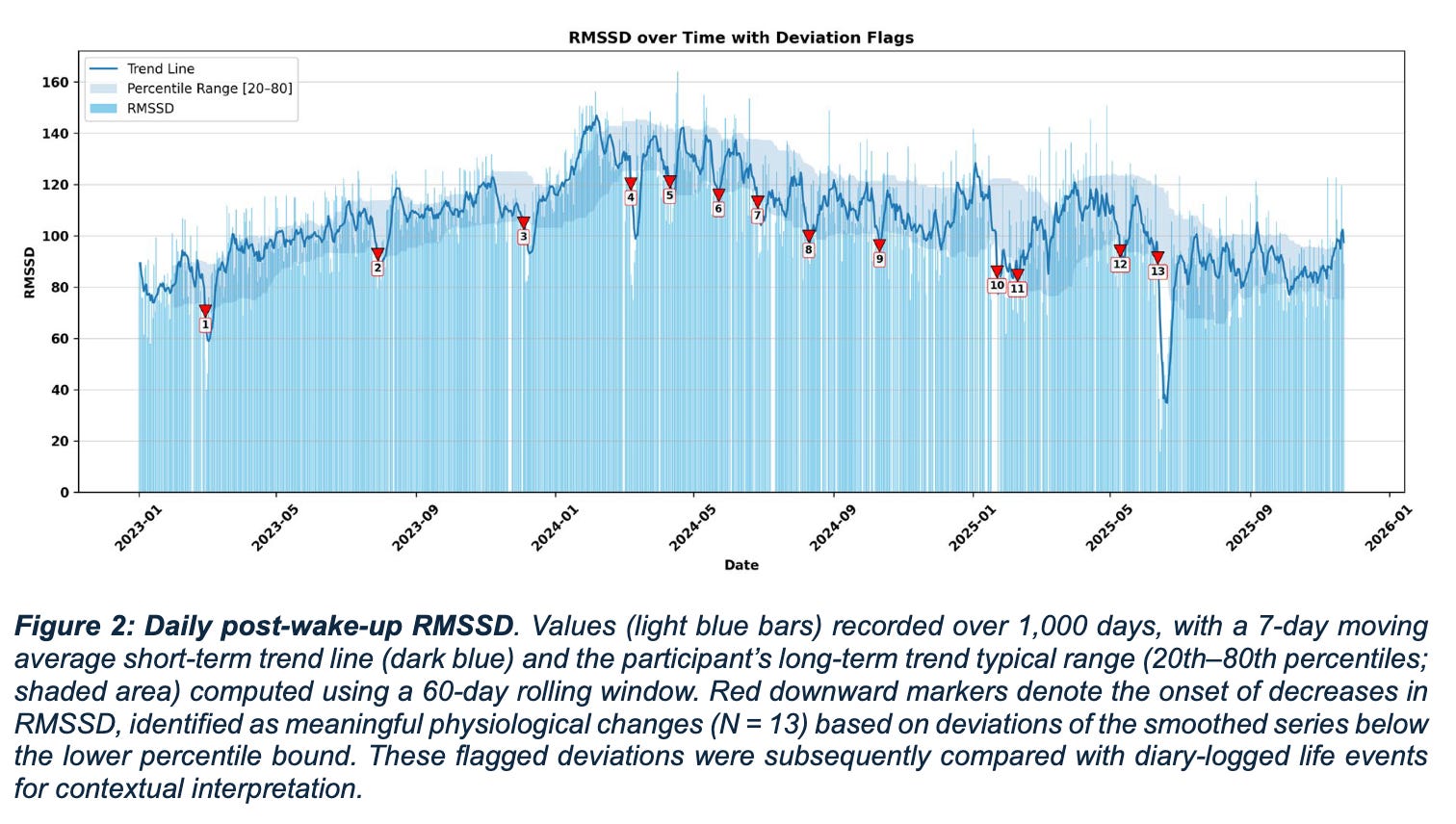
Amin collected also night data (using a Polar Grit X Pro) and compared it with morning measurements.
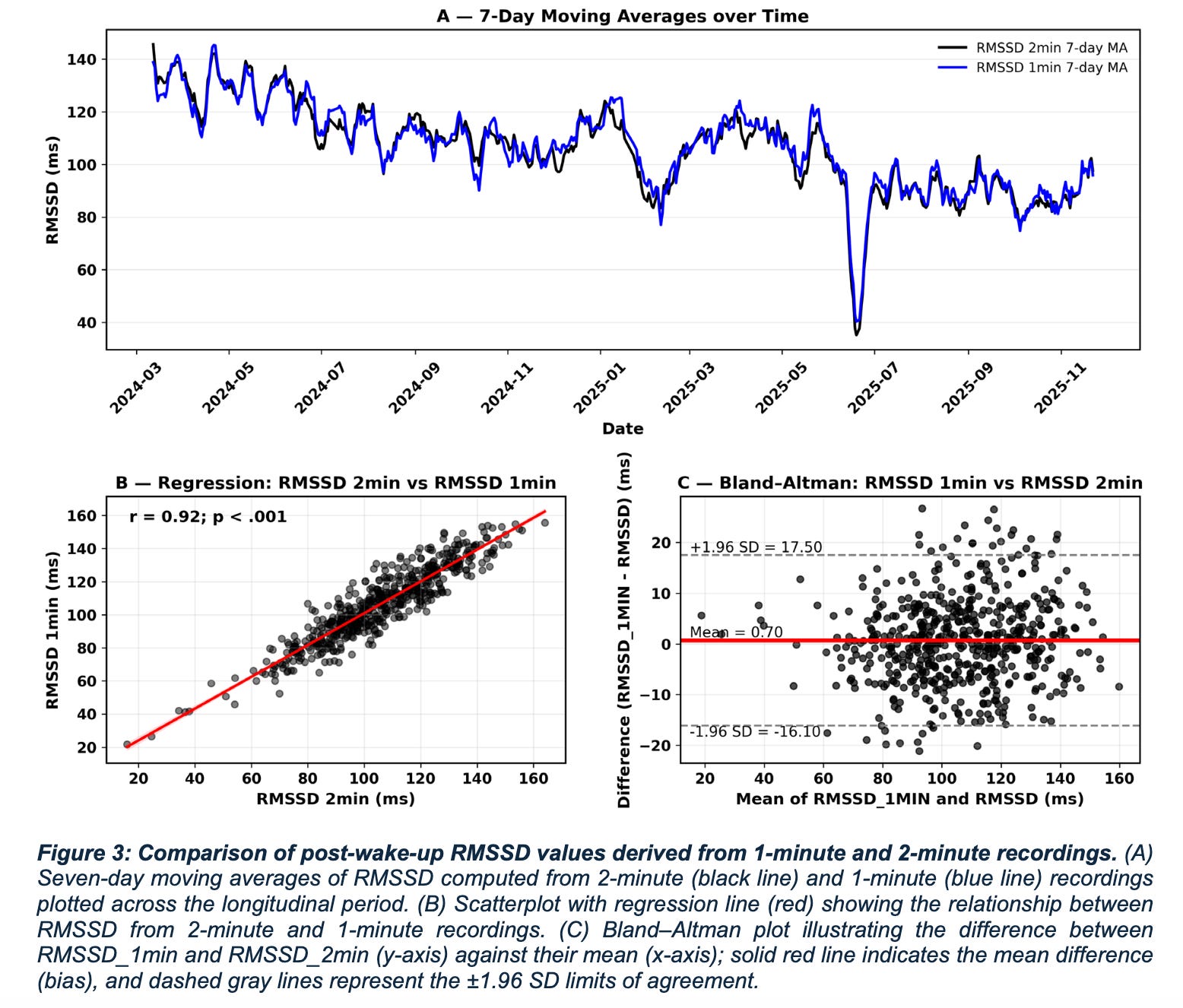
His analysis first assessed how 1-minute versus 2-minute recordings showed close agreement, and how nocturnal HRV appeared more blunted and less sensitive to contextual changes (something at this point we’ve stressed plenty in the past, e.g. when discussing the orthostatic stressor or recent research highlighting how night data misses important changes visible in morning data).
In the author’s words: “the current results suggest that seated post-wake-up intentional recordings, rather than passively collected nocturnal averages, align more closely with real-life stressors”.
Protocol:
The resting-state HRV data is recorded after waking up (and after using the bathroom, if necessary). The recording is done for two minutes, while sitting down with knees at a 90-degree angle, eyes closed, breathing normally and spontaneously.
Note that further analysis showed how 2 minutes was equivalent to 1, hence you do not need to increase the duration if you are using one minute.
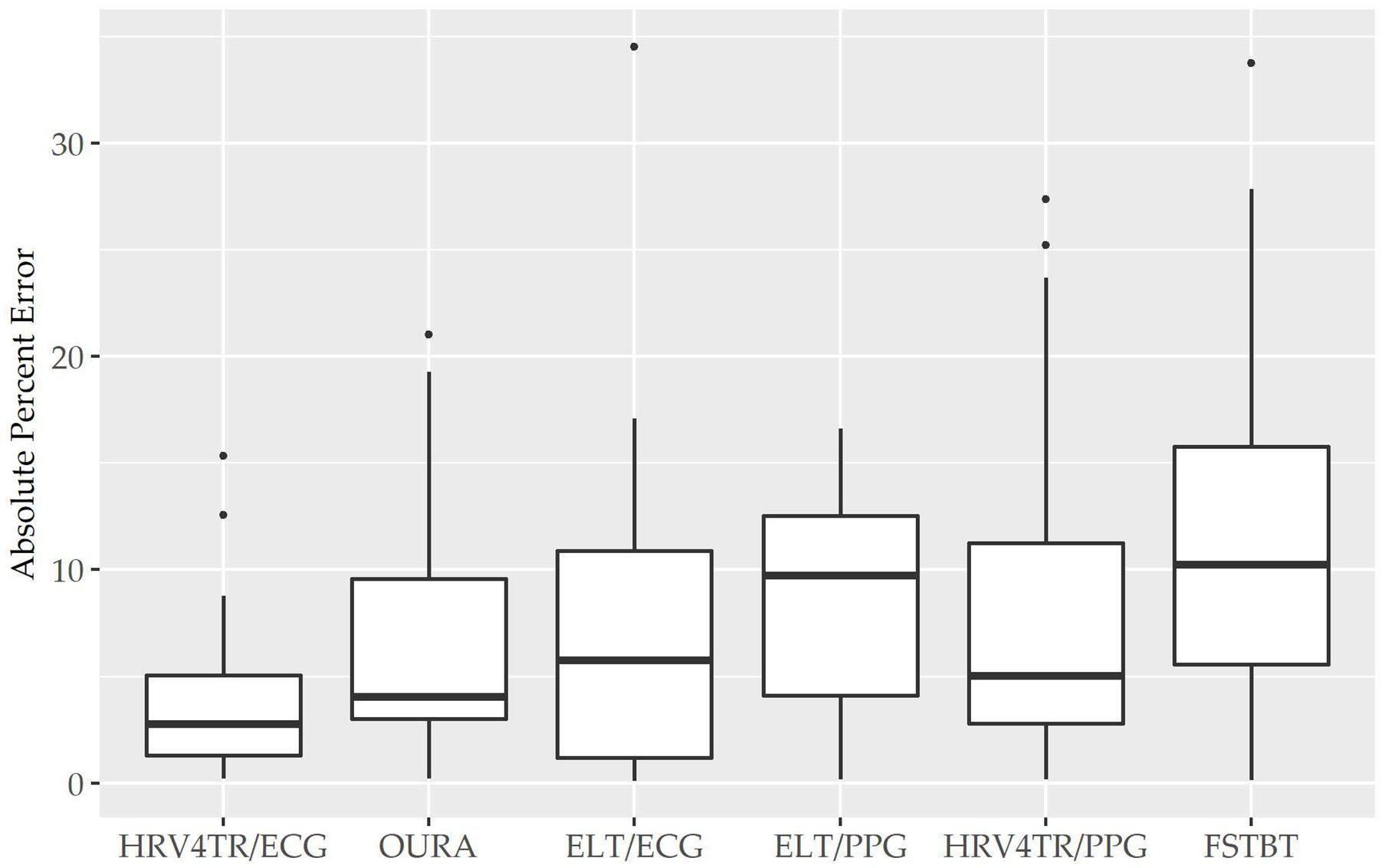
Recording device: HRV4Training + Polar H10.
This combination showed the lowest error with respect to wearables as well as other apps paired to the same chest strap in independent validations.
Thank you Amin for your work!
Please apply here should you be interested in working with me.
You can also learn more about my coaching, here.
Thank you!
HRV4Training Pro is the ultimate platform to help you analyze and interpret your physiological data, for individuals and teams.
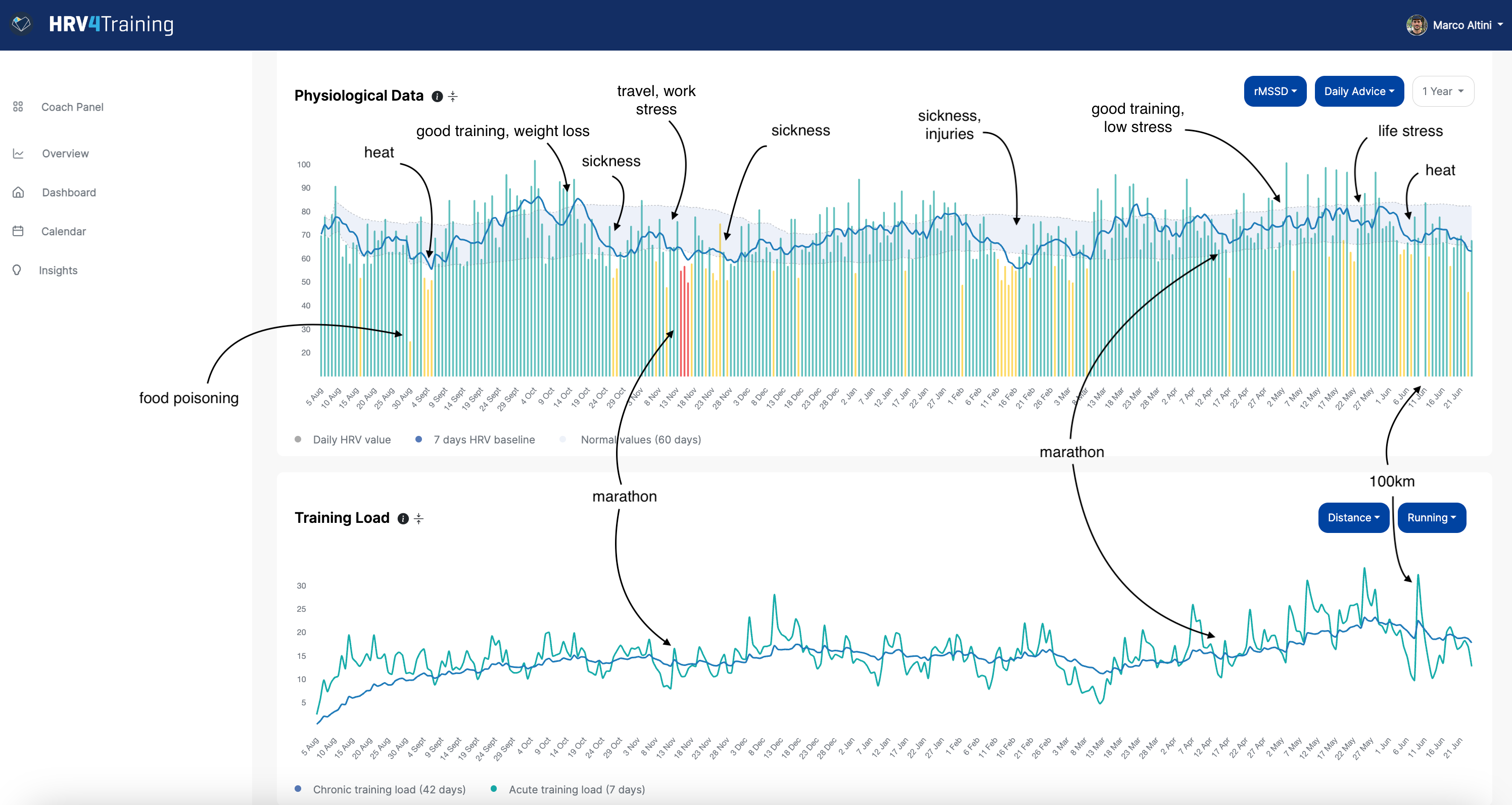
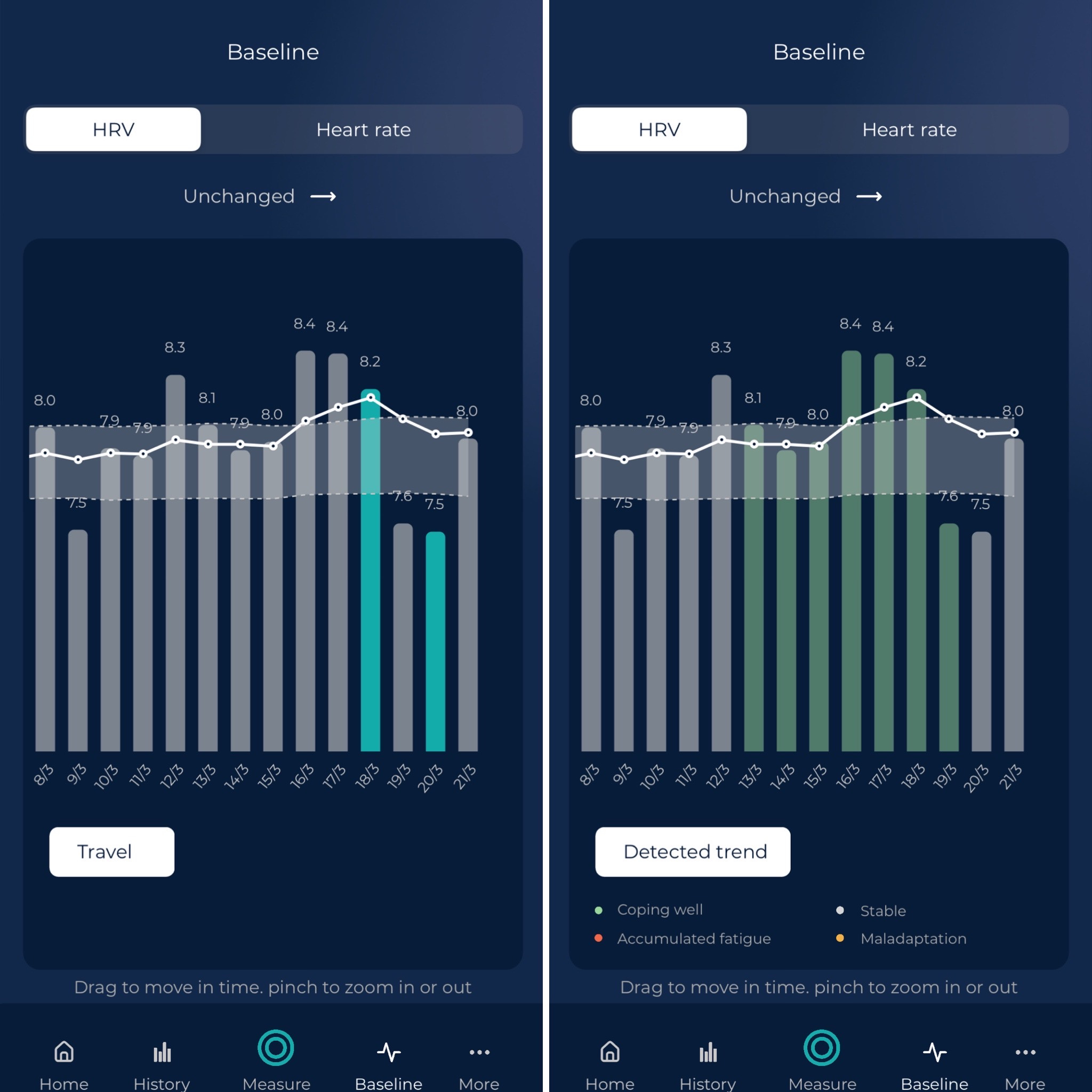
When using Pro, the app will also automatically recognize your account and add the Normal Range to the Baseline view, together with detected trends and additional annotations, which can help contextualizing longer-term changes.
You will also be able to pick rMSSD as the parameter to see on the homepage of the app.
Thank you again for your support and for allowing us to remain independent.
See you next week!

Marco holds a PhD cum laude in applied machine learning, a M.Sc. cum laude in computer science engineering, and a M.Sc. cum laude in human movement sciences and high-performance coaching. He is a certified Ultrarunning Coach.
Marco has published more than 50 papers and patents at the intersection between physiology, health, technology, and human performance.
He is co-founder of HRV4Training, Endurance Coach at Destination Unknown, advisor at Oura, guest lecturer at VU Amsterdam, and editor for IEEE Pervasive Computing Magazine. He loves running.
Social:
Personal Substack
Strava
Instagram
No posts
Comments
Nothing yet. Say the first thing.
Sign in to join the conversation.