
By Sarah van Gelder
Eight years ago, I wrote a piece for YES! Magazine called “9 Ways You Can Use the Midterm Elections to Build Local Power.” Rereading it now, ahead of this year’s midterms, what strikes me most is how little the underlying picture has changed — and how much more dangerous it has become.
Even before Trump rode down that golden escalator, the country was in trouble: economic hardship for most people alongside historic wealth concentration at the top, unaffordable health care, a climate crisis that kept getting more dire, and the kind of national malaise Jimmy Carter named decades earlier. People were hungry for change.
When the Democratic establishment pushed aside Bernie Sanders, the candidate offering the other version of “change” was Donald Trump.
That divide — corporate Democrats versus a progressive base — hasn’t healed. What has changed is the other side’s competence. In 2018, the first Trump administration was often chaotic and improvisational. This time, the Christian nationalist–corporate power–billionaire coalition backing him has spent years preparing: staffing the agencies with loyalists, pre-writing the executive orders, and building the legal arguments to dismantle the parts of American governance that stood in their way.
The result is an unapologetically racist and mysogynist administration that is systematically unwinding institutions that, for all their flaws, had stabilized the U.S. economy; supported science, the separation of church and state and the rule of law; and offered a basic safety net.
Which is why the strategies in the piece below are even more urgent than when I wrote it. The brilliant organizers I talked to for this piece were right then, and even more so today: lasting power isn’t won in a single election cycle or by top-down party politics. The sort of infrastructure that can deliver authentic change must be built from the ground up and sustained year round, not just during election drives.
Here are key strategies for doing that work in the communities where we live.
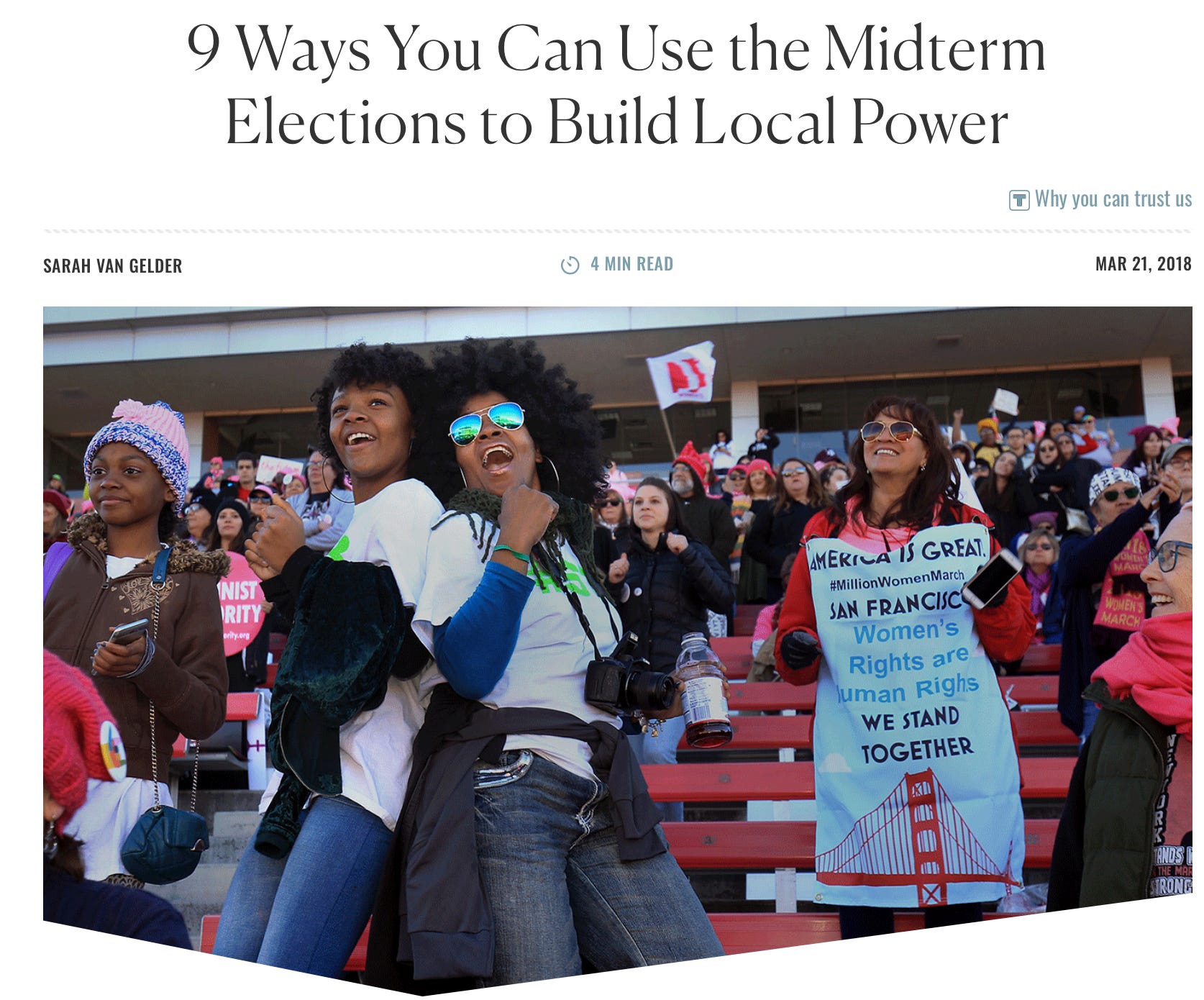
First published in YES! Magazine
It’s no secret that many voters are ticked off with the Democratic Party. By more than 2 to 1, Americans believe the party is out of touch with the concerns of most people, according to a 2017 Washington Post/ABC Poll. Think superdelegates; DNC leaders who sided with Hillary Clinton at the expense of the Bernie Sanders campaign; compromises with the corporate elite; and behaviors that seem to disparage black folks, young people, and so-called deplorables.
Nonetheless, recent special elections show that the Democratic base is on fire, mobilizing, voting, and winning.
The stakes couldn’t be higher. Climate crisis, money in politics, DACA, white supremacy, the future of the internet, gun safety, health care, public lands, regulation of the banking industry, civil liberties, and so much more are all being contested. With the entire House of Representatives, a third of the Senate, and many governors and state legislators up for election, much will be determined in the midterms. So, in spite of disquiet with party leadership, many are already working hard for Democratic candidates.
And some are doing this work in a way that builds independent power—power that can also be used to hold elected officials accountable, work for the long-term well-being of their communities, and take stands on issues the major parties’ elites may or may not support.
These folks are using the excitement and widespread engagement that comes with a high-stakes election to build local organizations that are independent of the party organizations. This strategy offers the possibility for remaking the Democratic Party (in ways that roughly parallel what the Tea Party did to the Republican Party) starting from the bottom up. But even more importantly, it offers the possibility of building a power base that can help remake the country.
I spoke to two luminaries in the world of organizing to learn how to make this strategy work: One is Heather Booth, who is the founder of iconic organizing school Midwest Academy; an activist for tax justice, marriage equality, women’s rights and civil rights. The other is Dan Cantor, national director of the Working Families Party, which works in 17 states on electing progressive leaders and building grassroots power.
Here’s what I learned from them that resonates with my own experience as a local activist.
Join and support an existing group that fits with your values, if one exists, or start a new one. Consider affiliating with a national organization such as Indivisible, Working Families Party, or Our Revolution.
As you knock on doors, attend rallies, and in other ways support your favorite candidate, also build your own group’s power by expanding your email list, network, volunteer base, and skills.
Reach out to people you know, and also ask who else has shared interests and, especially, who is left out? In an era when racial and class inequality is widespread, it’s important that movements put economically disenfranchised groups at the center of their organizing strategies. Organizers should learn about the issues that are important to other segments of their community and meet leaders in local politics, civic organizations, and businesses.
Create inclusive processes for decision making. Get good at navigating conflict. “One of the most important things is that the group itself stays together,” Booth said. “In my experience, we can deal with many kinds of attacks and strains if we stay together, but when we fracture, everything is more difficult.”
Set goals that are inspiring but achievable. “You attract many more people if you’ve got a credible plan that people believe is a winnable plan. Design that from the start,” Booth said.
“You want voters to trust that you have their interests at heart and to remember the name of your group,” Cantor told me. “If you do that, candidates come flocking for your support because they realize that you are a shorthand way to signal to voters who to vote for.”
What values and issues are most important to you and to others in the diverse communities that make up your town or city? Work together to set your agenda. Then question candidates about which of your priorities they will support.
“Every good idea—abolition, women’s suffrage, anti-child labor laws, unemployment, Social Security—initially came from people who were seen as on the fringe,” Cantor said. “They organized … and slowly but surely these ideas capture people’s imagination and eventually migrate into the major parties.”
Today, that might include federally funded health care, which a majority of Americans favor. But the Democratic Party establishment has for years refused to consider this option. If that’s important to your group, ask candidates if they will cosponsor a “Medicare for All” bill in Congress. If not, consider running another candidate against them in the primary.
“It has taken us a long time to get as weak as we are. Corporations have been in the saddle and riding mankind for decades,” Cantor points out.
By building local organization, the impact of our work is cumulative—each time we mobilize around a candidate or issue, we can increase long-term local power.
Together, locally based groups can galvanize enough power to counter the influence of big corporations and outside money.
“It doesn’t take you long to get to the point where you’re screening local candidates for Congress,” Cantor said. This doesn’t mean you will always win—but you will prevail much more often, and if you pick your fights, those can be important wins.
This post is public so feel free to share it.
Meet with your elected officials regularly, Cantor recommends. “Don’t wait to see how he or she turns out.”
Elected officials hear from lobbyists all the time, he pointed out. They need to hear from you, too.
And if someone really abandons his or her commitments, challenge them in the primary. “You only have to do that every now and then for that to send a message,” Cantor said.
It would be easy to get swept up in the immediate demands of a high-stakes election. If we want fresh ideas and new initiatives, though—if we want to lift up the voices of those left out, and to put the interests of ordinary people, instead of corporations, front and center—we’ll need our own organizations. We can build long-term power in our communities and also help elect our favorite candidates if we work strategically, inclusively—and independently.
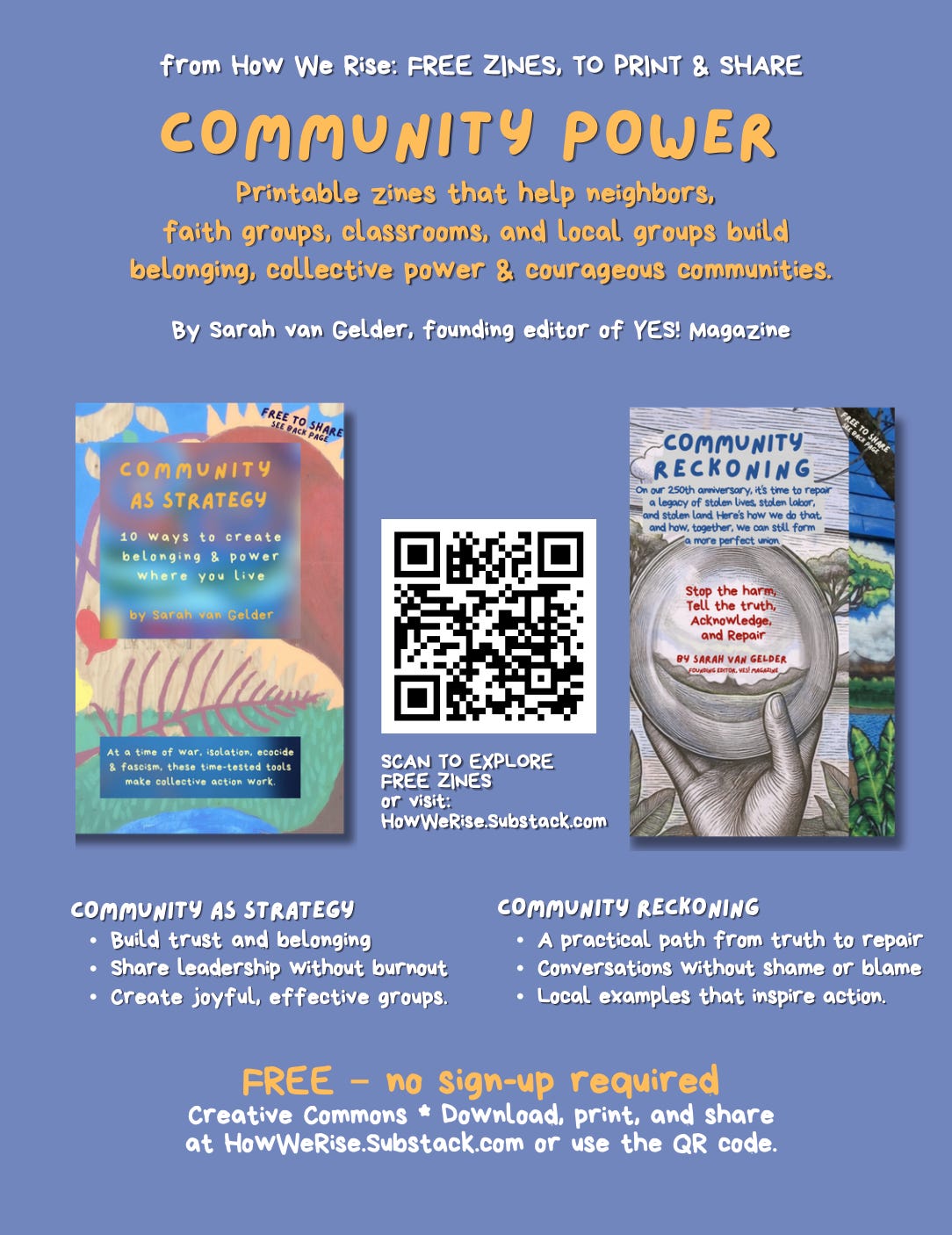
Access them at this link, or use the QR code below.
Comments
Nothing yet. Say the first thing.
Sign in to join the conversation.