
It’s 11:40 on a Tuesday in week four and you’re looking at a paper that is too clean.
The sentences are smooth. The argument is competent and slightly hollow. The student hasn’t spoken in class since the second day.
You know. You also can’t prove it.
So you run a paragraph through a detector, which says 87%, which means nothing, because it says something similar about the international student who writes carefully and the honors kid who over-edits.
You imagine the meeting with the chair. You imagine the parent. You imagine being wrong in front of both of them.
You give it a B minus, you write “develop this further” with a few ore comments and you go to bed.
Doing nothing quietly became your policy for the rest of the semester.
You can build the way out of that in twenty minutes, right now, before you have any reason to be angry.
The conversation you need doesn’t require proof.
Proof is a courtroom standard. You aren’t running a courtroom, and every hour you spend building a case is an hour you’re not spending on the only question that matters: can this student explain the thinking in this work?
Someone who did the thinking can talk about it.
Someone who didn’t will stall inside ninety seconds.
That gap shows up without a detector, without an accusation, and without a hearing.
Every major assignment carries a short oral component.
After each one you pull a handful of students at random and sit with them for five minutes while they walk you through two decisions they made in the work.
Random selection is the whole design. Nobody gets singled out, so the conversation is never an accusation, and the students who did the work tend to enjoy it. You’re checking work, the way a lab checks work.
The version that fails is the one where you only pull the students you suspect. Do that and you’re back to building a case, and everyone in the room can tell.
Paste this into any AI tool, along with the assignment prompt and rubric your students are about to work from:
“You teach [COURSE, LEVEL, DISCIPLINE]. Here is an assignment my students are about to complete: [PASTE THE PROMPT AND THE RUBRIC].
Write me two things.
First, six questions I can ask a student in a five-minute conversation about their submitted work. Each one should be answerable in under a minute by someone who did the thinking, and hard for someone who generated the work and skimmed it once. Ask about decisions, tradeoffs, and the options they rejected, never about definitions or summary. For each question, describe the answer pattern I should expect from a student who did the work, so I know what I am listening for.
Second, an opening script for the conversation where the answers do not hold up. It cannot accuse, it cannot mention AI in the first thirty seconds, and it has to end with a specific next step the student can take. Under 120 words, written as words I would say out loud, not as a policy paragraph.”
Read the six questions and cut any that a well-prepared bluffer could answer from the rubric alone. Usually two of the six go.
The script is the part you’ll be glad you have. At 11:40 on a Tuesday you will not invent a non-accusatory opening. You’ll either avoid the conversation or open it badly, and the script exists so there’s a third option sitting in a document you can open.
Run it on the first small assignment, when the stakes are nothing. A check you introduce in week nine reads as a trap, because it is one.
On day one, say out loud why it exists. You want to hear how they think, and being able to defend your work to someone hunting for the hole in it is the skill that outlives every assignment in the course.
The last decision is whether the conversation carries points. Either answer works. Deciding in the moment, student by student, is what turns it into the thing students argue about in March.
Six questions and a script, one assignment, this month.
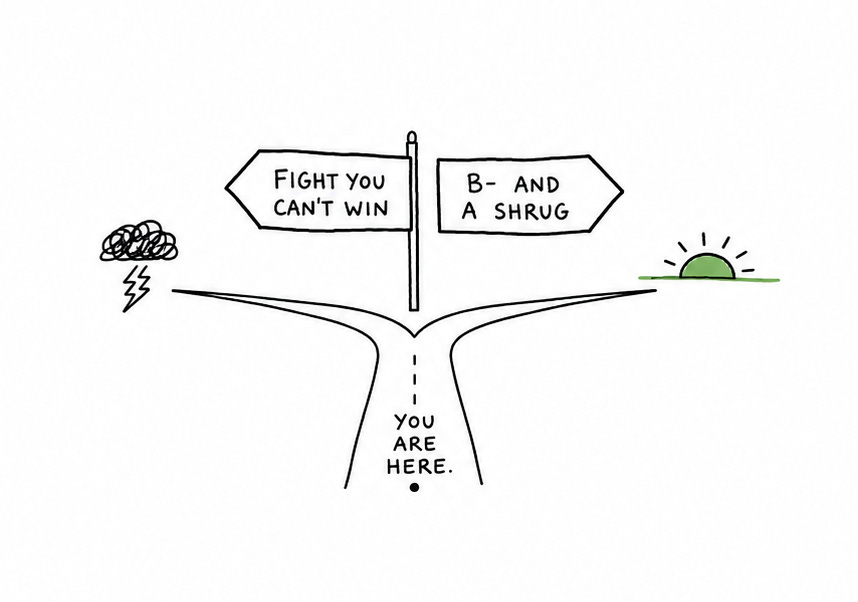
The September version of you is holding a paper that is too clean and has two options: a fight you can’t win, or a B minus and a shrug.
The August version of you has six questions in a document and a script for the hard part, and needs neither.
Write the six questions this week, before the first assignment goes out, while it costs you twenty minutes and nothing else.
If you want more of this:
The free Teacher AI Prompt Pack. Ten copy-paste prompts, including Cheat Your Own Assignment (run your assignment through AI before your students do, and rebuild whatever it can fake) and The Line You Don’t Cross (the AI-use standard you can actually state on day one). https://doanwinkel.com/pack
The How to Teach With AI membership. Every month I ship what I’m actually running in my own classroom, built for the semester you’re in rather than the one you planned in August. https://doanwinkel.com/products
Department training. If the conversation above needs to happen across twenty faculty instead of one course, that’s the work I do with departments. https://doanwinkel.com/services
Comments
Nothing yet. Say the first thing.
Sign in to join the conversation.