
This is an update and a repost, because after my article on Warburg, Keto and Seyfried, some of you with hormone-driven breast cancer are not sure what might be right for you. I am going to be digging deeper on this topic with more posts covering keto, the pros and cons, who it is right for and who should avoid it, in the next couple of weeks so stay tuned.
A note before we start.
This replaces my January 2026 piece on this subject. The core argument has held up: fasting-mimicking diet (FMD), paired with the right metabolic cocktail, is one of the most evidence-supported strategies in ER+ breast cancer today. I will also address the concern that tamoxifen can lead to endometrial cancer in this article.
What follows is the refreshed version. If you read the original, the headline conclusions are the same. What’s changed is the order in which I think you should approach this, the metabolic readiness check I now believe should come before anyone starts an FMD cycle, and a sharper line on what I would and wouldn’t put in the protocol now and where a short keto phase may be useful.
This article is for women with hormone-positive (ER+) breast cancer on tamoxifen, without liver-dominant metastatic disease.
If you have ER+ disease with extensive liver metastases and you are on fulvestrant rather than tamoxifen, the metabolic equation flips - I’ll cover that briefly at the end, but the FMD-first guidance below does not apply to you in the same way. You need a different protocol, and I’m writing a separate piece on that specific niche.
If you have triple-negative breast cancer, HER2+ disease, or are on a different endocrine therapy (aromatase inhibitor, CDK4/6 inhibitor monotherapy), this piece is still worth reading for the metabolic principles, but the timing and synergy I’ll describe are specifically calibrated for the tamoxifen-FMD axis.
This is the section I would have written differently in January, and it’s the most important update.
Fasting-mimicking diet cycles work brilliantly in metabolically flexible patients, women whose insulin signalling, blood sugar regulation, and lipid metabolism are already functioning reasonably well. In those women, a 5-day FMD lowers IGF-1, insulin, and leptin by 30–50%, activates autophagy, and primes the tumour for tamoxifen exactly as the Nature 2025 fasting/glucocorticoid paper describes.
But in women with baseline insulin resistance, throwing themselves into a 5-day FMD from a standing start is not a kind thing to do. The body that has been running on glucose-and-spikes for years cannot pivot to fat-burning in 48 hours.
What happens instead is hypoglycaemia, cortisol surges, brutal hunger, sleep disruption, and, most predictably, quitting by day three.
So before any FMD cycle, ask yourself (or ideally ask your GP for the bloods to answer):
Is my fasting insulin above 10 mIU/L?
Is my HbA1c at or above 5.7%?
Is my fasting glucose at or above 5.6 mmol/L (100 mg/dL)?
Is my HOMA-IR at or above 2.5? (your GP can calculate this from fasting insulin and glucose; or use the formula: insulin × glucose ÷ 22.5 in mmol/L units)
Is my triglyceride to HDL ratio above 2.0?
Have I been told I have type 2 diabetes, pre-diabetes, metabolic syndrome, fatty liver, or PCOS with insulin resistance?
If you answered yes to any of these, you are not yet metabolically ready for FMD cycles. You need an induction phase first.
For women who fail the screen above, I now recommend 4 weeks of a well-formulated ketogenic diet as an on-ramp, not as a destination. The point of these four weeks is to restore your metabolic flexibility, to let your body remember how to burn fat, so that when you do start FMD cycles, your body can actually do what’s being asked of it.
What “well-formulated” means in practice: under 30g net carbs daily, moderate protein (1.2–1.6 g per kg lean body mass - not high protein, which spikes mTOR), generous monounsaturated and saturated fats from olive oil, avocados, macadamias, eggs, oily fish. Electrolytes are non-negotiable: sodium, potassium, magnesium, to avoid the “keto flu” that makes most people quit in week one.
At the end of week 4, re-check the markers above. If your HOMA-IR has come below 2.0, your fasting insulin below 8, or you are stably in nutritional ketosis (BHB 1.0–3.0 mmol/L on a finger-prick meter for at least two weeks), you are ready to transition to the FMD + cocktail protocol described below.
If markers haven’t moved, extend induction by another 2–4 weeks, but don’t go beyond 8 weeks of strict KD without re-evaluating with a clinician. Chronic KD is not my recommendation for ER+ breast cancer maintenance. It is an induction tool, not a long-term strategy.
This induction principle is the single biggest update from my January piece.
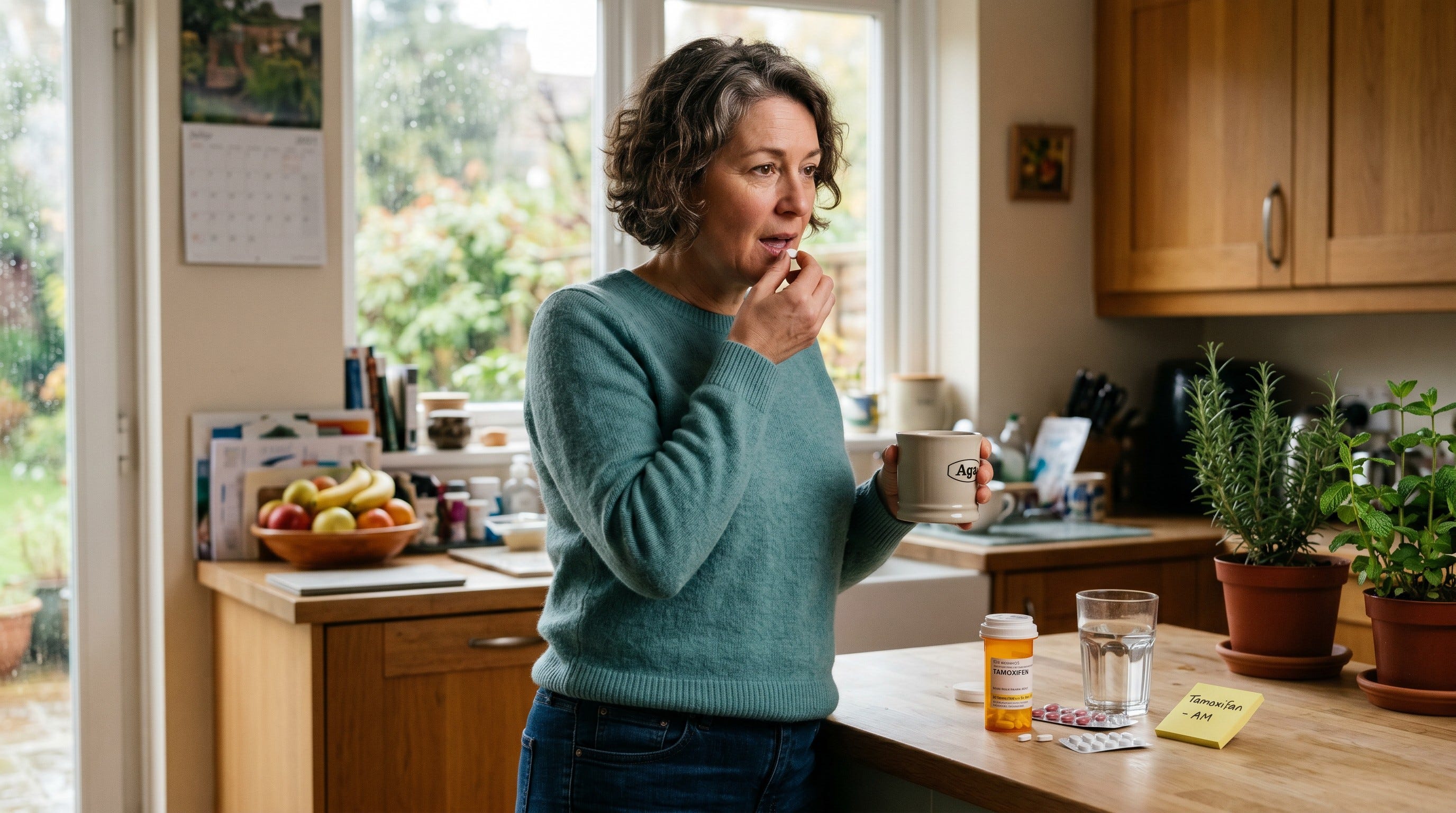
Tamoxifen is taken orally, once daily, 20 mg every morning (or 10 mg twice daily in some prescriptions), continuously for typically 5–10 years. It is not pulsed, cycled, or paused for FMD weeks. Steady-state plasma levels build over the first 4 weeks of daily dosing, so what we are timing the FMD against is not a single dose, it is the continuous tamoxifen blockade that is always present once you have been on it for a month or more.
When I talk about “timing the FMD to your tamoxifen,” what I mean is timing the FMD so that the deepest hormone/IGF-1/insulin suppression coincides with the daily tamoxifen pill landing on a tumour that has been starved of the growth signals it normally uses to compensate. The pill is daily. The fasting is cyclical. The synergy happens because the cyclical intervention is layered on top of the continuous one.
This was ambiguous in my January piece. I’m being explicit about it here.
Once you’re metabolically flexible (either because you were to start with, or because you’ve completed induction), here’s what the FMD-plus-daily-tamoxifen architecture is actually doing.
Breast cancer cells don’t just feed on oestrogen. They feed on three other hormones that most modern breakfasts deliver in abundance: insulin, IGF-1, and leptin.
A typical morning of toast, cereal, fruit juice, milk in coffee will spike insulin within thirty minutes. That insulin binds to IGF-1 receptors and insulin receptors on the cancer cell surface, activating the PI3K/AKT/mTOR pathway, the master switch for cell division (via cyclin D1) and survival (via Bcl-2). Worse, insulin cross-talks with the oestrogen receptor (ERα), helping the cancer cell evade tamoxifen’s blockade. You can take your tamoxifen pill religiously and still be feeding the cancer with breakfast.
Dairy delivers IGF-1 directly to the tumour and promotes angiogenesis (VEGF) and epithelial-mesenchymal transition (the cellular shape-shift that lets cancer invade and spread).
Visceral fat, the belly, the hips, the post-menopausal middle that creeps up on all of us, secretes leptin, which acts like a relentless growth signal in ER+ tissue. The longer that visceral fat sits there, the harder the cancer is to control.
The Nature 2025 study quantified what happens when you remove these inputs through fasting: IGF-1, insulin, and leptin all dropped 30–50%, and tumour shrinkage correlated directly with the magnitude of the drop. In other words, breakfast might be feeding the cancer. Fasting starves it.
But there’s a catch - not all fasting is created equal.
The popular 5:2 diet (five normal eating days, two days at 500 calories) is a fine tool for weight management. It is not a cancer therapy. It doesn’t produce deep enough ketosis (you need BHB above 1.0 mmol/L) or long enough hormonal suppression to shut down the cancer-relevant growth genes (MYC, E2F).
Daily 16:8 intermittent fasting is better, and is the foundation I recommend for ER+ maintenance, but on its own it doesn’t reach the autophagy threshold that the FMD-tamoxifen synergy depends on.
True therapeutic fasting for ER+ breast cancer means at least 48 hours of true fasting, or 5 days of FMD-level calorie restriction (400–800 plant-based calories), repeated every 2–3 weeks, run on top of your continuous daily tamoxifen.
In the Nature 2025 mouse work, this was 48-hour water fasts repeated weekly. In the human translation, it’s the Caffa/Longo 5-day FMD design: 400–800 calories per day from nuts, vegetables, and olive oil, low protein, repeated every 2–3 weeks. Continue taking your daily tamoxifen pill every morning during the FMD — do not pause it. The fasting cycle is the multiplier; the tamoxifen is the always-on anti-oestrogen backbone.
The dual hit, a tumour continuously blocked at the oestrogen receptor by daily tamoxifen, then periodically deprived of insulin/IGF-1/leptin signalling by FMD, is what produces the 2–3× greater tumour kill versus tamoxifen alone in the published models. Neither half on its own delivers this. The cancer cell that can’t use oestrogen can still use growth-factor signalling, and vice versa. Both doors have to be shut, repeatedly.
Most people taking tamoxifen know it blocks the oestrogen receptor. Far fewer know that tamoxifen also blocks ASCT2, the glutamine transporter.
Glutamine is the second most important fuel after glucose for cancer cells. They use it for DNA synthesis, for antioxidant defence (glutathione), and as a backup pathway to feed mTOR when glucose is scarce. So when you fast, the cancer cell tries to compensate by drinking glutamine - and tamoxifen slams that door shut.
This is why fasting + tamoxifen synergises so much harder than fasting + just-about-anything-else. The two interventions block different exits from the same trap.
Tamoxifen + FMD is the backbone. The cocktail layers on top:
Metformin, 500–1000 mg daily. Slashes insulin and IGF-1 even in non-diabetics, activates AMPK, suppresses mTOR and ERα signalling. In MCF7 ER+ models, metformin alone produced ~75% growth inhibition versus 40–50% for tamoxifen alone, and the combination is super-additive. Also blocks the post-FMD insulin rebound that can otherwise undo some of your fasting work.
Timing note: on FMD days 1–3, pause metformin to let pure autophagy run. Restart day 4 onwards.
Safety: type 1 diabetics or anyone on insulin must work with their endocrinologist on dosing to avoid hypoglycaemia. Metformin is contraindicated in eGFR < 30.
Indole-3-carbinol / DIM, 400 mg daily. Downregulates ERα directly (independent of tamoxifen), shifts oestrogen metabolism away from the more oncogenic 16-hydroxy metabolites toward the safer 2-hydroxy pathway. In ER+ growth models, 50–70% inhibition.
Caveat: avoid if you have confirmed uterine or endometrial metastases (per a 2004 rat study suggesting paradoxical effects in that specific setting).
Statin - pitavastatin preferred. Cancer cells need cholesterol and isoprenoids for membrane synthesis and Ras/Rho signalling. Pitavastatin is my preferred statin in cancer protocols (better mitochondrial profile than atorvastatin or simvastatin).
Coordinate with your GP, this is a prescription decision, not a supplement choice.
Cyclic progesterone, 10 mg for 14 days per month, postmenopausal women with intact uterus. Reduces tamoxifen-driven endometrial overgrowth by approximately 80%. Annual gynaecological exam plus prompt reporting of any abnormal spotting is non-negotiable.
Daily 16:8 intermittent fasting between FMD cycles. This is the maintenance baseline. Most days, eat your meals within an 8-hour window (e.g. 12pm to 8pm). It keeps insulin sensitivity rising between FMD cycles and is the foundation everything else sits on.
Tamoxifen carries a 2–7× increased risk of endometrial hyperplasia and uterine cancer in postmenopausal women after roughly two years of use. This is the risk your oncologist mentioned (or should have mentioned) when you started.
What the Nature 2025 human data showed is that fasting cycles neutralise this risk: zero endometrial hyperplasia in the fasting arm, driven by the same IGF-1 crash and the natural cortisol/progesterone opposition to oestrogen that the FMD induces. Add cyclic progesterone (10 mg, 14 days per month) for further protection, plus annual transvaginal ultrasound or hysteroscopy as indicated. Report any postmenopausal bleeding the same week it happens, do not wait.
The protocol I’m describing reduces tamoxifen’s endometrial risk, it doesn’t add to it. That’s worth knowing if your oncologist has been hesitant about long-term tamoxifen on uterine-risk grounds.
Day 1 of FMD and the second 24 hours of a 48-hour water fast are the windows where blood sugar can drop low enough to matter.
Prepare: the two weeks before your first FMD, eat lower-carb. Build some metabolic flexibility. (If you’ve completed the 4-week induction phase, this is already done.)
Electrolytes: coconut water for potassium, sea salt liberally for sodium, a magnesium supplement at night. The headache, fatigue, and “I can’t do this” feeling on day 1–2 is almost always electrolyte depletion, not real hunger.
Don’t use bone broth. It sounds intuitively right, but bone broth delivers glycine and other amino acids that boost glutathione synthesis and glutathione blocks ferroptosis, which is one of the cell-death pathways you want your cocktail to enable. Stick to water, herbal tea, electrolyte water, and the small daily plant-based calorie allowance.
Monitor: if you have any history of hypoglycaemia, diabetes, or are on metformin, finger-prick blood glucose twice daily during the FMD. If it falls below 3.5 mmol/L (63 mg/dL), then stop and treat.
If you need to break the fast for hypoglycaemia, here’s what I’d actually do
The default rescue is a small protein-fat snack like a tablespoon of almond butter, a teaspoon of MCT oil in water, half an avocado, or two macadamia nuts. This raises blood sugar gently without spiking insulin and without dragging you out of ketosis. Within 15 minutes you should feel stable.
Glucose tablets remain the backup for severe hypoglycaemia (below 3.0 mmol/L or symptomatic) as they work fast, which is what severe hypoglycaemia needs. But for mild hypoglycaemia, the protein-fat snack is the safer default because it doesn’t undo the metabolic work you’ve been doing.
In the original piece I mentioned Manuka honey for emergency carbs. The methylglyoxal anti-cancer mechanism is real in vitro, but in a fasting ER+ patient the dominant in vivo effect of 10–20g of honey is an insulin spike, precisely what we’re trying to avoid. I’m taking that recommendation out.
This is a list of things people sometimes assume should be in this protocol, that aren’t:
Chronic strict ketogenic diet for ER+ maintenance. KD is induction-only in this context (4 weeks for the metabolically inflexible). For maintenance, IF + FMD cycles + the cocktail beats chronic KD on adherence, on stress hormone profile, on microbiome diversity, and on lived quality of life. ER+ disease is not glioma as the metabolic logic is different. Patients with severe insulin resistance may stay on a modified low-carb pattern after induction, but not strict KD long-term. My opinion on this stands.
Dexamethasone as a fasting substitute. The Nature 2025 paper showed glucocorticoid-receptor activation was the mechanism behind much of fasting’s tamoxifen-boosting effect, and that dexamethasone could recreate it in mice. This was widely reported, and I covered it in the January version of this piece. I’ve removed it from this rewrite.
The reason: chronic dexamethasone exposure has a documented survival-shortening signal in solid tumours (the GBM data is the clearest, but the principle generalises), and the public-facing risk of readers asking their oncologist for dex as a “fasting alternative” outweighs the educational value of describing the mechanism. If you genuinely cannot fast if you are frail, brittle diabetes, history of an eating disorder — talk to your oncologist about other options. Dexamethasone is not the answer I’d give today.
Bone broth. Covered above, please note glutathione interferes with the ferroptosis arm of the protocol.
One brief note for the readers this doesn’t apply to.
If your ER+ disease has progressed past tamoxifen and you’re now on fulvestrant, and you have liver-dominant metastatic disease, the metabolic equation flips. ER+ liver mets upregulate OXCT1 (the ketone-utilising enzyme), but they do so in a way that creates a specific vulnerability to fulvestrant + ketogenic diet, the Zuo/Madak-Erdoğan 2024 work showed this clearly. In that indication, KD is not the wrong answer, it’s the right one.
I’m writing a separate piece on this mechanism specifically. If you’re in that situation, don’t extrapolate from this article as your protocol is different.
For a metabolically flexible patient on tamoxifen, here’s the integrated rhythm:
Daily backbone (every day, indefinitely):
16:8 intermittent fasting (eating 12pm–8pm or similar)
Metformin 500mg AM, 500mg PM (or as your clinician prescribes)
Pitavastatin as prescribed
I3C/DIM 400mg with first meal
Tamoxifen as prescribed (typically morning)
Cyclic progesterone 10mg, 14 consecutive days each month (postmenopausal women, intact uterus)
Every 2–3 weeks — a 5-day FMD cycle:
Days 1–5: 400–800 plant-based calories (Caffa/Longo FMD design — pre-packaged ProLon, or home-built with nuts, vegetables, olive oil)
Continue your daily tamoxifen pill every morning throughout the FMD — do NOT pause it
Days 1–3: pause metformin (allow pure autophagy)
Day 4: restart metformin
Day 5 evening: meal that breaks the fast gently (eggs, avocado, leafy greens — not carbs)
Monitor blood glucose if diabetic or on metformin
Quarterly:
Fasting insulin, HOMA-IR, HbA1c, lipid panel
Track whether your metabolic flexibility is staying restored
Annually:
Transvaginal ultrasound (postmenopausal with intact uterus)
Full tumour-marker panel
Bone density (DEXA) as both tamoxifen and chronic low-insulin states can affect bone
The January piece was right that fasting + tamoxifen is one of the highest-yield strategies in ER+ breast cancer today. What I’d refine is the sequencing: not everyone can or should jump straight into FMD cycles. Metabolic flexibility comes first. For those who already have it, FMD + tamoxifen + the cocktail is exactly the architecture. For those who don’t, four weeks of well-formulated KD as an on-ramp is the kind, evidence-aligned way to get there.
The cocktail is the work. The diet is one lever inside it. Tamoxifen is the drug doing the most direct anti-oestrogen work. Fasting is the multiplier. Metformin and I3C/DIM and a statin and progesterone are the supporting structure that keeps the multiplier honest.
If you’re already on this protocol or a version of it, great, so check whether you’ve done the metabolic-flexibility step honestly. If you’re new to it, do that step first.
Caffa et al., Nature 2020 — FMD + endocrine therapy in ER+ breast cancer
Nature 2025 — Fasting boosts breast cancer therapy efficacy via glucocorticoid activation
Elgendy, Cazzoli, Minucci, Cancer Cell 2019 — Metformin + glucose restriction synergy via PP2A-GSK3β-MCL-1
Ferraro et al., Cell Metabolism 2023 — Ketogenic diet and HPA-axis effects
How to Starve Cancer (Jane McLelland, 2nd edition) — full protocol context
Forthcoming Substack pieces: the ER+ liver-mets / fulvestrant carve-out; the nine confounders in dietary cancer research
For research and educational purposes. Not a substitute for medical advice. Any change to your protocol — especially adding metformin, statins, dietary restriction, or fasting cycles — should be discussed with your oncologist and GP, ideally with baseline bloods and ongoing monitoring. The principles in this article are the foundation of the integrative protocol I teach; the specifics need calibration to your individual case.
© 2026 Jane McLelland. GIOR Ltd, London.
No posts
Comments
Nothing yet. Say the first thing.
Sign in to join the conversation.