
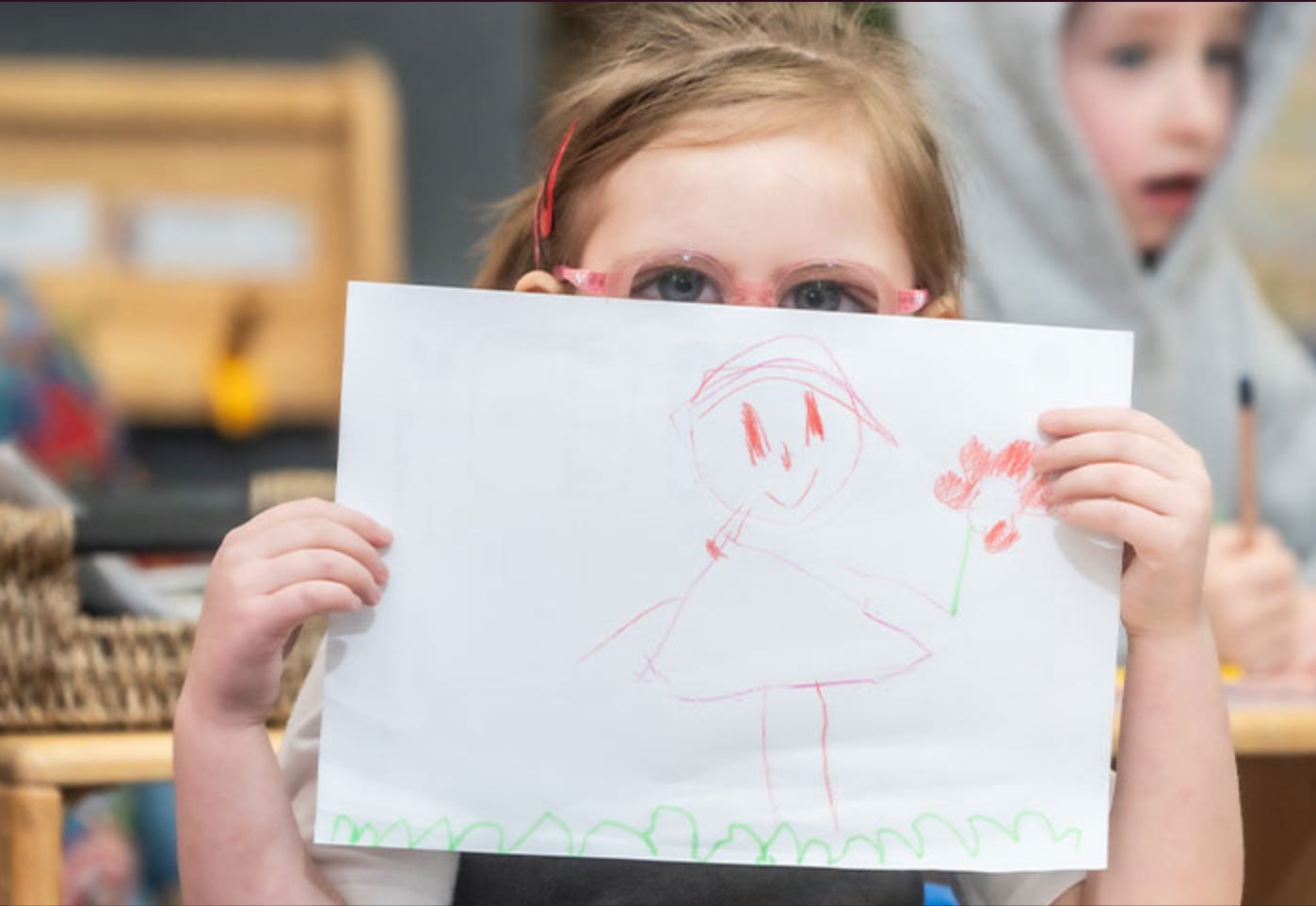
Photo: Barrowford Primary School
Rachel Tomlinson is the head teacher of a primary school in Barrowford, Lancashire. I’ve known Rachel for years and was intrigued by her “no sanctions, no rewards” approach. I recently visited the school and asked her to explain it.
The “no sanctions” idea was familiar to me. Restorative practices are at the heart of many progressive schools, the idea being that students and faculty deconstruct what’s gone wrong, identify who’s been harmed, and set about restoring the relationships and the outcomes. It doesn’t mean no consequences: it means trying to get to the root of problems, rather than punishing “bad” behaviours and hoping they somehow don’t repeat themselves. Some research shows this approach doesn’t serve students, while other studies show these practices can enhance school climates, and improve academic engagement and performance.
But no rewards? I remember star charts and “choice time” and all sorts of rewards from my kids’ primary schools. (I’ve also seen the older version of this: paying for grades, which is a terrible idea.) Furthermore, when Rachel told me on our drive to the school from Preston station that “I don’t use ‘I’m proud of you’” anymore—and explained why—I was all ears. I realized I’d probably used that phrase a lot in the past few weeks as my kids have endured yet another marathon round of exams, essays and end-of-year challenges. I wanted to hear more.
The school is in a very disadvantaged part of the north of England. Nearly half of the kids are on free school meals; about 17% have special educational needs, compared to about 15% nationally, and about 18% have Educational Health and Care Plans, compared to 3.5% nationally. Rachel is a fierce advocate for what is right for children and families. I’ve always seen her as a shining example of how to be brave.
Her philosophy intrigues me for three reasons: 1) Like many parents my age, I probably over-praise my kids and I am almost certain it doesn’t have the effect I hope it will, 2) Barrowford is deeply inclusive, warm, and very intentionally-designed; 3) It is highly contentious, or what Rachel calls Marmite (after the salty British spread): you love it or you hate it. It is the opposite of ‘no excuses’ schools that offer strict routines and a laser focus on academic achievement.
Barrowford has a “relationship management policy,” not a behaviour management policy, Rachel explained (the latter being standard for most schools). “Sanctions cause trauma and break relationships,” she said. They are one-sided, focused on power dynamics, and often don’t make space for the child to understand their behaviour, or the opportunity to repair harms they might have caused. “What we are trying to teach children is that relationships are two-sided. [The kids] are involved in understanding their own behaviour and why their behaviours might be unacceptable or inappropriate,” she said.
Rachel is keen to point out this isn’t fluffy, but actually intensely hardcore (and time-consuming). “Our minimum expectation is you come as your best self every day. If you fall short, we will help you get up, but we won’t give you rewards for it,” she explained.
You are expected to be your best self, but guess what? We all get it wrong, adults too, because “we are all still learning how to do relationships,” she says.
A restorative approach is not everyone’s cup of tea.
It works well for families who are looking for deep support for their kids, or a more flexible approach to learning, than the rigid, Ofsted-obsessed UK system typically affords. (Ofsted is the UK inspections body that rates schools. Head teachers say they spend 50-75% of their time making sure their school will be Ofsted-compliant.) Case in point: Barrowford offers a flexi-school system whereby kids can be homeschooled for some of the time and come in for the rest.
To those for whom more traditional schooling, meant to maximize academic outcomes, works, Barrowford’s approach feels crazy. Indeed, the school received a mixed Ofsted report, which highlighted its warm and inclusive environment, but noted big gaps in attendance and academic achievement. These gaps are largely due to its inclusivity. Kids who start at reception and stay at Barrowford through Year 6 perform at or above the national average. Its high percentage of high-needs students alters that average. Rachel believes that is the right trade off for her community.
For those with kids for whom the traditional system fails them, Barrowford offers something most of us want for children: safety, warmth and a promise to see each kid as they are, and not just a set of scores.
I asked Rachel exactly this.
“Kids need feedback. People need feedback on performance all the time. We are constantly feeding back to children,” she says, about learning and about behaviour. “‘It’s lovely that you were kind to a friend,” or “Because you are really observant you were able to write a very detailed character description.”
But feedback isn’t the same as praise, Rachel notes. “There’s loads of research showing rewards are damaging,” she explains, “maybe even more damaging than sanctions.” That applies both to the kids who are not rewarded, and also to those who are. “It goes back to Achiever mode,” she said. Kids will gravitate to the rewards if that’s what we offer, and avoid risks that might see them fail.
“For children who are high-attaining, it can limit what they can do, they stop taking risks and stop exploring, [because] they might not get it right, they might not get the top score,” she says.
Instead of rewards, Rachel encourages her teachers to offer a lot of targeted feedback.
What we typically mean when we say we are proud of someone is that we are impressed by something they have done, Rachel suggested, but that’s actually a misuse of the word, which is intensely personal. “I won’t say ‘I am really proud of you’ because I don’t want to take that achievement and make it mine,” Rachel told me. “You can tell me I did a good job, or why I’ve had the feedback I’ve had, but I can only be proud of the things I’ve done, not what you have done,” she said.
So, if you want to avoid that sentiment, what do you say to a kid who comes home beaming about a score on a test? Rachel suggests a few formulations:
You must have worked hard!
Did you find it interesting?
Did you find it challenging?
Or even: Do you feel proud? I would if I were you.
“I acknowledge pride but I give it back to them,” she says.
I am pretty grateful that I missed the “gentle parenting” movement. But I do believe our words matter. I remember discovering Carol Dweck’s growth mindset and the power of adding “yet” to a child’s discouragement: When a kid announces “I can’t do math,” you answer “yet.” Their brains are malleable. If the kid puts in the effort, and gets good math instruction, they can improve.
As Rachel noted, and as I wrote in Quartz, reams of research do show that kids who are praised for being smart fixate on performance, shying away from taking risks and from meeting potential failure. Kids who are praised for their efforts try harder and persist with tasks longer. These “effort” kids have a “growth mindset” marked by resilience, and a thirst for mastery. The “smart” ones have a “fixed mindset” believing intelligence to be innate and not malleable.
But Carol Dweck herself, the Stanford psychology professor who spent 40 years introducing, researching, and explaining the growth mindset, told me that the research got misinterpreted along the way. Too many kids were offered empty praise for just trying. Effort became praise-worthy without the goal it was meant to unleash: learning. Parents told Dweck that they had a growth mindset, but then they reacted with anxiety or false affect to a child’s struggle or setback.
“They need a learning reaction – ‘what did you do?’, ‘what can we do next?’” Dweck says.
In other words, don’t panic when there’s struggle. Instead, help them make a plan to get through the struggle.
A good way to get a kid into what I call Explorer mode is to help them learn to care about the process of learning, not just obsess over the outcome (recall: Explorers perform better, but also have better mental health outcomes than other groups). Reframing rewards and praise to make sure kids understand their behaviour, their effort and themselves, is a great way to get there.
Rachel’s been a head teacher for 18 years. She is committed to trying to make school a place that is safe and exciting and deeply values-based. The curriculum at Barrowford is built around UNICEF’s rights of the child, as well as the UN’s Sustainable Development Goals. Spending time in its two SEND (special educational needs and disabilities) units is powerful: you see deep needs and the resources required to provide safe and stimulating learning for kids who would not make it in mainstream school.
Many people, especially in the UK, hyper fixate on knowledge-based standards. There is true power to knowledge. But the truth is, that approach won’t work for all students because many have needs that are complex. Rachel has chosen to welcome those students, results be damned. I admire this, but also understand it’s a choice that every family may not want to make. That is precisely my dream for education: that every family has access to a school that serves the needs of their child. Wealthy people do it with independent schools. Charter schools and free schools try to broaden that menu too. We should welcome that. I get that for those zoned for Barrowford, who don’t appreciate this approach, it’s probably frustrating. I spent the afternoon with teachers there and there was no question they buy in, and they feel part of something important (one way I know this is they speak their minds and challenge Rachel directly. Humor is encouraged, as is critique).
In 2014, Rachel went viral for sending a note to her year 6 students before SATs (standardized tests taken by 10/11 year olds) explaining to them that they were more than their test scores. Someone sends a version of that email every year, as well as another, after the exams, with a similar message.
Those letters get sent because Rachel and her leadership team believe that learning isn’t about praise for achievement, or punishment for getting things wrong, but helping kids become the best versions of themselves; as learners, of course, but also as humans.
No posts
Comments
Nothing yet. Say the first thing.
Sign in to join the conversation.