
This issue sets the threat model, five-layer architecture, and OCSF-mapped
TelemetryEventwire contract used for every later module. No host agent runs here. Issue 02 introduces the first executable binary.
Antivirus evaluates files against signatures and heuristics at write or execution time.
EDR (Endpoint Detection and Response) evaluates sequences of behavior: process trees, command lines, file and network activity, plus response actions such as process kill, host isolation, and file quarantine. Living-off-the-land activity (
certutil, PowerShell,rundll32) often never drops a distinct malware file, so file-only detection is incomplete. Phases A and B of this course build the OS telemetry EDR requires.SIEM aggregates logs from multiple point products (firewalls, EDR, identity providers) into a shared query surface.
XDR extends detection and correlation beyond endpoints to network, identity, and container sources so related alerts form one incident. Module 9 implements that layer. Earlier modules produce the telemetry it joins.
MITRE ATT&CK is a public catalog of adversary techniques (for example
T1105, Ingress Tool Transfer). From Module 7 onward, detection rules are tagged with the technique they target so Module 14 can report coverage against exercised techniques rather than untested rule tags alone.The EDR agent itself is part of the threat model. It typically runs with elevated privileges and is a high-value target for disablement or tampering. Tamper resistance is deferred to Module 13; the design implication starts now: assume an attacker who knows the agent is present.
Keep these layers separate while building:
LayerResponsibilityPrimary failure modeTelemetryCollect host and cloud eventsSilence: missing fields make activity invisible downstreamDetectionScore telemetry and raise alertsNoise or blindness: excessive false positives, or missed true positivesResponseChange host state (kill, isolate, quarantine)Unsafe control: a remote action path without sufficient authorization and audit
A missing telemetry field often looks like a detection bug. Confirm collection before tuning rules.
The platform data plane has five layers: agents, ingestion, storage, detection and correlation, and dashboard / copilot. Response commands return to agents on a separate control-plane path. Do not model response as only a dashboard button.
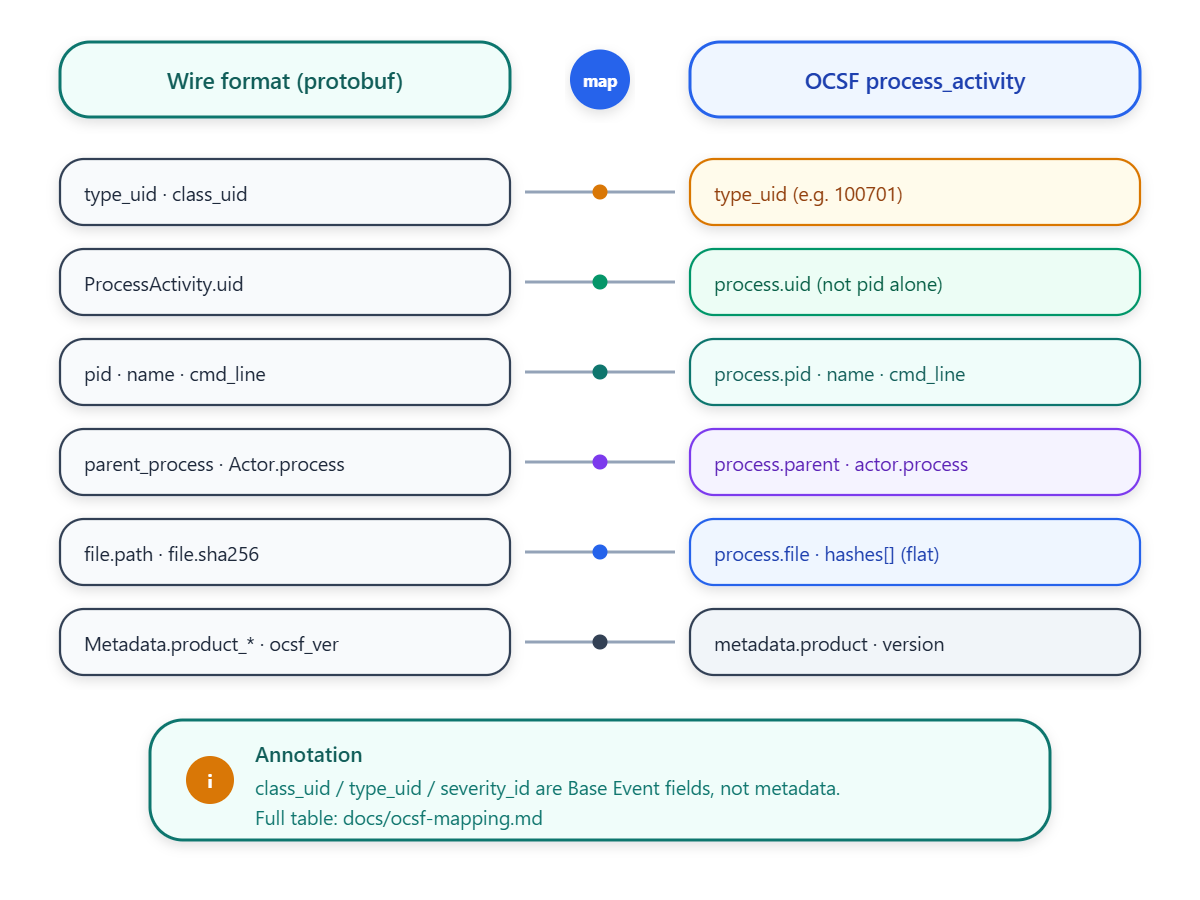
The same spine applies to a Linux host, a Kubernetes node, or identity-provider audit logs. Modules 1–6.5 align each source to one vocabulary before deeper detection work.
Custom JSON field names (for example
parentProcId) are inexpensive in early modules and costly later. Public Sigma rules still use classic fields such asImageandCommandLine. OCSF does not eliminate conversion; it provides one storage vocabulary for Sigma pipelines, correlation joins, and later investigation tools.This course normalizes to the Open Cybersecurity Schema Framework (Linux Foundation project since November 2024). Confirm the current release at schema.ocsf.io. This issue was verified against 1.8.0 (March 2026). AWS Security Lake is a clear OCSF-native lake example. Elastic’s primary gravity remains ECS. Vendor agent wire formats are not uniformly OCSF. The project adopts OCSF as the greenfield storage and query model.
Protobuf is the wire format. OCSF is the data model. Classification fields (
class_uid,category_uid,activity_id,type_uid,severity_id) belong on the Base Event. Themetadataobject carries product identity and the OCSF schema version string.
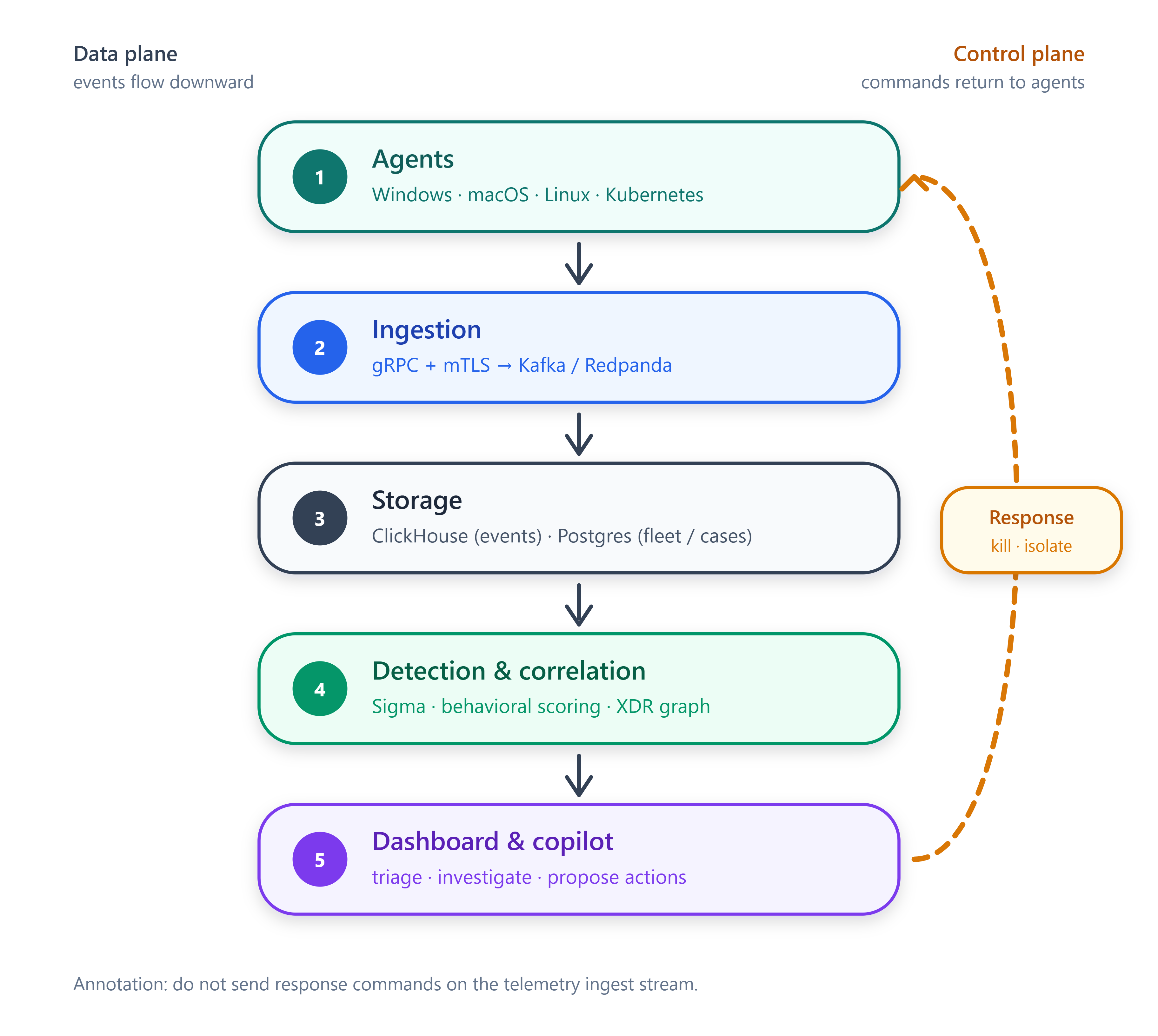
Maintain
docs/ocsf-mapping.mdas the source of truth. Update that document before extendingproto/telemetry.protowhen new event classes are added.
Place classification fields at the top level of
TelemetryEventso conversion and query code share one convention.Model
Actorwith bothprocessanduser. For process Launch, the actor process is typically the parent. A user-only actor object does not match OCSF process activity semantics.Include
process.uidas durable process identity. Operating systems reuse PIDs; lineage and process-tree views require a stable id. Agents populateprocess.uidbeginning in Issue 02.Start
oneof activityat field number 10 so later file and network arms can be added without renumbering. Assigned field numbers are part of the wire contract.Compute
type_uidasclass_uid * 100 + activity_id(process Launch →100701). Downstream tables and rules key on this value.Store file hashes as a single
sha256string until Module 6 (TIER 2). Leavingprocess.uidempty while claiming OCSF alignment produces incorrect lineage later; populate the field when agents ship.
Produce the repository scaffold,
proto/telemetry.protomapped to OCSFprocess_activity,docs/ocsf-mapping.md, and the architecture and mapping diagrams. No host agent executes in this issue.Completion criteria:
protoc --proto_path=proto --python_out=/tmp proto/telemetry.protocompletes without errors.You can locate top-level
type_uid,severity_id, andActor.processin the proto without referring to this article.You can redraw the five-layer architecture and state the primary failure mode of each layer.
Install Sysmon on a Windows VM and osquery on any OS. Generate ordinary activity (browser, terminal). Inspect raw event schemas. Do not write project code yet.
Open the
process_activityclass on schema.ocsf.io. Compare fields to Sysmon and osquery output. Note gaps in both directions; do not resolve them yet.Redraw the architecture diagram from memory. Write one sentence per layer describing its role. If any layer is unclear, reread the architecture section before starting Issue 02.
https://github.com/sysdr/production-xdr-edr/tree/main/v01-foundations-ocsf
Keep this guide open while building. Design rationale is in the issue article; this document is the step sequence only.
gitprotoc(protobuf compiler), v3.21+ recommendedmacOS:
brew install protobufLinux:
apt install -y protobuf-compiler(or distro equivalent)Windows: install from protobuf releases and add to
PATH
A text editor
No OS-native agent tooling in this issue (starts Issue 02)
Verify:
mkdir edr-xdr-from-scratch && cd edr-xdr-from-scratch
git init
mkdir -p agent-windows agent-macos agent-linux agent-k8s \
         backend dashboard detections copilot proto \
         docs/issue-notes docs/implementation-guides docs/diagrams
Verify:
tree -L 2(orls -R) shows the nine top-level module directories plusdocs/andproto/.
Create
proto/telemetry.protowithTelemetryEventand related messages. Read every OCSF mapping comment while writing. Field comments are the contract later modules assume.Requirements:
Classification fields are top-level on
TelemetryEvent:class_uid(1007),category_uid(1),activity_id,type_uid(class_uid * 100 + activity_id),severity_id. Do not place these only insidemetadata.Metadataholds product identity and OCSF schema version (ocsf_version→metadata.version).Actorincludesuserandprocess. For Launch, actor process is typically the parent.ProcessActivity.uidprovides durable process identity. PID alone is insufficient for lineage.oneof activitycurrently contains onlyprocess_activityat field10. Later modules add arms without renumbering existing fields.
Verify:
protoc --proto_path=proto --python_out=/tmp proto/telemetry.proto
--python_outis a syntax check only. Module 1 onward uses Rust. No compiler output means success.
Create
docs/ocsf-mapping.mdbefore treating the proto as finished. Later modules that add event types edit this file first, then the proto.Include at minimum:
Rationale for OCSF (Sigma conversion target, lake/interchange where OCSF is used, shared tool vocabulary)
Top-level classification and
type_uid/severity_id/ propermetadataFull field mapping table including
process.uidandactor.processExplicit list of deliberate non-exact mappings (for example flattened
sha256)Short detection field contract preview for Module 7
StepSandbox / CIReader machineRepo scaffold + markdownFullFullprotoc compileNeeds protobuf in the environmentRequired — Step 2SVG render checkOptional XML well-formednessOpen in browserLive OS agentsN/A this issueStarts Issue 02
Write top-level
README.mdcovering repository layout, navigation ofdocs/issue-notes/, and the honesty label (demoable vertical slice).Start
CHANGELOG.mdwith one section per issue tag:
## v01-foundations-ocsf
- Repo scaffold
- TelemetryEvent protobuf schema, mapped to OCSF process_activity (class_uid 1007)
- System architecture + OCSF mapping diagrams
Curriculum deliverable: architecture diagram + README + protobuf schema stub with an explicit field-to-OCSF mapping table.
Checklist:
proto/telemetry.protocompiles withprotocTop-level
type_uid,severity_id,class_uid,category_uid,activity_idexist onTelemetryEventMetadatacarries product + OCSF version;Actorhas user + processProcessActivity.uidandProcessRef.uidexistMapped fields have OCSF attribute comments
docs/ocsf-mapping.mdis complete and uses Sigma-as-conversion wordingREADME.mdexplains repository structureYou can state the role and primary failure mode of each architecture layer
protoc: command not found— install the compiler and restart the shell soPATHupdates apply (especially on Windows).Unexpected field numbers after edits — protobuf field numbers are part of the wire format. Do not renumber existing fields; later issues assume stability.
Nothing runs yet — expected. Issue 01 is architecture and schema only. The first runnable binary is
linux-agentin Issue 02.
Tag this checkpoint before Issue 02:
git add -A
git commit -m "Issue 01: foundations, threat model, OCSF schema"
git tag v01-foundations-ocsf
proto/telemetry.protoshould be checked for brace balance and field uniqueness. Fullprotoccompilation requires a local protobuf install. If compilation fails on a correct install, treat it as a bug report against this issue package.
Comments
Nothing yet. Say the first thing.
Sign in to join the conversation.