
“Those who do not want to imitate anything produce nothing.”
– Salvador Dali
At some point in your creative career, you’ve probably felt the euphoric bliss of something I call “New Project Energy.”
You know: That moment when an idea sparks in your head and grabs ahold of you. It can be a story or a business idea or a marketing strategy or anything in the creative realm.
Your heart races and your palms sweat as you feel a swell of excitement, and your brain begins making connections at breakneck speed.
You tell yourself: “This is brilliant. This is going to change everything.”
If it’s a business idea, you’re already designing the logo.
If it’s a film project, you’re already drafting your Oscars acceptance speech.
If it’s a piece of content, you’re already anticipating the post hitting 1M+ views.
I’ve personally experienced this high dozens of times in my life. It’s exhilarating, addictive, self-propagating…
It’s also a total mirage.
This post is about the myth of originality, the fine line between remix and ripoff, and how to replace New Project Energy with something far more robust and sustainable.
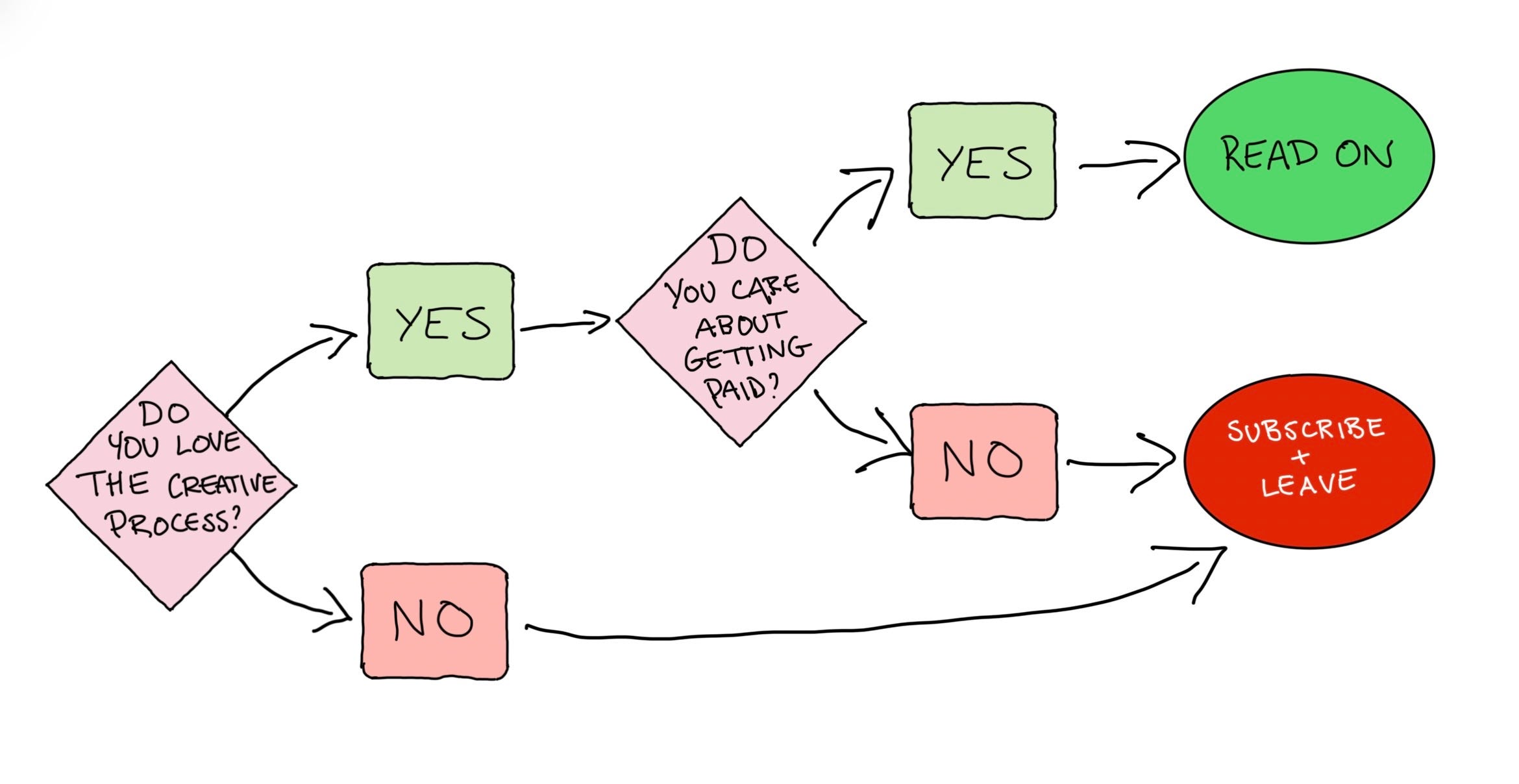
This post is for you if:
You genuinely enjoy the creative process. You care about the act of writing, not just “having written.”
AND…You want to turn that creativity into a sustainable career. You love being creative and you want to get paid to do it so that you can do it more (and more better).
For everyone else – those who are in it purely for the sake of art or purely for a paycheck – you can skip this post.
If you’re confused, here’s a diagram:
For all the people leaving, be sure to subscribe and I’ll see you on the next one:
🧐 The neuroscience of why your brilliant new idea is lying to you
📓 Comps: The pitch tool that’s secretly a writing tool
🥷🏻 Tarantino robbed everybody. Gus Van Sant robbed one guy. Only one of them got away with it.
☝️ Your originality budget is exactly one item. You’re probably blowing it.
🤖 The one thing a machine that’s read every script ever written still can’t do.
So you’ve felt New Project Energy before. You’ve felt the rush of ideas and the bliss of creative flow.
In all likelihood, you’ve also felt the painful dopamine crash of attempting to put these ideas into practice. It’s a lot less blissful. It’s a lot less exciting. It sucks.
This is not just me guessing, by the way.
Science predicts this.
In a 2016 paper, Kent C. Berridge and Terry E. Robinson at the University of Michigan laid out a relatively groundbreaking finding:
“The brain circuitry that mediates the psychological process of ‘wanting’ a particular reward is dissociable from circuitry that mediates the degree to which it is ‘liked.’”
In English: The actual level of enjoyment you experience from a thing does not scale with how deeply that thing is craved.
A deep craving for pepperoni pizza doesn’t mean you’re going to enjoy the slice any more.
How they put it:
“Wanting is not proportional to liking.”
Huge caveat here: This study was conducted with drug addiction and the enjoyability of food in mind, and I’m admittedly going out on a limb by extending those lessons to creative pursuits.
But the parallels are there:
New project energy is almost undoubtedly characterized by a rush of dopamine, just like “wanting”
The ideation phase precedes the execution phase just like wanting precedes liking
The rush of the idea phase is strong and the crash of actually executing it is abysmal
When you encounter the bliss of New Project Energy, you’re effectively craving an execution phase that hasn’t come yet and will be a lot tougher than just freestyle jazzing your way through ideas with your collaborators.
And this is why very few projects born of New Project Energy go anywhere.
For every business venture, film idea and strategic initiative that succeeds, there are many, many more that do not.
And here you thought I was an optimist.
So how can the delta between the excitement of New Project Energy and the massive letdown of execution be so large?
The answer – I think – lies in our collective obsession with originality.
If you’ve worked in the Film & TV industry, you probably already know what a “comp” is.
For everyone else, it’s an exercise where you establish films or shows that are similar – or “comparable” – to your project (or the project you’re covering).
For instance, I recently watched The Sheep Detectives (penned by Chernobyl writer Craig Mazin), and I would say a reasonable comp is: “Babe meets Knives Out.”
I say that having done zero research into the development of that film, but I found it charming, heartfelt and delightful.
Anyway, when I first got started in TV/Film, I was confused by the concept of comps:
“You’re telling me you want me to pitch this project using other projects that it’s similar to? Why would I do that? Shouldn’t my own work be entirely original?”
If my 41-year-old self could talk to that 20-something version of me, I would beat the shit out of him.
As I added mileage to my career odometer, I came to view comps through an entirely different lens:
Comps provide a reference point to both the writer and the studio. The script tells the story. A comp helps demonstrate how the story feels.
A lot of people might see this explanation as bowing to the forces of rampant commercialism. After all: Why would you force your original idea into a box where it has to conform to one or more existing ideas?
First off: There’s no such thing as a truly “original” idea (more on that later).
Second: Get off my fuckin’ back.
Third: I would push back against that logic.
Of course executives and agents use comps to better understand how to make, market and sell your project.
But I’ve discovered that the real value of comps is to help the writer imagine the experience of the audience watching the movie/show.
A script can be a very abstract artifact. The best writers might be able to convey the tone of a project on the page, but not everyone has that talent.
By hanging a comp on the project, you’re providing a shorthand to the reader (and yourself): The script reads like this, and the movie will feel like that.
What did you – Craig Mazin – love about Babe and about Knives Out, and how can you apply those things to your story about a flock of sheep who try to solve the murder of their shepherd?
If you can’t identify a comp for your story / script, that doesn’t necessarily mean your project is more original.
It might just mean you’re not looking hard enough, or you don’t understand how it will play when it’s actually made.
But that comp – that point of reference – isn’t just for conveying tone. According to science, it also makes you a better writer.
In my post The Three-Minute Pilot, I cited a study conducted in 2022 that asked two groups of participants to write a short story:
One group was told: “You can write anything you want” while the other was given a constraint: “The story must be about a shy, red-haired boy named Colin who is missing a toe.”
Both sets of stories were [then] read by independent evaluators, who deemed the stories about Colin to be more inventive than the unconstrained ones.
I used the study to illustrate a point about budget and format constraints, but the study itself was actually about the power of creative constraints in writing.
For the sake of argument, I’m going to call the act of taking creative ideas from outside your brain “stealing” even though the setup of the red-haired boy named Colin was willingly volunteered by the experimenters.
It’s also worth distinguishing between “creative theft” (which I argue is good) and plagiarism and derivativeness (both of which I argue are bad).
In the case of the Colin experiment, writers stole the subject matter. But you can steal any aspect of a story to apply to your own project: Style. Character. Tone. Setting. World.
Recall that Fifty Shades of Grey started as Twilight fan fiction. I have no idea what aspect of Twilight E.L. James borrowed from to arrive at her story (probably tone and/or breathiness), but it must have worked!
This isn’t to prove the brilliance of Fifty Shades, but merely to demonstrate that countless successful projects have been built on the foundation of other creative works.
In fact, I would say ALL projects result from that process.
By using other projects – books, movies, plays, even music – as a creative foundation, you can focus your attention on the strengths that make you unique – whether those strengths be world-building, character development or visual style.
But there’s a potential pitfall worth mentioning…
When building your project atop the works of others – which you’re doing whether you know it or not – you run a very serious risk.
At its worst, this risk manifests as plagiarism.
At best, it can be called “derivativeness.”
Because you can find in-depth discussions of plagiarism elsewhere, I’m going to focus on the latter.
Derivative works are those that hew too closely to the work that inspired them.
Quentin Tarantino is on record saying that he steals from every movie ever made. The style of Kill Bill is lifted from Shaw Brothers kung fu movies from the 1970s. The track suit worn by The Bride in Kill Bill is identical to the one worn by Bruce Lee in Game of Death. The score of The Hateful Eight consisted of music that was cut from the final edit of John Carpenter’s The Thing.
But when Gus Van Sant remade Psycho in 1998 shot-for-shot – same script, same blocking, same score, just in color – Roger Ebert called it “pointless and invaluable.”
Tarantino took the skeleton and grew a different animal on it. Van Sant dragged out the corpse of the animal and filmed it in technicolor.
There’s nothing inherently unique about a hostile alien force harvesting the natural resources of a planet, but if your story takes place on a planet where there’s a sacred ancient life force and the dominant life form is a species of 8-foot-tall sexy magic cat people… Well then you might have wandered into derivative territory.
In Avatar, James Cameron did A LOT of work on world-building. In fact, I would argue that this world-building is responsible for the bulk of Avatar’s commercial success.
You’re allowed to pull references from Avatar. You can – and should – explore themes of colonialism and industrial conquest. You could even use a “Tree of Life” as a centerpiece of your script.
Terrence Malick certainly did.
Or – I don’t know. I’ve never been a fan of his work1.
Point is: Creative borrowing is a delicate dance, and it’s easy to fuck up.
Counterintuitively, the easiest way to avoid being derivative is to consume more outside creative material rather than less. More books. More movies. More scripts. More poems. More plays and performances and albums.
In Steal Like an Artist, Austin Kleon makes the argument for drafting a family tree consisting of those who inspire you creatively: Your influences.
Understand what about their work speaks to you, understand what doesn’t, understand how you can complement their weak spots with the strengths of other artists…
If you create this family tree, you’ll know exactly what you’re stealing and from whom, and your creative work will be a lot more purposeful and a lot more fun.
So you’ve identified your creative influences. You’ve put together your creative family tree. You know what you bring to the table.
And yet something nags at you: A feeling that this practice is somehow cheating or being dishonest. I’ve felt it too. It feels like abandoning originality for formula.
But I promise it’s not the same thing.
The steps below are to help you overcome that feeling and pursue your creative projects with more confidence and abandon.
The more you read, the more films you watch, the more of the world you see… the more you realize that wholly original stories are a myth.
In the words of The Barenaked Ladies:
“It’s All Been Done. Hoo-hoo-hoo.”
–The Barenaked Ladies
The greatest creatives of our time all realized this fact at some point in their career, and that realization is exactly the reason they were able to tell the compelling stories that they told.
In The Act of Creation (1964), Arthur Koestler makes the argument that creativity requires the collision of two previously unrelated frames of reference, and you can’t collide two frames that you don’t possess2.
These frames represent inputs: The stuff that we experience that informs our outputs: Our creative work.
A person who has only ever been in writers’ rooms can only make writers’-room-shaped things.
Side note: I would argue that this is part of the problem of modern entertainment: Too many creatives whose experience consists entirely of output (hanging out in writers’ rooms) without any meaningful inputs to speak of.
There are a few ways to gather these inputs:
Travel to new places: See more of the world. Visit locales where you’ve never been. Immerse yourself in cultures radically different from the ones you’re used to.3
Talk to new people: Approach these talks with as much curiosity as you can muster and refrain from making the conversation about yourself. Ask open-ended questions and really listen to the answers.
Read books: In lieu of travel, this is the second best way to experience other cultures and points of view. Fiction, non-fiction, all of it is helpful.
The most important variable in choosing which inputs to gather is distance to the subject.
Visit locales with the greatest difference in culture from your own.
Talk to people who come from radically different social and ideological backgrounds.
Read books on subjects where you have exactly zero firsthand knowledge.
Then you can take those inputs and recombine them to make something that speaks to you.
I would say the appropriate split between inputs and outputs should be approximately 50-50.
If that sounds like a lot of reading/meeting new people/traveling, try and remember: Gathering these inputs doesn’t just improve your writing.
It also makes you a more well-rounded human being.
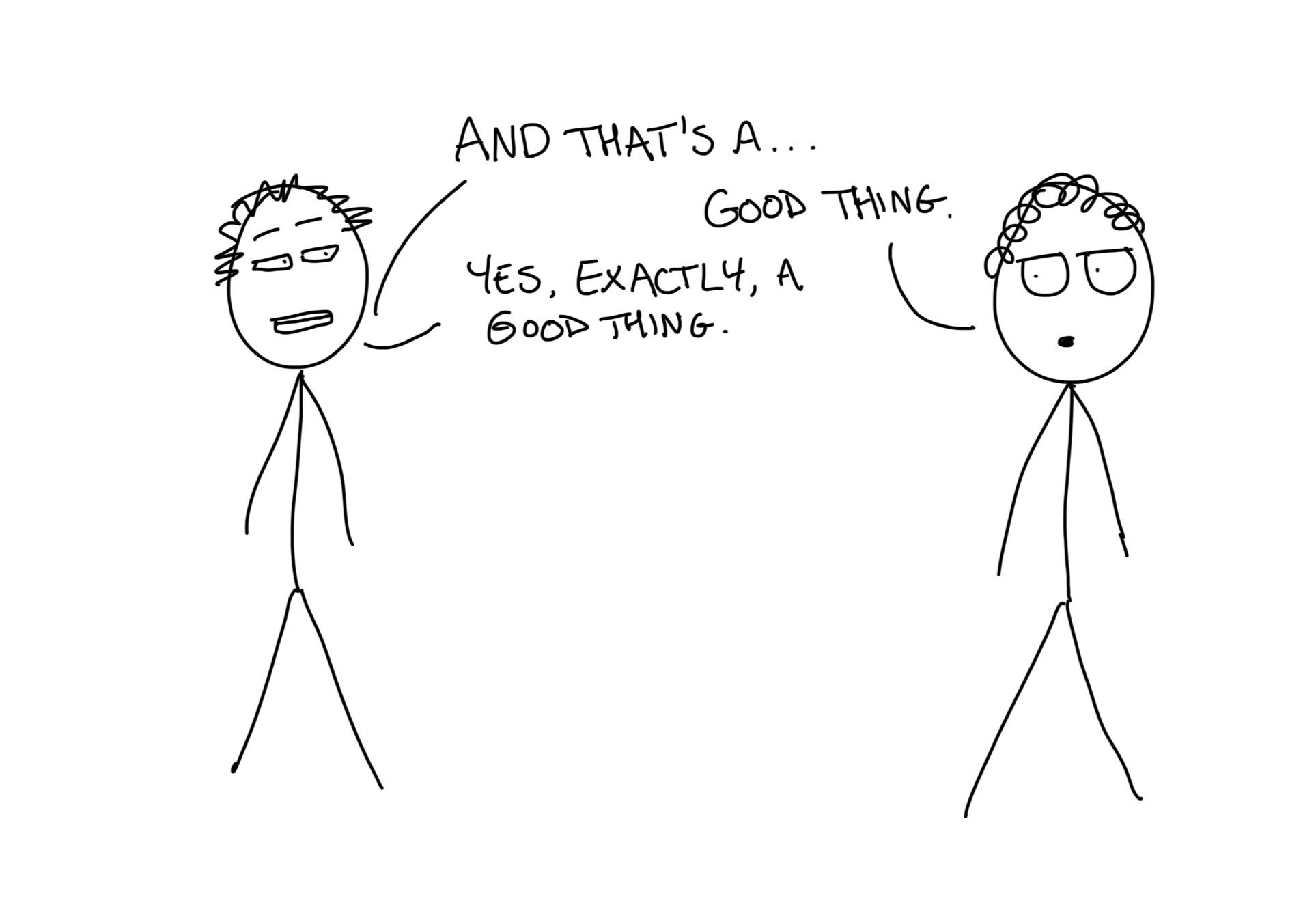
I promise that you are not inventing a new style with your writing. I promise that the character you’re developing shares most of their traits with other characters from other projects. I promise that some version of that clever line of dialogue you wrote already exists in another story somewhere out there.
Meaningful originality is pretty much impossible, and you should be grateful for that!
Because that means you don’t have to reinvent the wheel every time you sit down to write.
There are shortcuts you can use to get to the fun part of the story; the part that you bring to it.
These shortcuts are about as old as the written word itself, and you can deploy them at any point in the creative process to develop a character or get to the next scene quicker or set up the Act 3 finale in a fun and exciting way.
One such shortcut is structure. My favorite structure was developed by Dan Harmon and is based on The Hero’s Journey. Check it out here.
Borrow structure from movies like Memento, 500 Days of Summer and The Prestige (sorry to throw in two Christopher Nolan examples, but he’s top of mind at the moment).
Another shortcut is archetype. I dig into archetypes in my post on producing vertical series, where I advocate for using existing modern archetypes to develop your own “original” characters. Some fun archetypes to borrow: Ron Burgundy from Anchorman, Dori from Finding Nemo, Buster Bluth from Arrested Development.
World-building is its own beast, and in that regard, no one has been more prolifically stolen-from than J.R.R. Tolkien. Everything from Dungeons & Dragons to Game of Thrones has been based on the worlds he’s built. James Cameron is a master world-builder and you can take cues from his movies to populate the landscapes of your projects.
When it comes to dialogue, you could always pull from the wells of Aaron Sorkin and Quentin Tarantino, but then again, a lot of people do that.
I think you can go deeper. Find the influences that really speak to you, try to understand why they speak to you, and steal from that.
Think of it like building a machine. If you want the machine to work, you probably need to buy some of the parts from the factory. But if you want the machine to do something that no machine has ever done before, well, some of those parts had better be designed by you.
The problem with many early-career writers isn’t that they’re trying to do something new. The problem is that they’re trying to do too many new things at once.
The story is new and the format is new and the character combinations are new and the tone is new...
They want to build the machine with entirely custom components. And no one can do that. Not even the greats.
If you’re an early-career writer/creative, I want you to take away this if nothing else:
Pick one thing to make new.
Build the rest of the machine with off-the-shelf components.
(I’m on a ‘90’s/early aughts music kick right now, sue me.)
While we’re on the subject, I can already hear some of you grumbling in the comments about the implications this has for AI.
After all, if creativity is just a remix of other, past creativity, then the Generative AI maximalists are right and we are no different from the machines that scoop up IP and remix it into something “new.”
And if that’s the case, then we are doomed to subservience as the machines take over all creative pursuits and we become physical laborers manually pumping the last of the clean water to their data centers.
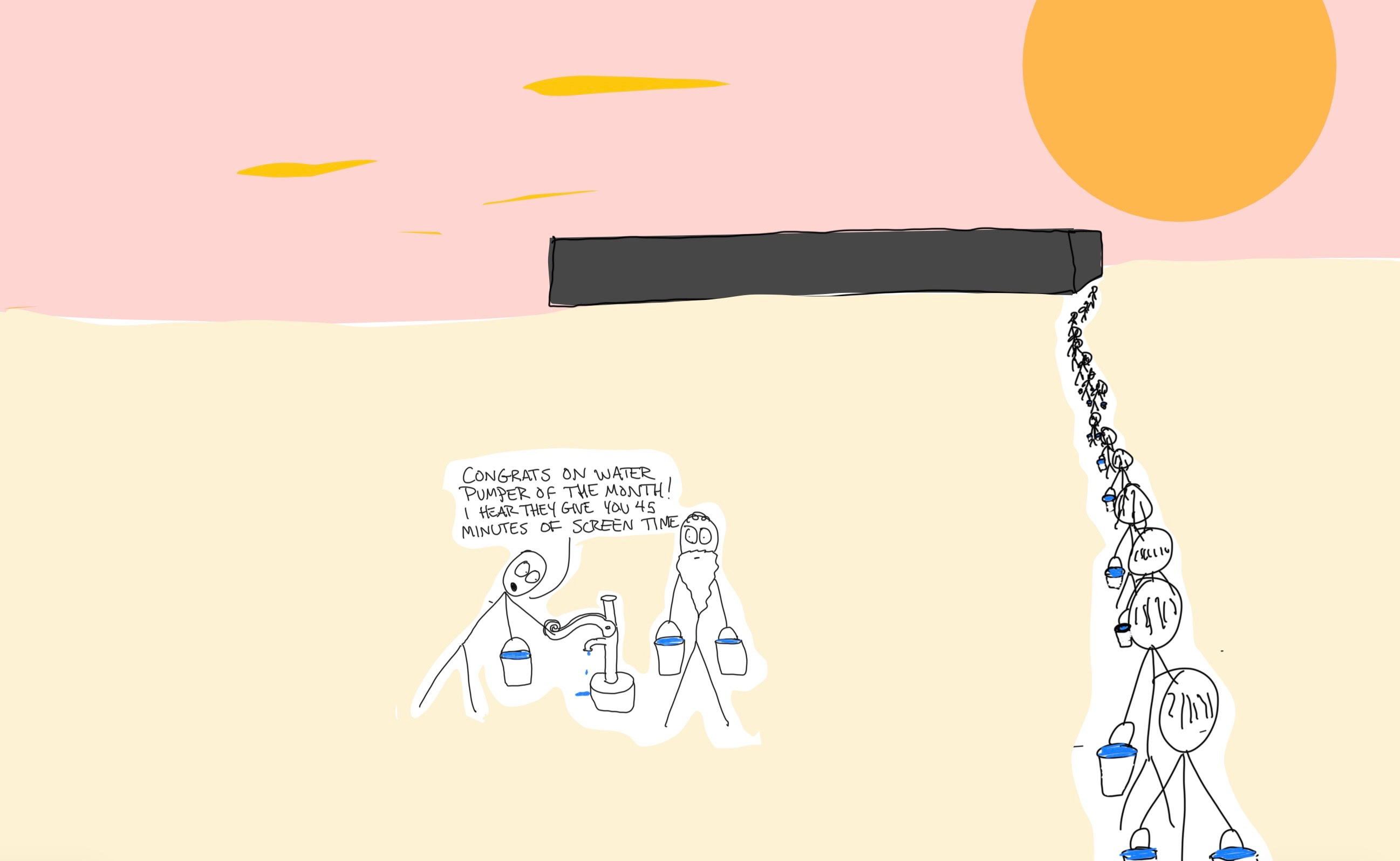
I don’t mean to dismiss your concerns, but this is a dystopian fantasy (well, maybe not the water part).
LLMs (and their cousins LVMs) are prediction engines. They are trained on billions of differently-weighted words from news articles, poems, code, short stories, illegally-obtained IP… and they predict the most likely sequence of words based on a given prompt.
These models are very good at prediction, but there’s a big, big reason I don’t see them taking over all creativity in the near future.
And that reason comes down to the one thing these technologies will never possess:
Your perspective is your superpower: The way you see the world; the way you understand other people; the way you approach solving problems…
All the robots can regurgitate facts and statistics. The one thing they cannot develop is a point of view.
That’s not just wishful thinking. It’s exactly the reason there’s been a huge rush to scoop up talented writers, even among AI companies whose models were supposed to replace them.
But here’s the part that matters for everything else in this post: Your point of view isn’t only what separates you from AI.
It’s what separates you from the writers you’re stealing from.
It’s the difference between Tarantino and Gus Van Sant. One had a point of view and something meaningful to add to the conversation, the other didn’t.
A point of view takes a long time to develop. I only started really refining my own comedic / tonal sensibilities in the past 5-10 years. Prior to that, my writing was much more imitation than perspective.
If you’re young and still early in this journey, right now is the time to go out and make mistakes. Try new things. Do dumb shit (within reason). Meet – and get to know – new people. Yes, even those you disagree with politically.
Travel. Read. Try. Fail. Learn. Grow. If it sounds like I’m aping the “inputs” passage above, that’s the entire point. Developing your perspective and gathering inputs are the same activity.
These inputs are what you will end up using to build the custom components for your machine.
It should be noted that when Craig Mazin spoke to The Hollywood Reporter about his inspiration for The Sheep Detectives, he said: “Our goal was always Babe, which is what I would call the last realist talking animal movie that was special. And that’s what we aimed to do.”
The movie was also described in another Hollywood Reporter article as “Babe Meets Knives Out.”
Oh my god! I nailed the comp without even knowing it!
Look: It’s not magic that I independently arrived at the exact same comp. Because the comp is in the movie. Babe’s DNA was present in The Sheep Detectives from script to screen. And that’s what came through when I saw it.
And that’s okay. In fact, it’s better than okay.
Because a heartfelt, funny movie about sheep detectives is now part of Babe’s family tree.
Discovering your own inspiration and building it into your creative process may not result in the same feeling as the rush of New Project Energy, but it’s much more rewarding and much, much more sustainable.
So: Find the right inputs. Steal like an artist. Remix and reuse and make yourself part of the lineage of creative influence that has existed since the dawn of the written word.
What do you think?
Have you watched something recently that was beyond any comparison? Something you felt was entirely original? Did you enjoy it?
Leave a comment below!
And stay tuned,
Jon
Fun fact: Despite what the internet says, I actually wrote that joke in Veep, and I have the paper trail to back it up.
Disclosure: I ordered this book but I have not read it yet. This is just from internet research.
I’m under no illusion that this is easy or affordable for most people, which is why I provide a couple more options for gathering inputs.
No posts
Comments
Nothing yet. Say the first thing.
Sign in to join the conversation.