
My neighbor, Tony, who had just turned 92, was one of those guys who fiddled incessantly with his lawn, tweezering out dandelions and barking at my kids when basketballs or Frisbees took an errant trajectory onto his Kentucky bluegrass.
I liked him.
One morning I wake up to the grinding squeal of heavy machinery, and see out my window that he’s having his perfectly manicured lawn violently yanked out by its shaggy roots. A sweat-soaked landscape crew was feverishly rolling out brand new golf course-quality sod.
“I just couldn’t leave this Earth with my lawn looking that way,” he explained
While I’m not quite 92 (though there are days), I felt a similar impetus with the five original studio tracks a band I played in, PZB, recorded in 1980 at the long-gone Agency Recording Studios.
I just couldn’t leave this Earth with those tracks mixed the way they were.
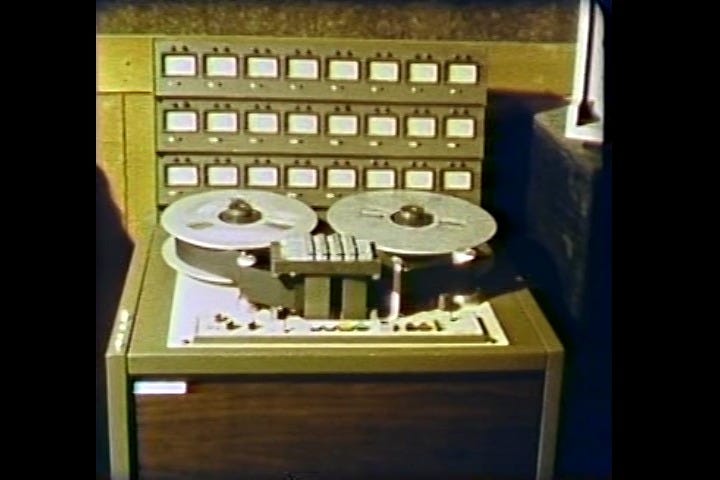
Our engineer for the 1980 sessions was John Nebe (say it “NEE'-bee”), whose production credits curiously include Maureen McGovern’s schlock hit, “The Morning After,” the theme song for a campy disaster flick, “The Poseidon Adventure.” John sent us home with a final cassette mix that sounded — well, it sounded like a 1980 mix on a cassette — what else? I never felt the mix captured the rowdy DNA of the band — we had a Replacements vibe without any of us knowing about the Replacements.
John asked if we wanted to take the tape master, a massive 20-pound metal spool with a mile of 2” audio tape wound on it. Alternately, he said Agency Recording would be happy to archive our master in its in-house library at no charge, for safekeeping. I elected to take the master home instead.
That decision turned out to be a bit of karma, as a few years later, the studio, and the concert hall below it, burned to the ground.
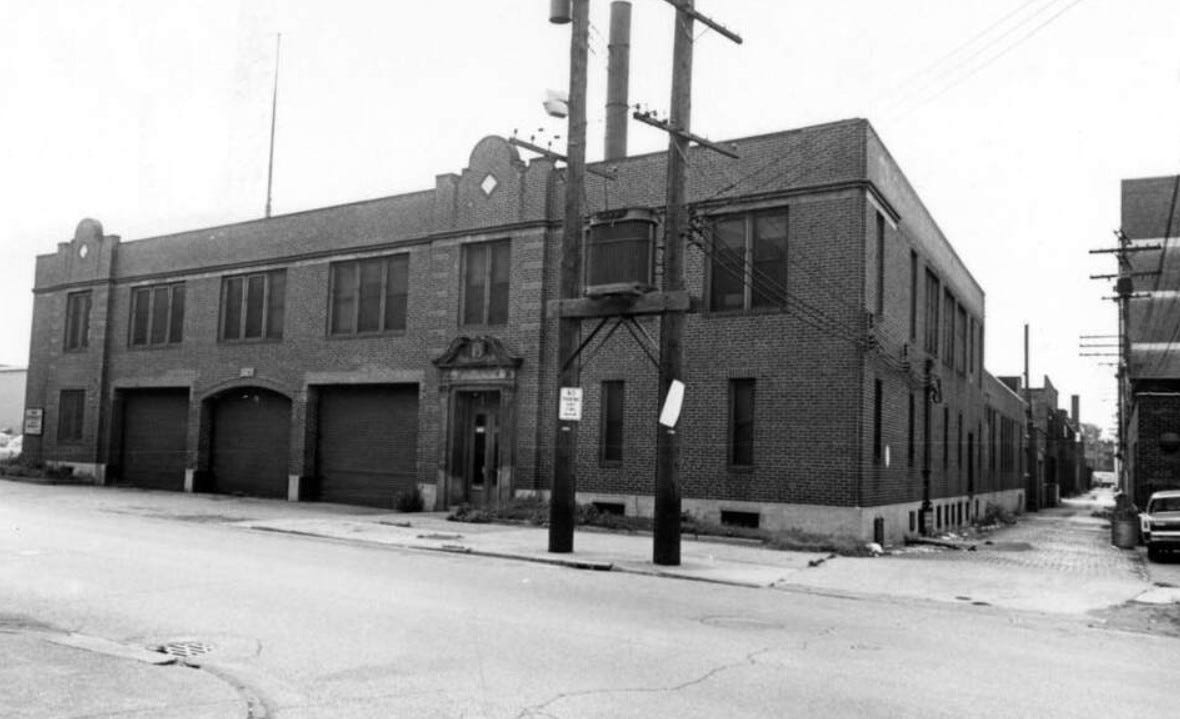
I hung on to the master for nearly two decades with no way to play it back. It sat in a cardboard moving box in the back of a bedroom closet (apparently, my “vault”) until 1999, when I found a local recording studio called Clockwerke [sic] that still had a working 2” playback machine.
Our drummer, Bob, and I booked studio time at Clockwerke to digitally transfer the tracks, assuming the magnetic layer of the tape wouldn’t flake off during playback after 18 years on a closet floor, baking in summer and freezing in winter.
The re-mix we ultimately got from an uninterested Clockwerke audio engineer was — well, uninteresting, but at least we had rescued the tracks from the original source — our 1980 cassettes from John Nebe had long since ascended into rock-n-roll heaven.
Fast forward 24 years, and an ad for audio restoration caught my eye in an issue of Tape Op, a gearhead magazine for recording freaks:
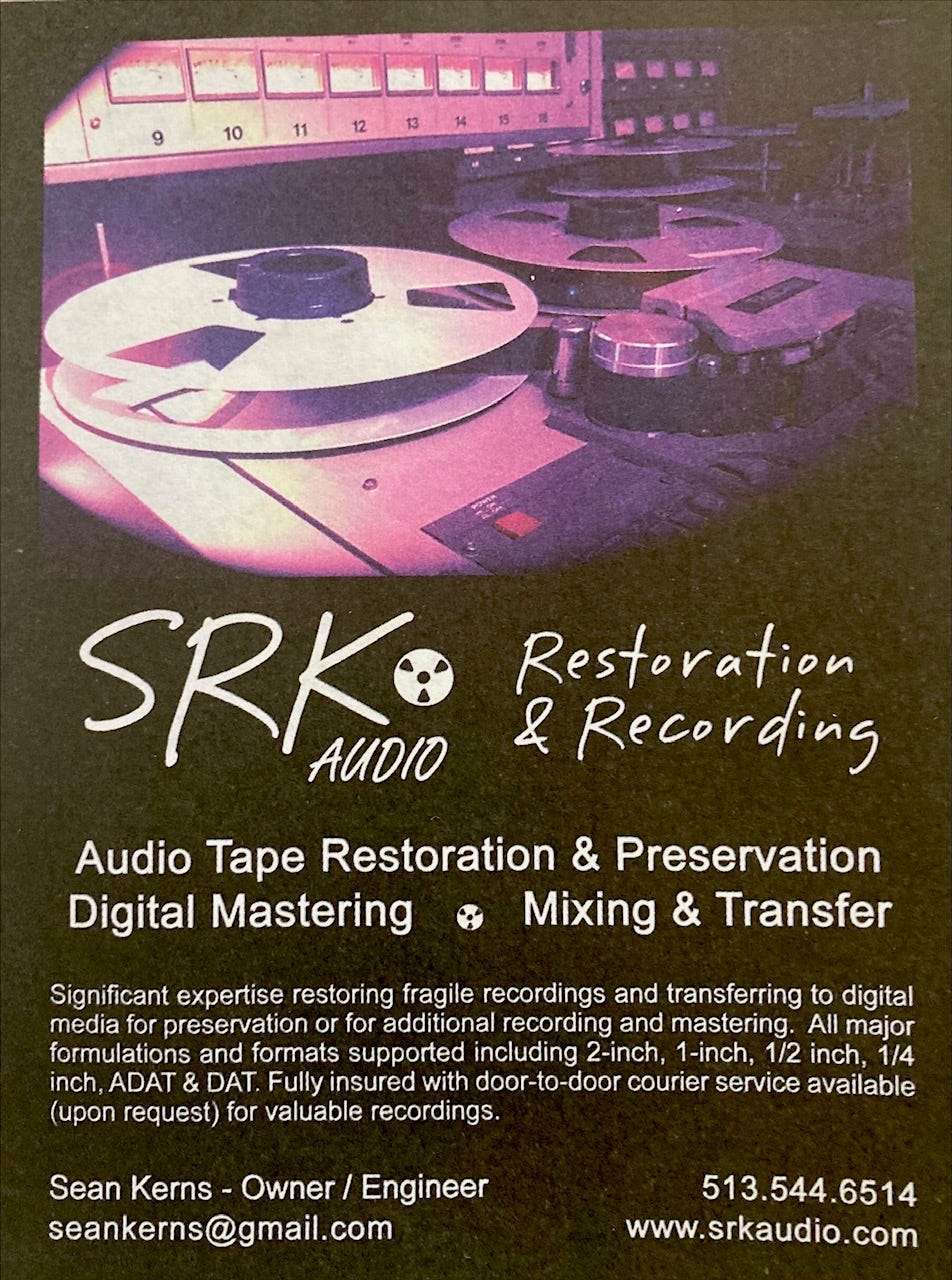
The Clockwerke 1999 boondoggle just never cut it with me — I had to gamble on yet another re-mix. With considerable trepidation, I watched as a UPS counter guy packed up the 2” master and shipped it off to SRK Audio. SRK’s owner and preternaturally talented engineer, Sean Kerns, punched up the mix with his magic and sent back .wav and .mp3 files that finally had the crackly energy I remembered in the studio. Amazing.
The files sat on my hard drive, in the back of my desk drawer (“vault” #2), until I started reading about boutique lathe cut record makers a couple of years later. Wesley Wolfe and his company, Tangible Formats, kept popping up. Then I saw Wes in the excellent documentary, “Vinyl Nation.” I was sold.
Sean Kerns had unearthed alternate takes of “Students on the Go” and “G-I-R-L-S” buried on our 2” master, so I asked Wes to create a 12” disc with our five original tracks on the “A” side, and the two alternate takes on the B-side.
I designed an album jacket, and shot all the audio and art files to Tangible Formats:
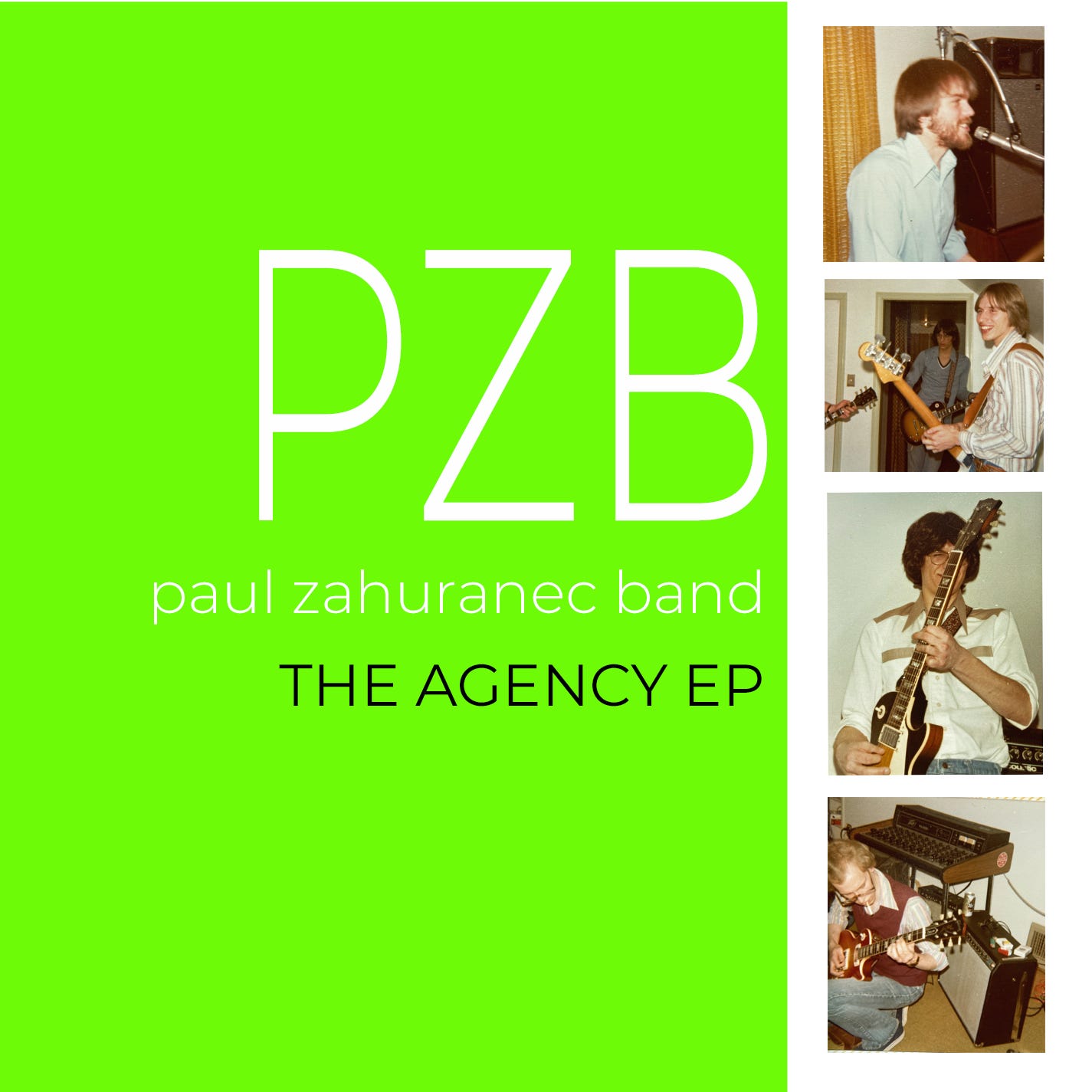
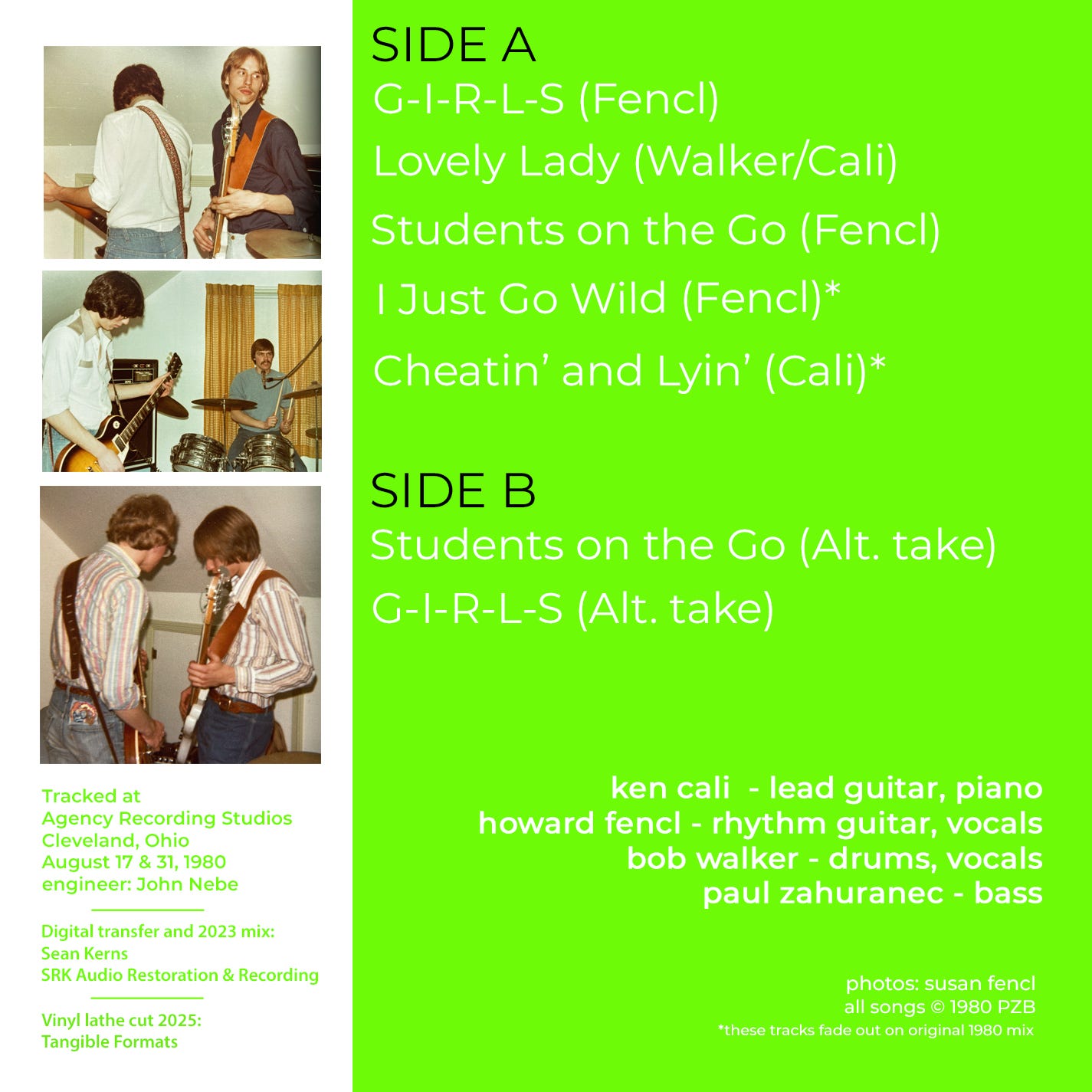
What came back from Wes is amazing. Real 12” records you can crank with real album jackets you can pore over while listening (and perhaps while enjoying an adult intoxicant or two). Wes added his extraordinary mastering skills to Sean’s intense mix, and the result is a super-loud rock-n-roll EP with incredible modern presence. The drums in your face. The bass lines thumping in your chest. The guitar solos blistering across the mix. Finally.
“…my thought was that this sounds like it could have been a modern college indie rock record,” Wes wrote in an email. You couldn’t wipe the smile off my face.
It was a project that took a mere 45 years to complete. Pinocchio turning into a real boy, kinda.
Because when the needle slides into the groove of the new PZB record, for me, it’s just magic.
G-I-R-L-S (Fencl)
Lovely Lady (Cali/Walker)
Students on the Go (Fencl)
I Just Go Wild (Fencl)
Cheatin’ and Lyin’ (Cali)
A few minutes of Super-8 film of PZB recording these tracks in August 1980 survives. I edited it a few years ago using the 1999 Clockwerke mix (the only re-mix then available to me) under the silent portions of the film:
“Cheatin’ and Lyin” © 1980 Ken Cali
“Lovely Lady” © 1980 Ken Cali/Robert Walker
“Students on the Go,” “G-I-R-L-S,” “I Just Go Wild” © 1980 Howard Fencl
No posts
Comments
Nothing yet. Say the first thing.
Sign in to join the conversation.