
I was invited by Baltimore’s 14 West Hamilton Street Club to deliver remarks at their 2026 annual meeting held at Clifton Mansion on May 30, 2026. The following is the text of my speech, lightly edited and annotated for Substack.
“As I begin, I want to draw your attention to the remarkable work that has been taking place around us here at Clifton and has been funded by the Friends of Clifton Mansion. The architects, artisans and preservationists restoring this house have spent years carefully removing layers of paint, wallpaper, and alterations in order to better understand what was originally here and return the house to its original glory. Sometimes the process confirms what people expected to find. Sometimes it reveals surprises. And occasionally it shows that something long accepted as true about the building was never quite right in the first place.
In many ways, historical research works the same way.
Over the last several years, as I’ve been writing a new biography of Johns Hopkins, I’ve become increasingly interested not only in Hopkins himself, but also in how his story, and the story of his parents and ancestors, has been told and retold over the last 150 years. What I’ve discovered is that many of the claims repeated about Hopkins for generations were not based directly on primary sources. Instead, they were inherited from earlier biographies and then repeated by later writers until they came to be accepted as fact.
Let’s take, for example, the oft-repeated claim that Johns Hopkins’ grandfather, who was also called Johns Hopkins, owned a hundred slaves. The “chain or error,” as we might call it, begins in 1873 when Hopkins died. One newspaper obituary described his grandfather, Johns Hopkins the Elder, as a Maryland planter who had once worked his estate with “some hundred negroes” before freeing them.1
Then, in 1885, the journalist Laura Carter Holloway (1843–1930) published the first substantial biography of Hopkins after his death.2 Holloway repeated many of the stories that appeared in the newspaper obits, including the claim that Hopkins’ grandfather had owned one hundred enslaved people.
Next, in 1929, Hopkins’ grandniece Helen Hopkins Thom (1867–1948) published Johns Hopkins: A Silhouette.3 Thom changes the story. She claimed that Hopkins’ father, Samuel Hopkins, had emancipated the family’s enslaved people in 1807. According to Thom, this forced young Johns to work on the family farm which helped shape his character. Thom cited almost no documentary evidence, but her version became the accepted story, especially at Johns Hopkins University.
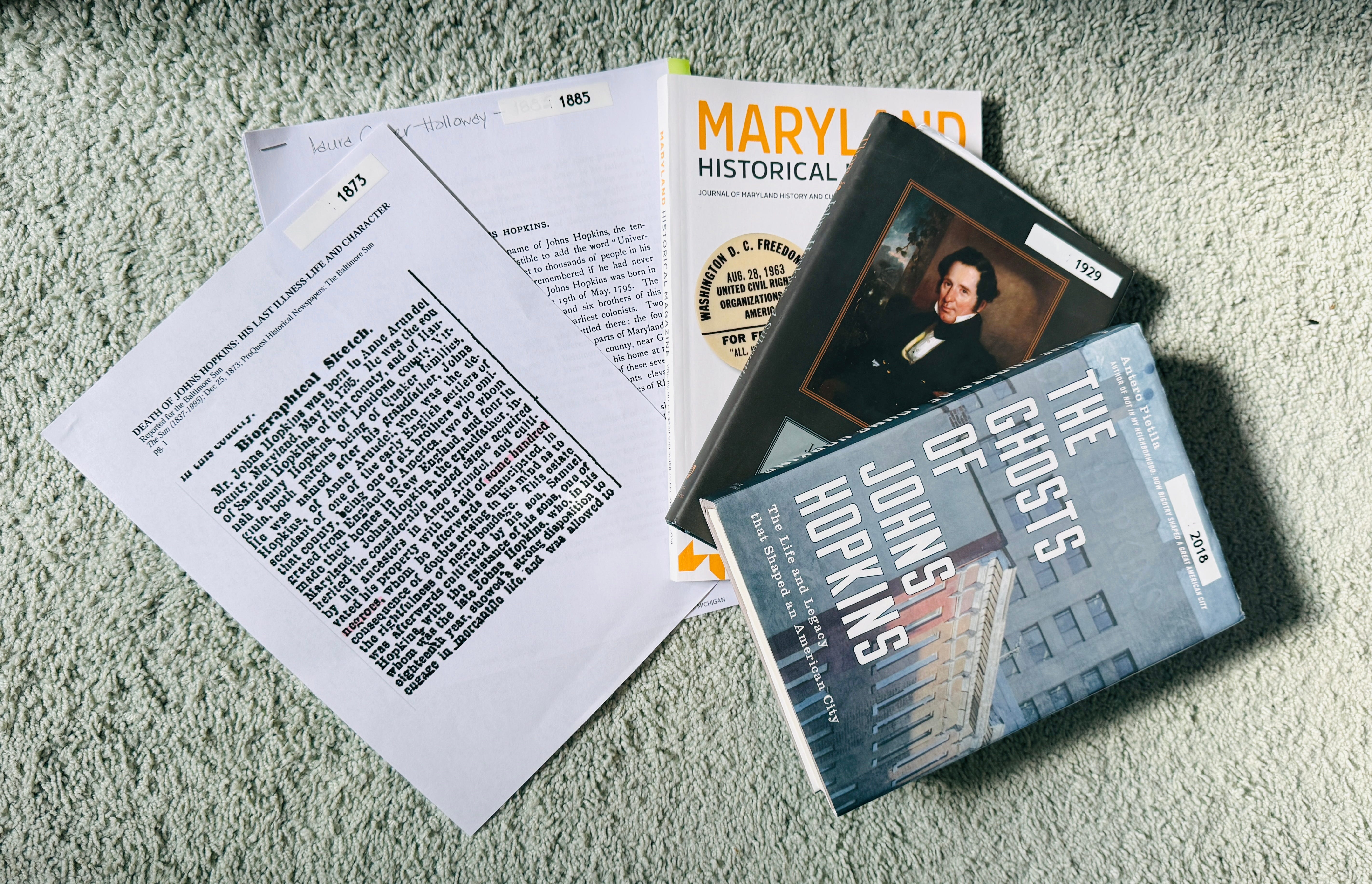
Fast forward to 2018, when Baltimore Sun journalist Antero Pietila revisited these questions in his book The Ghosts of Johns Hopkins.4 To his credit, he rejected Thom’s story of the 1807 manumission event and correctly shifted attention back to Johns Hopkins the Elder. But, relying on Holloway’s account, he picked up and repeated the claim that the elder Hopkins had “owned a hundred captive men, women, and children on the family plantation.”
Finally, we have JHU’s Hard Histories report written in 2020 by Martha S. Jones.5 Jones, a historian of nineteenth century Baltimore, challenged some older assumptions about Johns Hopkins and brought the evidence of the 1850 census to light (the primary focus of our 2026 article.) Yet she too accepted parts of the inherited narrative, including the idea that the elder Hopkins had once been a very large slaveholder and that the manumissions of 1778 were only “partial” in scope.6
What is striking is that the key evidence needed to evaluate these longstanding claims had been sitting in public archives and was readily available online.
For example, a Revolutionary War census carried out in 1776 recorded forty-three enslaved people at White’s Hall, the Hopkins family plantation. Two years later, a 1778 manumission deed named forty-two enslaved people individually. Nine were freed immediately, and thirty-three others were assigned additional terms of service before receiving their freedom.
Taken together, these documents tell a very different story from the one repeated for generations. Rather than owning one hundred enslaved people, the evidence shows that Johns Hopkins the Elder held approximately forty-three.7 And rather than only partially emancipating a much larger enslaved population, the 1778 deed appears to represent a comprehensive plan to liberate the Hopkins’ entire enslaved community.
Gone altogether now is Thom’s apocryphal tale that the family’s enslaved workforce was freed en masse in 1807. So, when Pietila wrote in 2018 that “Johns Hopkins was born into a slaveholding tradition” he was wrong. In fact, he was born into a abolitionist tradition, and this is, I believe, absolutely key to understanding the rest of his life.
But the lesson here is, I think, larger than Johns Hopkins. Historical errors often survive not because sources are unavailable, but because later writers trust earlier writers. A claim appears in an obituary, then in a biography, then in another biography, and so on, until it acquires the status of fact.
As I stand here today at Clifton, surrounded by this extraordinary restoration project, I am reminded that historians and preservationists share a common task.
The artisans working in this house have not tried to invent a new Clifton. Nor have they simply accepted every alteration or coat of paint that accumulated over the last century and a half. Instead, they have carefully peeled back the layers, examined the evidence, and tried to understand what was actually here.
Our work, as I said before, is much the same.
For generations, writers have repeated stories about Johns Hopkins that were inherited from earlier biographies and family traditions. Some of those stories contained important truths. Others were exaggerations, misunderstandings, or assumptions that hardened into facts through repetition. Thankfully, in the case of Johns Hopkins and his family, many of the original primary records still exist. We consulted them in writing our Maryland Historical Magazine article, and I will rely on them in the biography I’m hoping to complete soon.8 They allow us to strip away some of the accumulated layers and recover a more accurate, more complicated, and ultimately more human story of Johns Hopkins.
Thank you!”
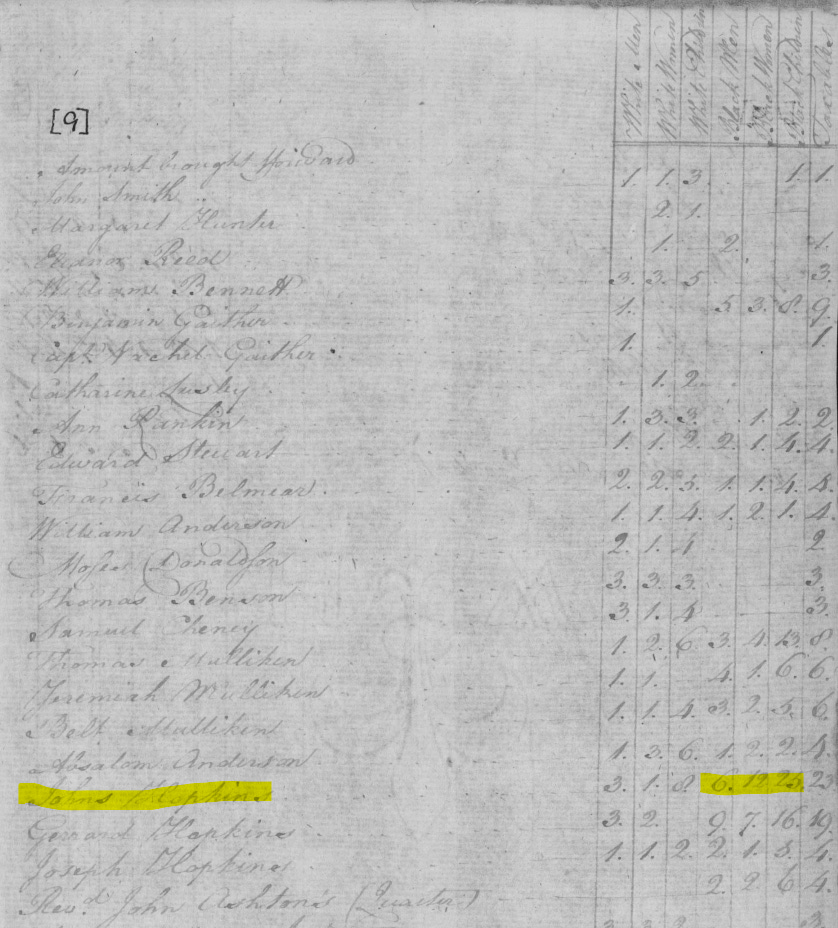
Maryland State Archives, COUNCIL OF SAFETY, Census of 1776, S961-1, AA, All Hallows Parish, MdHR No: 4646-1, record for Johns Hopkins. This census of White’s Hall records 6 Black men, 12 Black women, and 25 Black children at the plantation.
“Death of Johns Hopkins,” The [Baltimore] Sun, December 25, 1873. In fact, the Sun obituary copied the key text almost word-for-word from Brantz Mayer’s 1871 bio of Hopkins: “Johns Hopkins, the grandfather of the gentleman who is the subject of this notice, … inherited the considerable landed estate acquired by his ancestor in that neighborhood, and cultivated his property with the aid of some hundred negroes, of whom he became possessed by bequest from his parents and by marriage. He had eleven children. At that period slave labor was essential to profitable farming in the colony, and the industry and enterprise of Mr. Hopkins were taxed by the necessity of providing for the support of so large a family. But doubts arose in his mind as to the rightfulness of keeping negroes in bondage ; and he, therefore, gave freedom to all his slaves, cultivating his estate afterwards by his own labor, aided by the toil of bis sons and by such free labor as could then be procured.” See Brantz Mayer, Baltimore: Past and Present, with Biographical Sketches of Its Representative Men, Baltimore: Richardson & Bennett, 1871. p 299-300.
Laura Carter Holloway, “Johns Hopkins,” Famous American Fortunes and the Men Who Have Made Them, Philadelphia: Bradley & Co., 1884, p. 335.
Helen Hopkins Thom, Johns Hopkins: A Silhouette, Baltimore: Johns Hopkins University Press, 1929, p. 7.
Antero Pietila, The Ghosts of Johns Hopkins: The Life and Legacy That Shaped an American City, Rowman & Littlefield, 2018, p. 4.
No posts
Comments
Nothing yet. Say the first thing.
Sign in to join the conversation.