
The first moments of the TV series The Last of Us introduces a disturbing consequence of climate change. As the climate warms, fungi will begin to adapt to warmer temperatures, meaning they could live inside of us. There are at least 20 known species of fungus that co-habit our gut in a so-called mycobiome, but they are beneficial and not of concern.

Whether fungi evolution works fast enough to be more than just good TV is unclear. However, there are already numerous thermotolerant fungi that can survive at warm temperatures. At some point, other fungi will die off from the heat, leaving fertile ground for those fungi that have already adapted to warmer temperatures. When those fungi make it inside humans, the consequences can be severe.
Speculating about this situation highlights a broader point: we don’t really know how life around us will adapt to a hotter planet. We also don’t really know how changes in one population will affect other populations. Ecosystems are living examples of exquisite balance. Like walking on a high-wire, one small sway can build into a massive wobble that can topple everything.
We are already seeing die-offs and migrations. With rising ocean temperatures, marine ecosystems are seeing multiple mass deaths. More droughts and habitat destruction is accelerating the pace of extinction for many amphibians. The UN recently warned that 40 percent of invertebrate pollinators, including bees and butterflies, risk global extinction. For pollinators, we know generally what the consequences will be, but the details are murky. Effects will likely be idiosyncratic and vary greatly by location.
The secondary effects of die-offs are murkier still. Mass die-offs of the ash tree due to emerald ash borers is an example of a secondary effect. The insects killing these trees are migrating due to a warming climate. In this new habitat, they find trees that are defenseless and easily consumed. This is not unlike when Europeans brought smallpox to the Americas.
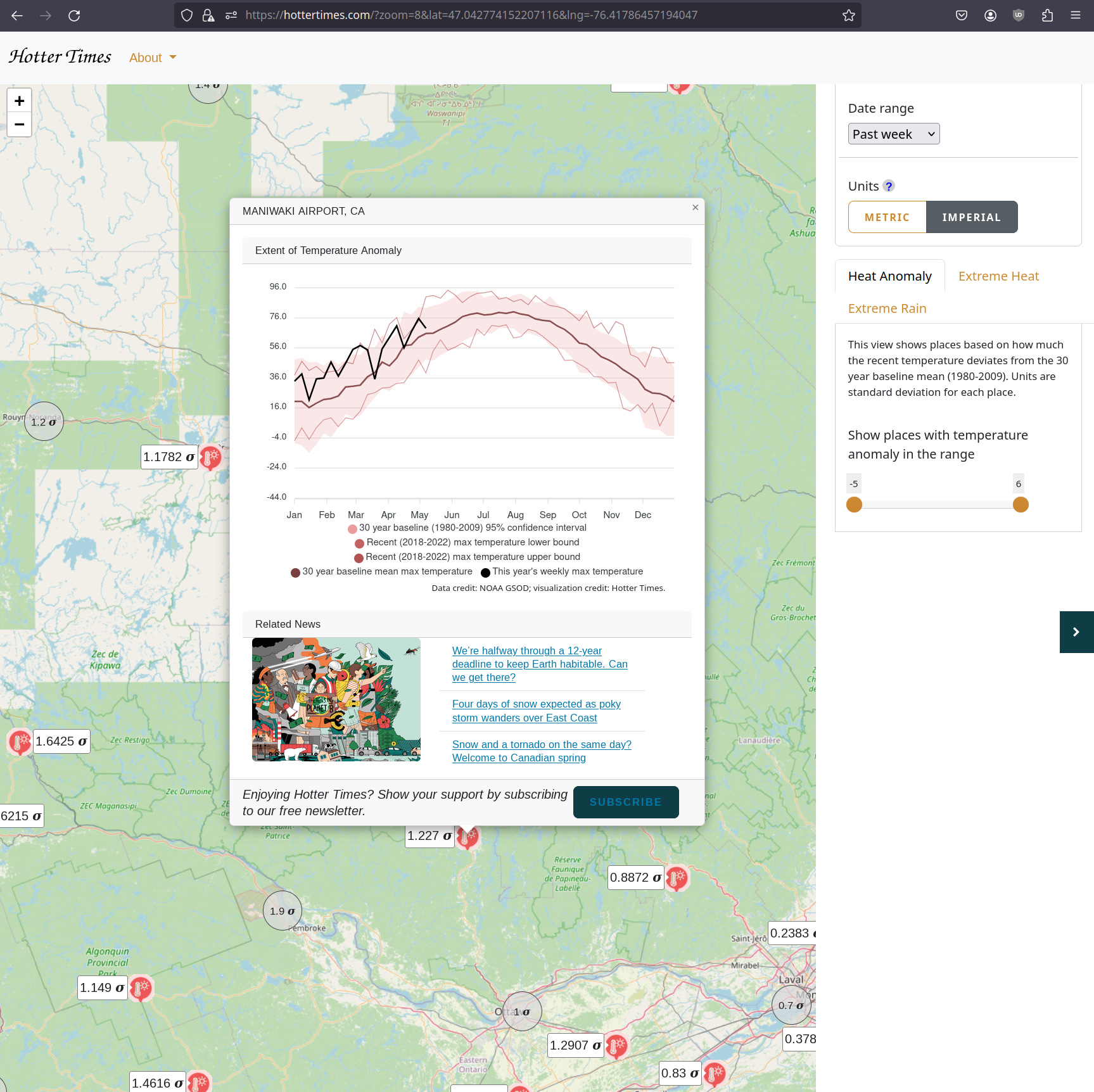
What we are seeing is that while the amount of CO2 in the atmosphere has incrinearly since about 1950, the effects appear to be exponential. A key characteristic of exponential processes is that by the time they are visible, it is too late to do anything about it.
Monitoring gives us precious time to understand the underlying drivers of a process and take action before it’s too late. The data that monitoring provides feeds forecasting models that let us peer into the future. The better the data, the further into the future we can see.
This is why monitoring is so important and why it needs to be low cost. Sensors need to be deployed everywhere to help us understand how things are changing and at what rate. With adequate monitoring we can evaluate different risks and know where we need to allocate resources.
Some readers have asked what are actions that they can take to help make an impact. I’ve been mulling over this for a bit now. Given how little inaction there has been at the government and corporate level, it does seem like grassroots, community-led initiatives will be more relevant. The recent boycott of a mega-grocer in Canada underscores that collective action can still be an effective means of catalyzing change.
If you have thoughts on what actions people can take to contribute to climate adaptation, please share them in the comments!
Hotter Times is published by Zato Novo. We are building the Climate Adaptation Data Platform, an open source sensor and data infrastructure to accelerate climate action and digital development projects. Quickly build applications for food security and public health that rely on hyperlocal weather forecasts. Get in touch with Brian at rowe@zatonovo.com to learn more.
No posts
Comments
Nothing yet. Say the first thing.
Sign in to join the conversation.