
Hello!
Welcome back to Routine Triage!
Routine Triage is a way to make my advice feel more immediate & similar to the types of questions I get everyday in the treatment room and in my group chats. In fact, that’s exactly how I envisioning it—like a text to a friend.
How it works is simple: you fire off a quick question about your at-home routine, and I reply/troubleshoot exactly how I would in a casual conversation. Perhaps I’ll ask a few clarifying questions, but it’ll be mostly straightforward answers and actionable advice. In order to accomplish this, I set out strict parameters:
Submit a focused, single question about your at-home routine.
You can ask questions about products you use, gaps you feel are missing, techniques, or devices etc.
You cannot submit a multi-part question, or ask questions about professional treatments or in-office procedures.
Moving forward, I’ll put out a call for Routine Triage questions via Substack Chat, which is where today’s came from. I also got the question about silicones that I just really wanted to answer, so I did!
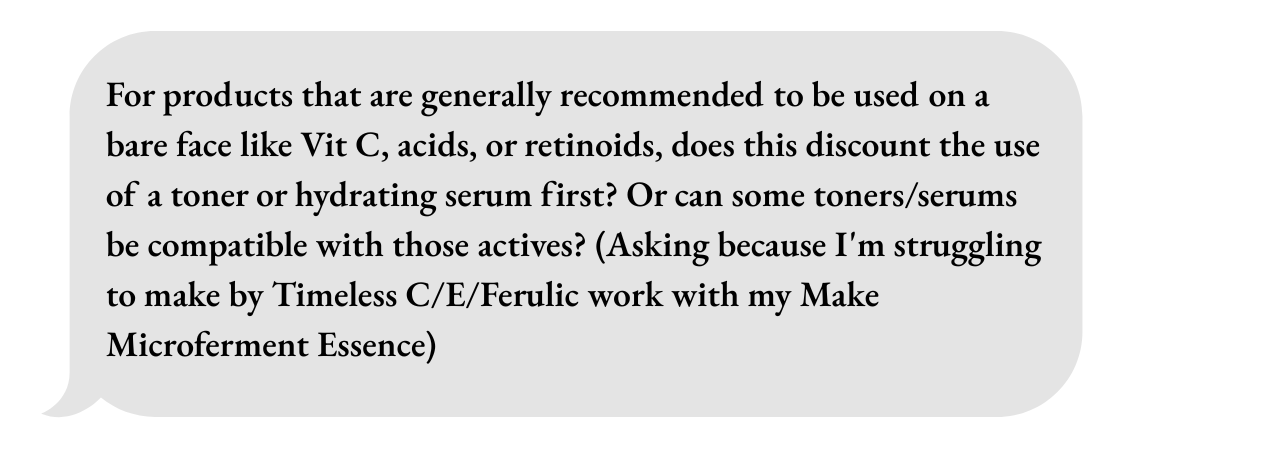
It depends on the exact products because it is a matter of pH. L-ascorbic acid (pure vit C, like in the Timeless serum you’re using) has a low pH, so it needs to be on bare, clean skin to stay active and effectively be delivered into the skin. If you use something with a higher pH beforehand, you’ll neutralize the vitamin C. I don’t know the pH of Make’s Microferment Essence, but usually hydrating/humectant heavy products tend to have more skin-identical pH’s of around 5.5. So in your case, it’s just a matter of reversing the order! Use the vit C first, then wait a few minutes to give it time to start penetrating, then go in with the essence and the rest of your routine.
This layering issue only really applies to pure L-ascorbic acid and (most) exfoliating acids—this post covers it in detail and likely has answers to anyone’s follow-ups!

So yes and no. We’re really working against gravity, which will ultimately win, but that doesn’t mean we can’t put up a fight. Just like with the face, using products with retinoids and peptides to build collagen and elastin will help, and for some people that means just bringing their products down to the neck, which is just something I generally recommend. Neck skin is quite thin and fragile, so retinoids (especially prescription) can be too aggressive for some, so just be wary before you go all in.
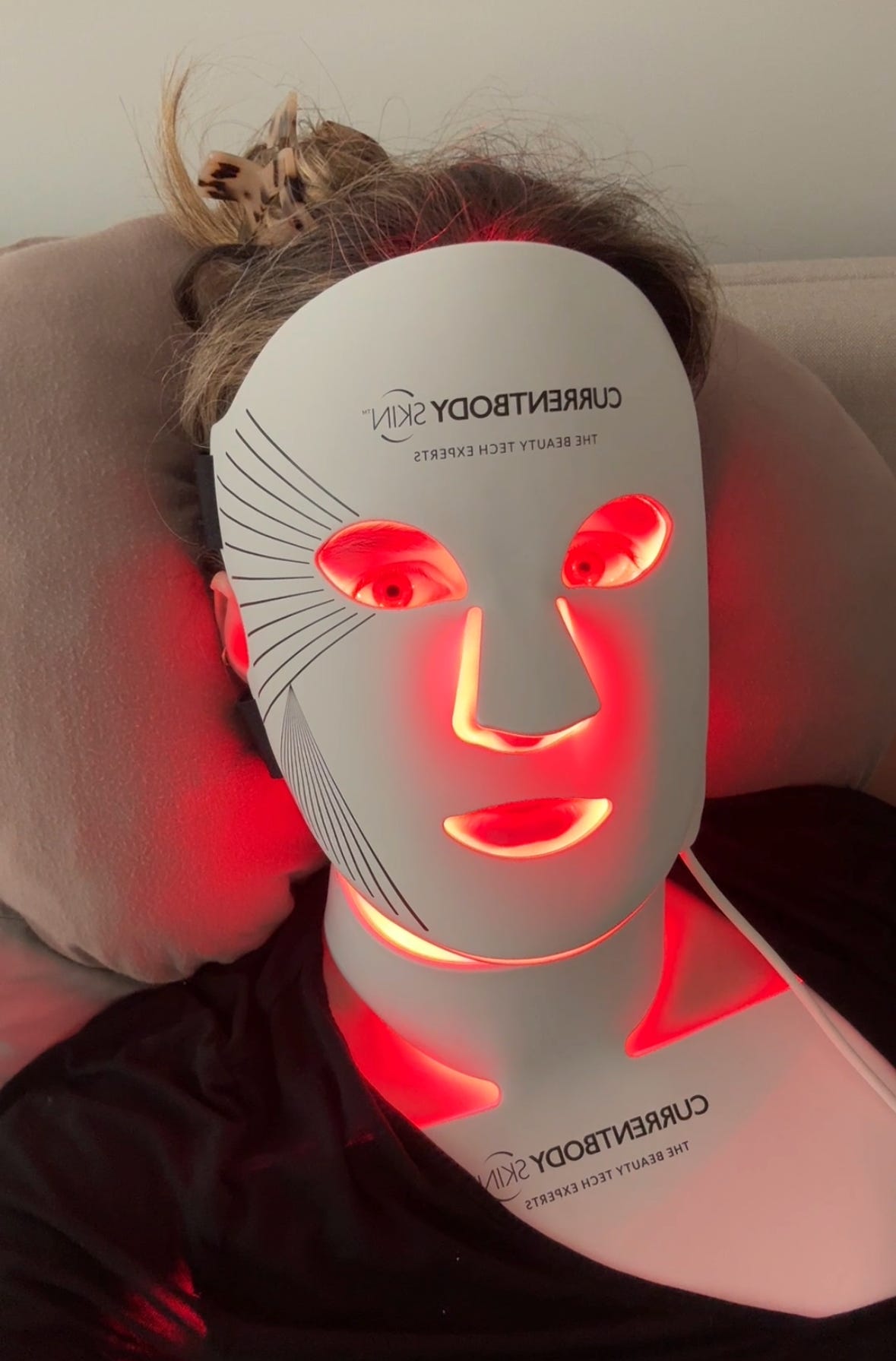
If you do want to try dedicated neck products: because the skin is so thin, it ages a little differently/faster, so neck-specific products tend to have denser concentrations of firming ingredients, and there are some neat peptides being used in neck products these days that really target the needs of the neck, linked here. I also know people who still use and swear by the classics from Gold Bond and Strivectin. NIOD also has the Neck Elasticity Catalyst that I’ve heard good things about, but also that it is smelly, which is true of many NIOD products, but they also tend to be effective. If you have a ZIIP, there’s a new neck program on the app which is great and provides more “instant” lifting. And of course, I can’t forget the CurrentBody Neck & Dec LED Mask, which, unlike the mask, I am not great at using, but inspired by this question, I now have a 2 day streak of starting the day like this:
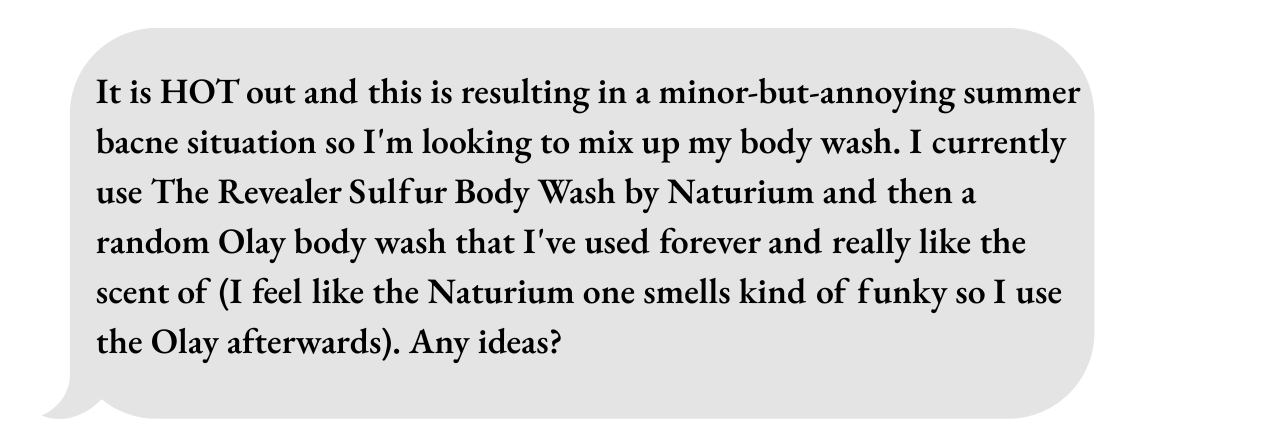
Sulfur is known for a lot of great things, but the scent is not one of them! Before we get to body wash, let’s talk tools: use either a silicone scrubber with a handle or exfoliating cloth so that you are really working in the product and giving your back a thorough cleanse. I also really like using hypochlorous acid to kill bacteria (spritz before/after workouts or anytime you feel a little sweaty, but won’t be showering yet). A salicylic acid body spray is also a great option, just be mindful not to overuse it and cause excess irritation. Scent-wise, for exfoliating body washesI loooove the smell of the Sol de Janeiro Bom Dia Bright™ Clarifying AHA BHA Body Wash (it’s my favorite of their scents). For something a little more woodsy, try Nécessaire’s Hinoki Body Wash, which has a blend of acids.
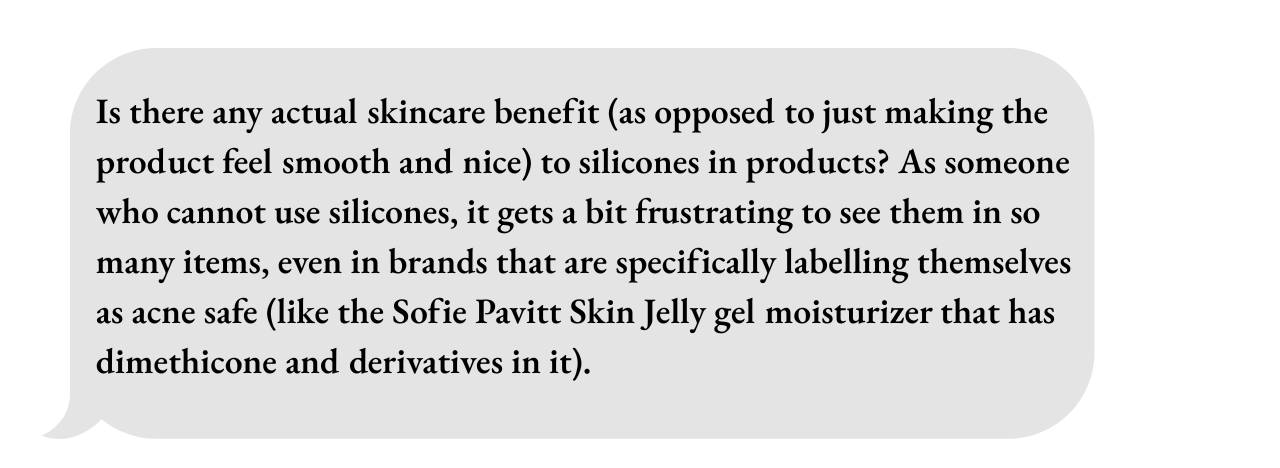
Great question! Silicones (of which there are many types) in skincare products have a few purposes. The biggest skin-specific benefit is occlusion, making it harder for water to evaporate off the surface of the skin. Occlusion doesn’t mean suffocation though, and many silicones are very lightweight and breathable. I forget where I read this, but I once read an analogy comparing silicones to tea bags—the tea bag is still permeable, but just not everything passes through. That’s also why silicone is often used in wound healing to provide protection while still allowing skin to breathe. (There are also other wound-specific benefits that I’m not well-versed enough to speak on, but there’s a reason why surgeons recommend silicone scar gel.) Other benefits—if you count as benefits vs. just a formula perk—can include blurring, mattifying and temporarily reducing the appearance of fine lines by smoothing the surface. In the case of Sofie’s Skin Jelly, the silicones are playing a role in both the finish and the texture.
Silicones are also chemically inert, making them really safe and well-tolerated (unless you have an allergy, of course) and actually aren’t known to clog pores themselves, which is a hotly debated topic in the skincare world. It’s pretty impossible for silicones themselves to actually be comedogenic as the molecule is just way too big. However, because different silicones have varying levels of occlusion and/or you may be layering multiple types across products and/or you may just be layering a lot of products in general underneath a silicone-based product, this over-occlusion can create the perfect environment for acne-causing bacteria to thrive (this logic can also be applied to perioral dermatitis or malassezia folliculitis/fungal acne, which don’t like over occlusion). So it really is individual and dependent on your skin type/acne presentation, the types of and amount of product you’re using, which is why you’re likely to keep seeing them in acne safe products. Does this answer your question?! (Personally, my very acne-prone skin is very triggered by over-occlusion, but I don’t avoid silicones, just am mindful not to over-layer.)
CurrentBody: JOLIECB for 10% off
Dermstore: JOLIE for up to 15% off many brands
Hanni: JOLIE15 for 15% off
Sofie Pavitt Face: JOLIE10 for 10% off
ZIIP: ZIIPJOLIE for 10% off
Join us for Office Hours on Sunday! This exclusive weekly opportunity is available to paying subscribers.
Every Sunday around 5pm EST, I’ll begin a new thread for the week in Substack Chat, where you can ask me anything. Every Monday from 8-9pm EST, I’ll be in that chat live, answering questions for the hour. That way, if you can’t make it, you can submit any time after 5pm Sunday and still get an answer. If you can make it live, join in! You can ask questions in real time and (hopefully) interact with others in class ;)
Also! You have about a week to use our exclusive code HOTLINE20 for 20% off Celisse through 8/19. They just launched new colors including their first RED & you can read this to learn why I’m a Celisse superfan.
Have a great week!
xx,
Jolie
CATCH UP ON HOTLINE SKIN:
No posts
Comments
Nothing yet. Say the first thing.
Sign in to join the conversation.