
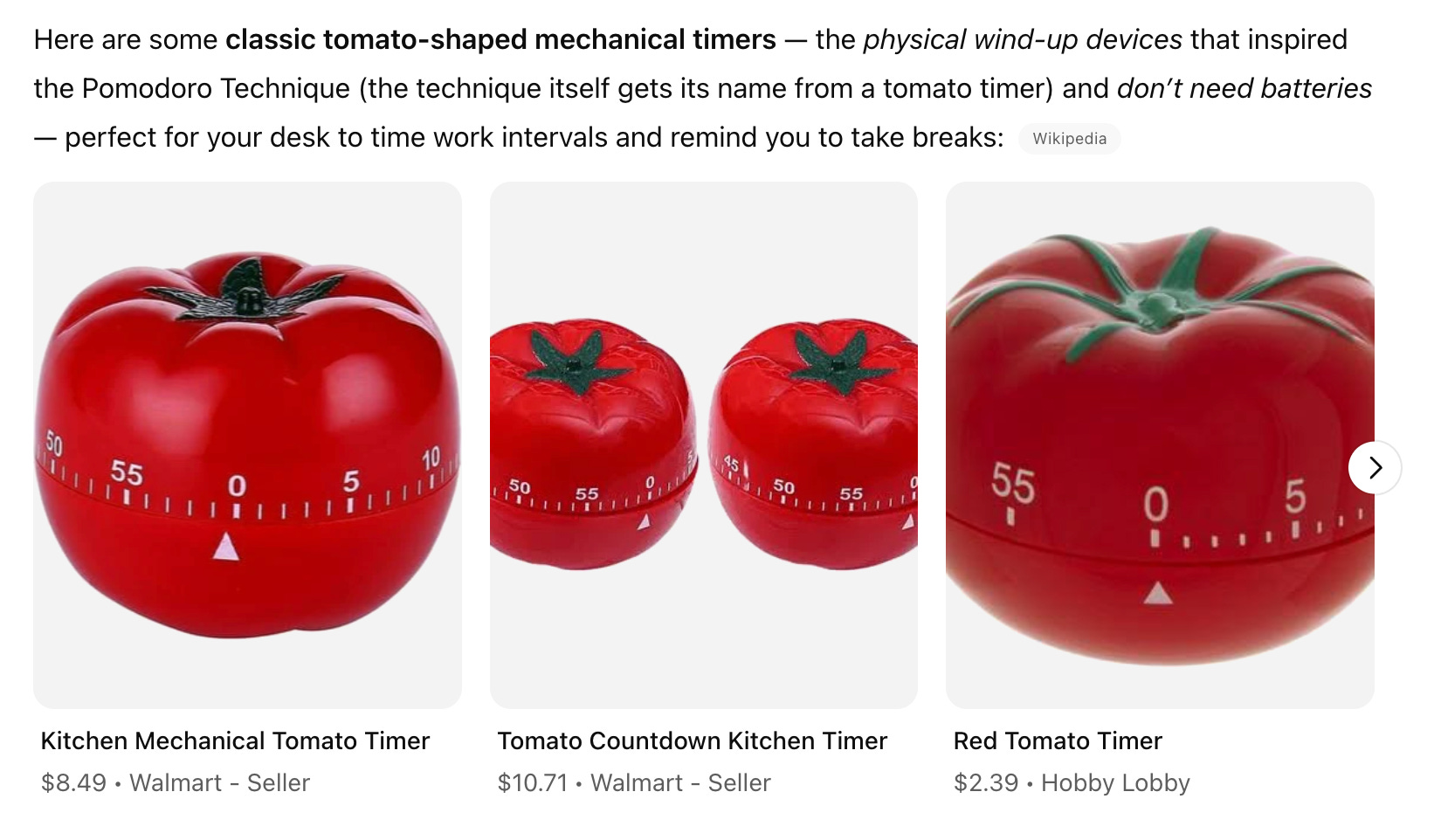
I was recently looking for a pomodoro timer. I opened ChatGPT’s Atlas browser and typed a simple query. Alongside recommendations were actual products, complete with images, prices, and details. Many of them came from Walmart. I moved from question to product in a single chat without opening any retailer’s website.
Two months before my search, Walmart had announced a partnership with OpenAI around Agentic Commerce Protocol (ACP). ACP makes it easy for retailers to share their product feed with OpenAI, making them accessible inside ChatGPT; with Stripe powering Instant Checkout, purchases can soon be completed directly in the chat. Two weeks back, Walmart decided to partner with Google for its Universal Commerce Protocol, an end-to-end protocol to allow AI agents to buy and sell.
Walmart’s move surprised me. If I do my product research, discovery, and purchase on Google or OpenAI’s chat interface, they’re giving away the customer relationship and the brand experience. Walmart has spent decades owning the customer relationship through stores, websites, and loyalty programs. Why hand over the interface so early, before consumer behavior has shifted, and especially when competitors like Amazon are clearly holding back?
What looks like a routine retail partnership is in my opinion a sign that commerce is about to change. Not an incremental shift in channels or interfaces. But an “Internet changed retail forever“ type of change. In today’s article, I’ll explore this shift.
Think of agentic commerce as AI that can autonomously shop and complete purchases, not just help you find products. There are two modes of AI support in shopping today.
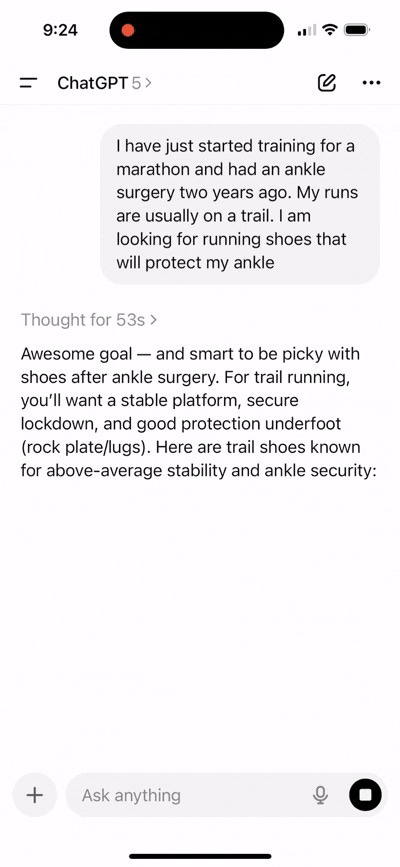
First, the AI assistant. You explain your context. “I am training for a marathon. I had ankle surgery. I run on trails. Please suggest shoes.” The LLM searches the web, reads various pages and suggests options and links. You still evaluate, decide, and complete the transaction. This is how most of us use ChatGPT/Gemini today for shopping research.
Second, the shopping agent. You say “Order a good Hoka, Brooks, or New Balance running shoe with strong ankle support for running a half-marathon. Shoe size 10. Price under $100.” The agent researches products, filters options, and picks one. In the “Human Present” mode, you approve the purchase and the agent uses your credit card to make the purchase. In the fully autonomous mode, the system completes the purchase without even asking for approval.
Three technology layers enable AI agents to shop autonomously:
1. Agents Need to Talk to Each Other (The Protocol Layer)
AI agents must communicate across platforms. If there is no common standard, every merchant will have their own approach to sharing product information and shopping agents will need to integrate with thousands of them. That fragmentation will make agentic shopping impractical. To avoid this, Google and OpenAI are developing UCP and ACP respectively.
2. Agents Need Places to Actually Shop (The Commerce Layer)
Retailers must open “machine-accessible” back doors so agents can query and transact. Shopify, Etsy, and Salesforce are already enabling this for merchants. Some integrations are already live:
ChatGPT + Instant Checkout: You can now buy certain products directly in a ChatGPT conversation. Works with major platforms like Shopify, Stripe, and Etsy.
Perplexity: Partnered with Firmly.ai to enable in-chat purchasing across 150+ retailers since launch in late 2024, with shopping queries up 5x.
Google Gemini: Rolling out features with the UCP announcement.
3. Agents need to trust each other (The Governance and Payments Layer)
As AI agents begin to transact, the existing payment system loses a line of accountability. Issuers need to know whether a user actually authorized a purchase to an agent, merchants need to understand liability when an agent misbehaves, and networks need a way to distinguish compliant agents from bots. While Google’s Agent Payments Protocol (AP2) references “mandates,” there is still no industrial-grade system for issuing, verifying, and enforcing user authorization across autonomous agents.
Most retailers I chat with are falling into three critical misconceptions that could undermine their ability to respond.
I am not suggesting we will outsource all our shopping to AI agents but some of it offers no joy and involves a fair amount of research. For example, I would be happy to outsource my travel booking to a competent AI agent.
With agentic shopping, users can set spending rules. “Reorder my usual groceries if the total is under $200.” “Buy Coldplay concert tickets under $150.” (OK, that one is infeasible), “buy a gift for a birthday.” Sometimes, we may choose a “human present” mode in which we make the final approval. But even then, the agent – and not the human – is choosing. And when that happens, the agent never sees the website experience.
AI Engine Optimization (AEO) assumes visibility is enough: make content structured and crawlable. But AI agents are not just a filtering tool; they can decide.
Over decades, marketers have mastered human persuasion. We know that $19.99 converts better than $20. We understand social proof, scarcity, authority. These techniques work because we understand human psychology. But artificial neural networks (ANNs) have different biases and framing effects than biological neural networks (BNNs). Companies will have to decode “AI persuasion” to succeed.
This is the mistake many studios made with Netflix’s entry: mistaking a system-level shift for another distribution channel. Soon, the entire content market changed and most studios are now at the mercy of Netflix and Amazon, which control what gets made, by whom, and who gets to see it.
Similarly, a new platform (AI models and agents) will likely control big chunks of commerce. If retailers are not careful with their next moves, AI will control what people buy and from whom. Retailers risk becoming back-end fulfillment centers to AI models that shape demand and control customer relationships.
Agentic commerce opens up many tactical questions and two big strategic ones for me. At a tactical level, companies face familiar questions:
Infrastructure: Is your product data structured, and machine-readable?
Partnerships: Which AI ecosystems should you integrate with: ChatGPT, Google, Perplexity, or all?
Measurement: If visits vanish, what replaces website analytics as the measure of success?
Branding: How do you build preference when AI makes the choice?
Customer Relationships: When AI owns the interaction, what does “customer loyalty” look like for retailers?
Strategically, I see two big questions.
First, What is AI, if it’s not a channel? My view is that for retailers, AI is best understood as a new class of customer. You have spent decades figuring out how to influence humans (BNNs). The same approaches may no longer work. ANNs are like a new species and you therefore need a new science on how this species makes (shopping) decisions. You need to get to work to figure out this science.
Second, how can you play in agentic commerce and still control branding and customer relationships. Amazon’s strategy seems to be that they need to own the I agent that consumers will use for shopping. This is their strategy with their shopping agent, Rufus. It’s another story that Rufus is mostly underwhelming. Walmart is hedging its bets. On the one hand, Sparky is their response to Rufus. They’d love for everyone to use Rufus. But they are also (rightly) worried that shopping gateways might be ChatGPT or Gemini so they are also providing their catalogs to them. Should other retailers follow suit? Should they resist like Amazon and try to build their own shopping agents? That’s the big strategic question.
How are you thinking about it?
No posts
Comments
Nothing yet. Say the first thing.
Sign in to join the conversation.