
First, a fun anecdote. To celebrate the end of the teaching season, I had a dance-off with my students, doing a few steps from Charleston to Twist to Soulja Boy and Bollywood. Wharton posted a snippet on Instagram, and to my surprise, the clip — across multiple variations — been viewed over a million times on Insta. For some holiday cheer, below is the original Insta post from Wharton (And here is the full dance).
A few weeks ago, I was driving home with my wife. We were an exit away when she casually ended the GPS directions. I immediately turned them back on. It startled me how disoriented I felt. This was our own neighborhood and I should know the way. In fact, I did know the way. But I’ve grown so accustomed to GPS guiding every turn that its absence made me uncomfortable.
It wasn’t always like this. Growing up in Bangalore, my father built a mental map of the city the old-fashioned way: through curiosity, attention, and plenty of wrong turns. I never had to develop that skill.
In London, aspiring “black cab” drivers spend years mastering The Knowledge of London: thousands of streets and landmarks, memorized through intense study. Today, an Uber driver can navigate the same city without knowing a single turn.
We celebrate this convenience. But as we use AI to drive efficiency in more parts of life, it makes me wonder: What parts of our minds are going quiet without us noticing?
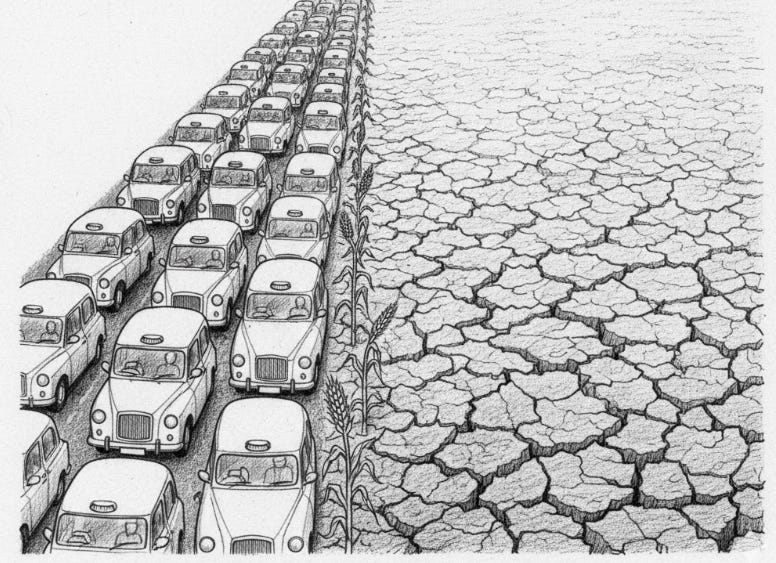
AI makes task completion easier and faster, but it creates a paradox of help and harm: the more the tool does for us, the less capable we become without it. This de-skilling process isn’t new; tools and automation have long eroded physical skills. But with modern AI, are we outsourcing cognitive judgment itself?
The Early Warning: Autopilot systems made flying safer but also reduced pilots’ manual practice. The tragic crash of Air France 447 in 2009, triggered in part by the pilots’ inability to manually fly the plane after automation disengaged, remains a stark reminder of how quickly manual proficiency and situational awareness can erode through overreliance on automation.
A 2019 study found that long-haul pilots are particularly vulnerable to skill erosion due to prolonged exposure to highly automated flights. The degradation goes beyond “stick and rudder” skills; it affects situational awareness, cognitive agility, and workload management. Their recommendation? More scheduled manual flying and unpredictable simulator scenarios. The FAA now recommends that pilots do more manual flying to maintain core skills, a recognition that automation, left unchecked, hollows out the very expertise it was designed to support.The Current Reality: A recent study found that Endoscopists who regularly used AI for polyp detection became worse at finding polyps when the AI was turned off, with adenoma detection rates dropping from 28% to 22%. Continuous reliance on AI subtly altered clinician behavior in ways that reduced performance when the technology wasn’t available. My colleagues found a similar pattern in education: students who practiced math with unrestricted access to GPT-4 initially performed better, but once access was removed, they underperformed compared with peers who had never used AI. Generative AI without guardrails can hinder skill development when learners begin treating it as a cognitive crutch.
For tech teams, everyday tools like coding assistants speed up development but consistently offloading routine tasks can make developers less capable of starting from scratch.
AI-enabled workflows are designed to remove friction. But we underestimate how valuable friction is. Struggling through a task and doing the reps is what helps us develop skills.
Not every skill deserves preservation. I don’t need to chop wood to heat my home but some capabilities are too fundamental to lose. Are we outsourcing foundational capabilities like ideation, critical thinking, and the ability to organize our thoughts while struggling with a messy first draft?
Being more mindful about our AI use is a first step. When I ask AI to design something for me, I am not losing a core skill. I never had that skill in the first place. AI simply reduces my dependency on others but does not erode a skill for me. But when I use AI to write the first draft of a paper or figure out how best to communicate an idea, I’m giving up something central to my work as a professor and entrepreneur.
Before handing a task to AI, take an initial pass: a sketch, a list of assumptions, a hypothesis, a rough direction. This simple constraint ensures the model amplifies a human starting point rather than defining it outright. When a designer produces three rough concepts before asking AI to refine them or generate a few more concepts, the final output reflects human imagination expanded by machine capability and not machine output lightly edited by human taste.
In recent research, my coauthor and I studied how different human–AI collaboration models shape the diversity of stories writers produce. When writers ceded early creative control to AI, outputs became strikingly similar. When humans led the early stages—ideation, outlining—before bringing in AI for drafting, the resulting stories preserved far more diversity, in fact close to fully human work.
As MIT’s Renée Richardson Gosline notes, “Sometimes, slowing people down is the best way to serve them.” Short, intentional pauses before accepting an AI output or moving to the next stage force us to re-engage judgment rather than sleepwalk through automation.
While individuals have agency in retaining their skills, organizations must implement structural safeguards to counteract systemic over-reliance on AI. Two process-level tools help: Reliance Drills and Analog Practice.
These are routine stress tests that simulate what happens when AI guidance is wrong, missing, or unavailable. In practice, this might mean running failure scenarios where teams must reach decisions without AI support, or instituting periodic “off-AI days” that expose where knowledge has quietly eroded. The goal isn’t to eliminate AI but to prevent passive human oversight and keep expertise alive. When a team discovers during a drill that they can no longer evaluate a financial model without the model’s assistance, they’ve surfaced a critical vulnerability before it turns into a crisis.
Just as pilots are required to hand-fly periodically to maintain touch, analog practice ensures your team can still think independently, create from zero, and reason across ambiguity. These aren’t nostalgic exercises but are insurance policies.
Every generation gains tools that free it from old forms of effort. But every generation also risks forgetting something essential in the process. AI will take on more of our tasks, but it shouldn’t take over our thinking. The work ahead is to remain awake. To protect the skills that shape our ideas and anchor our judgment.
Two recent posts I enjoyed (and which nominally connect with the theme of this post):
Vizi Andrei’s essay in praise of the slow life and why meaning and purpose are to be found there.
A post by PG Bhat, who writes about living lightly and purposefully, sustained by teaching and simple self-reliant routines (with plenty of friction). (Mr Bhat is my uncle and a reader of this Substack)
No posts
Comments
Nothing yet. Say the first thing.
Sign in to join the conversation.