

With summer in full swing, the two most common issues we face as we spend more time outdoors are sun exposure and mosquito bites. This time of the year, we get a number of emails asking for our favorite solutions to both, so I’ll briefly cover these topics and, for those who’d like to dive deeper, I will post the extensive references below the main text.
Our family lives on a farm, and while we love being outdoors working in the garden and tending to life outdoors with a busy family, we want to be wise about sun exposure but have never used commercial sunscreen.
"The Environmental Working Group says 56% of beach and sport sunscreens contain the chemical oxybenzone. The primary function of oxybenzone is to absorb ultraviolet light, but some research shows oxybenzone can be absorbed through the skin. The Environmental Working Group and other toxicology experts believe that oxybenzone is linked to hormone disruption and potentially to cell damage that may lead to skin cancer."1
The EWG also warns consumers to avoid retinyl palminate. "A 2012 study by U.S. government scientists suggests that retinyl palmitate, a form of vitamin A, may speed the development of skin tumors and lesions when applied to the skin in the presence of sunlight (NTP 2012)."2
We boost our skin’s “internal sunscreen” with antioxidants from whole fresh vegetables and fruits, such as goji berries, raspberries, blackberries, and blueberries. The relationship between solar UVB exposure, subsequent vitamin D synthesis, and the reduction of cancer incidence and mortality is substantially supported by epidemiological and clinical research.3
Regular exposure to UVB from sunlight, which in turn increases our vitamin D levels, actually reduces our risk of breast, colon, lung, and prostate cancers. Joseph Mercola, MD wrote, “For all of these benefits, the only risks of UVB come from overexposure. This can be greatly minimized by avoiding sunburn, not staying out in the sun too long, and eating a healthy diet (full of antioxidants from fruits and vegetables). What you may not realize is that the amount of antioxidants that you have in your skin plays a major role in your development of sunburn. The more antioxidants you take in, the lower your risk of sunburn. Additionally, omega-3 fat deficiencies are a far more significant risk factor for deadly skin cancers than sun exposure. There is a good deal of evidence that sun exposure without sunburns actually decreases your risk of melanoma.”456
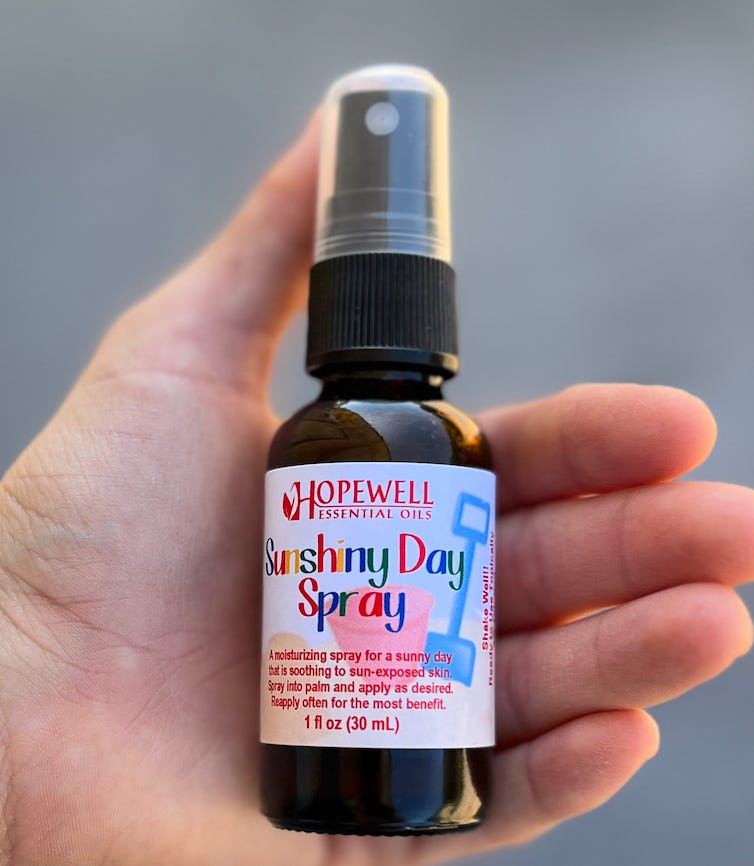
Our Sunshiny Day Spray is formulated with high-quality components and has been effective protection against burning when out in the sun for long periods. Included in this blend is our unrefined Tamanu (Foraha) oil, which has a rich nutty scent. It has antibacterial properties, is soothing for burns, insect bites/stings, eczema, wounds, and is safe internally (although we don’t suggest that you ingest it!). Natives have used Tamanu topically for hundreds of years to promote smooth, healthy skin. In addition to Tamanu oil, Sunshiny Day has Calendula infused in organic olive oil, Pomegranate Seed oil, Hemp Seed oil, and Avocado oil. While not a sun “screen,” the oils in the blend have potent antioxidant properties and help us tan rather than burn. The essential oils of Lavender, Manuka, Marigold, and Patchouli are noted to be beneficial to the skin, including burns.
Carrier Oils in Sunshiny Day Spray with Antioxidant Properties (listed most to least)
Calendula-infused Olive Oil (Highest phenolic and carotenoid content)
Pomegranate Seed Oil (Exceptionally high specialized polyphenol and punicic acid activity)
Hemp Seed Oil (Good tocopherol content, though limited by polyunsaturated stability)
Avocado Fruit Oil (Nourishing and protective, but lower total free-radical scavenging capacity relative to the others)
We suggest that Sunshiny Day Spray be applied frequently or at least every couple of hours, including before and after swimming. It is not waterproof or a sun “screen.” It is a skin-nourishing and safe alternative to toxic sunscreens. The mother of a young baby sums up the testimonies of many: “My baby has red hair and is very fair-skinned, and we are very happy with how well this blend works for us. No worries; no burns!”

Everyone agrees that mosquitoes can be troublesome unless you use something to deter them. Many of the commercial insect repellents contain DEET¹ (which has been shown to be toxic and even caused deaths of children) and/or other undesirable components. The undesirable smell of commercial repellents is another reason to dislike them. Not only do the insects stay away, but we don’t even care to be around ourselves!
If you’d like to enjoy the outdoors and not smell like citronella, our No Bites! blend of 100% high-quality essential oils in a coconut oil base may be a welcome addition to your summer. It has a pleasant, mild vanilla scent, and yet it is the most effective anti-mosquito blend we’ve ever used. We offer No Bites! and No Bites+Geranium, which has an extra punch to deter ticks, in a 1-oz or 2-oz spray.
I hope you have a wonderful and safe summer!
Linda
Functional Foods in Dermatology, PubMed
Whole Fruit Phytochemicals Combating Skin Damage and Carcinogenesis
Internal Sunscreen Supported by Dietary Antioxidants
The concept of an “internal sunscreen” supported by dietary antioxidants, often referred to in nutritional science as systemic photoprotection, is well-documented in dermatological and biochemical research. Rather than acting as a physical barrier like topical sunscreen, whole-food phytonutrients work systematically to modulate the skin’s internal environment, reducing oxidative stress, suppressing UV-induced inflammatory pathways, and supporting cellular repair mechanisms.
The following peer-reviewed references and scientific literature support the role of berries and whole-food antioxidants in enhancing the skin’s resilience to UV radiation:
1. Berries, Phytochemicals, and UV Protection
Berries—specifically raspberries, blackberries, and blueberries—are rich in polyphenols (such as anthocyanins, ellagic acid, and resveratrol) that interact with cellular signaling pathways to mitigate UV-induced damage.
Mechanisms of Whole Fruit Phytochemicals: Research published in Nutrients outlines how the phytonutrients in berries and other whole fruits act as chemoprotective agents. They reduce ultraviolet (UV)-mediated cutaneous damage by suppressing inflammatory mediators (like NF-κB and COX-2), scavenging free radicals, and enhancing DNA repair mechanisms (such as nucleotide excision repair) in skin cells.
Reference: Basu, A., et al. (2019). “Whole Fruit Phytochemicals Combating Skin Damage and Inflammation.” PMC, PMC6926315.
Modulation of Inflammatory Pathways: Studies investigating black raspberries and other berry extracts demonstrate their ability to inhibit oxidative stress markers and UVB-induced photoaging and photocarcinogenesis by supporting the skin’s endogenous defense systems.
Reference: Huang, H. C., et al. (In studies evaluating berry extracts on epidermal cells, demonstrating suppression of UV-induced inflammatory cascades). Discussed broadly in PMC6926315.
2. Systemic Photoprotection via Carotenoids and Polyphenols
The idea of boosting the skin’s threshold against erythema (redness) and UV radiation through dietary intake has been extensively demonstrated using carotenoid- and polyphenol-rich whole foods:
Clinical Trials on Dietary Photoprotection: Controlled human studies have shown that regular ingestion of antioxidant-rich whole foods (such as tomato paste rich in lycopene, or high-flavanol cocoa) significantly increases the Minimal Erythemal Dose (MED)—the threshold of UV radiation that causes skin redness—effectively providing an internal layer of photoprotection.
Reference: Stahl, W., et al. (2006 / general dermatological consensus on systemic photoprotection). Documented extensively in reviews on Photoprotection via functional foods (PMC10656176).
Grapes and Polyphenols: Clinical and animal studies involving grape powder (rich in resveratrol and other polyphenols) demonstrate a marked reduction in UV-induced DNA damage (such as cyclobutane pyrimidine dimers) and reduced markers of apoptosis and inflammation.
Reference: Snijders, T. et al. / Research highlighted in dermatological reviews on dietary polyphenols and skin barrier water homeostasis (PMC10656176).
From a “biological” standpoint, the research mentioned above aligns with viewing the body as beautifully designed. Rather than treating the skin as a passive surface to be defended solely from the outside, consuming targeted whole-food micronutrients provides the systemic “terrain” with the raw materials it needs to adapt, neutralize oxidative fluctuations, and maintain internal homeostasis when exposed to environmental stressors like sunlight.
Functional Foods in Dermatology, PubMed
Whole Fruit Phytochemicals Combating Skin Damage and Carcinogenesis
Role of ingestible carotenoids in skin protection: A review of clinical evidence, Wiley Online Library
Mercola, Joseph MD., Over a Million People Die EVERY Year From Lack of Sun Exposure, PDF
UVB Exposure and Vitamin D Cancer Risk Reduction: Key peer-reviewed references and scientific literature substantiating this relationship:
The relationship between solar UVB exposure, subsequent vitamin D synthesis, and reduced cancer incidence and mortality is supported by a large body of epidemiological and clinical research.
How strong is the evidence that solar ultraviolet B and vitamin D reduce the risk of cancer?
Solar ultraviolet-B exposure and cancer incidence and mortality in the United States, 1993–2002
Roles of Solar UVB and Vitamin D in Reducing Cancer Risk and Increasing Survival
Vitamin D and Sunlight: Strategies for Cancer Prevention and Other Health Benefits
Broad Epidemiological Reviews and Cancer Incidence
Ecological and epidemiological studies consistently demonstrate an inverse correlation between solar UVB doses, serum 25-hydroxyvitamin D [25(OH)D] levels, and the risk of multiple internal malignancies.
Comprehensive Review of UVB and Vitamin D: A foundational review published in Anticancer Research and indexed in PubMed analyzes the epidemiological evidence, clinical trials, and biological mechanisms showing that adequate UVB exposure and higher 25(OH)D concentrations are associated with a reduced risk of incidence and mortality from breast, colorectal, lung, and prostate cancers.
Reference: Grant, W. B., et al. (2016). “The roles of UVB and vitamin D in reducing risk of cancer incidence and mortality: A review of the epidemiology, clinical trials, and mechanisms.” PubMed / National Institutes of Health. (See also Garland, C. F., et al., for foundational epidemiological linkages between solar UV-B exposure and reduced cancer risk, PMC1665523).
Geographic and Ecological Studies: Studies tracking cancer mortality rates against geographic solar irradiance gradients demonstrate that populations living at higher latitudes with lower UVB exposure experience significantly elevated mortality rates for colon, breast, and lung cancers compared to sunnier regions.
Reference: Grant, W. B. (2006). “Solar ultraviolet-B exposure and cancer incidence and mortality in the United States.” PMC, PMC1665523.
Specific Cancer Sites
Breast and Colorectal Cancers: Case-control and prospective cohort studies have established strong inverse relationships between serum vitamin D status—sustained primarily via sensible sunlight exposure and endogenous synthesis—and the risk of developing and dying from breast and colorectal cancers. Maintaining higher 25(OH)D concentrations appears particularly critical for limiting tumor progression and metastasis.
Reference: Baggerly, C. A., et al. (Review of observational studies supporting higher 25(OH)D concentrations in reducing risk of breast and colorectal cancer incidence and mortality rates). Summarized in recent updates on vitamin D and cancer risk (PMC31892604).
Prostate and Lung Cancers: Epidemiological mapping of solar radiation indicates that non-Hispanic white populations and other demographic groups residing in regions with higher UVB flux experience lower age-adjusted mortality rates for several major cancer sites, including the prostate and lung, due to the upregulation of cellular differentiation and the inhibition of unregulated cell proliferation mediated by active vitamin D metabolites (1,25-dihydroxyvitamin D).
Reference: Garland, C. F., et al. (2006). “The Role of Vitamin D in Cancer Prevention.” American Journal of Public Health / PMC1665523.
Comments
Nothing yet. Say the first thing.
Sign in to join the conversation.